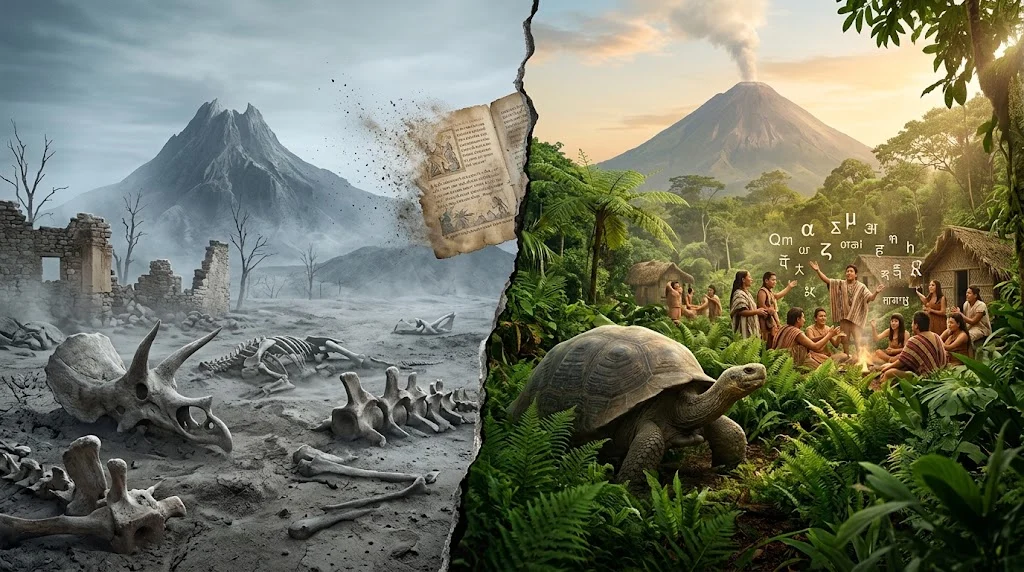
The question of whether something is extinct or alive pops up everywhere from biology textbooks to casual conversations about dinosaurs, languages, and even old traditions. Yet despite seeming like a simple opposite pair, these two words carry more nuance than most people realise.
“Extinct” and “alive” describe two very different states of living organisms. Extinct means a species or organism no longer exists anywhere on Earth, while alive means it still exists and living members can be found.
Understanding the difference between “extinct” and “alive” is useful when discussing animals, plants, and other species. In this guide, we’ll explain their meanings, differences, and provide simple examples.
Extinct vs Alive: What Is the Real Difference?.
Extinct is an adjective. It means no longer in existence, having died out, or having come to an end. Originally, the word referred to fires that had been put out think of a candle flame that has been extinguished. Over time, its meaning expanded to cover anything that once existed but no longer does: species, languages, customs, volcanoes, even grammatical constructions. When something is extinct, there is no living representative left. Dinosaurs are extinct. The dodo bird is extinct. Latin as a spoken vernacular is extinct.
Alive is also an adjective. It means having life, living, or being in a state of active existence. Unlike extinct, which signals finality, alive signals presence and vitality. A person is alive. A thriving ecosystem is alive. A debate that still generates passion can be described as alive. The word comes from the Old English phrase on life, meaning “in living” or “in life”. It has always been about the state of being, not the absence of it.
The key difference is permanence versus presence. Extinct is a terminal condition. Once something goes extinct, it does not come back (outside of science fiction). Alive is a current condition. It can change something alive can die, and something alive can also be dormant or inactive without being extinct.
Here is a quick comparison to lock it in:
| Feature | Extinct | Alive |
| Part of speech | Adjective | Adjective |
| Core meaning | No longer in existence; died out | Having life; currently existing |
| Reversibility | Permanent (cannot be undone) | Temporary (can change) |
| Common contexts | Species, volcanoes, languages, customs | People, animals, plants, ideas, traditions |
| Antonym | Extant, living, existing | Dead, extinct, inactive |
| Example | The passenger pigeon is extinct. | The passenger pigeon was once alive. |
Mini recap: Extinct means gone forever. Alive means here right now. One is about absence; the other is about presence. They are opposites, but they are not interchangeable, and they do not always apply to the same kinds of things.
Is Extinct vs Alive a Grammar, Vocabulary, or Usage Issue?
This is a usage issue more than a grammar or vocabulary problem. The words themselves are not hard to define. The challenge is knowing which one fits the situation, especially when you are dealing with subjects that blur the line between active and inactive.
Are They Interchangeable?
No. Never. Extinct and alive are absolute opposites. You cannot swap them without reversing the meaning of your sentence. Saying “the volcano is alive” might sound poetic, but in scientific terms, it is imprecise. Saying “the tradition is extinct” might be understandable, but dead or defunct would be more accurate.
Formal vs Informal Usage
In formal writing—scientific papers, legal documents, academic essays—precision matters. Biologists do not call a species “not alive” when they mean extinct. They use extinct because it has a specific, accepted definition. The International Union for Conservation of Nature (IUCN) defines extinct as applying when “there is no reasonable doubt that the last individual has died”. That is a formal standard. In informal settings, people are more relaxed. You might hear someone say “my old phone is extinct” as a joke, and everyone understands. But that is colloquial, not correct.
Academic vs Casual Usage
In academic contexts, extinct is reserved for species, languages, and other phenomena that have truly ended. Alive is used for living organisms or active processes. In casual conversation, the lines blur. People say “that band is still alive” to mean they are still performing, or “that style is extinct” to mean it is no longer popular. These are metaphorical uses, and they are fine in everyday speech. But if you are writing a report, a research paper, or anything that requires authority, stick to the literal meanings.
Practical Usage: When to Use “Extinct”
Extinct is your word when something has ended permanently. Here is how it plays out in different settings.
Workplace Example
Imagine you are presenting a market analysis. You might say: “Our competitor’s product line is effectively extinct in the North American market.” That means it no longer exists there. You would not say it is “not alive” because that sounds odd and imprecise. Extinct conveys finality and disappearance, which is exactly what you mean.
Academic Example
In a biology lecture, you might write: “The trilobite, a marine arthropod, became extinct approximately 252 million years ago.” This is the standard, correct usage. The species no longer exists. There is no ambiguity.
Technology Example
In tech, you might say: “Floppy disks are extinct in modern computing.
Usage recap: Use extinct when something has completely disappeared, died out, or ended. It implies finality and irreversibility.
Practical Usage: When to Use “Alive”
Alive is your word when something is currently existing, functioning, or full of life.
Workplace Example
In a team meeting, you might say: “Our brand is alive and well in the European market.” That means it is active, present, and performing. You would not say it is “not extinct” because that is clunky and negative. Alive is positive and direct.
Academic Example
In a conservation biology paper, you might write: “The giant panda remains alive in the wild, though its population is fragile.” This is accurate and clear. It acknowledges existence without overstating vitality.
Technology Example
In a software review, you might say: “Open source communities keep this project alive.” That means active development and support continue. The project is not abandoned.
Usage recap: Use alive when something is living, active, or currently in existence. It implies presence and vitality.
When You Should NOT Use “Extinct” or “Alive”
Misusing these words is more common than you might think. Here are some scenarios where people get it wrong.
- Do not use extinct for dormant volcanoes. A volcano that has not erupted in recorded history is dormant or inactive, not extinct. An extinct volcano is one that scientists believe will never erupt again. The difference matters to geologists.
- Do not use alive for active volcanoes. A volcano that is currently erupting or showing signs of activity is active, not alive. Volcanoes are not living things.
- Do not use extinct for endangered species. An endangered species is at risk of extinction but is still alive. Calling it extinct is premature and incorrect.
- Do not use alive for things that were never alive. A language, a tradition, or a company is not literally alive. Use existing, active, or thriving instead.
- Do not use extinct for obsolete technology. A technology that is no longer used is obsolete or defunct. Extinct is overly dramatic and technically inaccurate.
- Do not use alive for inanimate objects that are functioning. A machine that works is operational or functional, not alive.
- Do not use extinct for ideas or fads that have faded. An idea that is no longer popular is outdated or passé, not extinct.
- Do not use alive for things that exist but are inactive. A tradition that is rarely practised is dormant or moribund, not alive.
Common Mistakes and Decision Rules
Here is a quick reference table to help you avoid the most frequent errors.
| Correct Sentence | Incorrect Sentence | Explanation |
| The dodo bird is extinct. | The dodo bird is not alive. | Not alive is vague; extinct is precise. |
| The volcano is dormant. | The volcano is extinct or alive. | Volcanoes are neither; they are active, dormant, or extinct. |
| The tradition is still alive in rural areas. | The tradition is still extinct in rural areas. | Alive means still practised; extinct means gone. |
| Latin is an extinct language. | Latin is not alive. | Extinct is the standard term for dead languages. |
| The company is alive and growing. | The company is extinct and growing. | Contradiction. |
| The species is critically endangered. | The species is almost extinct. | Almost extinct is acceptable but critically endangered is more formal. |
Decision Rule Box
If you mean the action or state of being currently present, living, or functioning, use alive.
If you mean the permanent end of existence, with no living or functioning representatives left, use extinct.
Extinct and Alive in Modern Technology and AI Tools
The distinction between extinct and alive has taken on new meaning in the digital age. In artificial intelligence and machine learning, we talk about “extinct” models—algorithms that are no longer used or supported. We also talk about “alive” projects—open source repositories that are actively maintained.
For example, a programming language like COBOL is often described as “still alive” in legacy systems, even though it is rarely used for new development. Meanwhile, a framework like AngularJS is considered “effectively extinct” in modern web development because it has been superseded by newer tools.
In conservation technology, AI is being used to search for species that may not be extinct after all. The TV show Extinct or Alive follows wildlife biologist Forrest Galante as he uses cutting edge technology to find animals that have been declared extinct. The show highlights how our understanding of extinction is not always final. Sometimes, what we think is extinct turns out to be alive, hiding in plain sight.
This has real implications. If we declare a species extinct too quickly, we stop looking for it, and we stop protecting its habitat. That can become a self fulfilling prophecy. The distinction between extinct and alive is not just academic. It affects conservation funding, legal protections, and public awareness.
Authority and Trust: The Words Behind the Words
Understanding where these words come from adds depth to your usage.
Etymology of extinct: The word comes from the Latin exstinctus, the past participle of exstinguere, meaning “to extinguish” or “to put out”. Originally, it referred to fires that had been quenched. By the 15th century, it was being used for species and other things that had died out. The metaphor is powerful: extinction is like a flame that has been blown out and cannot be relit.
Etymology of alive: The word comes from the Old English on life, meaning “in living” or “in life”. It is a compound of *a* (meaning “in”) and life. It has always been about the state of being alive, not the process of dying.
Expert quotation: As linguist and lexicographer John Ayto notes in his Dictionary of Word Origins, “The notion of extinction is fundamentally about the cessation of fire or light, and only metaphorically about the end of life. This metaphorical extension has become so dominant that we forget the original literal sense.” That is a useful reminder: extinct is a metaphor that has become literal in many contexts.
Case Study 1: The Fernandina Giant Tortoise
For decades, the Fernandina giant tortoise was considered extinct. No living specimen had been seen since 1906. Then, in 2019, an expedition funded by the Galapagos National Park and directed by biologists found a female tortoise on Fernandina Island. Genetic testing confirmed she was the same species. The tortoise was not extinct. She was alive. This discovery changed conservation priorities and proved that extinction declarations are not always final.
Case Study 2: The Zanzibar Leopard
The Zanzibar leopard was declared extinct in the 1990s after years of habitat loss and hunting. But the TV show Extinct or Alive captured footage that suggested the leopard might still exist on Unguja Island. While conclusive proof remains elusive, the possibility has kept the species in the public eye and prompted renewed survey efforts. The case shows how the question of extinct or alive can drive real world action.
Error Prevention Checklist
Before you hit publish or submit your next piece of writing, run through this checklist.
- Always use extinct when: You are describing a species, language, or other entity that has no living representatives and is permanently gone.
- Never use extinct when: You mean dormant, inactive, endangered, obsolete, or outdated.
- Always use alive when: You are describing something that is currently living, functioning, or active.
- Never use alive when: You mean active (for volcanoes), operational (for machines), or existing (for inanimate objects).
- Double check: If you are unsure, ask yourself: “Is this thing permanently gone, or is it just not currently visible?” If permanently gone, use extinct. If still there but maybe hidden, use alive, extant, or existing.
Related Grammar Confusions You Should Master
If you found this helpful, you might also want to explore these related topics:
- Extinct vs extant—the true opposite pair
- Alive vs living—subtle differences in usage
- Active vs dormant—for volcanoes and other phenomena
- Endangered vs threatened—conservation terminology
- Obsolete vs defunct—for technology and practices
- Dead vs deceased—for living things
- Extinguish vs quench—the root verbs
- Vanish vs disappear—temporary vs permanent absence
- Surviving vs extant—overlapping but not identical
- Moribund vs dormant—for things that are fading but not gone
FAQs
1. What is the difference between extinct and alive?
Extinct means something no longer exists, while alive means it still exists and is living.
2. Can a species come back from being extinct?
No, true extinction is permanent. However, some species thought to be extinct have later been rediscovered.
3. What is the opposite of extinct?
The precise opposite is extant, meaning still in existence. Alive can also be an opposite in many contexts.
4. Can a language be extinct or alive?
Yes. A language is extinct when it has no native speakers and alive when it is still spoken by a community.
5. How do scientists determine if a species is extinct?
Scientists conduct extensive surveys and research to determine whether any living members of the species remain
Conclusion
In conclusion, “extinct” and “alive” describe whether a species or organism still exists. An extinct species has no living members remaining, while an alive species continues to exist.
Understanding these terms makes it easier to discuss the status of animals, plants, and other organisms accurately. Using the right word helps make your meaning clear and precise.

Neil Gaiman is an American writer who contributes educational content to LingRoya.com. His work focuses on helping readers improve their English with clear, practical and easy to follow guidance.