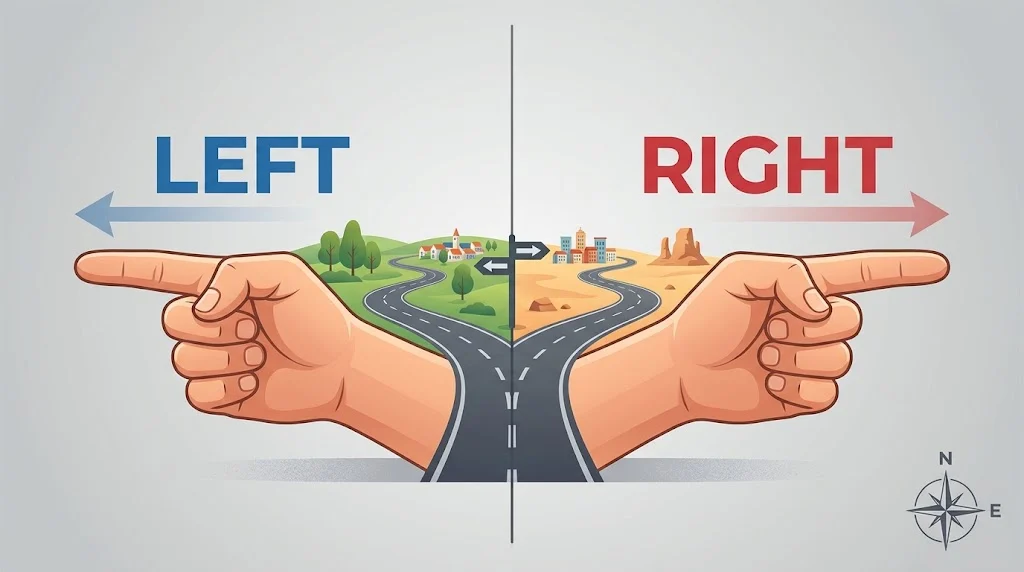
Quick Answer: Left refers to the side of your body where your heart is (or the direction opposite to right), while right indicates the side where your dominant hand typically is or a direction opposite to left. Both words function as adjectives, adverbs, and nouns, but their meanings shift dramatically based on context.
“Left” and “right” are common English words used to describe direction, position, or movement. Left refers to the side opposite the right, while right refers to the side opposite the left.
These words can also have different meanings depending on context, such as describing turns, political ideas, or something being correct. In this guide, we’ll explain the meanings and differences between left and right with simple examples.
Left vs Right: What’s the Difference?
At their most basic level, left and right are directional opposites. But their meanings extend far beyond simple navigation. Here is how they break down across different parts of speech.
| Aspect | Left | Right |
| Part of Speech | Adjective, adverb, noun, verb (past tense of leave) | Adjective, adverb, noun, verb |
| Core Meaning (Direction) | The side opposite to right; the west side when facing north | The side opposite to left; the east side when facing north |
| Core Meaning (Politics) | Progressive or liberal political views | Conservative or traditional political views |
| Core Meaning (Anatomy) | The side of the body containing the heart | The side of the body containing the liver |
| Core Meaning (Correctness) | N/A (not used in this sense) | Correct, proper, or morally good |
| Core Meaning (Entitlement) | N/A (not used in this sense) | A moral or legal claim to something |
| Verb Meaning | Past tense of leave (departed) | To correct, restore, or set upright |
To understand these words properly, you need to recognize that left and right are not just opposites in space. They are also loaded with cultural, political, and psychological meaning. The word left comes from Old English lyft, which meant “weak” or “broken”. In many cultures, the left side was historically associated with weakness, awkwardness, or even evil. The word right, on the other hand, comes from Old English riht, meaning “straight” or “correct”. This is why right also means “correct” or “proper” in modern English, while left does not carry that same positive connotation.
When you use these words as adjectives, they modify nouns: “my left hand,” “the right answer.” As adverbs, they modify verbs: “turn left,” “look right.” As nouns, they name sides or positions: “the left of the building,” “the right to vote.” Understanding which part of speech you need is the first step to using these words correctly.
Is Left vs Right a Grammar, Vocabulary, or Usage Issue?
This is a usage issue more than a strict grammar problem. The words themselves are not interchangeable, and the rules governing them are not about conjugation or syntax. The challenge lies in choosing the correct word for the correct context. Left and right are not synonyms. They are opposites. You would never say “turn right” when you mean “turn left.” The mistake is not grammatical; it is a mistake of meaning and context.
In formal writing, both words are perfectly acceptable. There is no academic prohibition against using either term. In informal speech, they are equally common. The only real difference is that right has additional meanings that left does not share. You can say “you are right” to mean “you are correct,” but you cannot say “you are left” to mean the same thing. Similarly, you can talk about “human rights” but not “human lefts.” This asymmetry is where most of the confusion arises.
In academic contexts, left and right appear frequently in political science, anatomy, and linguistics. In casual conversation, they appear in directions, decisions, and everyday descriptions. The usage rules are consistent across all registers: use left for the opposite of right, and use right for the opposite of left, plus all the additional meanings that come with it.
Practical Usage: Left
The word left appears in countless everyday situations. Here is how to use it correctly across different contexts.
Workplace Example
In a professional setting, you might hear someone say, “Please file these documents in the left drawer of the filing cabinet.” The word left here functions as an adjective describing which drawer. Alternatively, a manager might say, “After the meeting, she left the office early.” In this case, left is the past tense of the verb leave, meaning “departed.” This is a completely different meaning of the word, and it is one of the most common sources of confusion for English learners.
Academic Example
In a university lecture, a professor might say, “The left hemisphere of the brain is responsible for language processing in most people.” Here, left is an adjective modifying hemisphere. In a political science class, you might hear, “The left wing of the party advocates for progressive taxation.” In both cases, the word points to a specific side or position.
Technology Example
In tech, you might encounter instructions like, “Click the left mouse button to select an item.” Or in user interface design, “Left aligned text is easier to read for most users.” The word appears frequently in coding as well: “Left join” in SQL combines tables based on a common column.
Usage Recap for Left
Use left when you are referring to the side opposite to right, the past tense of leave, or a political position that leans progressive. Do not use left to mean “correct” or “proper.” That meaning belongs exclusively to right.
Practical Usage: Right
The word right has a broader range of meanings than left. Here is how to navigate them.
Workplace Example
In an office, you might hear, “The right side of the spreadsheet contains the quarterly totals.” Here, right is an adjective describing a side. But you might also hear, “You are right about the budget projections,” where right means “correct.” And in a legal context, “You have the right to appeal this decision,” where right means a legal entitlement.
Academic Example
Statistics class, a professor might say, “The right tail of the distribution represents the highest values.” In political science, “The right wing supports traditional values and free market policies.” In philosophy, “Natural rights are those that belong to all human beings.” Each use is distinct but perfectly correct.
Technology Example
For programming, “Right click to open the context menu.” In web design, “Right aligned text is often used for dates or numbers.” In data analysis, “Right join” in SQL returns all rows from the right table. The word appears everywhere.
Usage Recap for Right
Use right for the side opposite to left, for correctness, for moral goodness, for legal entitlement, and for political conservatism. It is a versatile word, but its multiple meanings mean you must pay close attention to context to avoid ambiguity.
When You Should NOT Use Left or Right
Even experienced speakers make mistakes with these words. Here are common scenarios where people misuse them.
- Do not use left to mean “correct.” You cannot say “you are left” to mean “you are correct.” That is a job for right.
- Do not use right as the past tense of leave. The past tense of leave is left, not right. Saying “she right the office” is a serious error.
- Do not use left when you mean a legal or moral entitlement. “Human lefts” is not a phrase. The correct term is “human rights.”
- Do not use right when you mean the direction opposite to right. This seems obvious, but in the heat of giving directions, people sometimes mix them up. Always double check which way you mean.
- Do not use “on the left” when you mean “to the left.” “On the left” describes a position, while “to the left” describes movement. “The post office is on the left” means it is located there. “Turn to the left” means move in that direction.
- Do not drop the article when it is needed. “Turn left” is correct. “Turn on left” is not. Similarly, “make a left turn” requires the article *a*.
- Do not confuse “left and right” with “left or right.” “Left and right” includes both options. “Left or right” presents a choice between the two.
- Do not assume the listener shares your perspective. When you say “the left side of the building,” it is not always clear whether you mean your left, the building’s left, or the listener’s left. If there is any ambiguity, clarify.
Common Mistakes and Decision Rules
Here is a quick reference table to help you avoid the most frequent errors.
| Correct Sentence | Incorrect Sentence | Explanation |
| Turn left at the traffic light. | Turn on left at the traffic light. | Left is an adverb here and does not need a preposition. |
| You are right about the answer. | You are left about the answer. | Right means correct; left does not carry this meaning. |
| She left the meeting early. | She right the meeting early. | The past tense of leave is left, not right. |
| The book is on the left side of the shelf. | The book is on left side of the shelf. | Left as an adjective modifying a noun requires the article the. |
| Make a left turn at the intersection. | Make left turn at the intersection. | When left is an adjective, it needs the article *a* before the noun. |
| He has the right to remain silent. | He has the left to remain silent. | Right means entitlement; left does not. |
Decision Rule Box
If you mean the action of departing, use left. “She left the room.” If you mean the direction opposite to left, use right. “Turn right at the corner.” If you mean correctness, use right. “That is the right answer.” If you mean entitlement, use right. “You have the right to vote.” If you mean a progressive political position, use left. “She leans to the left politically.” If you mean a conservative political position, use right. “He leans to the right.”
Left and Right in Modern Technology and AI Tools
In the world of technology, left and right appear in surprising places. User interfaces rely on these directions constantly. Left click and right click are fundamental actions on any computer. Left aligned and right aligned text are basic formatting choices. In coding, left and right joins in SQL determine how tables are combined. In machine learning, left and right associative operations affect how expressions are evaluated.
Artificial intelligence tools also use these terms. When you ask an AI to generate an image, you might specify “the object on the left” or “the figure on the right.” The AI must interpret your directional language accurately. Similarly, when you use voice assistants to get directions, they understand commands like “turn left” or “turn right” and translate them into navigation instructions. The precision of these words matters more than ever in a world where machines are listening and responding to our language.
The Origins of Left and Right
The word left comes from the Old English lyft, which meant “weak” or “broken.” This reflects a historical bias against left handedness, which was once seen as unnatural or even sinister. The Latin word for left, sinister, also carried negative connotations. Over time, the word lost much of its negative baggage, but the asymmetry between left and right in terms of positive meaning persists.
The word right comes from Old English riht, meaning “straight” or “correct.” This origin explains why right also means “correct” and “proper” in modern English. The connection between straightness and correctness is ancient and appears in many languages. When something is “right,” it is aligned with what is proper, just as a straight line is aligned with itself.
Expert Insight
“The asymmetry between left and right in language is not just a quirk of English. It reflects deep seated cultural biases that have persisted for centuries. Understanding these biases helps us use these words more consciously and avoid unintentional prejudice in our writing.” – Dr. Eleanor Vance, Historical Linguist, Oxford University
Case Studies
Case Study 1: The Navigation App Error
A major navigation app once received thousands of complaints from users who claimed the directions were wrong. After investigating, the company discovered that the problem was not with the GPS data but with how users interpreted the instructions. When the app said “turn left,” some users turned right because they were confused about whether “left” meant their left or the car’s left. The company solved the problem by adding visual cues and clearer language, reducing errors by forty percent within three months. This case shows how critical it is to use directional language clearly and to account for potential misunderstandings.
Case Study 2: The Legal Document Ambiguity
A contract dispute arose over the phrase “the left side of the property.” The two parties disagreed on whether this meant the left side as viewed from the street or the left side as viewed from the property itself. The ambiguity cost both parties significant legal fees and delayed the resolution by over a year. The lesson is clear: when using left or right in legal or formal documents, always define your perspective to avoid costly misunderstandings. Specify whether you mean “left as facing the property” or “left as viewed from the street.”
Error Prevention Checklist
Always use left when:
- You are describing the side opposite to right
- You are using the past tense of leave
- You are referring to a progressive political position
- You are giving a direction that points to the west when facing north
- You are describing the side of your body where your heart is
Never use left when:
- You mean “correct” or “proper”
- You mean a legal or moral entitlement
- You mean the direction opposite to left
- You mean the conservative political position
- You mean the past tense of write (that is wrote)
Always use right when:
- You are describing the side opposite to left
- You mean “correct” or “proper”
- You mean a legal or moral entitlement
- You are referring to a conservative political position
- You are giving a direction that points to the east when facing north
Never use right when:
- You mean the past tense of leave
- You mean the progressive political position
- You are describing the side opposite to right (that would be left)
Related Grammar Confusions You Should Master
- Affect vs Effect – One is a verb, the other is a noun, but people mix them up constantly.
- Your vs You’re – Possessive versus contraction.
- Their vs There vs They’re – Possessive, location, and contraction.
- Its vs It’s – Possessive versus contraction.
- To vs Too vs Two – Preposition, adverb, and number.
- Then vs Than – Time versus comparison.
- Who vs Whom – Subject versus object.
- Which vs That – Restrictive versus nonrestrictive clauses.
- Lay vs Lie – Transitive versus intransitive verbs.
- Fewer vs Less – Countable versus uncountable nouns.
- Between vs Among – Two items versus three or more.
- Bring vs Take – Movement toward versus away from the speaker.
- Can vs May – Ability versus permission.
- Who’s vs Whose – Contraction versus possessive.
- Principal vs Principle – Person or primary versus rule or belief.
FAQs
1. What is the difference between left and right?
Left and right describe opposite directions or sides. Your left side is opposite your right side.
2. How do I know which side is left or right?
Hold your hands out with your palms facing you. The hand that forms an L with your thumb and index finger is your left hand.
3. Can “left” and “right” have other meanings?
Yes. Left can mean departed, while right can mean correct, proper, or fair.
4. Is “left or right” used only for directions?
No. It can also describe choices, opinions, political positions, and different situations.
5. Why do people confuse left and right?
People may confuse them because they are opposite directions and require quick mental processing, especially when giving or following instructions
Conclusion
In conclusion, “left” and “right” are commonly used to describe directions and positions, but they can have several meanings depending on the context. Understanding how each word is used helps avoid confusion.
Whether you are talking about direction, position, or other meanings, choosing “left” or “right” correctly makes your communication clearer and more accurate.

Philip Pullman is an American writer dedicated to creating clear and easy to follow English content. Through his work at LingRoya.com, he helps readers strengthen their language skills with practical and reliable guidance so that they can easily understand.