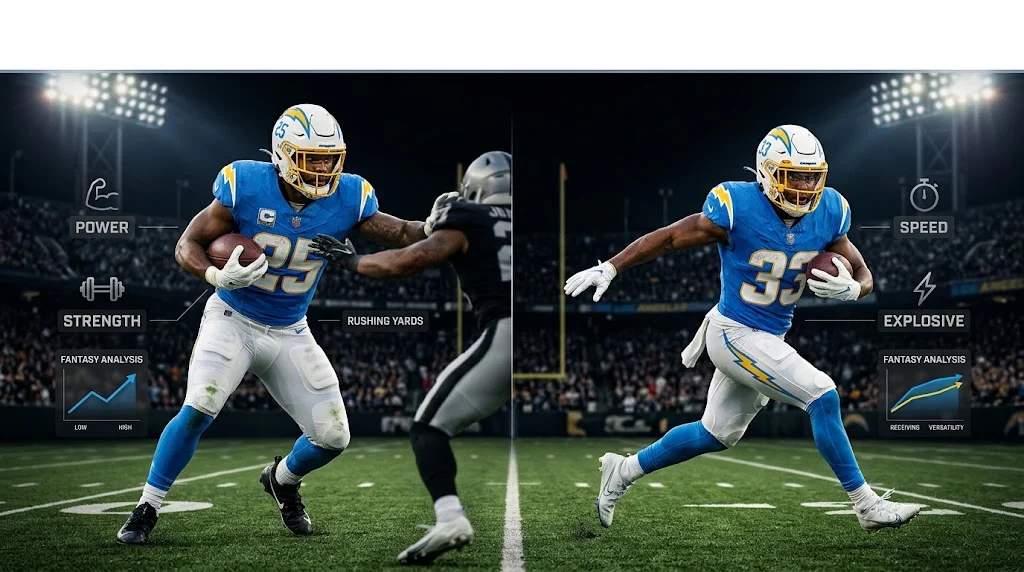
Hassan Haskins and Kimani Vidal are both running backs for the Los Angeles Chargers, but they offer different strengths. Haskins is a bigger, more physical runner with experience from Michigan, while Vidal is a younger, more explosive back who has developed into a significant part of the Chargers offense.
The two backs are not identical players. Haskins brings size, physicality, and experience from Michigan, where he played under Jim Harbaugh. Vidal brings a different combination of quickness, explosiveness, receiving ability, and developing NFL experience.
That distinction is important because choosing between them is not simply about asking who is the better player. The more useful question is which running back fits a particular role.
Haskins vs Vidal: What Is the Difference?
Hassan Haskins and Kimani Vidal are professional American football running backs who play different styles.
Haskins is the bigger back. He played college football at Michigan and entered the NFL after a productive final college season in which he rushed for 1,327 yards and 20 touchdowns. His familiarity with Harbaugh also helped him earn opportunities with the Chargers.
Vidal played college football at Troy before joining the Chargers as a sixth round selection in the 2024 NFL Draft. He entered the league with a reputation as a versatile running back and gradually earned more opportunities in Los Angeles.
| Feature | Hassan Haskins | Kimani Vidal |
| Position | Running back | Running back |
| College | Michigan | Troy |
| NFL team | Los Angeles Chargers | Los Angeles Chargers |
| Running style | Physical and powerful | Explosive and versatile |
| Receiving role | Complementary | Increasingly important |
| NFL experience | More established early | Developing rapidly |
| 2025 rushing yards | Limited role compared with Vidal | 643 |
| 2025 receptions | Limited | 16 |
| Best quality | Physical running | Explosiveness and versatility |
Vidal clearly received a larger offensive role in 2025. He played 13 games and made 10 starts while recording 643 rushing yards and three rushing touchdowns. He also caught 16 passes for 136 yards and one touchdown.
Quick Recap
Haskins is the larger and more physical option.
Vidal offers more explosive potential and receiving versatility.
Vidal had the larger offensive role in 2025.
Both players can provide value depending on the Chargers offensive plan.
Is Haskins or Vidal a Talent, Role, or Usage Issue?
The comparison between Haskins and Vidal is primarily a football role and player evaluation issue rather than a simple question of talent.
A running back can be valuable without being the primary runner. Teams often use different backs for different situations. One player might receive early down carries, while another handles passing situations or outside runs.
That distinction became clear when Haskins and Vidal were both expected to contribute after injuries affected the Chargers backfield in 2025. Chargers coaches indicated that both backs would receive significant opportunities rather than immediately declaring one player the unquestioned lead back.
The situation also changed during games. In the Chargers matchup against Miami in October 2025, Vidal quickly received several early carries and produced 53 rushing yards on his first seven attempts, while Haskins had two early carries for two yards. That performance helped Vidal strengthen his case for a larger role.
This demonstrates why a backfield comparison should consider opportunity, offensive design, and game situation rather than reputation alone.
When Should You Choose Haskins?
Haskins makes sense when you value physical running, size, and a complementary rushing role.
He has a strong college background and already understands the offensive philosophy associated with Jim Harbaugh. His experience at Michigan also gives him familiarity with physical football and a run focused system.
Workplace Example
In a team management analogy, Haskins resembles a dependable specialist who performs well when a specific physical role is required.
For football purposes, this means he can be useful when the Chargers need a bigger back for tough rushing situations.
Academic Example
Haskins is an interesting case study in player development. His college production shows that he can handle a substantial workload when given the opportunity.
His 2021 Michigan season produced 1,327 rushing yards and 20 touchdowns, showing that his physical running style can generate significant production in the right environment.
Technology Example
Think of Haskins as a system component optimized for a particular job. He does not need to perform every function to provide value. His physical rushing style can complement a more versatile player.
Usage Recap
Haskins is most attractive when the Chargers need physical rushing, short yardage ability, and a complementary running back.
When Should You Choose Vidal?
Vidal is the more attractive choice if you are looking for explosiveness, versatility, and receiving potential.
His development became much more obvious during the 2025 season. After limited opportunities early in his career, he became a major contributor for the Chargers and finished the season with 643 rushing yards. He also contributed through the passing game.
Workplace Example
In a workplace analogy, Vidal is the versatile employee who can handle several different responsibilities. He can contribute as a runner while also providing value as a receiver.
Academic Example
Vidal provides a useful example of development through increased opportunity. His NFL workload expanded significantly in his second season, and his production increased accordingly.
Technology Example
In a modern offense, a versatile running back can function like a multipurpose system component. Vidal can contribute through rushing and receiving, which gives offensive coaches more ways to use him.
Usage Recap
Vidal is particularly appealing when you value versatility, explosive plays, receiving production, and a growing offensive role.
When You Should NOT Choose Haskins or Vidal
There are several situations where choosing either player without considering context can lead to a poor decision.
1. Do not judge them only by college production
College statistics do not automatically predict NFL production.
2. Do not assume the bigger player always receives more carries
Backfield usage depends on coaching decisions, game plans, injuries, and performance.
3. Do not assume the younger player automatically has more upside
Age can influence projection, but opportunity and skill matter more.
4. Do not use one game as the entire evaluation
A single performance can provide useful information without defining a player’s complete ability.
5. Do not ignore receiving ability
Fantasy football value can change significantly when a running back contributes as a receiver.
6. Do not ignore offensive line performance
Running backs depend heavily on blocking and offensive scheme.
7. Do not assume a committee will disappear immediately
NFL teams often continue rotating backs even after one player has a strong performance.
8. Do not confuse current opportunity with permanent role
A temporary injury situation can create opportunities that later disappear when another player returns.
Common Mistakes When Comparing Haskins and Vidal
| Correct Approach | Incorrect Approach | Explanation |
| Compare rushing and receiving | Look only at rushing yards | Receiving can significantly affect overall value |
| Consider offensive role | Assume one player owns the backfield | NFL roles can change quickly |
| Examine multiple games | Judge one performance | One game does not establish a complete trend |
| Consider team injuries | Ignore the depth chart | Injuries can dramatically change opportunities |
| Evaluate skill sets | Compare only player size | Different backs can succeed in different roles |
Decision Rule: Haskins or Vidal
If you want a more physical complementary runner, Haskins is the better fit.
If you want greater explosiveness and receiving versatility, Vidal is the more appealing option.
For fantasy football, however, workload should always be considered alongside talent. A talented running back with limited touches can be less valuable than a complementary player receiving consistent opportunities.
Haskins and Vidal in Modern Technology and AI Tools
Modern fantasy football platforms and AI tools make player comparisons much easier.
Fantasy managers can now compare rushing attempts, rushing yards, receiving production, snap counts, touchdowns, projections, and matchup information almost instantly.
AI tools can summarize these statistics and explain possible scenarios, but they should not replace current injury reports or official team information.
The Haskins and Vidal comparison demonstrates why context matters. A statistical model might identify Vidal’s larger 2025 workload, but a complete evaluation also needs to consider the Chargers depth chart, coaching philosophy, injuries, offensive line, and expected workload.
As of the 2026 preseason, Vidal remained with the Chargers and had already established himself as a more experienced contributor. The Chargers reported that he returned as an exclusive rights free agent and entered his third season after his significant 2025 campaign.
Haskins and Vidal: Background and Development
Hassan Haskins developed at Michigan under Jim Harbaugh and became one of the team’s most productive runners during his final college season. His 20 touchdown season demonstrated his ability to handle a heavy rushing workload.
Kimani Vidal developed at Troy and entered the Chargers organization through the 2024 NFL Draft. His early NFL role was modest, but his workload expanded considerably in 2025.
The Chargers reported that Vidal went from 43 carries for 155 yards as a rookie to 155 carries for 643 yards in 2025. That represents a major increase in responsibility and production.
What Experts and Coaches Showed About the Competition
The most important lesson from the Haskins and Vidal competition is that NFL coaches may value different characteristics depending on the situation.
In October 2025, Chargers offensive coordinator Greg Roman said both players would have significant opportunities after injuries affected the backfield. The team did not initially treat either player as an unquestioned lead back.
That approach reflects a common NFL principle: the best running back for one situation may not be the best running back for another.
Case Study 1: Vidal’s Expanded 2025 Role
Vidal’s 2025 season is the clearest example of his development.
He played 13 games and started 10, recorded 155 rushing attempts for 643 yards and three touchdowns. He also caught 16 passes for 136 yards and one touchdown.
The concrete result was a dramatic increase in workload compared with his rookie season, when he had 43 rushing attempts for 155 yards.
This makes Vidal’s development one of the strongest arguments in his favor.
Case Study 2: The 2025 Backfield Competition
When injuries created a larger opportunity in the Chargers backfield, both Haskins and Vidal were placed in position to compete for touches.
The Chargers themselves described the situation as a major opportunity for both players.
During the Miami game, Vidal received seven of the first nine running back carries and gained 53 yards on those attempts. Haskins had two early carries for two yards. Vidal’s early performance demonstrated how quickly a player can change the backfield conversation when opportunity and production meet.
Error Prevention Checklist
Always consider Vidal when:
- You want explosive rushing potential.
- Receiving ability matters to your evaluation.
- You value a player with a growing offensive role.
- You are projecting future opportunity based on recent development.
- You want a versatile running back.
Always consider Haskins when:
- You value physical rushing.
- You expect a complementary role.
- Short yardage situations matter.
- You are evaluating depth rather than only the lead role.
- His projected workload is higher than Vidal’s in a specific matchup.
Related Football Comparisons You Should Know
If you are researching the Chargers backfield, several related comparisons are useful.
- Vidal or Hampton
- Haskins or Hampton
- Vidal or Harris
- Haskins or Harris
- Vidal or Edwards
- Haskins or Edwards
- Chargers running back depth chart
- Chargers fantasy football running backs
- Best Chargers running back for fantasy
- Chargers rushing offense
These comparisons can help you understand how injuries, competition, and offensive roles influence fantasy value.
Frequently Asked Questions
Is Haskins or Vidal better?
Vidal currently has the stronger case based on his expanded NFL role and 2025 production, while Haskins remains a useful physical complement.
Should I draft Haskins or Vidal in fantasy football?
Vidal generally offers greater upside because of his rushing and receiving potential, but the better choice depends on expected workload and the Chargers depth chart.
Who has more rushing upside, Haskins or Vidal?
Vidal has demonstrated strong rushing production and greater explosiveness, while Haskins brings a more physical running style.
Who is better at receiving, Haskins or Vidal?
Vidal has shown more notable receiving production. In 2025, he recorded 16 receptions for 136 yards and one receiving touchdown.
Who had more carries in 2026, Haskins or Vidal?
Vidal had substantially more rushing attempts in 2025, recording 155 carries for 643 yards.
Does Hassan Haskins have a connection with Jim Harbaugh?
Yes. Haskins played at Michigan under Jim Harbaugh before joining the Chargers, which gave him familiarity with Harbaugh’s football system.
Is Kimani Vidal still with the Chargers?
Yes. The Chargers reported in August 2026 that Vidal had returned to the team and was entering his third season.
Who has more upside, Haskins or Vidal?
Vidal generally has the higher upside because of his combination of rushing explosiveness, receiving ability, and demonstrated increase in workload.
Can Haskins and Vidal both have fantasy value?
Yes. If the Chargers use a running back rotation, both players can have value, particularly when injuries or game situations increase their opportunities.
Conclusion
The Haskins or Vidal debate is ultimately a comparison between two different running back profiles. Hassan Haskins offers size, physicality, and experience, while Kimani Vidal brings explosiveness, versatility, and receiving ability.
Haskins should not be overlooked, particularly when the Chargers need a physical complementary runner. His college production and familiarity with Jim Harbaugh’s system make him a useful part of the backfield.
For fantasy managers, Vidal is generally the more attractive upside option. For evalua

Philip Pullman is an American writer dedicated to creating clear and easy to follow English content. Through his work at LingRoya.com, he helps readers strengthen their language skills with practical and reliable guidance so that they can easily understand.