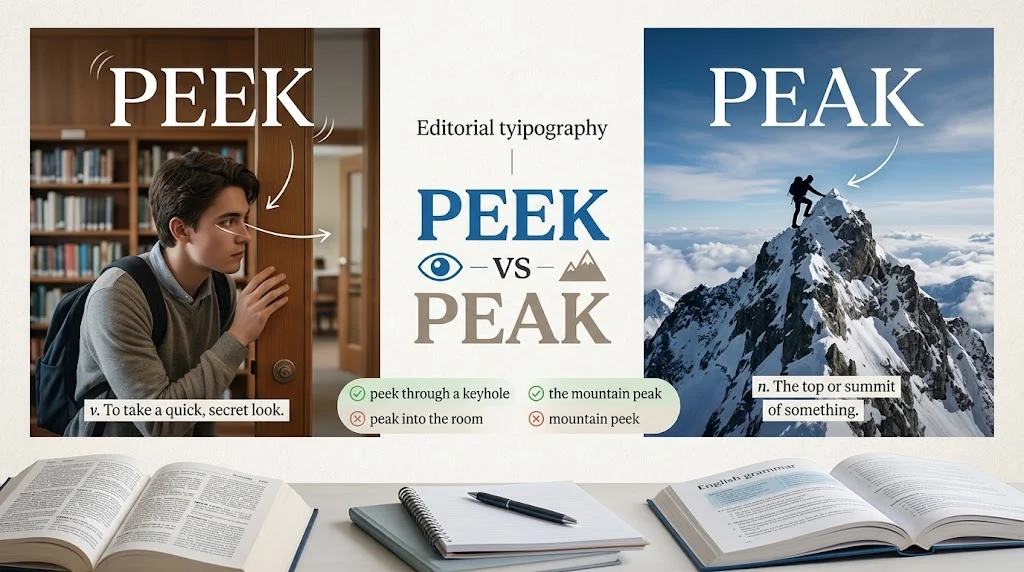
Peek means a quick or secret look, usually as a verb or noun. Peak means the highest point, level, or degree and can function as a noun, verb, or adjective. For example, “Take a peek at the report” means to look briefly, while “Sales reached their peak” means sales reached their highest level.
Have you ever written “take a peak” when you actually meant “take a quick look”? You are not alone. Peek and peak are homophones, meaning they sound alike but have different meanings and spellings. This small distinction matters in emails, academic writing, reports, websites, and everyday communication.
A simple way to remember the difference is to connect peek with looking and peak with the top or highest point. Understanding this distinction helps you write with greater accuracy and confidence, especially when choosing words that sound identical but perform very different jobs in English.
Peek vs Peak: What’s the Difference?
The simplest distinction is this:
| Word | Part of Speech | Meaning | Example |
| Peek | Verb | To look quickly or secretly | I took a peek inside the room. |
| Peek | Noun | A quick or secret look | She had a peek at the answer. |
| Peak | Noun | The highest point or level | The mountain has a snowy peak. |
| Peak | Verb | To reach the highest level | Website traffic peaked at noon. |
| Peak | Adjective | Highest or greatest | The company experienced peak demand. |
The key difference is meaning, not pronunciation.
Peek is connected with looking briefly, secretly, or quickly.
Peak is connected with a top point, maximum level, or greatest degree.
If you can replace the word with “quick look,” choose peek. If you can replace it with “highest point” or “maximum,” choose peak.
Mini Recap
Peek is about looking.
Peak is about the top or highest level.
They sound alike but are not interchangeable.
A quick memory trick is: Peek with your eyes, peak at the top.
Is Peek vs Peak a Grammar, Vocabulary, or Usage Issue?
The confusion between peek and peak is mainly a vocabulary and usage issue rather than a grammar rule.
Both words are grammatically correct, but they cannot normally replace one another because their meanings are different. The problem usually occurs because they are homophones. Their pronunciation is similar, so writers may select the wrong spelling when writing quickly.
Peek is appropriate in casual and formal contexts when you mean a brief look. For example, “Could you take a peek at this document?” can work in a workplace conversation.
Peak is equally suitable in casual, academic, professional, and technical writing. It is frequently used when discussing maximum performance, demand, temperature, prices, traffic, population, or physical height.
In academic writing, “The population reached its peak in 2010” is correct. Writing “The population reached its peek in 2010” would be a spelling error because the intended meaning is the highest level.
How to Use Peek Correctly
Peek means to look at something quickly, briefly, or sometimes secretly.
As a verb, it describes the action of looking.
Example:
“I decided to peek through the window.”
As a noun, it refers to the quick look itself.
Example:
“Can I have a peek at your notes?”
Workplace Example
“Could you take a peek at the revised proposal before the meeting?”
Here, peek means to look at something briefly.
Academic Example
“Students were not allowed to peek at another student’s answers.”
The word refers to looking secretly or improperly at something.
Technology Example
“Users can peek at their notifications without opening the application.”
Here, peek suggests getting a quick look at information.
Usage Recap for Peek
Use peek when someone looks quickly, briefly, or secretly.
Remember the association:
Peek = look.
If the sentence involves seeing, checking, glancing, or looking briefly, peek is usually the correct choice.
How to Use Peak Correctly
Peak refers to the highest point, maximum level, or greatest degree of something.
As a noun, it often describes a top point.
Example:
“The climbers finally reached the peak of the mountain.”
It can also describe the highest level of activity or performance.
Example:
“Demand for the product reached its peak in December.”
As a verb, peak means to reach the highest point.
Example:
“Temperatures are expected to peak in the afternoon.”
As an adjective, peak describes a period or condition of maximum activity.
Example:
“Travelers should expect heavy traffic during peak hours.”
Workplace Example
“Customer demand usually reaches its peak during the holiday season.”
Here, peak means the highest level of demand.
Academic Example
“The study found that population growth peaked during the early twentieth century.”
Peak functions as a verb because it describes reaching the highest level.
Technology Example
“Server usage peaked after the software update was released.”
Again, peak means that usage reached its maximum point.
Usage Recap for Peak
Use peak when you mean the highest point, maximum level, greatest degree, or a period of maximum activity.
Remember:
Peak = top or maximum.
When You Should NOT Use Peek or Peak
Many mistakes disappear when you identify the intended meaning before choosing the spelling.
- Do not use peak when you mean a quick look.
Correct: “Take a peek at this.” - Do not use peek when you mean the highest point.
Correct: “The mountain peak was covered in snow.” - Do not use peek for maximum performance.
Correct: “The athlete was at her peak.” - Do not use peak for secretly looking at someone’s work.
Correct: “He tried to peek at the answers.” - Do not use peek when discussing maximum demand.
Correct: “Electricity use reached its peak.” - Do not use peak when asking someone to look briefly.
Correct: “Can you take a peek?” - Do not confuse peak with the idea of watching something secretly. Peek carries that meaning.
- Do not choose the spelling based only on pronunciation. Both words sound alike, so meaning must determine the spelling.
Common Mistakes and Decision Rules
| Correct Sentence | Incorrect Sentence | Explanation |
| Take a peek at this email. | Take a peak at this email. | Peek means a quick look. |
| The mountain has a high peak. | The mountain has a high peek. | Peak means the top point. |
| Sales reached their peak. | Sales reached their peek. | Peak means the highest level. |
| She tried to peek at the answer. | She tried to peak at the answer. | Peek means to look secretly. |
| Traffic peaked at 8 a.m. | Traffic peeked at 8 a.m. | Peaked means reached the highest level. |
Decision Rule
If you mean a quick or secret look, use peek.
If you mean the highest point, greatest level, or maximum degree, use peak.
A useful mental image is simple: peek with your eyes and peak at the top.
Peek and Peak in Modern Technology and AI Tools
Both words appear naturally in technology writing.
Technology companies often use peek when describing quick access to information. A feature may let users peek at notifications, messages, previews, or settings without fully opening another screen.
Peak is especially common in data and performance discussions. Analysts may discuss peak traffic, peak demand, peak processing capacity, peak usage, or peak performance.
AI systems also encounter this distinction during spelling correction and language generation. Because peek and peak are pronounced alike, context is essential. An accurate language model must determine whether a sentence describes looking or reaching a maximum level.
For writers using AI writing tools, the same principle applies. Always check whether the intended meaning is a quick look or a highest point before accepting a suggested spelling.
Etymology: Where Do Peek and Peak Come From?
The histories of these words help explain why they developed different meanings despite their similar modern pronunciation.
Peek is related to the idea of looking or peeping. Its history is associated with forms meaning to look quickly or cautiously.
Peak is connected with the idea of a pointed top or summit. It developed from words associated with a pointed object or elevated point.
Their spellings therefore reflect different historical paths even though modern English speakers pronounce them alike.
An Expert Style Principle
“When two words sound alike, meaning should guide spelling, not pronunciation.”
This is a practical principle for mastering homophones. Instead of asking how the word sounds, ask what the sentence actually means.
Two Practical Case Studies
Case Study 1: Workplace Communication
Imagine an employee writing, “Please take a peak at the attached report.”
The intended meaning is clearly a quick review. However, peak means the highest point, so the sentence contains a vocabulary error.
Changing it to “Please take a peek at the attached report” immediately makes the meaning accurate and professional.
Result: The correction removes ambiguity and prevents a common spelling mistake in workplace communication.
Case Study 2: Data Reporting
Consider a sentence in a business report: “Website traffic reached its peek during the product launch.”
The intended meaning is that traffic reached its highest level. The correct sentence is:
“Website traffic reached its peak during the product launch.”
Result: The correction makes the sentence suitable for professional reporting and accurately communicates a maximum value.
These examples show why homophone accuracy matters even when the reader can guess the intended meaning.
Error Prevention Checklist
Always use Peek when
You mean a quick look.
Mean a brief glance.
You mean looking secretly.
Asking someone to look at something briefly.
Never use Peak when
You mean a quick look.
Mean secretly checking something.
You mean briefly viewing information.
Using the word as a synonym for glance.
Always use Peak when
You mean the highest point.
Mean the maximum level.
You mean the greatest degree.
Mean a mountain top or summit.
You are describing maximum activity or performance.
Related Grammar Confusions You Should Master
Once you understand peek and peak, it is useful to study other commonly confused English words. These include:
- Affect vs effect
- Advice vs advise
- Breathe vs breath
- Where vs were
- Their vs there vs they’re
- Your vs you’re
- Lose vs loose
- Principal vs principle
- Complement vs compliment
- Then vs than
Learning these pairs improves spelling accuracy, vocabulary control, and professional writing.
FAQs
What is the difference between peek and peak?
Peek means a quick or secret look, while peak means the highest point, level, or degree of something.
Is it take a peek or take a peak?
The correct expression is take a peek because it means to take a quick look.
Is it peak or peek at something?
Use peek at something when you mean to look at it briefly or secretly.
What does peak mean in a sentence?
Peak means the highest point or level, as in “Sales reached their peak in July.”
Is peek a noun or a verb?
Peek can be both a noun and a verb. It can mean a quick look or the action of looking quickly.
Is peak a noun or a verb?
Peak can be a noun, verb, or adjective. It can describe a highest point, reaching the highest level, or a period of maximum activity.
How do you remember peek vs peak?
Remember peek with your eyes and peak at the top. This simple association helps separate the two meanings.
Are peek and peak homophones?
Yes. Peek and peak are homophones because they have the same pronunciation but different meanings and spellings.
Can peek and peak be used interchangeably?
No. They are not interchangeable because peek refers to looking, while peak refers to a highest point or maximum level.
Which is correct: take a peek or take a peak?
Take a peek is correct when you mean “take a quick look.”
Conclusion: Peek or Peak
The difference between peek or peak becomes easy once you focus on meaning rather than sound. Peek relates to looking quickly, briefly, or secretly. Peak relates to the highest point, maximum level, greatest degree, or summit. Because both words sound alike, spelling mistakes are common, but the correct choice depends entirely on context.
When you mean a quick look, choose peek. When you mean the top or maximum level, choose peak. Remembering this simple distinction can make your emails, academic work, reports, and everyday writing more accurate and polished.

Margaret Atwood is an American writer who contributes to LingRoya.com creating clear and engaging content about the English language and everyday communication. She enjoys helping readers build confidence in their writing through simple, practical guidance.