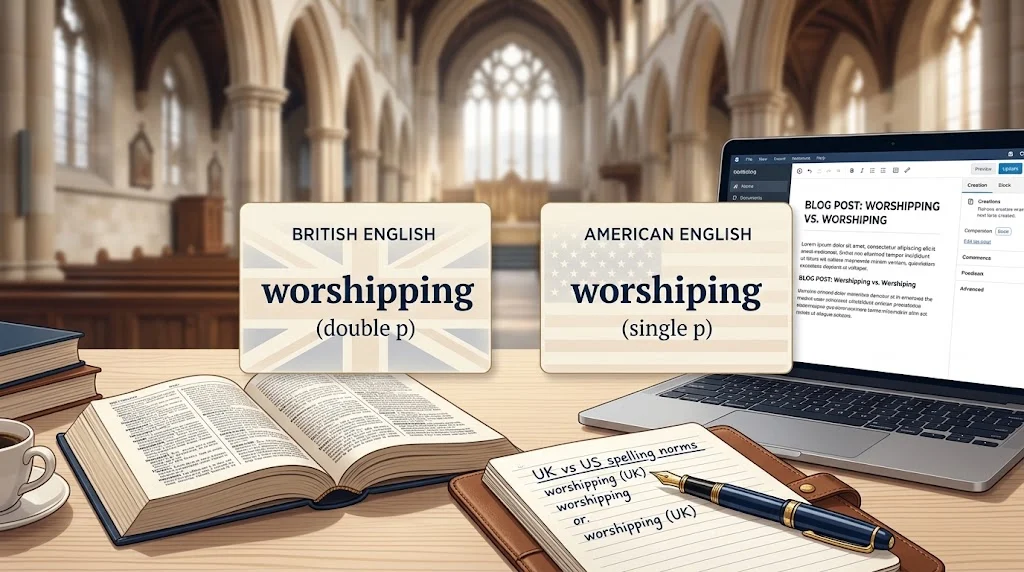
Quick Answer: Worshipping and worshiping are both correct spellings of the present participle of the verb worship. Worshipping is especially common in British English, while worshiping is the standard shorter form commonly preferred in American English.
The question of worshipping or worshiping usually comes down to one spelling difference, but that difference reflects an important variation between British and American English. Both forms describe the act of worshipping or worshiping, meaning showing reverence toward a deity or participating in religious worship.
The confusion arises because English has different conventions for doubling the final consonant before adding an ending such as ing. British English generally retains the doubled p, producing worshipping, while American English commonly uses the shorter worshiping. Major dictionaries recognize both forms, so neither spelling is inherently wrong.
Worshipping vs Worshiping: What’s the Difference?
Worshipping and worshiping are both present participles and gerunds formed from the verb worship.
The verb worship means to show reverence or devotion toward a deity or supernatural power. It can also describe extreme admiration or devotion toward a person or thing. Cambridge Dictionary gives both the religious meaning and the broader meaning of admiring someone or something intensely.
When the ending ing is added, English spelling conventions produce two accepted forms.
| Form | Part of speech | Main usage | Example |
| Worshipping | Present participle or gerund | Especially common in British English | They were worshipping at the temple. |
| Worshiping | Present participle or gerund | Especially common in American English | They were worshiping at the temple. |
| Worship | Verb | Base form | They worship regularly. |
| Worshipped | Past tense or past participle | British form and also accepted in other varieties | They worshipped at the shrine. |
| Worshiped | Past tense or past participle | Common American spelling | They worshiped at the shrine. |
Merriam Webster explicitly lists both worshipped and worshiped, as well as worshipping and worshiping, confirming that the two present participle spellings are accepted forms.
Mini Recap
Worshipping is correct.
Worshiping is also correct.
British English generally favors the double p.
American English commonly favors the single p.
The meaning does not change.
Is Worshipping vs Worshiping a Grammar, Vocabulary, or Usage Issue?
This is primarily a spelling and usage issue, not a difference in meaning or grammar.
Both forms come from exactly the same verb. Both can function as a present participle after a form of be, as in “They are worshipping” or “They are worshiping.” Both can also function as gerunds, as in “Worshipping is central to their religious practice” or “Worshiping is central to their religious practice.”
The choice depends mainly on regional spelling conventions.
Are Worshipping and Worshiping Interchangeable?
Yes, in meaning they are interchangeable.
You can write:
“They were worshipping in the temple.”
Or:
“They were worshiping in the temple.”
Both sentences communicate the same idea.
Cambridge Dictionary uses worshipping as the present participle of worship, while Merriam Webster recognizes both spellings.
Formal Versus Informal Usage
In formal writing, consistency matters more than choosing one form as universally superior.
If your publication follows British English, worshipping is the natural choice.
If your publication follows American English, worshiping is generally the better choice.
An editor should avoid switching between the two forms within the same document unless there is a specific reason for doing so.
Academic Versus Casual Usage
Academic writing should follow the spelling convention of the institution, publisher, journal, or chosen style guide.
Casual writing is more flexible, and readers will normally understand either spelling. Nevertheless, consistent regional spelling gives professional writing a more polished appearance.
How to Use Worshipping Correctly
Worshipping is the traditional British spelling and is widely used in British English and other varieties influenced by British spelling conventions.
Workplace Example
“Employees were asked to respect visitors who were worshipping in the designated area.”
The word describes an activity taking place at that moment.
Academic Example
“The study examines communities worshipping at historic religious sites.”
Here, worshipping functions as a present participle describing the communities.
Technology Example
“The documentary platform contains footage of people worshipping in different parts of the world.”
The spelling is appropriate when the surrounding publication follows British English conventions.
Usage Recap for Worshipping
Choose worshipping when following British English conventions.
It is a standard present participle of worship.
It has the same meaning as worshiping.
Consistency is more important than treating one form as universally correct.
How to Use Worshiping Correctly
Worshiping is the shorter spelling and is especially common in American English.
The spelling follows a broader American tendency to avoid doubling the final consonant in certain words when endings are added. Similar spelling differences appear in other word families, although the exact rules vary from word to word.
Workplace Example
“The organization provides a quiet space for employees who are worshiping during their break.”
In an American English document, worshiping fits naturally with the regional spelling convention.
Academic Example
“The article explores the ways communities were worshiping in ancient societies.”
The form is grammatically correct and appropriate for academic writing using American spelling.
Technology Example
“The application includes resources for people worshiping remotely.”
Again, worshiping is appropriate when the surrounding content follows American English conventions.
Usage Recap for Worshiping
Choose worshiping when following American English conventions.
It is not a misspelling.
It has the same meaning as worshipping.
Use it consistently throughout an American English document.
When You Should NOT Use Worshipping or Worshiping
There are several situations in which neither form is the best choice.
- Do not use either form when you need the base verb. Write “They worship regularly,” not “They worshipping regularly.”
- Do not use either form when you need the noun worship. Write “Worship is important to the community.”
- Do not mix British and American spelling randomly within one article.
- Do not assume worshiping is incorrect simply because you learned British English.
- Do not assume worshipping is incorrect simply because you normally read American English.
- Do not change the spelling merely because a search engine displays the other form.
- Do not use worshipping or worshiping when the intended meaning is simply admiration unless the context supports that meaning.
- Do not treat the doubled p as a change in pronunciation or meaning. The difference is orthographic.
Common Mistakes and Decision Rules
| Correct sentence | Incorrect sentence | Explanation |
| They are worshipping at the temple. | They are worshipping at the temple. | This sentence is correct in British English. |
| They are worshiping at the temple. | They are worshiping at the temple. | This sentence is correct in American English. |
| Worship is central to the ceremony. | Worshipping is central to the ceremony. | Use the noun when referring to the practice itself. |
| They worship every Friday. | They worshiping every Friday. | The base verb is required after they. |
| She was worshipping with her family. | She was worship with her family. | The continuous construction requires the present participle. |
| The community worships together. | The community worship together. | A singular subject requires worships in the present tense. |
Decision Rule Box
If your writing follows British English, choose worshipping.
If your writing follows American English, choose worshiping.
If you mean the religious practice itself, use worship.
This rule is more reliable than trying to decide which spelling is “correct” in isolation.
Worshipping and Worshiping in Modern Technology and AI Tools
Modern digital writing has made regional spelling differences more visible.
Search engines, grammar checkers, AI writing assistants, translation systems, online dictionaries, content management systems, and word processors may recognize both spellings. That does not mean every platform will recommend the same form.
For example, an American English grammar tool may prefer worshiping, while a British English publication may use worshipping throughout its editorial content.
AI systems also learn from large quantities of text produced in different varieties of English. Consequently, they may generate either form depending on context, source patterns, or the requested language variety.
For professional content, the safest approach is to establish a spelling standard before writing and apply it consistently.
Etymology: Where Does Worship Come From?
The history of worship is much older than the modern spelling difference.
Merriam Webster traces the word to Middle English forms including worþschipen, worschepen, and worshippen, associated with holding something in honor, showing respect, revering a deity, and conducting religious rites. The related noun developed from Old English forms connected with worth, dignity, honor, and esteem.
This history also explains why worship can have both a religious meaning and a broader meaning involving intense admiration.
Merriam Webster defines the verb as honoring or showing reverence toward a divine being or supernatural power and also recognizes a broader meaning involving extravagant respect or devotion.
Expert Style Insight
“worshipped also worshiped; worshipping also worshiping”
Merriam Webster’s dictionary entry lists both forms, providing direct evidence that the spelling difference is a legitimate variation rather than a simple right versus wrong distinction.
Two Practical Case Studies
Case Study 1: British Religious Publication
Imagine a British religious organization preparing an article about community prayer.
The editorial sentence is:
“Members were worshipping together during the evening service.”
The spelling fits British English conventions.
If the organization consistently uses British spelling elsewhere, changing this sentence to worshiping would create an unnecessary regional inconsistency.
Concrete result: The corrected version establishes one consistent British spelling pattern while preserving exactly the same meaning.
Case Study 2: American Academic Article
Now consider an American academic article discussing religious practices:
“Communities were worshiping at sacred sites.”
The single p spelling fits American English usage.
Merriam Webster recognizes this form alongside worshipping, while Cambridge’s British English dictionary presents worshipping as the present participle.
Concrete result: Choosing worshiping for an American English publication aligns the spelling with the regional convention without changing the grammatical function or meaning.
Error Prevention Checklist
Always use Worshipping when
☐ Your document follows British English.
☐ Your publication uses British spelling consistently.
☐ Your institution specifically recommends the double p form.
☐ You are maintaining consistency with surrounding British vocabulary.
Never use Worshiping when
☐ Your British English style guide specifically requires the double p form.
☐ You are editing a document that has an established British spelling standard.
☐ Changing the spelling would create inconsistency within a controlled editorial style.
Always use Worshiping when
☐ Your document follows American English.
☐ Your publication follows American spelling conventions.
☐ Your institutional style guide prefers the single p form.
Never assume either spelling is universally wrong
Both forms are recognized by major dictionaries.
Related Grammar Confusions You Should Master
Understanding worshipping and worshiping can lead to a broader understanding of English spelling variation. Other useful distinctions include:
- Travelling and traveling
- Cancelled and canceled
- Labelled and labeled
- Modelling and modeling
- Worshipped and worshiped
- Colour and color
- Centre and center
- Defence and defense
- Licence and license
- Practise and practice
These examples show why regional English matters when preparing professional or academic content.
FAQs
- Is worshipping or worshiping correct?
Both are correct. Worshipping is more common in British English, while worshiping is preferred in American English. - Is worshipping British English?
Yes, worshipping is the commonly used British English spelling. - Is worshiping American English?
Yes, worshiping is commonly used in American English. - Why does worship have two spellings?
The difference comes from British and American spelling conventions for doubling consonants before -ing. - Does worshipping mean something different from worshiping?
No. Both have the same meaning and grammatical function; only the spelling differs. - Should I use worshipping in academic writing?
Use worshipping for British English and worshiping for American English, depending on your style guide. - Is worshipping with two p’s wrong?
No. Worshipping is a correct and widely accepted spelling, especially in British English. - Is worshiping with one p wrong?
No. Worshiping is also correct and commonly used in American English. - Which spelling should I use for a website?
Choose worshipping for a British audience and worshiping for an American audience. - What is the past tense of worship?
Both worshipped and worshiped are correct, with the former more common in British English and the latter in American English.
Conclusion
The choice between worshipping or worshiping is not a question of right versus wrong. Both forms are legitimate spellings of the present participle of worship. Worshipping is especially common in British English, while worshiping is especially common in American English. The meaning, pronunciation, and grammatical function remain essentially the same.
The most important rule is consistency. Choose the spelling that matches your target audience, publication, institution, or style guide, and use that form throughout your content. Major dictionary sources support both spellings, so writers should focus less on declaring one form incorrect and more on following the appropriate variety of English.

Philip Pullman is an American writer dedicated to creating clear and easy to follow English content. Through his work at LingRoya.com, he helps readers strengthen their language skills with practical and reliable guidance so that they can easily understand.