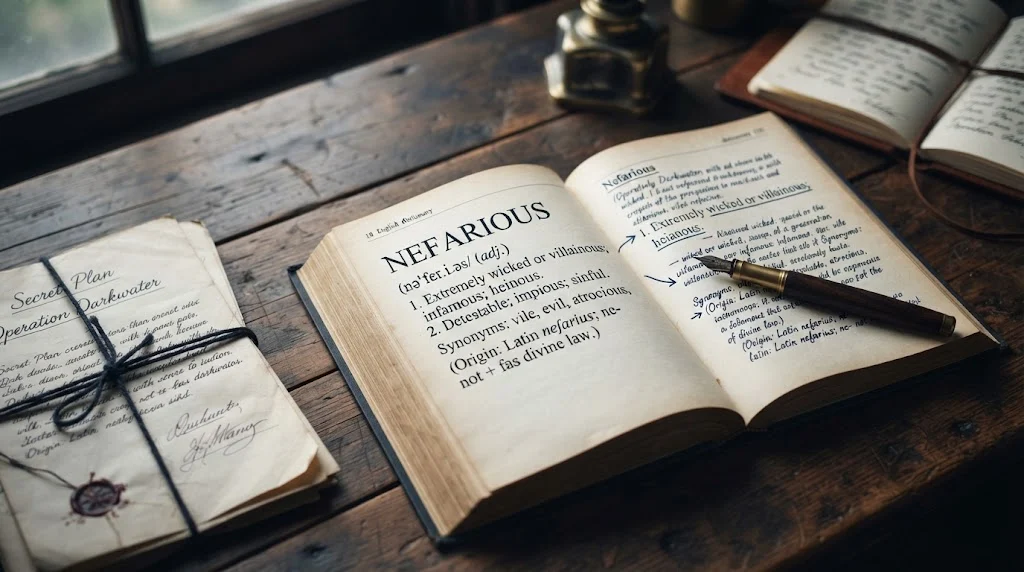
Nefarious means wicked, evil, or seriously dishonest, particularly when someone plans or carries out harmful or immoral actions. It is an adjective used to describe behavior, intentions, activities, or plans that are morally wrong.
For example, someone who secretly steals company money for personal gain might be involved in nefarious activities. The word suggests more than an ordinary mistake because it often implies deliberate wrongdoing.
You will commonly encounter nefarious in crime stories, mystery novels, discussions of corruption, and descriptions of people with harmful intentions.
| Detail | Explanation |
|---|---|
| Part of speech | Adjective |
| Main meaning | Wicked, evil, or morally wrong |
| Common context | Crime, deception, corruption, and harmful plans |
| Tone | Serious, dramatic, or disapproving |
| Formal or informal | Suitable for both formal writing and everyday conversation |
How Is Nefarious Used in Everyday English?
People use nefarious when they want to describe wrongdoing in a stronger and more expressive way than words such as bad or unfair.
The word frequently appears in three situations.
To describe dishonest actions
Nefarious can describe activities involving fraud, deception, theft, or corruption.
Example: “The investigation uncovered a nefarious scheme to steal customer information.”
This sentence suggests that the scheme involved deliberate and seriously unethical behavior.
To describe harmful intentions
The word can describe what someone intends to do, even before the plan is carried out.
Example: “The detective suspected that the stranger had nefarious intentions.”
Here, the detective believes the stranger may be planning something harmful or dishonest.
To describe fictional villains
Writers often use nefarious to make a character’s behavior sound sinister or deliberately evil.
Example: “The villain revealed his nefarious plan to control the entire kingdom.”
The adjective helps establish the character as someone pursuing an immoral goal.
Nefarious Meaning in Different Contexts
Although the basic definition remains the same, the surrounding context determines what kind of wrongdoing the word describes.
Nefarious in Literature and Movies
In fiction, nefarious commonly describes villains, secret plots, criminal organizations, or schemes designed to harm others.
Example: “The detective worked tirelessly to expose the nefarious mastermind.”
The word creates a dramatic atmosphere and signals that the character is involved in serious wrongdoing.
Nefarious in Business
In business writing, nefarious may describe fraudulent practices, deliberate deception, or unethical schemes.
Example: “The company was accused of nefarious practices that misled its customers.”
This usage communicates strong disapproval. When describing real people or organizations, however, it is important to distinguish proven facts from allegations.
Nefarious in Technology
The word can describe harmful online activities, including scams, identity theft, or attempts to gain unauthorized access to information.
Example: “The security team detected a nefarious attempt to access confidential files.”
In this context, nefarious emphasizes the suspected malicious purpose behind the activity.
Nefarious in Everyday Conversation
You can also use nefarious humorously when talking about harmless mischief, although the word’s usual meaning is much more serious.
Example: “The children had a nefarious plan to eat cookies before dinner.”
The exaggerated wording makes an ordinary act of mischief sound like a major criminal operation.
Nefarious Examples in Sentences
The following examples show how the word works in different situations.
- The detective uncovered a nefarious plot involving stolen government documents.
- The scammer used nefarious tactics to trick unsuspecting customers.
- The novel follows a hero who fights against a nefarious criminal organization.
- Investigators examined whether the manager had nefarious motives.
- The hacker was suspected of carrying out nefarious online activities.
- The politician denied participating in any nefarious scheme.
- The mysterious stranger appeared to have nefarious intentions.
- The company introduced stronger security measures to prevent nefarious activity.
- The villain’s nefarious plan threatened the safety of the entire city.
- Their seemingly innocent conversation concealed a nefarious purpose.
Notice that nefarious generally describes something morally wrong or malicious. It is not usually the best word for a harmless accident, an innocent misunderstanding, or a simple disagreement.
Is Nefarious a Negative Word?
Yes, nefarious has a strongly negative meaning. It communicates moral disapproval and suggests that an action, plan, or intention is wicked, dishonest, or harmful.
However, the word does not automatically prove that someone is guilty of wrongdoing. It describes how an action or intention is characterized, rather than establishing whether an accusation is true.
Compare these sentences:
- “He made a poor decision.” This describes a potentially unwise choice.
- “He made a nefarious decision.” This suggests a deliberate, seriously immoral choice.
The second sentence is much stronger because it implies wrongdoing rather than merely bad judgment.
Does Nefarious Mean Illegal?
Not necessarily. Nefarious describes something morally wicked or seriously dishonest, but the behavior does not have to violate a specific law.
For example, deliberately betraying a friend’s trust might be described as nefarious in a particular context, even if the act is not a crime. Conversely, not every illegal act is necessarily described as nefarious.
The distinction is that illegal refers to breaking the law, while nefarious expresses a judgment about the wicked or harmful nature of an action.
Synonyms of Nefarious
Several English words have meanings similar to nefarious, but each emphasizes a slightly different quality.
| Synonym | Meaning | Main Difference |
|---|---|---|
| Wicked | Morally evil or wrong | Broad and commonly understood |
| Evil | Profoundly immoral or harmful | Often stronger and more absolute |
| Sinister | Suggesting hidden danger or harmful intentions | Emphasizes an ominous feeling |
| Villainous | Resembling the behavior of a villain | Common in stories and descriptions of cruel people |
| Malicious | Intending to harm someone | Focuses on the desire to cause harm |
| Devious | Dishonest or indirect in achieving a goal | Emphasizes sneaky methods |
| Corrupt | Dishonest, especially through the abuse of power | Often used in government and business |
| Vile | Extremely unpleasant or morally offensive | Expresses strong disgust |
These words overlap, but they are not always interchangeable. For example, a sinister smile may seem threatening without proving that the person has done anything wrong. A nefarious scheme, by contrast, suggests a morally bad plan.
Nefarious vs. Malicious: What’s the Difference?
Nefarious and malicious are closely related, but they emphasize different aspects of wrongdoing.
It describes something wicked, immoral, or seriously dishonest. Malicious specifically emphasizes an intention or desire to harm someone.
Consider these examples:
- “The company was involved in a nefarious scheme.” This emphasizes the scheme’s immoral nature.
- “She made a malicious comment to hurt her colleague.” This emphasizes the intention to cause emotional harm.
A nefarious act can be malicious, but the terms are not identical. Someone may use dishonest methods for personal gain without their main purpose being to hurt a particular person. Malicious, meanwhile, directly highlights harmful intent.
Common Mistakes When Using Nefarious
Understanding the definition is useful, but using the word correctly also means recognizing its limits.
| Common Mistake | Correct Understanding |
|---|---|
| Using nefarious to mean merely unusual | It describes wicked, dishonest, or seriously immoral behavior |
| Assuming it always means illegal | An action can be nefarious without breaking a specific law |
| Treating it as a synonym for malicious in every sentence | Nefarious emphasizes wickedness, while malicious emphasizes an intent to harm |
Another common mistake is using nefarious to describe a person simply because you dislike them. The word makes a serious judgment about their behavior or intentions, so it is better suited to situations involving meaningful evidence of wrongdoing.
When Should You Use Nefarious?
Use nefarious when you want to describe deliberate wrongdoing in a precise and expressive way.
It works particularly well in:
- Academic writing: Describing unethical conduct in a historical or social context.
- Professional writing: Discussing suspected fraud or deceptive business practices when the wording is justified.
- Creative writing: Describing villains, secret plots, or morally corrupt characters.
- News and commentary: Characterizing harmful schemes or dishonest activities with appropriate evidence.
- Everyday conversation: Emphasizing how seriously wrong someone’s actions appear to be.
For example, “The investigation revealed a nefarious attempt to manipulate the results” communicates a stronger accusation than “The results were handled poorly.”
Choose the word carefully when discussing real individuals or organizations, especially if the alleged wrongdoing has not been established.
When Should You Avoid Nefarious?
Nefarious may sound unnecessarily dramatic when you are describing a minor mistake or an ordinary inconvenience.
For example, calling a friend nefarious for forgetting to return a book exaggerates the situation unless you are deliberately joking.
Consider these alternatives when you need a more accurate description:
- Unfair: When someone treats another person inequitably.
- Dishonest: When someone lies or misrepresents the truth.
- Suspicious: When something appears questionable but wrongdoing is unproven.
- Harmful: When something causes damage or negative effects.
- Unwise: When someone makes a poor decision without necessarily acting immorally.
Choosing a more specific word helps readers understand exactly what happened without making the situation sound more serious than it is.
Origin of the Word Nefarious
The word nefarious comes from Latin nefarius, meaning wicked or criminal, and is connected to nefas, referring to something considered wrong or contrary to divine or moral law.
The word entered English through historical language development and has retained its association with wickedness and serious wrongdoing.
Today, nefarious appears in both formal and informal English. It is particularly useful when a writer wants a more vivid description than bad, dishonest, or wrong. In storytelling, it can make a villain’s plans sound more sinister, while in nonfiction writing it can communicate strong moral disapproval when the facts support that characterization.
Quick Recap: Nefarious Meaning
- Nefarious means wicked, evil, or seriously dishonest.
- It is an adjective used to describe actions, plans, intentions, or activities.
- The word often appears in discussions of crime, deception, corruption, and fictional villains.
- Nefarious is not exactly the same as illegal or malicious.
- Use it when the wrongdoing is serious enough to justify its strong negative tone.
Frequently Asked Questions
What does nefarious mean in simple words?
Nefarious means wicked, evil, or seriously dishonest, especially when someone intends to do something morally wrong.
Is nefarious a positive or negative word?
Nefarious is a negative word because it describes behavior, plans, or intentions considered wicked, dishonest, or harmful.
What is an example of nefarious?
“The businessman devised a nefarious scheme to deceive investors” describes a deliberately dishonest plan intended to achieve an improper goal.
What is a synonym for nefarious?
Common synonyms include wicked, evil, sinister, villainous, malicious, and devious, although each emphasizes a slightly different aspect of wrongdoing.
Does nefarious mean illegal?
No, nefarious does not necessarily mean illegal; it describes wicked or immoral behavior, which may or may not violate the law.
Final Thoughts
The nefarious meaning refers to something wicked, evil, or seriously dishonest, particularly when an action involves harmful intentions or deliberate wrongdoing. You can use the word to describe criminal schemes, deceptive business practices, suspicious plans, and fictional villains. Although it shares similarities with words such as malicious, sinister, and wicked, each term has its own emphasis. The key is to consider the seriousness of the behavior and the message you want to communicate. When used accurately, nefarious adds precision and a strong sense of moral disapproval to your writing.
Discover More Articles:
- Burned or Burnt: Meaning & Difference In 2026
- Supper or Super: A Complete Guide In 2026
- Ms or Mrs: The Definitive Guide to Choosing the Right In 2026

Neil Gaiman is an American writer who contributes educational content to LingRoya.com. His work focuses on helping readers improve their English with clear, practical and easy to follow guidance.