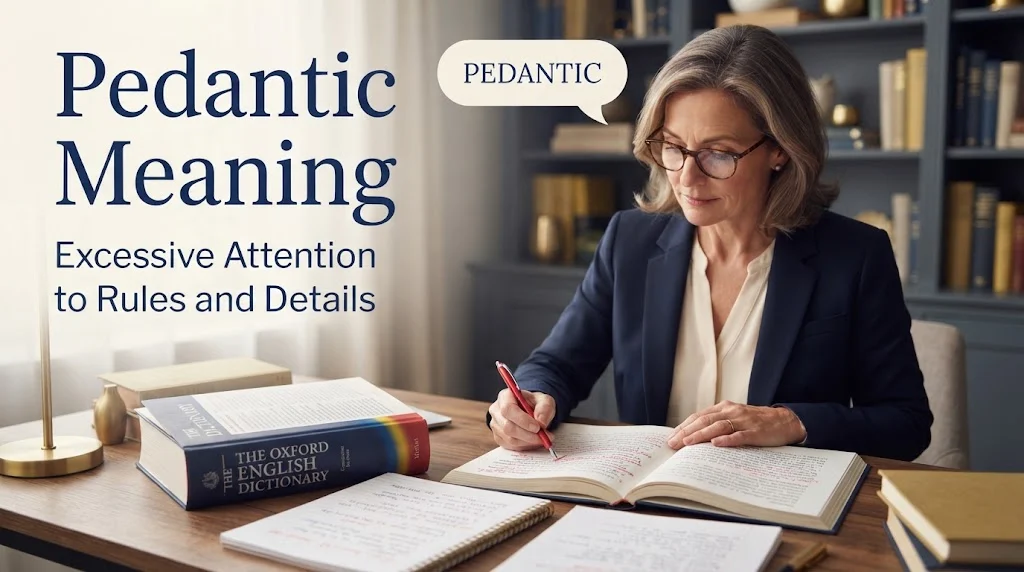
The pedantic meaning refers to being overly concerned with minor details, formal rules, or academic knowledge, especially when showing that knowledge feels unnecessary. The word can describe a person’s behavior, writing style, or way of speaking.
Pedantic means paying excessive attention to small details, rules, or academic knowledge, especially when that attention seems unnecessary or is used to show off what someone knows.
A pedantic person may focus on technical accuracy instead of the main idea. They might correct someone’s word choice, explain an obvious rule, or insist on a minor distinction during a casual conversation.
For example:
“She gave a pedantic explanation of the grammar rule when everyone understood the sentence.”
This means her explanation focused too heavily on technical details that were not necessary for the situation.
| Detail | Explanation |
|---|---|
| Part of speech | Adjective |
| Main meaning | Excessively concerned with details or rules |
| Typical tone | Critical or disapproving |
| Common contexts | Conversations, education, writing, and academic discussions |
| Formal or informal | Used in both formal and everyday English |
How Is Pedantic Used in Everyday English?
People use pedantic to describe behavior that prioritizes minor technical details over the larger purpose of a discussion. It often suggests that someone is being unnecessarily precise, overly academic, or more concerned with correctness than communication.
Here are three common situations.
Correcting unnecessary details
A person may interrupt a conversation to correct a small mistake that does not affect the message.
Example: “He was being pedantic about the exact pronunciation of a familiar word.”
The sentence suggests that the correction was more detailed than the situation required.
Overexplaining simple ideas
Someone might give a long, technical explanation when a short answer would be enough.
Example: “Her pedantic response turned a simple question into a lecture.”
Here, pedantic describes an unnecessarily complicated explanation.
Insisting on technical accuracy
A person may focus on precise definitions even when the difference is unimportant to the discussion.
Example: “The discussion became pedantic when they argued about the wording instead of solving the problem.”
The word suggests that excessive attention to detail distracted everyone from the main objective.
Is Pedantic a Negative Word?
Yes, pedantic usually has a negative or critical tone. It often implies that someone is being overly particular, unnecessarily technical, or eager to demonstrate their knowledge.
However, the word does not mean that accuracy itself is bad. Precision can be essential in science, law, medicine, editing, and academic research. The criticism arises when attention to details becomes excessive or interferes with useful communication.
Consider these examples:
- Critical: “His pedantic comments made the meeting longer than necessary.”
- Mildly humorous: “I’m being pedantic, but that comma belongs inside the quotation marks in this style guide.”
- Descriptive: “The professor’s pedantic approach examined every detail of the historical text.”
The second example shows that someone can acknowledge their own excessive precision without intending to offend anyone.
Whether pedantic sounds harsh depends on the situation, the speaker’s tone, and the behavior being described.
Does Pedantic Mean Intelligent?
No, pedantic does not simply mean intelligent or knowledgeable. It describes an excessive focus on details, rules, or formal knowledge, particularly when that focus seems unnecessary.
A person can be intelligent without being pedantic. Similarly, someone may know many facts but communicate them in a way that feels overly complicated or condescending.
Is Pedantic an Insult?
Pedantic can be an insult when used to criticize someone’s behavior. Calling a person pedantic may suggest that they are annoying, overly particular, or more interested in proving a point than helping others understand.
However, it can also serve as a fair description of an overly technical writing style or an unnecessarily detailed argument. The context determines how personal or harsh the criticism feels.
Pedantic Meaning in Different Contexts
The word retains its central meaning across different situations, but the behavior it describes may look different depending on the setting.
Pedantic in Conversation
In everyday conversation, pedantic often describes someone who corrects insignificant mistakes or explains things that others already understand.
Example: “He became pedantic about the difference between two nearly identical expressions.”
The speaker suggests that the distinction was not important enough to dominate the discussion.
Pedantic in Writing
In writing, pedantic can describe language that is excessively technical, formal, or filled with unnecessary explanations.
Example: “The essay sounded pedantic because it explained every basic term in unnecessary detail.”
Here, the criticism concerns the writing style rather than the writer’s intelligence.
Pedantic in Education
In an educational setting, pedantic may describe a teacher, student, or academic who focuses too heavily on technical rules instead of the broader concept.
Example: “The lesson felt pedantic when the instructor spent twenty minutes discussing a minor formatting rule.”
Detailed instruction is not automatically pedantic. The word becomes appropriate when the detail receives disproportionate attention.
Pedantic in Professional Settings
At work, pedantic behavior may occur when someone repeatedly corrects minor wording choices or insists on unnecessary procedural details.
Example: “The manager’s pedantic feedback distracted the team from meeting its deadline.”
However, precise language and careful checking are valuable when mistakes could affect safety, compliance, or the quality of the work.
Real Conversation Examples of Pedantic
These short conversations show how the word works naturally in different situations.
Example 1: Friends discussing a movie
Person A: “That movie was about two hours long.”
Person B: “Actually, it was one hour and fifty eight minutes.”
Person A: “You’re being pedantic. You know what I meant.”
Meaning: Person A thinks the exact runtime is too minor to correct during a casual conversation.
Example 2: A classroom discussion
Student A: “The main character was angry because he lost his home.”
Student B: “Technically, he was frustrated rather than angry.”
Student A: “That distinction seems a little pedantic for this discussion.”
Meaning: Student A believes the correction places too much emphasis on a small difference in wording.
Example 3: A workplace meeting
Colleague A: “We need to finish the report by Friday.”
Colleague B: “You should say complete the report, not finish the report, because complete sounds more precise.”
Colleague A: “Let’s not get pedantic. We need to agree on the deadline.”
Meaning: Colleague A wants the team to focus on the deadline instead of debating an unnecessary wording preference.
How to Use Pedantic Correctly
Pedantic is an adjective, so it describes a person, behavior, explanation, argument, or style.
Common expressions include:
- A pedantic person: Someone who focuses excessively on details.
- A pedantic explanation: An explanation that includes unnecessary technical detail.
- A pedantic argument: An argument centered on minor distinctions.
- A pedantic approach: A method that gives disproportionate attention to rules or details.
- Pedantic about something: Excessively particular about a specific subject.
For example, “She is pedantic about punctuation” means she pays very close attention to punctuation, possibly more than the situation requires.
You can also use the adverb pedantically.
Example: “He pedantically corrected every small error in the informal message.”
The adjective describes the person or behavior, while the adverb describes how an action is performed.
When to Use Pedantic
Use pedantic when you want to describe excessive attention to rules, small distinctions, or technical details.
Appropriate situations include:
- Describing an unnecessarily detailed explanation.
- Criticizing repeated corrections that interrupt a conversation.
- Reviewing writing that feels overly technical or formal.
- Discussing an argument focused on insignificant distinctions.
- Describing your own overly precise behavior in a lighthearted way.
For example, you might say, “I’m not trying to be pedantic, but the two terms have different meanings.”
This phrasing acknowledges that the distinction may seem overly detailed while explaining why you consider it relevant.
When to Avoid Using Pedantic
Avoid calling someone pedantic when you simply mean that they are careful, knowledgeable, or accurate. The word usually carries criticism, so it may create unnecessary tension.
It may also be inappropriate when someone is correcting an important mistake or explaining a genuinely complicated subject.
Consider these alternatives:
- Precise: When someone communicates accurately and clearly.
- Thorough: When someone examines a subject carefully.
- Detail oriented: When someone notices small but useful details.
- Meticulous: When someone works with great care and attention.
- Technical: When an explanation uses specialized knowledge or terminology.
Choosing a more accurate adjective helps you describe the behavior without unfairly criticizing someone for being careful.
Common Mistakes About Pedantic
People sometimes confuse pedantic with related words that have different meanings.
| Common Mistake | Correct Understanding |
|---|---|
| Thinking pedantic means intelligent | It describes excessive attention to details or formal knowledge |
| Using pedantic as a synonym for careful | Careful behavior is not necessarily excessive or annoying |
| Assuming every correction is pedantic | Corrections are pedantic when the attention to detail seems disproportionate or unnecessary |
Another mistake is assuming that pedantic always describes a person. The word can also describe an explanation, argument, writing style, or approach.
Pedantic and Similar Words
Several English words describe precision, excessive detail, or a tendency to correct others. However, their meanings are not identical.
| Word | Meaning | Main Difference |
|---|---|---|
| Nitpicky | Overly concerned with small faults | Usually emphasizes finding minor errors |
| Meticulous | Extremely careful about details | Often positive rather than critical |
| Picky | Difficult to please or selective | Focuses on preferences or choices |
| Fussy | Excessively concerned with small details or standards | Often suggests unnecessary concern or difficulty |
| Pompous | Acting overly important or self important | Focuses on an exaggerated sense of importance |
Pedantic vs. nitpicky: Pedantic often involves technical rules or academic distinctions, while nitpicky usually means finding fault with minor details.
Pedantic vs. meticulous: A meticulous person carefully checks details, often for a good reason. A pedantic person focuses on details to an excessive or unnecessary degree.
Pedantic vs. pompous: Pedantic behavior centers on excessive precision or knowledge, while pompous behavior involves acting more important or impressive than others.
Origin and History of Pedantic
The word pedantic is associated with the older word pedant, which referred to a teacher or schoolmaster and later developed a critical sense involving excessive attention to learning and formal knowledge.
English adopted pedantic from French pédantique, with related forms appearing in European languages. Over time, the word became associated with people who display learning in an overly formal, detailed, or unnecessary way.
Today, pedantic is used in everyday conversation as well as academic and professional writing. Its central idea remains the same: excessive concern with details or technical correctness, especially when that concern distracts from the main point.
Quick Recap: Pedantic Meaning
- Pedantic means excessively concerned with minor details, rules, or academic knowledge.
- It usually has a negative or critical tone.
- It can describe people, conversations, writing, explanations, and arguments.
- It does not simply mean intelligent, careful, or knowledgeable.
- Use it when attention to detail becomes unnecessary or distracts from the main purpose.
Frequently Asked Questions
What does pedantic mean in simple words?
Pedantic means paying too much attention to small details or rules, especially when those details are unnecessary for the situation.
Is pedantic a positive or negative word?
Pedantic is usually negative because it suggests excessive attention to details, although it can describe a style without directly insulting someone.
What is an example of being pedantic?
Correcting someone’s insignificant grammar mistake during an unrelated conversation can be pedantic when the correction adds no meaningful value.
What is the difference between pedantic and meticulous?
Pedantic suggests excessive or unnecessary attention to details, while meticulous usually describes careful and thorough work positively.
What is a synonym for pedantic?
Common synonyms include nitpicky, overly particular, fussy, and captious, although each word has slightly different shades of meaning.
Final Thoughts
The pedantic meaning describes excessive concern with small details, technical rules, or academic knowledge, particularly when that attention distracts from the main point. Although precision and accuracy are valuable, pedantic behavior can make communication feel unnecessarily complicated or critical.
The word can describe a person, an explanation, a writing style, or an argument. When using it, consider whether the attention to detail is genuinely excessive or simply appropriate for the situation. Understanding this distinction will help you use pedantic accurately and recognize it in everyday conversations, academic discussions, and professional writing.
Discover More Articles:
- Tomatoes or Tomatos: Which Spelling Is Correct In 2026
- Gage or Gauge: Which Spelling Is Correct In 2026
- Yea or Yeah: Meaning, Differences & Usage for 2026

Margaret Atwood is an American writer who contributes to LingRoya.com creating clear and engaging content about the English language and everyday communication. She enjoys helping readers build confidence in their writing through simple, practical guidance.