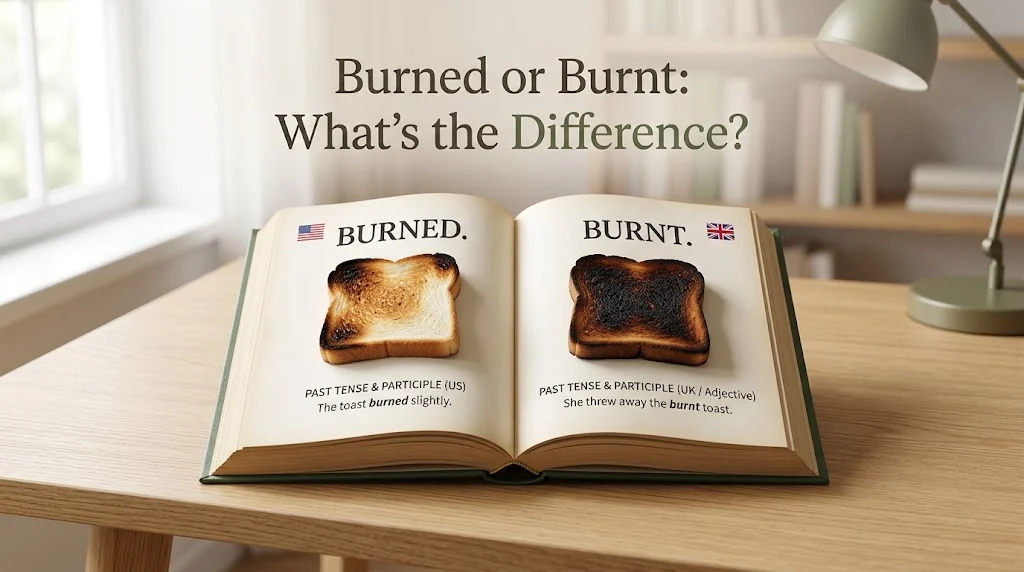
Burned or burnt are both correct past tense and past participle forms of the verb burn, meaning to damage something with fire or heat. Burned is more common in American English, while burnt is widely used in British English and often appears as an adjective describing damaged or overcooked food.
Have you ever wondered whether to write burned or burnt when describing a fire, a cooking mistake, or a painful experience? Both spellings are grammatically correct, but their usage can vary by region and context. Understanding this difference helps you write more accurately in academic assignments, professional documents, everyday conversations, and online content.
English grammar and vocabulary can be confusing because some verbs accept different forms without changing their essential meaning. As an English language resource focused on practical usage and clear explanations, this guide explores the definitions, grammatical rules, regional preferences, common mistakes, and real world examples that help you choose the right form confidently.
Burned or Burnt: What’s the Difference?
The main difference between burned and burnt is regional preference and usage rather than meaning. Both words can describe the result of burning something or the process of being damaged by heat or fire.
| Feature | Burned | Burnt |
| Part of speech | Verb and adjective | Verb and adjective |
| Base verb | Burn | Burn |
| Past tense | Burned | Burnt |
| Past participle | Burned | Burnt |
| American English | More common | Less common |
| British English | Correct and widely understood | Common |
| Food descriptions | Burned toast | Burnt toast |
| Fire descriptions | The house burned down | The house burnt down |
Quick recap
Burned and burnt are two accepted forms of the same verb.
American English generally favors burned, especially in ordinary verb usage.
British English commonly uses both forms, with burnt particularly familiar in descriptions of food and physical damage.
Neither spelling is inherently incorrect. Consistency and context should guide your choice.
Is Burned or Burnt a Grammar, Vocabulary, or Usage Issue?
The distinction between burned and burnt is primarily a usage issue involving alternative verb forms. It isn’t a difference in basic meaning or a rule that makes one spelling grammatically wrong.
Are burned and burnt interchangeable?
In many sentences, yes. You can say, “The paper burned quickly” or “The paper burnt quickly.” Both communicate that the paper was consumed or damaged by fire.
However, some expressions favor one form in particular varieties of English. For example, burnt toast is a familiar British English expression, while burned toast is common in American English.
Formal versus informal usage
Both forms are acceptable in formal and informal writing. In academic essays, workplace reports, and professional publications, the important consideration is consistency with the preferred variety of English.
If you’re writing for an American university, burned may be the more natural choice. For a British audience, burnt may fit the local writing style, although burned remains correct.
Academic versus casual usage
In academic writing, use the spelling that matches your institution’s style guide or the variety of English you’re following. In everyday speech and casual messages, either form is generally understandable.
For example:
Academic: The forest burned extensively during the drought.
Casual: I accidentally burnt the pizza.
Both sentences are correct. The difference is a matter of preference rather than grammatical accuracy.
When to Use Burned
Burned is the simple past tense and past participle of burn. It is especially common in American English and works naturally in descriptions of fires, injuries, cooking, and figurative experiences.
1. Workplace example
“The electrical fault burned several wires inside the control panel.”
This sentence describes damage caused by excessive heat. Burned is appropriate in technical reports, incident summaries, and workplace safety documentation.
2. Academic example
“The researchers found that the burned vegetation released carbon into the atmosphere.”
Here, burned describes vegetation affected by fire. The form is suitable for scientific writing and environmental research.
3. Technology example
“The overheating battery burned the surrounding plastic casing.”
In technology related writing, burned can describe heat damage to electronic components, devices, or materials.
It can also appear in computing expressions such as burned a disc, meaning that data was recorded onto optical media. This expression is less common today as physical discs have become less widely used.
Usage recap
Choose burned when writing in American English or when you want a widely understood form that works naturally across many contexts. It is especially suitable for straightforward descriptions of past actions and completed events.
When to Use Burnt
Burnt is an alternative past tense and past participle of burn. It is particularly common in British English and frequently appears as an adjective describing food, surfaces, or materials damaged by heat.
1. Workplace example
“The technician replaced the burnt insulation around the damaged cable.”
Burnt describes the condition of the insulation. This usage is familiar in British English, although burned insulation would also be correct.
2. Academic example
“The experiment examined the chemical properties of burnt wood.”
The word burnt describes wood that has undergone burning. It can appear naturally in scientific and educational writing, depending on the author’s regional preference.
3. Technology example
“The repair team discovered a burnt circuit board inside the device.”
Here, burnt functions as an adjective describing a damaged component. The sentence is understandable in both British and American English, though burned circuit board is also possible.
Usage recap
Choose burnt when it fits your regional variety or when it sounds natural in a descriptive expression such as burnt toast, burnt sugar, or burnt wood. Remember that burnt is not limited to adjectives because it can also function as a verb form.
When You Should NOT Use Burned or Burnt
Although both forms are correct, several situations require more careful word choice.
1. When describing the present action: Do not write “The paper burned now” if you mean the action is happening at this moment. Write “The paper is burning now.”
2. When describing a future action: Avoid “The wood burnt tomorrow.” Write “The wood will burn tomorrow” if you are referring to a future event.
3. When describing an ongoing process: Use “The building is burning” rather than “The building is burnt” when the fire is currently in progress.
4. When describing something that has not caught fire: Do not say “The untouched paper is burned.” Use “The paper is unburned” or “The paper has not burned,” depending on the intended meaning.
5. When confusing burning with heating: Not every heated object is burned. If food is simply warm, describe it as warm rather than burnt.
6. When describing a person who starts a fire: Burned and burnt do not ordinarily mean someone deliberately started a fire. Use a more precise expression, such as set fire to, when that is what happened.
7. When writing for a style controlled publication: Avoid switching randomly between burned and burnt within the same document. Follow the publication’s preferred spelling unless a quotation or specific expression requires otherwise.
8. When describing emotional disappointment: The expression burned by a bad investment can be figurative, but make sure the surrounding context clarifies that no literal fire was involved.
Common Mistakes and Correct Usage
The following examples illustrate frequent errors involving the verb burn and its alternative forms.
| Correct sentence | Incorrect sentence | Explanation |
| The toast burned in the toaster. | The toast burn in the toaster yesterday. | Use a past form for a completed past event. |
| The toast is burning. | The toast is burnt right now in the process. | Burning describes an ongoing action more naturally. |
| The building has burned down. | The building has burn down. | A perfect construction requires the past participle. |
| The wires were burnt by the heat. | The wires were burn by the heat. | Passive constructions require a past participle. |
| I burned my finger yesterday. | I burn my finger yesterday. | A completed past event normally takes burned or burnt. |
| She burnt the sugar accidentally. | She burnt the sugar accidental. | Accidental is an adjective, while accidentally is the appropriate adverb. |
The simple decision rule
If you mean the action: Use burned or burnt as the past tense or past participle of burn, depending on your regional preference.
If you mean the resulting condition: Either burned or burnt can describe the damaged object. Choose the form that sounds natural for your audience and remain consistent.
Remember that the distinction is not between an action word and a person or tool. Both burned and burnt are forms of the same verb, and both can also function as adjectives.
Burned and Burnt in Modern Technology and AI Tools
Modern technology frequently uses language to describe heat damage, battery failures, and manufacturing problems. Both burned and burnt can accurately describe damaged components.
For example, a technician might write, “The processor burned out after prolonged overheating,” or “The device contained a burnt connector.”
The expression burned out also has figurative meanings, including extreme exhaustion and the failure of electrical equipment. In workplace discussions, someone may say they feel burned out after a demanding project.
AI writing assistants and grammar checkers generally recognize both spellings as valid. However, they may suggest one form over the other based on the selected language setting. If your content targets a British audience, check that your writing tool is configured for British English. For American readers, an American English setting can help maintain consistency.
Automated grammar tools are useful for catching mistakes, but they should not be treated as proof that one accepted spelling is universally correct.
Etymology: Where Do Burned and Burnt Come From?
The verb burn has Germanic origins and has existed in English for centuries. Like several other English verbs, it developed alternative forms over time.
The ending ed is the regular way to form the past tense and past participle of many English verbs. The form burned follows this regular pattern.
Burnt reflects an older pattern of verb formation that remains in modern English. Similar alternatives occur with verbs such as learn, which has the forms learned and learnt, and dream, which can appear as dreamed or dreamt.
These alternatives illustrate how English preserves older grammatical patterns alongside more regular forms. Regional preferences influence which version speakers use most frequently.
An Expert Perspective on Choosing the Correct Form
A useful principle for English learners is:
“Correct word choice depends on meaning, grammatical function, audience, and consistency.”
This is a practical language learning principle rather than a quotation attributed to a specific linguist. It highlights why spelling differences should be understood in context rather than memorized as isolated rules.
For burned and burnt, both forms are accepted. The most reliable approach is to identify the intended meaning, recognize the sentence’s grammatical structure, and follow the conventions of your target audience.
Two Practical Case Studies
Case Study 1: An American school report
A student in the United States writes a science report about a controlled experiment involving dry leaves. The first draft reads:
“The leaves burnt rapidly when exposed to the flame.”
The sentence is grammatically acceptable, but the teacher asks the student to follow American English conventions consistently. The student changes it to:
“The leaves burned rapidly when exposed to the flame.”
Result: The revised sentence follows the preferred American English form throughout the report. The improvement is consistency, not a correction of an inherently incorrect spelling.
Case Study 2: A British cooking article
A food blogger in the United Kingdom is writing about common baking mistakes. The original sentence reads:
“The burnt sugar gave the dessert a bitter taste.”
The blogger keeps this wording because burnt is a natural and familiar adjective in British food writing.
Result: The article retains a regionally natural expression that communicates the condition of the sugar clearly. Replacing burnt with burned would also be grammatically acceptable, but it is not necessary.
These examples demonstrate that effective editing depends on the intended audience and context rather than a universal preference for one form.
Error Prevention Checklist
Use this checklist before publishing or submitting your writing.
Always use burned when
- You are following American English conventions and describing a completed burning action.
- Your publication or institution specifically prefers the regular ed form.
- You want consistency with other American English verb forms in your document.
Never use burnt when
- You have been instructed to use a particular spelling and burnt conflicts with that requirement.
- You are describing an ongoing action and actually need burning.
- You are using burnt merely because you assume it is the only correct British English form.
Important: Burnt is not inherently incorrect in American English, and burned is not incorrect in British English. These checklist points concern context and consistency, not absolute grammatical prohibitions.
Related Grammar Confusions You Should Master
Learning how alternative spellings and verb forms work can improve your overall English accuracy. These related topics are useful to explore next.
- Learned or learnt: Understand regional differences between two past tense forms.
- Dreamed or dreamt: Explore regular and alternative verb endings.
- Spelled or spelt: Compare common American and British preferences.
- Leaped or leapt: Learn how alternative past tense forms function.
- Smelled or smelt: Understand spelling variation in descriptions of smell.
- Judgment or judgement: Compare noun spelling conventions across English varieties.
- Color or colour: Explore American and British spelling differences.
- Canceled or cancelled: Learn how consonant doubling varies by region.
- Practice or practise: Distinguish noun and verb usage in British English.
- Advice or advise: Understand the difference between a noun and a verb.
Frequently Asked Questions About Burned or Burnt
1. Is burned or burnt grammatically correct?
Both burned and burnt are grammatically correct. They are alternative past tense and past participle forms of the verb burn. Burned is more common in American English, while burnt is especially familiar in British English.
2. What is the difference between burned and burnt in American English?
Burned is generally the more common form in American English. Burnt is also recognized and can appear in expressions such as burnt toast. The two forms usually communicate the same meaning.
3. Should I write burnt or burned toast?
Both expressions are correct. Burnt toast is particularly common in British English, while burned toast is widely used in American English. Choose the version that matches your audience.
4. Is burnt the British English spelling of burned?
Burnt is a common British English alternative to burned, but it is not exclusively British. British writers use burned as well, particularly in certain verb constructions and formal contexts.
5. Is it burned out or burnt out?
Both expressions are correct. Burned out and burnt out can describe electrical equipment that has stopped working or a person experiencing exhaustion. Regional preferences influence which form sounds more natural.
6. Which is correct in academic writing, burned or burnt?
Either form can be correct in academic writing. Follow the institution’s style guide and maintain consistency throughout the paper. American academic writing often favors burned, while British academic writing may use either form.
7. Is burnt a verb or an adjective?
Burnt can function as both a verb form and an adjective. In “The wood burnt quickly,” it is a verb. In “The burnt wood was collected,” it describes the wood and functions as an adjective.
8. Can I use burned and burnt in the same article?
You can, but switching between them without a reason may make your writing inconsistent. Choose a preferred form based on your audience and apply it consistently unless a particular expression or quotation calls for a different form.
9. What is the past tense of burn?
The past tense of burn can be burned or burnt. Both forms are accepted, and the preferred choice often depends on regional English conventions.
Conclusion: Choosing Between Burned and Burnt
Understanding burned or burnt is easier when you remember that both are correct forms of the verb burn. The main distinction involves regional preference and context rather than a strict grammatical rule. American English generally favors burned, while British English commonly uses both burned and burnt, especially in descriptive expressions involving food and heat damage.
For professional documents, academic assignments, and online articles, select the form that suits your intended audience and remain consistent. Also remember to distinguish a completed action, such as burned, from an ongoing process, such as burning. With these simple principles, you can avoid common mistakes and communicate clearly in everyday and formal English.

Philip Pullman is an American writer dedicated to creating clear and easy to follow English content. Through his work at LingRoya.com, he helps readers strengthen their language skills with practical and reliable guidance so that they can easily understand.