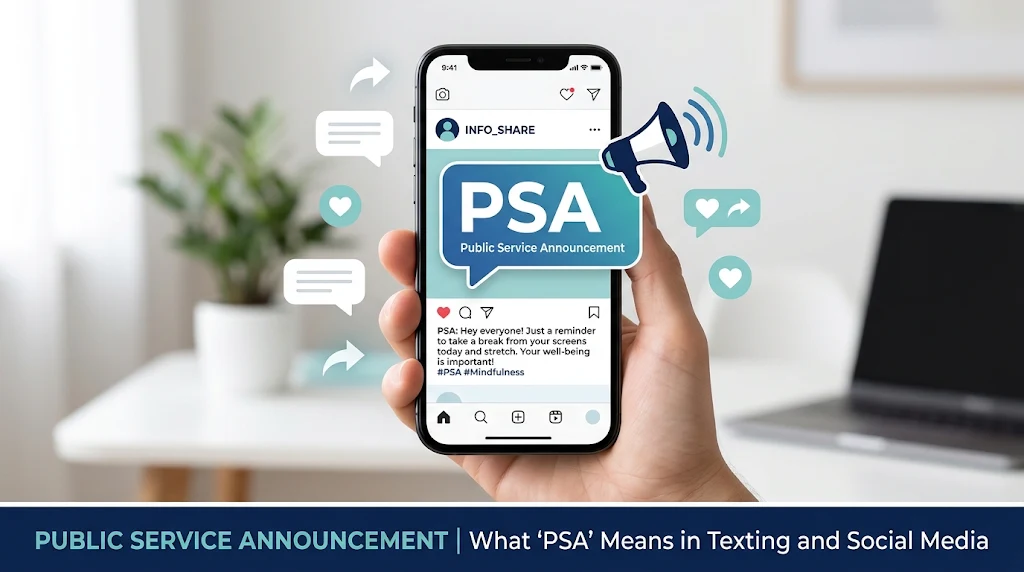
The PSA meaning is usually “Public Service Announcement,” a message shared to inform, educate, or warn people about something important. In texting and social media, people use PSA to draw attention to useful information, reminders, advice, or public concerns.
PSA stands for Public Service Announcement. It refers to a message intended to inform the public about something useful, important, or relevant to a particular community.
In everyday online communication, people use PSA before sharing information they believe others should know. It can introduce a safety warning, helpful reminder, personal observation, or general piece of advice.
For example:
“PSA: Always check your email before submitting an assignment.”
Here, the sender is highlighting a helpful reminder that may benefit other people.
The expression is not limited to official announcements. Friends, content creators, businesses, and online communities also use it in everyday communication.
| Detail | Explanation |
|---|---|
| Full form | Public Service Announcement |
| Main meaning | A message that shares useful or important information |
| Tone | Informative, helpful, serious, or humorous |
| Common platforms | TikTok, Instagram, Snapchat, WhatsApp, and Reddit |
| Formal or informal | Both, depending on the context |
How People Use PSA in Text Messages
People commonly use PSA to introduce information they want others to notice. It signals that the following statement is worth reading, remembering, or sharing.
Here are three common ways people use it.
To share helpful reminders
Someone may use PSA to remind friends, classmates, or coworkers about something important.
Example: “PSA: The library closes at 6 PM today.”
The abbreviation highlights information that people might otherwise overlook.
To warn people about something
PSA can introduce a warning about scams, safety issues, misleading information, or common mistakes.
Example: “PSA: Don’t click suspicious links in random messages.”
Here, the sender wants to protect others by sharing useful advice.
To make a funny announcement
People also use PSA humorously when sharing everyday observations or playful opinions.
Example: “PSA: Pizza tastes better when someone else pays.”
This is not an official public announcement. It is simply a humorous way to make a statement sound important.
Are There Alternative Meanings of PSA?
Although Public Service Announcement is the most widely recognized meaning in everyday texting and social media, PSA can have other meanings in specific fields.
The intended definition depends on the subject and conversation.
| Meaning | Context | Explanation |
|---|---|---|
| Public Service Announcement | Social media and everyday communication | An informative public message |
| Prostate-Specific Antigen | Medical discussions | A protein measured through a blood test |
| Public Service Advertising | Advertising and media | Advertising designed to communicate public-interest messages |
| Professional Services Automation | Business and technology | Software used to manage professional service operations |
For most casual conversations, PSA means Public Service Announcement. If someone discusses medical tests, business software, or advertising, the abbreviation may have a different meaning.
How Context Changes the Meaning of PSA
The surrounding message usually makes the intended meaning clear. Pay attention to the subject, wording, platform, and relationship between the people communicating.
Consider these examples:
Example 1: General advice
“PSA: Save your work before closing the laptop.”
Meaning: The sender is sharing a practical reminder.
Example 2: Social media warning
“PSA: There is a fake account pretending to be me.”
Meaning: The person is warning followers about impersonation.
Example 3: Medical conversation
“My doctor recommended a PSA test.”
Meaning: PSA refers to Prostate-Specific Antigen, not a public announcement.
Example 4: Funny group chat
“PSA: Nobody should text me before coffee.”
Meaning: The sender is making a humorous announcement.
These examples show why you should not assume every use of PSA has the same meaning.
PSA Meaning on Different Social Media Platforms
The basic meaning of PSA usually remains Public Service Announcement across social media platforms. However, the way people use it can vary.
PSA on TikTok
On TikTok, creators often use PSA in video captions, spoken introductions, and comments to highlight advice, warnings, or useful information.
Example: “PSA: You can turn off notifications for individual apps.”
The abbreviation helps introduce information that viewers may find useful.
PSA on Instagram
On Instagram, people use PSA in captions, Stories, and comments to share reminders, announcements, or opinions with their followers.
Example: “PSA: My old account is no longer active.”
Here, the sender is informing followers about an account-related update.
PSA on Snapchat
On Snapchat, PSA can appear in private messages, group chats, or Stories. Friends may use it to share quick reminders or humorous announcements.
Example: “PSA: The party starts at 8, not 9!”
The sender wants everyone to notice an important detail.
PSA on Reddit and WhatsApp
On Reddit and WhatsApp, people often use PSA to introduce community information, useful advice, warnings, or general reminders.
Example: “PSA: Check the group description before asking repeated questions.”
The abbreviation helps make the announcement stand out in a discussion or group conversation.
Real Conversation Examples of PSA
Here are three realistic examples showing how PSA appears in everyday communication.
Example 1: Friends sharing information
Person A: “Why is everyone talking about the new schedule?”
Person B: “PSA: Our classes start 30 minutes earlier tomorrow.”
Meaning: Person B is sharing an important reminder with friends.
Example 2: Social media conversation
Person A: “I almost clicked that suspicious link.”
Person B: “PSA: Never open links from accounts you don’t recognize.”
Meaning: Person B is giving a general online safety warning.
Example 3: Funny group chat
Person A: “Who’s bringing snacks tonight?”
Person B: “PSA: The person who brings pizza automatically becomes everyone’s favorite.”
Meaning: Person B is jokingly announcing a playful opinion.
What Is the Tone of PSA?
PSA is generally informative rather than emotional or confrontational. However, its tone depends on the message that follows it.
Common tones include:
- Informative: Sharing useful facts, instructions, or reminders.
- Serious: Warning people about scams, safety concerns, or important issues.
- Friendly: Giving helpful advice to friends or followers.
- Sarcastic: Introducing an obvious or exaggerated statement as if it were an official announcement.
- Funny: Making an ordinary opinion sound like important public information.
For example, “PSA: Drink enough water today” sounds helpful, while “PSA: Mondays should be canceled” sounds humorous.
Is PSA Rude?
No, PSA is not inherently rude or offensive. It is a neutral abbreviation used to introduce information. However, the wording after it may sound critical, sarcastic, or disrespectful.
Is PSA Flirty?
PSA is not normally a flirty expression. It can appear in playful conversations between romantic partners, but the abbreviation itself does not communicate romantic interest.
How to Reply to PSA
Your response should match the announcement’s purpose. You might acknowledge useful information, ask a question, or respond with humor.
Friendly Replies
When someone shares a helpful announcement, you can respond naturally:
- “Thanks for letting everyone know!”
- “Good reminder. I needed that.”
- “That’s actually useful information.”
- “Appreciate the heads-up!”
Funny Replies
If the PSA is clearly a joke, keep your response playful:
- “Finally, someone said it!”
- “This announcement deserves an award.”
- “I’m officially taking this advice.”
- “Important information for humanity 😂”
Replies When You Are Confused
If you do not understand the announcement, ask for clarification:
- “What exactly do you mean?”
- “Is this an official update or just a reminder?”
- “Can you explain what happened?”
When Should You Use PSA?
PSA works well when you want to draw attention to information that may benefit other people.
Suitable situations include:
- Sharing reminders in group chats.
- Warning friends about suspicious accounts or online scams.
- Posting useful advice on social media.
- Announcing schedule changes or important updates.
- Sharing community guidelines.
- Introducing humorous observations or relatable opinions.
You can also use PSA in casual workplace discussions when sharing a general reminder. Just make sure the message is relevant to the people reading it.
When Should You Avoid PSA?
Although PSA is widely understood, it is not always the clearest choice.
Avoid relying on it when:
- Writing formal academic papers.
- Communicating with people unfamiliar with internet abbreviations.
- Sending sensitive or personal messages.
- Sharing official company announcements without proper details.
- Discussing medical information where another meaning may cause confusion.
For professional communication, writing “Important Notice,” “Reminder,” or “Public Announcement” may be clearer.
Common Mistakes About PSA
People sometimes misunderstand PSA because the abbreviation appears in several different contexts.
| Common Mistake | Correct Understanding |
|---|---|
| Assuming PSA always means Public Service Announcement | It has other meanings in medical, advertising, and business contexts |
| Thinking PSA is only used by government organizations | Individuals and social media creators also use it |
| Assuming every PSA is serious | Some announcements are humorous, sarcastic, or casual |
Another misunderstanding is believing PSA automatically makes information official or verified. It does not. Anyone can introduce a personal opinion or unverified claim with PSA, so you should still check important information.
PSA and Similar Internet Slang Terms
Several abbreviations are used to introduce information, reminders, or important updates. However, their meanings are slightly different.
| Term | Meaning | Main Difference |
|---|---|---|
| FYI | For Your Information | Shares information someone may find useful |
| BTW | By The Way | Introduces an additional point |
| FWIW | For What It’s Worth | Introduces an opinion or personal perspective |
| IMO | In My Opinion | Clearly identifies a personal opinion |
| TIL | Today I Learned | Introduces something recently learned |
For example, FYI is useful when sharing information directly with someone, while PSA often addresses a wider audience or community.
Origin and Popularity of PSA
The phrase Public Service Announcement existed before modern texting and social media. It describes informational messages created to educate the public or raise awareness about issues affecting communities.
PSAs have traditionally appeared in television broadcasts, radio programs, posters, and other public communication formats.
With the growth of online communication, the abbreviation also became a convenient way to introduce announcements in posts, captions, and messages. Today, people use it for everything from serious safety reminders to everyday jokes.
The exact first use of the abbreviation is uncertain, so it is better not to assign it a specific creation date or individual creator.
Quick Recap: PSA Meaning
- PSA stands for Public Service Announcement.
- It introduces useful information, reminders, warnings, or announcements.
- People commonly use it on TikTok, Instagram, Snapchat, Reddit, and WhatsApp.
- Its tone can be informative, serious, friendly, or humorous.
- Context matters because PSA also has medical and business-related meanings.
Frequently Asked Questions
What does PSA mean in text?
PSA means Public Service Announcement in text messages, introducing useful information, reminders, warnings, or important updates.
What does PSA stand for on social media?
PSA stands for Public Service Announcement on social media, where users share advice, announcements, and information with followers.
What does PSA mean on TikTok?
On TikTok, PSA introduces helpful tips, public warnings, reminders, or humorous announcements in videos and comments.
Is PSA rude or offensive?
No, PSA is generally neutral and informative, although the message following it can sometimes sound critical or sarcastic.
How should you reply to PSA?
Acknowledge useful information with thanks, respond humorously to jokes, or ask questions when the announcement is unclear.
Final Thoughts
The PSA meaning is Public Service Announcement, an expression people use to introduce helpful information, warnings, reminders, and general announcements. You will commonly see it in text messages, TikTok videos, Instagram captions, Snapchat conversations, and online communities.
Although its main meaning stays consistent across most social platforms, PSA can have different definitions in medical and professional settings. When someone uses it, pay attention to the message that follows. Whether the announcement is serious, informative, or funny, understanding the context will help you interpret it correctly.
Discover More Articles:
- Nefarious Meaning: Definition, Examples & Usage
- Contingent Meaning: Definition, Examples & Usage
- Cap Meaning: Meaning & Usage Guide

Neil Gaiman is an American writer who contributes educational content to LingRoya.com. His work focuses on helping readers improve their English with clear, practical and easy to follow guidance.