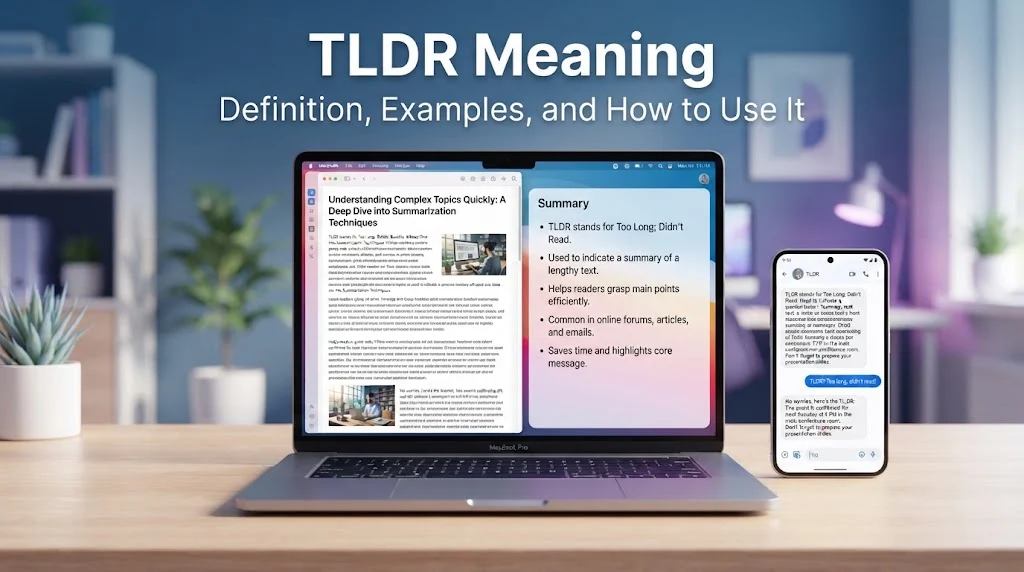
TLDR stands for “Too Long; Didn’t Read.” It is an internet abbreviation used when someone wants to summarize a long piece of writing or indicate that they have not read the entire text.
For example, someone might share a detailed explanation in a group chat and then write “TLDR: The meeting starts at 10 AM.” The short sentence gives readers the most important information without requiring them to read the entire message.
TLDR is common in digital communication because it provides a quick way to communicate the main point. Although it originally carries the idea that something is too long to read, it can be used neutrally, helpfully, or sarcastically depending on the situation.
| Detail | Explanation |
|---|---|
| Full form | Too Long; Didn’t Read |
| Main meaning | A short summary or a comment about lengthy content |
| Tone | Informal, neutral, humorous, or occasionally critical |
| Common platforms | Reddit, TikTok, Instagram, Discord, and text messages |
| Formal or informal | Primarily informal |
| Common purpose | Summarizing information quickly |
Unlike abbreviations such as LOL, which expresses laughter, TLDR usually relates to the length of a message, article, discussion, or explanation.
What Is the Main Meaning of TLDR?
The main meaning of TLDR depends on how someone uses it. It has two closely related uses: introducing a summary and commenting on content that is too long to read.
TLDR as a Summary
Writers often place TLDR before a short version of a longer explanation. This usage helps readers understand the key information quickly.
For example:
“TLDR: We should postpone the trip because the weather forecast looks bad.”
The sentence summarizes a longer discussion about travel plans, weather conditions, and possible alternatives. Readers can understand the decision without reading every detail.
In this context, TLDR is useful rather than dismissive. The writer is helping the audience find the main point.
TLDR as “Too Long; Didn’t Read”
TLDR can also describe a message that someone considers too lengthy to read in full. In this sense, it may suggest that the person skipped the details.
For example:
Person A: “I wrote five paragraphs explaining what happened yesterday.”
Person B: “TLDR?”
Here, Person B is asking for a shorter explanation. Depending on their relationship and tone, the request may sound practical, playful, or slightly impatient.
The abbreviation itself does not automatically make the message rude. The surrounding words and the relationship between the people determine how it comes across.
What Does TLDR Mean in Text Messages?
In text messages, TLDR usually means “Too Long; Didn’t Read.” Friends, classmates, coworkers, and group chat members may use it to shorten lengthy explanations or ask someone to get to the point.
For example:
“TLDR: I’ll be there around 6, so don’t wait for me.”
This message communicates the essential information quickly. The sender may have discussed other details earlier, but the TLDR gives the recipient the main takeaway.
When someone sends you “TLDR?” after a long message, they are usually asking for a summary. A simple response with the main point is often enough.
However, if someone replies only “TLDR” to a detailed message you wrote, they might be saying they did not read it because it was too long. Whether that feels dismissive depends on the conversation.
TLDR Meaning on Different Platforms
The basic meaning of TLDR stays the same across most online platforms, but its purpose may vary slightly depending on the type of content.
TLDR on Reddit
On Reddit, TLDR often appears before or after a short summary of a lengthy post, explanation, or discussion. It helps readers understand the main argument without going through the entire text.
Example:
“TLDR: The update fixed the main issue but introduced two smaller bugs.”
The abbreviation provides a convenient summary for people browsing a discussion with many comments.
TLDR on TikTok and Instagram
On TikTok and Instagram, TLDR may appear in captions, comments, video descriptions, or discussions where someone wants to summarize a longer explanation.
Example:
“TLDR: Don’t buy the product until you compare the prices.”
Here, the writer highlights the main recommendation. The abbreviation does not have a special meaning exclusive to either platform.
TLDR on Discord
On Discord, users may add TLDR to lengthy gaming discussions, server announcements, or group conversations.
Example:
“TLDR: The tournament has moved to Saturday at 4 PM.”
This format helps members quickly find important updates without reading a long announcement.
TLDR on WhatsApp and Other Messaging Apps
In WhatsApp messages, SMS, and other chat applications, TLDR can introduce a brief summary or ask someone to shorten a long explanation.
Example:
“TLDR: Bring your ID and arrive 15 minutes early.”
The abbreviation is informal and works best when the people involved understand common internet expressions.
Real Conversation Examples of TLDR
These examples show how people use TLDR in everyday online communication.
Example 1: Friends in a group chat
Person A: “I sent everyone a long message explaining the weekend plans.”
B: “TLDR?”
Person A: “We’re meeting at the mall at noon.”
Meaning: Person B wants a shorter version of the plans rather than reading the full explanation.
Example 2: Sharing an online review
Person A: “I wrote a detailed review of the new headphones. TLDR: Great sound, weak battery.”
Person B: “That helps. Battery life is important to me.”
Meaning: Person A summarizes a longer review by highlighting its two most important points.
Example 3: Workplace group chat
A: “The project update covers the deadline, budget, and revised schedule.”
B: “Can you add a TLDR at the top for the team?”
A: “Sure. TLDR: The deadline is Friday, and the budget remains unchanged.”
Meaning: Person B wants a concise summary that helps team members understand the main information quickly.
Is TLDR Rude?
TLDR is not always rude, but it can sound dismissive when someone uses it to criticize another person’s writing or effort.
When a writer adds a TLDR summary to their own message, the abbreviation is generally helpful. It shows that they understand readers may prefer a quick overview before reading the details.
On the other hand, replying “TLDR” to someone’s personal story or carefully written explanation may imply that you are unwilling to read what they shared. The person might interpret it as impatience or a lack of interest.
To keep the tone polite, try wording such as:
- “Could you give me the short version?”
- “Can you summarize the main point?”
- “What’s the key takeaway?”
These alternatives communicate the same request more clearly, especially when the conversation is serious or the other person has put considerable effort into their message.
Is TLDR Formal or Informal?
TLDR is primarily an informal internet abbreviation. It is appropriate in casual messages, online discussions, social media posts, and friendly group chats.
It can also appear in professional digital communication when the workplace culture is relaxed. For example, a team member might add a TLDR summary at the beginning of a lengthy internal update.
However, spelling out “Summary” or using “Executive Summary” may be better for formal reports, client communications, academic writing, and official announcements. The goal is to make information easy to understand without assuming every reader knows internet abbreviations.
How to Reply to TLDR
Your response should match what the other person means by TLDR. If they are asking for a summary, give them the main point. If they are commenting that your message was too long, you can shorten it or clarify what matters most.
Polite Replies
- “Sure! The main point is that we’re meeting tomorrow.”
- “Here’s the short version.”
- “In brief, the deadline has been extended.”
- “The key takeaway is that we need to finish by Friday.”
Casual Replies
- “Short version: Everything is sorted.”
- “Basically, we’re good to go.”
- “Long story short, the plan has changed.”
- “TLDR: It all worked out!”
Replies When You Are Confused
- “Do you mean you want a summary?”
- “Which part would you like me to shorten?”
- “Are you asking for the main point?”
These replies help you respond naturally without assuming that the other person is being rude.
When Should You Use TLDR?
TLDR is useful when you want to make lengthy information easier to understand or help readers find the main point quickly.
You can use it in:
- Long text messages and group chats.
- Social media captions and comments.
- Online reviews and discussion posts.
- Discord announcements and community updates.
- Internal workplace messages where informal language is acceptable.
- Articles or guides that benefit from a short summary.
A good TLDR summary should focus on the most important information rather than repeat every detail. One or two clear sentences are often enough for a straightforward message.
When Should You Avoid Using TLDR?
Avoid using TLDR in situations where it might sound dismissive or where the audience expects formal language.
For example, responding with “TLDR” to a sensitive personal message may make the sender feel ignored. Similarly, using unexplained internet abbreviations in a job application, academic paper, or formal business report may confuse readers.
If someone has shared important instructions, legal information, or safety-related details, do not rely on a brief summary alone. Read the full message when the details matter.
TLDR is most effective when it saves time without removing information the reader genuinely needs.
Common Mistakes About TLDR
| Common Mistake | Correct Understanding |
|---|---|
| Thinking TLDR only means someone refused to read | It can also introduce a helpful summary written by the author. |
| Assuming TLDR is always rude | Its tone depends on context, wording, and the relationship between speakers. |
| Treating TLDR as a formal business term in every situation | It is mainly informal, although it can be useful in relaxed workplace communication. |
Another common mistake is using TLDR before a summary that is almost as long as the original message. A useful summary should make the main point easier to find.
Similar Internet Abbreviations
TLDR is related to several other internet expressions, but each has a different purpose.
| Term | Meaning | Main Difference |
|---|---|---|
| TL;DR | Too Long; Didn’t Read | A common punctuation variation of TLDR |
| IMO | In My Opinion | Introduces a personal opinion |
| FWIW | For What It’s Worth | Adds a thought or perspective |
| ELI5 | Explain Like I’m Five | Requests a simple explanation |
| BTW | By the Way | Introduces additional information |
These abbreviations can appear together in online conversations, but they are not interchangeable. For example, ELI5 asks someone to explain a subject simply, while TLDR focuses on shortening or summarizing information.
Origin and Popularity of TLDR
TLDR developed as part of internet shorthand used in online discussions and digital communication. Its wording reflects a common problem: lengthy posts can be difficult to read when people want information quickly.
The related form TL;DR uses a semicolon between the letters and has the same meaning. Both forms are widely recognizable in online writing.
Today, TLDR is used in a variety of settings, including social media, discussion forums, messaging apps, and written summaries. Its continued usefulness comes from its straightforward purpose: helping readers identify the main point without having to process every detail first.
Quick Recap
- TLDR meaning: Too Long; Didn’t Read.
- Main purpose: Introducing a short summary or commenting on lengthy content.
- In text messages: It often means someone wants the main point quickly.
- Tone: It can be helpful, neutral, humorous, or dismissive.
- How to reply: Provide a concise summary or politely clarify what the person wants.
Frequently Asked Questions
What does TLDR mean in text?
TLDR means “Too Long; Didn’t Read” and commonly introduces a brief summary or requests a shorter explanation in text messages.
What does TLDR stand for?
TLDR stands for “Too Long; Didn’t Read,” an internet abbreviation used when discussing lengthy messages, articles, or online posts.
What does TLDR mean on TikTok?
On TikTok, TLDR usually introduces a concise summary of a longer explanation in a caption, comment, or discussion.
Is TLDR rude?
TLDR is not inherently rude, but using it to dismiss someone’s lengthy message can sound impatient or disrespectful.
How should you reply to TLDR?
Provide a short summary of the main point if requested, or ask politely which information the person wants summarized.
Final Thoughts
The TLDR meaning is “Too Long; Didn’t Read,” an internet abbreviation that helps people communicate the main point of lengthy content quickly. You will commonly see it in text messages, social media discussions, online articles, and group chats. It can introduce a useful summary or indicate that someone has not read a message in full. Although TLDR is generally informal, it can make everyday communication more efficient when used thoughtfully. Pay attention to your audience and the conversation’s tone, and keep your summaries clear, concise, and helpful.
Discover More Articles:-
- Isle or Aisle: Meaning, Difference & Examples for 2026
- Semaglutide or Tirzepatide: Key Differences, Benefits & Risks …
- An or A: Correct Usage of Article In 2026 – LingRoya

Margaret Atwood is an American writer who contributes to LingRoya.com creating clear and engaging content about the English language and everyday communication. She enjoys helping readers build confidence in their writing through simple, practical guidance.