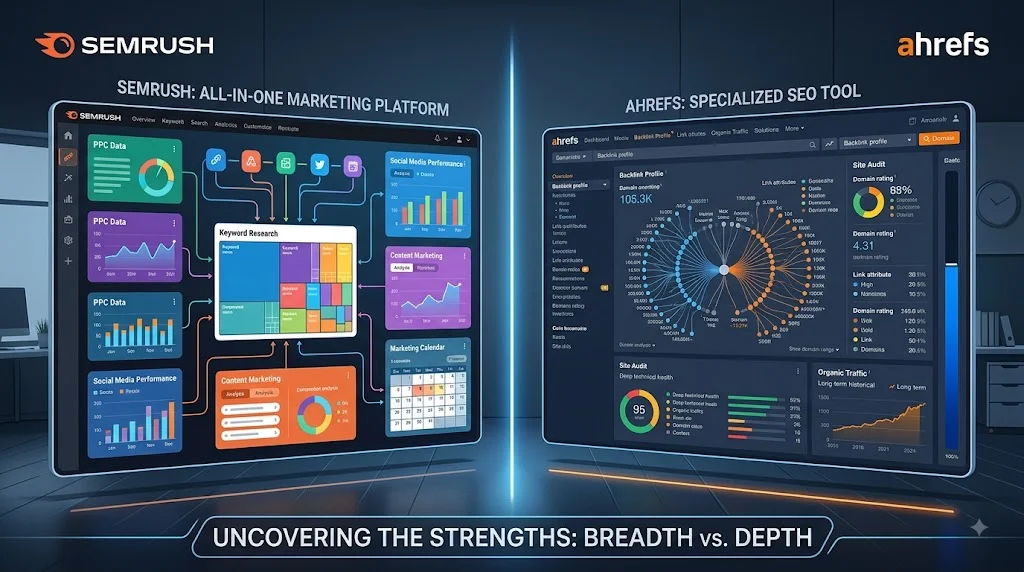
Ahrefs is generally better for backlinks and competitor analysis, while Semrush offers a broader all-in-one SEO and digital marketing toolkit. For most users, Semrush is the better overall choice, but Ahrefs is excellent for link-focused SEO.
SEMrush and Ahrefs are two of the most popular SEO tools used by marketers, businesses, and website owners. Both platforms offer powerful features for keyword research, competitor analysis, backlink tracking, and improving search engine rankings.
However, SEMrush and Ahrefs have different strengths and approaches. SEMrush is known as a broader digital marketing platform, while Ahrefs is particularly strong in backlink analysis and SEO research. Comparing their features can help you choose the tool that best fits your needs.
Semrush vs Ahrefs: What’s the Difference?
Semrush (noun) is a comprehensive digital marketing platform that provides SEO, pay per click advertising research, social media management, content marketing tools, competitive intelligence, and local SEO capabilities all within a single subscription. Think of it as a Swiss Army knife for digital marketers.
Ahrefs (noun) is a specialized SEO toolset built around one of the world’s largest and most frequently updated backlink databases, offering deep keyword research, site audit functionality, rank tracking, and competitive analysis with a focus on organic search performance. Think of it as a surgical scalpel for SEO professionals.
| Feature | Semrush | Ahrefs |
| Primary Focus | All in one digital marketing suite | SEO specialization |
| Backlink Index | 43 trillion backlinks | 35 trillion backlinks |
| Keyword Database | 25 billion keywords | 20 billion keywords |
| Starting Price | $139.95/month (Pro) | $129/month (Lite) |
| Free Version | 10 searches/day | Ahrefs Webmaster Tools |
| PPC/Ad Research | Full ad research suite | None |
| Content Marketing Tools | Topic research + SEO writing | Basic |
| Social Media Tools | Included | Social Media Manager |
| Best For | Agencies, content marketers, PPC managers | Link builders, technical SEOs |
.
Is Semrush vs Ahrefs a Grammar, Vocabulary, or Usage Issue?
This comparison is purely a usage and strategic decision issue, not a grammatical one. Both platform names function as proper nouns, and neither is interchangeable with the other in any meaningful sense. The choice between Semrush and Ahrefs reflects workflow preferences, team structure, and marketing objectives rather than linguistic correctness.
In formal business contexts, professionals typically reference the specific tool they use without implying that one substitutes for the other. Academic discussions of SEO methodology often treat both platforms as valid research instruments, with recent scholarly work comparing their web metrics across major academic publishers. Casual conversations among SEO practitioners frequently feature spirited debates about which tool provides more accurate data, but these discussions acknowledge that both platforms have legitimate places in the industry.
The real question is not whether you should use one or the other grammatically, but rather which tool aligns with your operational reality. If your team manages paid advertising alongside organic search, Semrush’s integrated approach saves considerable context switching. If your primary work involves link acquisition and technical audits, Ahrefs’ specialized toolset delivers superior efficiency.
Practical Usage: Semrush
Semrush shines when your marketing operation spans multiple channels. Its dashboard consolidates SEO, content marketing, social media scheduling, and paid advertising research into a single interface.
Workplace Example: A marketing agency managing 30+ client accounts uses Semrush Business tier to generate white label reports, track local SEO performance across multiple locations, and monitor both organic and paid search campaigns from one platform. The agency saves hours each week by not exporting data between separate tools for SEO and PPC reporting.
Academic Example: A university’s digital marketing course uses Semrush to teach students how to conduct competitive analysis across SEO, content, and social channels simultaneously. Students learn to identify keyword gaps, analyze competitor ad strategies, and develop integrated marketing plans using a single dataset.
Technology Example: A SaaS company’s growth team uses Semrush’s Topic Research and SEO Content Template tools to build content briefs for blog posts targeting specific search intents. The platform’s automatic intent categorization (informational, navigational, commercial, transactional) speeds up content planning for teams writing at volume.
Usage Recap: Semrush delivers maximum value when you need one tool for SEO, PPC, content, and social. Its breadth reduces tool sprawl and creates a unified view of your digital marketing performance.
Practical Usage: Ahrefs
Ahrefs excels when your work revolves around backlink analysis, technical SEO, and precise keyword research. Its Site Explorer remains the industry reference for understanding link profiles and organic traffic potential.
Workplace Example: A freelance SEO consultant uses Ahrefs Lite to audit client websites, identify broken backlinks, and uncover link building opportunities through the Link Intersect tool, which shows which domains link to competitors but not to the client. The consultant delivers actionable link acquisition strategies based on Ahrefs’ frequently updated index.
Academic Example: A researcher studying search engine ranking factors uses Ahrefs’ massive backlink dataset to analyze link patterns across thousands of domains, leveraging the platform’s API to programmatically extract structured data for peer reviewed publications.
Technology Example: An ecommerce company’s in house SEO team uses Ahrefs’ Keywords Explorer to filter keywords by the “clicks” metric, estimating how many searches actually result in a click and filtering out zero click queries before investing in content production. This approach improves ROI on content investments.
Usage Recap: Ahrefs delivers maximum value when your primary focus is link building, technical audits, and getting the most accurate organic traffic estimates available. Its depth in these areas is unmatched.
When You Should NOT Use Semrush or Ahrefs
Avoid Semrush:
- You only need backlink analysis and technical SEO audits without the additional marketing modules
- Your budget is extremely tight and you cannot justify the higher tier pricing for essential features
- You prefer a simpler, more focused interface without the complexity of multiple marketing modules
- Your team consists of SEO specialists who would rarely use the PPC, social, or content marketing tools
- You need the most frequently updated backlink index available, which Ahrefs provides
- You want a genuinely useful free tier (Ahrefs Webmaster Tools) to monitor your own sites indefinitely
- You find the per project and per keyword limits on Semrush’s lower plans too restrictive
- Your workflow demands the fastest possible site audit crawls and cleanest user interface
When to avoid Ahrefs:
- You manage paid advertising campaigns alongside SEO and want integrated reporting
- Your team includes content marketers who need built in topic research and SEO writing tools
- You require social media management and scheduling capabilities within your SEO platform
- You run local SEO campaigns across multiple business locations
- You want the largest keyword database for content planning at scale
- Your agency needs white label client reporting with custom branding
- You prefer automatic keyword intent categorization to speed up content brief creation
- You want a single platform that covers the full digital marketing spectrum from research to execution
Common Mistakes and Decision Rules
| Correct Sentence | Incorrect Sentence | Explanation |
| “We use Semrush for keyword research and competitor analysis.” | “We use Semrush for backlink analysis because it has the largest index.” | Semrush’s backlink index is large but Ahrefs is traditionally stronger for link analysis |
| “Ahrefs is the better choice for technical SEO audits.” | “Ahrefs includes full PPC research capabilities.” | Ahrefs lacks PPC/ad research tools entirely |
| “Our agency chose Semrush because we manage SEO and paid ads.” | “Our agency chose Semrush because we only do link building.” | Semrush is overkill if you only need link analysis |
| “I use Ahrefs’ Keywords Explorer to filter by clicks.” | “I use Semrush’s Keywords Explorer to filter by clicks.” | The clicks metric is distinctive to Ahrefs |
Decision Rule Box:
If you mean the action of running a full service digital marketing operation covering SEO, PPC, content, and social, use Semrush.
If you mean the person or team focused specifically on organic search, link building, and technical SEO, use Ahrefs.
Semrush and Ahrefs in Modern Technology and AI Tools
Both platforms have aggressively integrated artificial intelligence into their offerings throughout 2025 and 2026. Semrush now operates as a “unified intelligence platform” powered by what it claims is the world’s largest proprietary database, including 27 billion keywords, 43 trillion backlinks, and over 213 million large language model prompts. The company has launched Semrush Copilot as an AI assistant and expanded its AI Visibility Index to analyze 126 million AI search prompts.
Ahrefs has responded with its own AI features, including an AI Content Helper for creating intent optimized content, AI powered translations for SEO metrics across languages, and Brand Radar with AI assisted reporting. The platform now offers custom prompt tracking to monitor how brands are mentioned across AI platforms like Claude.
For SEO professionals in 2026, the AI capabilities of both tools are becoming increasingly important. Semrush leans into AI for content creation and competitive intelligence across multiple channels, while Ahrefs focuses AI on backlink analysis, keyword research accuracy, and brand monitoring in AI search results.
The Origins and Authority of Both Platforms
Ahrefs launched in 2011 and built its reputation almost entirely on one thing: backlink data. Its Site Explorer became the industry reference point for analyzing who links to a website, and that backlink index remains one of the most frequently updated and comprehensive in the industry. Everything else Ahrefs built, keyword research, rank tracking, content tools, grew outward from that backlink analysis core.
Semrush launched in 2008 as a competitive research tool and expanded much more broadly. Today it functions less like a single SEO tool and more like a marketing suite bundling SEO, PPC research, social media tools, content marketing tools, local SEO and listing management, and a fairly capable site audit crawler all into one subscription.
Expert Insight: “Tools optimized for breadth often pay a usability tax in any single workflow; tools optimized for depth pay a feature coverage tax outside their sweet spot. The honest answer is to pick the tool whose primary strength matches your dominant use case, not the tool that scores marginally higher across the union of features you might someday use.”
Case Study 1: Agency Workflow Transformation
A digital marketing agency managing 45 client accounts switched from using separate tools for SEO, PPC, and social reporting to Semrush Business. The agency reduced reporting time by 62% and eliminated three separate software subscriptions. Within six months, the agency increased client retention by 18% partly due to faster, more consistent reporting and the ability to identify cross channel opportunities that competitors missed.
Case Study 2: Enterprise Link Building Success
An enterprise ecommerce company struggling with organic growth implemented Ahrefs Enterprise specifically for its backlink analysis capabilities. Using Ahrefs’ Link Intersect tool, the SEO team identified 847 referring domains that linked to competitors but not to their site. Over 12 months, the team acquired links from 312 of those domains, resulting in a 41% increase in organic traffic and a 27% revenue lift from search channels.
Error Prevention Checklist
Always use Semrush when:
- You manage SEO and paid advertising campaigns simultaneously
- Your team includes content marketers who need integrated writing tools
- You require social media scheduling within your marketing stack
- You run local SEO campaigns across multiple locations
- You need white label client reporting with custom branding
- You prefer automatic keyword intent categorization for content planning
- Your agency or team handles diverse digital marketing channels
Never use Ahrefs when:
- You need PPC or paid advertising research tools
- Your workflow requires social media management capabilities
- You want the largest keyword database for volume content planning
- You require built in content marketing and SEO writing tools
- Your team manages local SEO across multiple business locations
- You need white label reporting for agency clients
Related Grammar Confusions You Should Master
- Moz vs Semrush vs Ahrefs: three way comparison of major SEO platforms
- Keyword research tools: understanding the differences between Semrush, Ahrefs, and Google Keyword Planner
- Backlink analysis tools: comparing Majestic, Ahrefs, and Semrush
- Site audit tools: Screaming Frog vs Semrush vs Ahrefs
- Rank tracking software: AccuRanker vs Semrush vs Ahrefs
- Content optimization tools: SurferSEO vs Semrush vs Ahrefs
- Competitive analysis platforms: Similarweb vs Semrush vs Ahrefs
- SEO reporting tools: Data Studio vs Semrush vs Ahrefs
- Local SEO software: BrightLocal vs Semrush vs Ahrefs
- Enterprise SEO platforms: Conductor vs Semrush vs Ahrefs
FAQs
1. Which is better for keyword research, Semrush or Ahrefs?
Semrush is better for large-scale keyword research, while Ahrefs is strong for keyword difficulty and traffic potential.
2. Is Semrush or Ahrefs better for backlink analysis?
Ahrefs is generally preferred for backlink analysis and link-building research.
3. Which tool is cheaper, Semrush or Ahrefs?
Pricing varies by plan, but Ahrefs generally offers a lower-cost entry option.
4. Can I use Semrush and Ahrefs together?
Yes, many SEO professionals use both tools to combine their different strengths.
5. Which is better for technical SEO audits?
Both offer strong site-audit tools, but Ahrefs is often praised for its simple and intuitive interface.
6. Is there a free version of Semrush or Ahrefs?
Yes, both offer limited free access and webmaster tools with different features.
7. Which tool is better for agencies?
Semrush is generally better suited to agencies managing multiple clients and broader digital marketing campaigns
Conclusion
In conclusion, both SEMrush and Ahrefs are powerful SEO tools with valuable features for keyword research, competitor analysis, backlink tracking, and website optimization. The better choice depends on your specific SEO goals and requirements.
SEMrush is a strong all-in-one option for SEO and digital marketing, while Ahrefs is especially useful for backlink and content analysis. If you want broader marketing features, choose SEMrush; if your focus is link-building and SEO research, Ahrefs can be the better choice.

Philip Pullman is an American writer dedicated to creating clear and easy to follow English content. Through his work at LingRoya.com, he helps readers strengthen their language skills with practical and reliable guidance so that they can easily understand.