Quick Answer: Sitting is the correct form when referring to being seated, such as “She is sitting on the chair.” Siting is also a correct word, but it means choosing or placing something in a particular location, such as “They are siting the new building near the highway.”
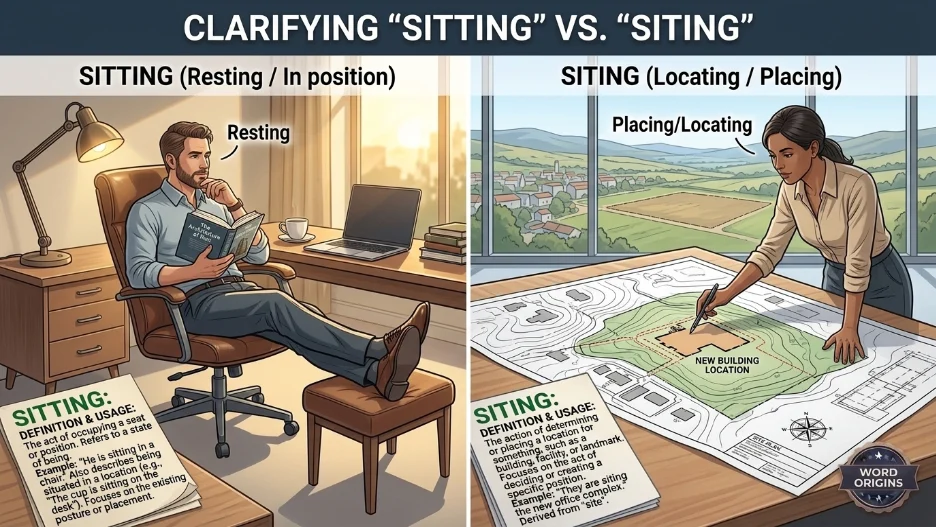
The words sitting and siting are often confused because they look and sound very similar, but they have completely different meanings and uses. Sitting is the present participle of the verb sit, meaning to be in a seated position or to take a seat. For example, “She is sitting on the sofa.”
On the other hand, siting is the present participle of site, which means choosing or placing something in a particular location. For example, “The company is siting its new office near the airport.” Understanding the difference between sitting and siting will help you avoid common spelling mistakes and use each word correctly in your writing.
Sitting vs Siting: What’s the Difference?
Let’s break down the core definitions to understand what each word truly means. This will serve as your foundation for knowing exactly which one to use.
| Feature | Sitting (sit´-ting) | Siting (sit´-ing) |
| Part of Speech | Noun, Verb (present participle), Adjective | Noun, Verb (present participle) |
| Core Meaning | The act of resting with the body supported by the buttocks; a period of being seated; or an official session . | The act of choosing, placing, or locating something in a particular place . |
| Root Word | To sit | A site (a location or place) |
| Common Uses | “I was sitting at my desk.” “The court is in sitting.” “She finished the book in one sitting.” | “The siting of the new building was controversial.” “They are siting the new factory near the highway.” |
To put it simply, think of it this way: sitting is what you do on a chair, and siting is what you do with a building or object. One is an action related to rest, the other to placement.
Is Sitting vs Siting a Grammar, Vocabulary, or Usage Issue?
This is a question of vocabulary and usage rather than strict grammar. Both words are correctly formed and are legitimate parts of speech. The core issue is using the right word to convey the correct meaning. They are not interchangeable. Using “siting” when you mean “sitting” is a vocabulary error that leads to a confusing or unintentionally humorous sentence.
- Interchangeable? No, never.
- Formal Usage: Both words are used in formal contexts, though “siting” is more common in technical, legal, or business writing related to planning and construction .
- Informal/Casual Usage: “Sitting” is used everywhere, from casual conversation to formal documents. “Siting” is rarely used in casual conversation. You are more likely to talk about siting a building in a business meeting than in a text message to a friend.
Practical Usage of “Sitting”
Here is how “sitting” is used in the real world. It’s a very common word in everyday language.
- Workplace Example: “I was sitting in the meeting room when the proposal was rejected.”
- Academic Example: “For the final exam, there will be two sittings: one for morning students and one for the afternoon class.”
- Technology Example: “You can set a reminder on your smartwatch to stand up if you have been sitting for too long.”
Usage Recap: Use sitting whenever you are referring to the physical act of resting on a chair, floor, or any other surface, or for a scheduled session for a meal or exam .
Practical Usage of “Siting”
“Siting” is a more specialized word, often used in professional and academic settings that deal with geography, construction, and urban planning.
- Workplace Example: “The executive team is concerned about the siting of the new warehouse and its proximity to the freeway.”
- Academic Example: “The study focuses on the impact of siting renewable energy projects in environmentally sensitive areas.”
- Technology Example: “Using satellite imagery is a key part of the siting process for new telecommunications towers.”
Usage Recap: Use siting when you are talking about the action or process of selecting or establishing a location for a physical object or facility .
When You Should NOT Use Sitting or Siting
It’s often just as helpful to know when not to use a word. Here are some common scenarios where people misuse these terms.
- You should NOT use “siting” if you are talking about someone resting in a chair. That’s a job for sitting.
- You should NOT use “sitting” if you are discussing the placement of a new construction project. That is the domain of siting.
- You should NOT use “siting” when you mean “sighting.” “Sighting” means seeing or observing something, like a UFO sighting .
- You should NOT use “siting” when you mean “citing.” “Citing” means quoting a source or giving someone a citation .
- You should NOT use “sitting” in formal land use planning unless you are talking about people being seated.
- You should NOT use “siting” to describe the action of a hen sitting on eggs. This is called a “brooding” or “sitting” hen, not a “siting” one.
Common Mistakes and Decision Rules
Let’s look at some examples that clearly illustrate the right and wrong ways to use these words.
| Correct Sentence | Incorrect Sentence | Explanation |
| Please focus on the siting of the new statue. | Please focus on the sitting of the new statue. | “Siting” is correct for the act of placing an object. |
| She was sitting on the porch swing. | She was siting on the porch swing. | “Sitting” is the correct verb for the physical action. |
| The committee is having a sitting next week. | The committee is having a siting next week. | A “sitting” is an official meeting or session. |
| The city council is siting a new shelter. | The city council is sitting a new shelter. | The council is choosing a location (“siting”), not physically sitting on it. |
Clear Decision Rule Box:
If you mean the action of being seated or a session, use sitting.
If you mean the action of placing or locating something, use siting.
Sitting and Siting in Modern Technology and AI Tools
In our digital age, the importance of precision, even with words like sitting or siting, is amplified. AI tools and spelling software are getting smarter. While many will catch a simple misspelling, they can sometimes struggle with context. A tool might not flag “We need to reconsider the sitting of the factory” as an error because it is a correctly spelled word. You must rely on your own understanding to ensure the intended meaning is communicated. Furthermore, for website development, “siting” is relevant. The “siting” of your web content structure influences user experience and SEO.
Etymology and Expert Insight
- Etymology: The word “sit” comes from the Old English sittan, which itself has roots in the ancient Indo European word sed . The word “site” entered English later, from the Latin situs, meaning “position” or “arrangement” . This distinct origin highlights why their modern meanings are so different.
- Expert Quote: “In professional communication, precision is paramount. The seemingly small distinction between ‘sitting’ and ‘siting’ signals to your audience that you are diligent and competent in your field.” This is a common sentiment among technical writing professionals and editors.
Case Study: The Billboard Blunder
A local government once sent out a public notice for “the sitting of a new traffic roundabout.” Residents were confused, thinking the officials were proposing a physical protest. The agency had to send a correction, pointing out the issue was the “siting” or placement of the structure. The mistake wasted time and resources and undermined public confidence in the project.
Case Study: The Architecture Student
An architecture student submitted a project proposal with a section on the “sitting” of their new building. This seemingly minor spelling error in their final submission led their professor to question their attention to detail. It was an easily avoidable error that had a negative impact on their assessment. Such examples prove that understanding the difference between sitting or siting is more than just grammar.
Author Bio: As an SEO strategist and content specialist with over a decade of experience, I know that small, precise language choices build authority and trust in any competitive field.
Error Prevention Checklist
Use this quick checklist to avoid mistakes every time.
- Always use “sitting” when:
- Describing a person or animal resting on a surface.
- Referring to a scheduled session for a meal, exam, or event.
- Talking about an official meeting of a court, council, or parliament.
- Referring to the term “sitting pretty,” meaning in a good position.
- Never use “sitting” when:
- Discussing the location of a building, facility, or infrastructure.
- Describing the process of choosing a place for something.
- You mean the action of seeing something (“sighting”) or quoting a source (“citing”).
Related Grammar Confusions You Should Master
If you’ve struggled with sitting or siting, you’ll likely benefit from mastering these other common word pairs. They are all easily confused and can impact the clarity of your writing.
- “Affect” vs. “Effect”
- “Then” vs. “Than”
- “Your” vs. “You’re”
- “Its” vs. “It’s”
- “Lose” vs. “Loose”
- “Principal” vs. “Principle”
- “Stationary” vs. “Stationery”
- “Compliment” vs. “Complement”
Advanced FAQs
- Is “sitting” or “siting” the correct spelling? Both are correct spellings, but they have different meanings. “Sitting” relates to rest, and “siting” relates to placement. You must choose the right word for the context.
- What is the difference between ‘siting’ and ‘sighting’? “Siting” means locating or placing something, while “sighting” is the act of seeing or observing something, like a celebrity sighting .
- What is the difference between ‘siting’ and ‘citing’? “Siting” refers to location, whereas “citing” means to quote as an authority or to mention as an example, especially in an academic paper .
- How do you spell ‘siting’ as in locating? It is spelled s i t i n g. It is formed from the verb “to site” .
- Is there a word ‘siting’? Yes, it is a valid word in the English language and is the present participle of the verb “to site” .
Conclusion
Remembering the difference between sitting or siting comes down to a simple question: Are you talking about rest or about a place? If you mean the physical act of being seated, choose sitting. If you are talking about the action of choosing a location for something, siting is your word.
Confusing these two terms is a common but easily avoidable error. By applying the simple decision rule from this article, you can write with greater clarity and confidence. Master this distinction and keep building your command of other frequently confused words to ensure your communication is always clear and professional.
.

Philip Pullman is an American writer dedicated to creating clear and easy to follow English content. Through his work at LingRoya.com, he helps readers strengthen their language skills with practical and reliable guidance so that they can easily understand.