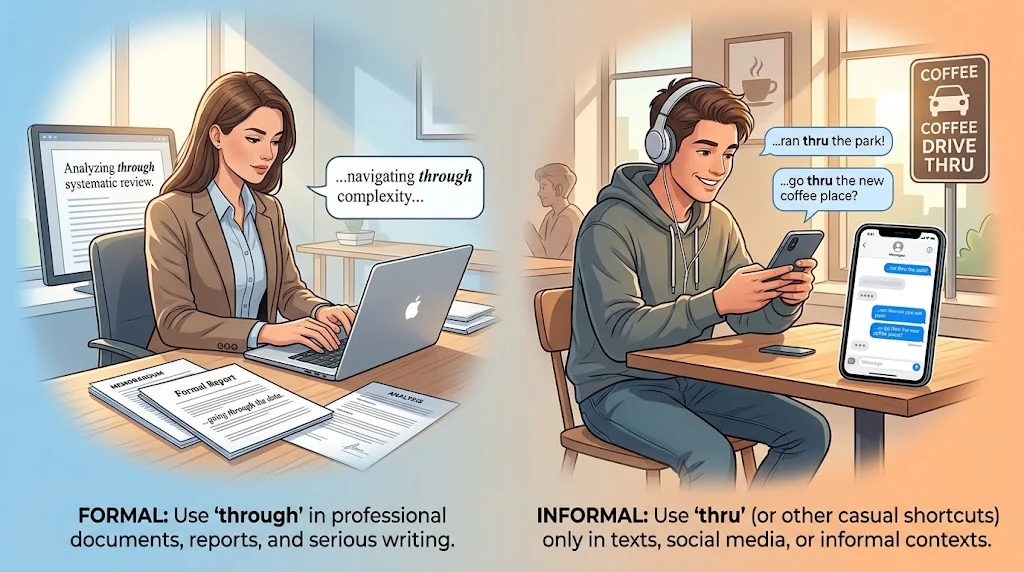
Quick Answer: Through is the standard, formally accepted spelling used in all professional, academic, and published writing. Thru is an informal variant that should be reserved for casual communication like text messages and the compound word “drive thru.
“Thru” and “through” have the same basic meaning, but they are used differently in English. “Through” is the standard and more formal spelling, while “thru” is an informal or shortened form often seen in signs, advertising, and casual writing.
Understanding when to use “thru” and “through” can help you choose the right spelling for different situations. In this guide, we’ll explain their meanings, differences, and common examples.
Through vs Thru: What Is the Real Difference?
Let us get straight to the heart of the matter. Through and thru are not two different words with different meanings. They are actually the same word, just spelled differently. Through is the original, standard, and formally accepted spelling. Thru is a shortened, informal variant that emerged as a simplified spelling reform.
Here is a quick comparison to make it crystal clear:
| Feature | Through | Thru |
| Part of speech | Preposition, adverb, adjective | Preposition, adverb (informal) |
| Meaning | From one side to the other; from beginning to end; by means of | Same as through |
| Formality | Formal, standard, accepted everywhere | Informal, casual, limited contexts |
| Where to use | Academic writing, business reports, journalism, books | Text messages, social media, drive thru signs |
| Pronunciation | /θruː/ | /θruː/ (identical) |
The table above shows that the only real difference is formality and context. Through is the spelling you will find in dictionaries, style guides, and every formal publication. Thru is an alternative spelling that has gained some acceptance but remains firmly in the informal category.
Here is the bottom line: through is always correct. Thru is only correct in very specific, casual situations. If you ever feel unsure, choose through. You will never be wrong.
Is This a Grammar, Vocabulary, or Usage Issue?
This is primarily a usage issue rather than a grammar or vocabulary problem. The words themselves are not grammatically different. They function the same way in sentences, take the same parts of speech, and convey the exact same meaning. The distinction is entirely about when and where you should use each spelling.
Grammar rules generally stay consistent across contexts. You do not change your verb conjugations or sentence structure based on whether you are writing an email or a text message. But usage rules, the conventions that govern how we apply language in different situations, are much more flexible. The through versus thru debate falls squarely into this category.
Formal writing demands through. Academic papers, business proposals, news articles, and published books all require the standard spelling. Informal writing allows thru. Text messages, quick notes to friends, and casual social media posts can get away with the shorter version. Some style guides have even given limited approval to thru in specific compound words. The Associated Press Stylebook, for example, allows “drive thru” instead of “drive through”. But that approval is narrow and does not extend to other uses.
So remember this distinction: it is not about meaning or grammar. It is about matching your spelling to your audience and context. Use through for professional credibility. Use thru only when informality is genuinely appropriate.
How to Use Through Correctly in Every Situation
Through is a remarkably versatile word. It can function as a preposition, an adverb, or an adjective, and it carries several related meanings. Let us explore how to use it properly across different contexts.
In the Workplace
Professional writing demands through every time. Consider these examples:
We reviewed the proposal through several rounds of editing before submission.
Correct: The new policy will remain in effect through the end of the fiscal year.
She secured the promotion through hard work and dedication.
Using thru in a workplace context would immediately undermine your professionalism. It signals carelessness or a lack of attention to detail. Even if your meaning is clear, the spelling choice speaks volumes about your credibility.
In Academic Settings
Academia is perhaps the strictest environment when it comes to formal spelling. Every paper, thesis, and assignment should use through exclusively.
Correct: The researcher analyzed the data through a statistical software package.
Students must complete all required courses through their fourth year.
The theory was developed through extensive experimentation and peer review.
Professors and academic reviewers expect standard English. Thru has no place in scholarly work. It would be marked as an error in most grading contexts.
In Technology and Digital Communication
Even in technology writing, which often embraces informality, through remains the standard for professional documentation.
Users can navigate through the interface using keyboard shortcuts.
The data flows through multiple servers before reaching the user.
Developers worked through the night to resolve the critical bug.
Technical documentation, software manuals, and professional tech blogs all prefer through. The only exception might be internal team chats or casual Slack messages where informality is acceptable.
Usage Recap for Through: Use through in all formal writing, including business, academic, professional, and published content. It is the safe, correct choice every time. Think of through as your default setting.
How to Use Thru Correctly (and When to Avoid It)
Thru has a much narrower range of appropriate use. It is not incorrect in an absolute sense, but it is restricted to informal contexts. Understanding these boundaries will help you use it appropriately when the situation calls for it.
In Casual Communication
Text messages, instant messages, and casual emails to friends are the primary domain of thru.
Can you come thru later tonight?
I read thru the whole article in ten minutes.
Acceptable: We are driving thru the mountains this weekend.
Notice that these are all informal, personal communications. The spelling choice matches the relaxed tone.
In the Famous Compound Word
The one place where thru has gained widespread acceptance, even in somewhat formal contexts, is in the word “drive thru.” This compound noun refers to a service window where customers can receive goods without leaving their vehicles.
Acceptable: Let us grab coffee at the drive thru.
Acceptable: The bank installed a new drive thru teller window.
Even here, though, “drive through” remains equally correct and is preferred by some style guides. The AP Stylebook allows “drive thru,” but many dictionaries still list “drive through” as the primary entry.
On Signs and Advertisements
You will often see thru on traffic signs, billboards, and advertisements where space is limited and informality is acceptable.
Acceptable: Open 8 AM thru 10 PM daily.
Acceptable: Thru traffic keep left.
These contexts prioritize brevity over formality, making thru a practical choice.
Usage Recap for Thru: Reserve thru for text messages, social media, casual notes, and the specific compound “drive thru.” Never use it in formal writing, academic papers, or professional correspondence. When in doubt, choose through.
When You Should NOT Use Thru
Understanding when to avoid thru is just as important as knowing when to use it. Here are the most common situations where thru is inappropriate:
- Academic essays and research papers – Professors and graders expect standard spelling. Thru will cost you points.
- Cover letters and resumes – Job applications demand professionalism. Thru signals carelessness.
- Business reports and proposals – Clients and executives judge your attention to detail. Use through.
- News articles and journalism – Reputable publications use through except in rare cases like “drive thru.”
- Books and published works – Editors will correct thru to through in almost every instance.
- Legal documents and contracts – Precision and formality are paramount. Through is the only acceptable choice.
- Professional emails to clients or superiors – Even semi formal communication should avoid thru.
- Standardized tests and official forms – These environments require conventional spelling.
The pattern is clear. Any situation where you want to appear competent, educated, or professional calls for through. Thru is for friends, family, and fast food signs.
Common Mistakes and How to Avoid Them
Even experienced writers sometimes stumble with these words. Here are the most common errors and the simple rules to prevent them.
| Correct Sentence | Incorrect Sentence | Explanation |
| She walked through the park every morning. | She walked thru the park every morning. | Formal writing requires through. |
| The store is open Monday through Friday. | The store is open Monday thru Friday. | Business hours should use through in professional contexts. |
| He got the job through his network. | He got the job thru his network. | Professional writing demands standard spelling. |
| Let us go through the proposal together. | Let us go thru the proposal together. | Workplace communication needs through. |
| We sat through the entire three hour movie. | We sat thru the entire three hour movie. | Formal contexts require the standard form. |
| I will see this project through to completion. | I will see this project thru to completion. | Professional commitment deserves professional spelling. |
Decision Rule Box
Here is a simple rule to guide your choice every time:
If you are writing anything formal, professional, academic, or published, use through.
If you are texting a friend, posting casually on social media, or writing “drive thru,” use thru.
When in doubt, always choose through. It is never wrong.
Through and Thru in Modern Technology and AI Tools
The rise of digital communication has brought new attention to the through versus thru debate. AI writing assistants, grammar checkers, and autocorrect tools all have opinions on which spelling to use.
Most grammar checking software, including popular tools like Grammarly, will flag thru as informal or nonstandard in formal writing contexts. These tools typically suggest changing thru to through in professional or academic documents. This reflects the broader consensus that through is the preferred spelling.
AI writing assistants trained on formal corpora will almost always generate through rather than thru. The training data for these models consists largely of published, edited text where through is the standard. As a result, they reinforce the formal preference.
Interestingly, some AI tools are becoming more context aware. They might accept thru in casual prompts or when the user explicitly signals an informal tone. But the default remains through.
Voice assistants and speech to text systems also default to through when transcribing spoken language. Since the words sound identical, these systems typically choose the more common, standard spelling.
The practical takeaway is that technology supports the formal standard. If you want your writing to pass muster with AI tools, grammar checkers, and professional readers, through is the way to go.
The Fascinating History of Through and Thru
The story of these two spellings is far more interesting than you might expect. Through has not always looked the way it does today. In fact, scholars have identified over fifty different spellings of this word throughout history.
The word began in Old English as “thurh,” when the language was still largely phonetic. Over centuries, influences from Old Norse and French changed both pronunciation and spelling. New versions emerged, including “thorgh,” “thorth,” and various other forms. The spelling “thro” was common from the fifteenth through the eighteenth centuries.
The simplified spelling “thru” first appeared around 1839, primarily in American English. It was part of a broader spelling reform movement that sought to make English more logical and easier to learn. These reformers argued that many English spellings were unnecessarily complex and inconsistent.
Despite this reformist push, through remained the dominant form. The extra letters persisted, and through became the standard. Thru survived as an informal variant, never quite achieving mainstream acceptance except in specific contexts.
This history reveals something important: language is always evolving. The spelling we consider “correct” today is just one stage in a long journey. But for now, through is the standard, and thru is the exception.
Expert Insight
Language expert and grammar columnist June Casagrande puts it this way: “Our modern spelling of ‘through’ isn’t some timeless pillar of correctness. It’s just one weird, illogical moment in the evolution of the word. You could even argue that ‘thru’ is better than ‘through’.” She acknowledges that thru might be more logical, but she also notes that style guides and dictionaries do not support its widespread use. The expert consensus remains clear: use through in formal writing.
Real World Case Studies
Case Study 1: The Job Applicant
A marketing professional submitted a cover letter that used “thru” three times. The hiring manager, who valued attention to detail, noticed immediately. The candidate was not called for an interview. In a competitive job market, small errors can have outsized consequences. A revised version of the same letter, with through in place of thru, would have projected the professionalism the employer expected.
Case Study 2: The Academic Paper
A graduate student submitted a research paper with several instances of thru. The professor returned it with corrections and a note about maintaining formal language throughout academic work. The student had to revise and resubmit, losing valuable time. The paper was otherwise excellent, but the informal spelling undermined its scholarly credibility.
These cases illustrate a simple truth: word choice matters. The difference between thru and through might seem trivial, but it signals your attention to detail and your understanding of audience expectations.
Error Prevention Checklist
Always use through when:
- Writing academic papers, essays, or theses
- Drafting business reports, proposals, or professional emails
- Creating content for publication in any medium
- Submitting job applications or cover letters
- Writing for clients, customers, or stakeholders
- Completing official forms or standardized tests
- Communicating with supervisors or executives
- Publishing on professional blogs or websites
Never use thru when:
- Writing anything formal or professional
- Submitting academic work
- Applying for jobs
- Communicating with clients or customers
- Publishing content professionally
Use thru only when:
- Texting or messaging friends and family
- Posting casually on social media
- Writing the compound word “drive thru”
- Creating informal signs where space is limited
Related Grammar Confusions You Should Master
Mastering through versus thru is just one step toward writing excellence. Here are other common confusions that trip up writers:
- Threw versus through – Threw is the past tense of throw; through indicates movement or completion.
- Though versus through – Though means despite or although; through indicates movement or completion.
- Thorough versus through – Thorough means complete or detailed; through indicates movement or completion.
- To, too, and two – These homophones confuse writers constantly.
- Their, there, and they are – A classic trio of confusion.
- Your and you are – Another common mistake.
- Its and it is – Possessive versus contraction.
- Affect and effect – Verb versus noun.
- Then and than – Time versus comparison.
- Who and whom – Subject versus object.
- Which and that – Restrictive versus nonrestrictive clauses.
- Less and fewer – Uncountable versus countable nouns.
Each of these pairs requires attention to context and meaning. Together with through versus thru, they form the foundation of clear, professional writing.
FAQs
1. Is “thru” a correct word?
Yes, “thru” is an informal spelling of “through,” commonly used in signs and casual contexts.
2. Is “through” more formal than “thru”?
Yes, “through” is the standard spelling and is preferred in formal and professional writing.
3. Can I use “thru” in academic writing?
It is best to use “through” in academic writing because it follows standard English spelling.
4. Do “thru” and “through” mean the same thing?
Yes, they generally have the same meaning, but they differ in formality and usage.
5. Where is “thru” commonly used?
“Thru” often appears on signs, such as “drive-thru,” and in informal writing.
6. Which should I use: “thru” or “through”?
Use “through” in most situations, especially formal writing, and use “thru” mainly for informal or space saving contexts
Conclusion
In conclusion, “thru” and “through” have the same basic meaning, but “through” is the standard spelling used in formal and professional writing. “Thru” is mainly used in informal contexts, signs, and shortened expressions.
Knowing the difference helps you choose the appropriate form for each situation. When in doubt, use “through” because it is widely accepted in standard English.

Margaret Atwood is an American writer who contributes to LingRoya.com creating clear and engaging content about the English language and everyday communication. She enjoys helping readers build confidence in their writing through simple, practical guidance.