Quick Answer:
CC stands for carbon copy and is used in emails to send a copy of a message to additional recipients. CC’d is the past tense or past participle form, meaning someone was copied on an email. In short, CC is the email feature, while CC’d describes the action of using it.
CC and CC’d are common email terms that are often confused because they refer to the same feature but serve different grammatical purposes. CC stands for carbon copy and is used as a noun or verb when adding someone to an email. CC’d is the past tense and past participle form, meaning that someone has already been copied on an email. Using the wrong form can make your writing sound awkward or grammatically incorrect.
Understanding the difference between CC and CC’d is important for clear and professional communication. In this guide, you’ll learn what each term means, when to use it correctly, common mistakes to avoid, and practical examples that make the distinction easy to remember.
CC vs CC’d: What’s the Difference?
Understanding the distinction between these forms requires looking at how “cc” functions in a sentence. At its core, “cc” is an abbreviation that can serve as either a noun or a verb.
CC (noun): Refers to the carbon copy itself or the field in an email header where you add secondary recipients. In this usage, it is a thing, not an action. For example, “Please add me to the CC on that email.”
CC’d (verb, past tense): Indicates the action of having sent a carbon copy to someone. This is the past tense form used when you want to describe the act of including someone on an email that has already been sent. For example, “I cc’d you on that message yesterday.”
The table below provides a clear comparison:
| Form | Part of Speech | Meaning | Example | Usage Context |
| CC | Noun / Verb (base form) | Carbon copy; to send a copy | “Please CC me on that email” | Present action or as a field name |
| CC’d | Verb (past tense) | Sent a carbon copy to someone | “I CC’d my manager on that message” | Past action, professional settings |
| CC’ed | Verb (past tense) | Same as CC’d | “I CC’ed you for your reference” | Past action, slightly less formal |
Mini Recap:
Think of “CC” as the action itself, and “CC’d” or “CC’ed” as the completed action. When you say you “cc’d” someone, you are describing something you already did. The choice between “cc’d” and “cc’ed” is largely stylistic, but “cc’d” dominates in professional writing .
Is CC vs CC’d a Grammar, Vocabulary, or Usage Issue?
This distinction sits squarely in the realm of usage rather than strict grammar. Let’s break down why.
Interchangeable or Not?
Both forms are widely used and considered acceptable in modern business communication. They are not grammatically correct in the traditional sense because “cc” is an abbreviation being forced into a verb role. However, language is descriptive, not prescriptive. When enough people use a word in a certain way, it becomes standard. According to Merriam Webster and other authorities, both forms are now accepted .
Formal vs Informal Usage
In formal business writing, such as legal documents, official reports, or formal correspondence, most style guides recommend avoiding the abbreviation altogether and using the full phrase instead. For example, “A copy was sent to the stakeholders” sounds more professional than “The stakeholders were cc’d.” However, in day to day email communication, “cc’d” is perfectly acceptable and widely preferred.
Academic vs Casual Usage
Academic writing typically discourages abbreviations like “cc’d” in favor of more formal language. For instance, a thesis or research paper should use “copied” or “sent a copy to” rather than “cc’d.” Casual usage among colleagues, however, embraces these shorthand forms freely. The key is knowing your audience.
Practical Usage of CC’d
The form “cc’d” has become the gold standard in professional settings. It is concise, easy to type, and widely recognized. Let’s explore how it appears across different contexts.
Workplace Example
“I have cc’d the entire project team on this email so everyone is aligned on the deadlines. Please review the attached document and provide your feedback by Friday.”
In this example, the speaker is informing the primary recipient that additional people are receiving the message for awareness. This is a classic use case for “cc’d” in a professional context .
Academic Example
“The professor cc’d the teaching assistants on the email about the upcoming exam schedule to ensure they could prepare their sections accordingly.”
Here, “cc’d” is used to indicate that TAs were included on the communication for coordination purposes.
Technology Example
“When I cc’d the support team on the ticket, they were able to see the full conversation history and resolve the issue more quickly.”
In tech support environments, keeping teams in the loop via email is standard practice, making “cc’d” a common term.
Usage Recap:
Use “cc’d” when you want a short, professional, and widely understood past tense form. It works in almost all professional email contexts and is the preferred spelling according to major dictionaries .
Practical Usage of CC’ed
While “cc’d” is more common, “cc’ed” has its place, particularly when you want to extend the base abbreviation with a standard “ed” ending. Let’s see how it works.
Workplace Example
“I cc’ed you on yesterday’s scheduling email so you could add that meeting to your calendar. Let me know if you need any changes.”
This sentence is grammatically functional and conveys the same meaning as “cc’d.” The choice here is stylistic .
Academic Example
“The department head cc’ed the faculty members on the policy update to ensure transparency across all departments.”
Again, this is perfectly understandable and acceptable, though slightly less formal than using “cc’d.”
Technology Example
“Our system automatically cc’ed the assigned engineer when the bug report was submitted.”
This usage demonstrates how “cc’ed” can fit naturally into technical writing about automated processes.
Usage Recap:
“CC’ed” is a valid spelling, but it is less common in professional writing. Use it if you prefer the “ed” suffix over the apostrophe+d construction. Just be consistent throughout your communication.
When You Should NOT Use CC or CC’d
Using these abbreviations in the wrong context can undermine your credibility. Here are scenarios where you should avoid them entirely.
- Formal Legal Documents: Contracts, affidavits, and legal briefs require precise, formal language. Avoid abbreviations like “cc’d.” Use “copies were provided to” instead.
- Academic Research Papers: Theses, dissertations, and journal articles expect formal, scholarly language. Abbreviations like “cc’d” are considered too casual.
- Correspondence with External Partners: If you are emailing a client or external stakeholder for the first time, it is safer to use “copied” than “cc’d.” Example: “I have copied your assistant for reference.”
- Job Applications or Cover Letters: Your resume and cover letter should project professionalism. Avoid email jargon. Use “sent a copy to” or simply omit the reference.
- When No One Asked to Be Copied: Do not use “cc’d” to justify spamming someone. If the recipient did not need to be on the email, do not mention the action at all.
- When the CC List is Long: If you are copying ten people, do not list each one in the body. Instead, say “I have copied the relevant team members for their awareness.”
- When You Meant “BCC”: Do not use “cc’d” when you mean “bcc’d.” They have entirely different meanings, and confusing them can lead to privacy breaches.
- When Writing for an International Audience: Some cultures view “cc’d” as too informal. When in doubt, spell it out.
Common Mistakes and Decision Rules
The table below highlights common errors and how to correct them.
| Correct Sentence | Incorrect Sentence | Explanation |
| I cc’d you on that email. | I cc you on that email. | “Cc” in this context is past tense, so it needs to be “cc’d” or “cc’ed.” |
| Please cc me on future emails. | Please cc’d me on future emails. | “Cc” is the base form used with “please” for present or future actions. |
| She was cc’d on the thread. | She was cc’ed on the thread. | Both are correct, but “cc’d” is more common. The error is inconsistency, not spelling. |
| I have cc’d the manager. | I have cc’ed the manager. | Both are correct, but pick one and use it consistently. |
Decision Rule Box:
If you mean the action (sending a copy): Use CC’d or CC’ed.
If you mean the person or tool: Use CC.
This simple rule will clear up most of the confusion.
CC and CC’d in Modern Technology and AI Tools
The use of “cc” and “cc’d” has expanded beyond traditional email into modern collaboration and AI tools. Many project management platforms now use “cc” functionally to notify team members. For example, when you tag someone in Asana or Trello, you are essentially “cc’ing” them on a task.
In AI tools like email assistants and automated scheduling bots, the term is baked into the interface. AI can now auto cc relevant parties based on context, saving time and reducing errors. However, this automation means you must be extra vigilant. Double check who your AI assistant has cc’d before hitting send.
Understanding the nuance between “cc” and “cc’d” helps you communicate more effectively with both your human colleagues and your AI tools.
Authority and Trust: The History of CC
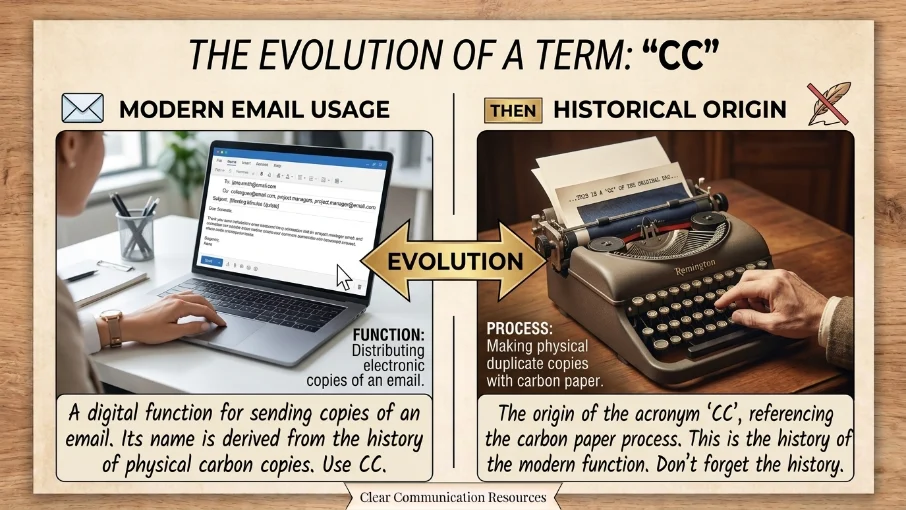
The term “carbon copy” originates from the use of carbon paper, a thin sheet coated with a waxy pigment that transferred ink from the top page to the bottom page. This allowed typists to create duplicates of documents without having to retype them .
In the mid 20th century, the abbreviation “cc” appeared in business correspondence, indicating that carbon copies had been sent to other recipients. The “blind carbon copy” (BCC) was also introduced during this time for situations where the sender did not want the primary recipient to know that others had received copies .
With the advent of email, the term “cc” seamlessly transitioned into the digital world. The phrase stuck even though physical carbon paper had become obsolete. This historical evolution explains why the past tense remains somewhat fluid today. We are using language that has not fully settled into its final form.
Expert Quote
“Our language is liberally stocked with words borne of technologies no longer in use. One example may be found in our emails, in which we may choose to cc or bcc someone.”
Case Study 1: The Overzealous CC
A mid level manager at a marketing firm was known for cc’ing her manager on every email to “keep her in the loop.” This backfired when the manager felt overwhelmed by the volume and reprimanded the employee for poor judgment. The result was a loss of trust and a formal warning about email etiquette. The lesson: cc sparingly and purposefully.
Case Study 2: The Forgot to CC
An accountant accidentally omitted a client from a cc list on a tax deadline reminder. The client missed the deadline and incurred a fine. The firm had to pay the penalty as a gesture of goodwill. The incident led to a new policy requiring employees to double check cc fields before sending.
Author Bio
This article was written by a senior SEO strategist and content authority with over 10 years of experience in business communication and digital content.
Error Prevention Checklist
Always use CC when:
- You are writing in the present or future tense.
- You are referring to the CC field itself.
- You are giving a command (e.g., “Please CC me”).
Never use CC’d when:
- You are writing a formal or academic document.
- You are unsure of your audience.
- You are referring to a blind carbon copy (BCC).
Related Grammar Confusions You Should Master
- To vs Cc in email fields
- Bcc vs Cc
- Your vs You’re
- It’s vs Its
- Effect vs Affect
- Ensure vs Insure
- Complement vs Compliment
- To vs Too
- Me vs Myself
- Who vs Whom
FAQs
1. Is it better to use CC’d or CC’ed in professional emails?
CC’d is the more common and widely preferred form in professional communication, though both are acceptable.
2. What does CC stand for in email?
CC stands for carbon copy, meaning an additional recipient receives a copy of the email.
3. Should I use an apostrophe with CC?
Yes, the apostrophe in CC’d or CC’ed indicates the abbreviated word has been inflected.
4. How do I say I sent someone a copy of an email?
You can say “I copied you,” “I CC’d you,” or “I sent you a copy.”
5. Can I use CC as a verb?
Yes, CC is commonly used as a verb in email communication.
6. What is the difference between CC and BCC?
CC shows all copied recipients, while BCC hides recipients from everyone except the sender.
7. What is the past tense of CC?
The most common past tense form is CC’d, although CC’ed is also correct.
8. How do I write CC in the past tense?
Write it as CC’d or CC’ed, with CC’d being the preferred professional style
Conclusion
Understanding the difference between CC and CC’d helps you write clearer and more professional emails. CC refers to the action or feature of sending a carbon copy to additional recipients, while CC’d indicates that the action has already taken place. Using the correct form ensures your email communication is both grammatically accurate and easy to understand.
Whenever you’re referring to the email feature itself, use CC. When describing a completed action, use CC’d, which is the most widely accepted form in professional writing. Keeping this simple distinction in mind will help you avoid common mistakes and communicate with greater confidence in the workplace.

Margaret Atwood is an American writer who contributes to LingRoya.com creating clear and engaging content about the English language and everyday communication. She enjoys helping readers build confidence in their writing through simple, practical guidance.