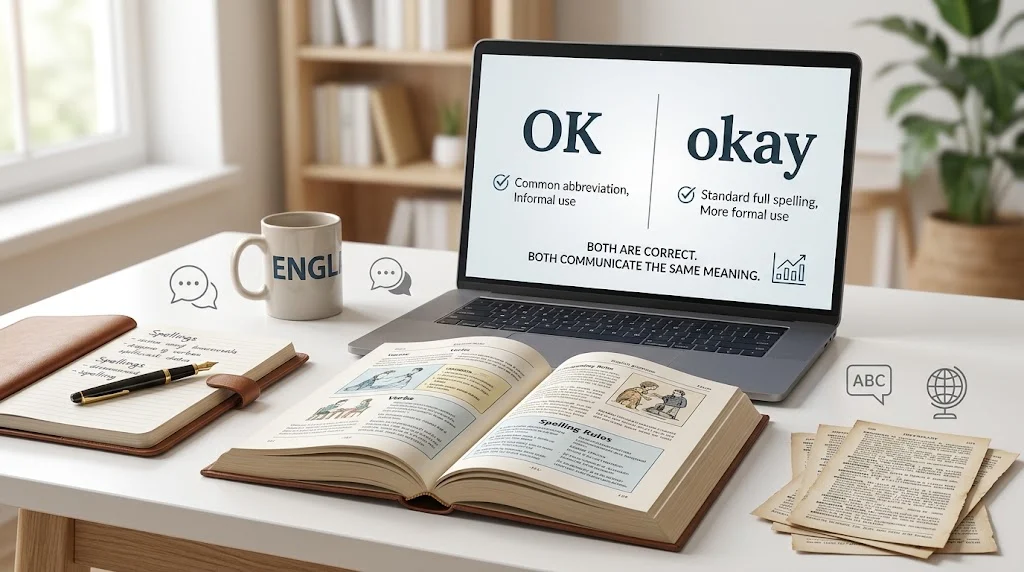
Quick Answer: OK and okay have the same basic meaning and are generally interchangeable. Both can mean that something is acceptable, satisfactory, correct, or understood. OK or okay mainly differs in style and preference:
Have you ever wondered whether you should write “OK” or “okay” in an email, text, essay, or professional message? The question OK or okay is usually about usage rather than meaning because both forms express agreement, acceptance, or satisfactory condition. OK is commonly used as an adjective, adverb, verb, noun, or interjection, while okay can perform the same functions.
The confusion matters because word choice can affect tone. A short “OK” may feel direct or informal in some contexts, whereas “okay” can sound slightly more conversational or relaxed. Understanding the history, grammar, tone, and modern usage of these two forms helps you choose the version that fits your audience instead of treating one as universally correct.
OK vs Okay: What’s the Difference?
The simplest answer is that OK and okay are spelling variants with the same core meaning. Neither is automatically more correct than the other.
OK is an adjective, adverb, verb, noun, and interjection depending on how it is used. It can describe something satisfactory, indicate agreement, or express acknowledgment.
Examples:
“Everything is OK.”
“Are you OK?”
“OK, I understand.”
Okay can serve the same grammatical roles and carries essentially the same meanings.
Examples:
“Everything is okay.”
“Are you okay?”
“Okay, I understand.”
Here is a concise comparison:
Mini recap
OK and okay normally mean the same thing.
Both can function in several grammatical roles.
The main distinction is style, spelling preference, and context.
Neither spelling is inherently wrong.
Is OK vs Okay a Grammar, Vocabulary, or Usage Issue?
The OK vs okay question is primarily a usage and style issue rather than a grammar problem.
If you write “The project is OK,” the sentence is grammatically acceptable. If you write “The project is okay,” it is also acceptable. The difference does not normally change the underlying meaning.
Are OK and Okay Interchangeable?
In most ordinary situations, yes. You can replace one with the other without changing the basic message.
“I’m OK.”
“I’m okay.”
Both tell the reader that the speaker is fine.
Likewise:
“Okay, let’s begin.”
“OK, let’s begin.”
Both express acknowledgment followed by an action.
There can be subtle differences in tone. Some readers may perceive uppercase OK as more abrupt, particularly when it appears alone in a digital conversation. That reaction depends heavily on context, punctuation, relationship, and personal communication habits.
Formal Versus Informal Usage
Neither form is inherently informal in every situation. Both appear in edited publications, dictionaries, professional communication, and everyday speech.
However, highly formal academic writing may sometimes benefit from a more precise expression.
Instead of:
“The results are OK.”
You might write:
“The results are satisfactory.”
That does not mean OK is grammatically wrong. It simply means another word may communicate the intended level of precision more effectively.
Academic Versus Casual Usage
In academic writing, context matters. A phrase such as “The results were okay” may sound vague because the reader may reasonably ask what standard made them satisfactory.
In casual writing, “okay” is perfectly natural:
“Okay, I’ll call you later.”
In short digital messages, OK is especially convenient:
“OK, thanks.”
The choice is therefore often about register and purpose rather than correctness.
When to Use OK
OK is particularly useful when you want a compact expression of acceptance, acknowledgment, or satisfactory condition.
Workplace Example
“OK, I’ll send the updated report this afternoon.”
Here, OK signals agreement or acknowledgment.
Academic Example
“The equipment was in OK condition before the experiment.”
The expression is grammatically possible, although “acceptable condition” may be more precise in formal academic prose.
Technology Example
“Click OK to close the window.”
This is one of the most familiar uses of OK in software interfaces. Buttons, menus, settings panels, and dialog boxes frequently use OK because it is short and immediately recognizable.
Usage recap: Choose OK when you want a concise form, especially in interface language, brief responses, signs, labels, and messages where space matters.
When to Use Okay
Okay is often preferred when writing ordinary sentences in a conversational voice. It can look more like a complete word and may feel smoother in continuous prose.
Workplace Example
“Is it okay if I send the proposal tomorrow?”
This sounds natural in a friendly workplace conversation.
Academic Example
“It is okay to revise the procedure when new evidence becomes available.”
Although grammatically acceptable, a formal academic version might use “acceptable” or “permissible” if greater precision is needed.
Technology Example
“Click okay when you are ready to continue.”
This sentence is understandable, although software interfaces traditionally favor the shorter OK label.
Usage recap: Choose okay when you want a conversational, fully spelled form in ordinary sentences. It is especially natural in questions, dialogue, and informal prose.
When You Should NOT Use OK or Okay
There are situations where neither form is the strongest choice. The issue is usually not grammatical correctness but precision, tone, or clarity.
- When you need a precise academic description
Instead of “The method was okay,” consider “The method was satisfactory” if that accurately describes the evidence.
- When the reader needs a measurable standard
“Sales were okay” is vague. A specific figure gives the reader more useful information.
- When expressing serious approval
“Your application is okay” may sound weaker than “Your application has been approved.”
- When describing a technical result
“Everything is okay” can hide important details. Technical writing often benefits from exact information.
- When communicating serious concerns
If someone asks about a safety problem, “It is okay” may be too vague. Explain the actual situation.
- When a formal document requires specialized terminology
Legal, scientific, and technical documents often need precise terms rather than broad conversational expressions.
- When a single word could be misunderstood
A standalone “OK” in a text message can sometimes be interpreted as agreement, acknowledgment, irritation, or dismissal depending on context.
- When tone is especially important
If a message concerns an emotional or sensitive subject, write enough context to make your intention clear.
Common Mistakes With OK and Okay
The most common mistake is assuming that one spelling is always correct and the other is always wrong. That is not how these forms work.
The incorrect examples above demonstrate that the real grammatical issue is often not choosing between OK and okay. It is using the expression correctly within the sentence.
Decision Rule Box
Simple decision rule:
Use OK when you want a short, compact form, particularly for buttons, labels, brief acknowledgments, and concise communication.
Use okay when you prefer the fully spelled form, especially in conversational sentences and ordinary prose.
If precision matters more than conversational tone, consider a more specific word such as satisfactory, acceptable, approved, or permissible.
OK and Okay in Modern Technology and AI Tools
Technology has made OK especially visible. Software interfaces commonly use OK as a button label because interface text needs to be brief and recognizable.
You may encounter:
“Click OK.”
“Press OK to continue.”
“Select OK to save your changes.”
Conversational technology, including chatbots and AI assistants, uses both forms. A person may type “OK” as a quick acknowledgment or write “okay” when using a more conversational style.
AI generated text can also contain either spelling. Neither automatically signals that text was written by a human or by an AI system. The surrounding language, context, and editing quality matter much more than the choice between these two spellings.
The Etymology of OK and Okay
The history of OK is unusually interesting. The expression became popular in the United States during the nineteenth century. One widely documented explanation connects OK with a humorous abbreviation based on the intentionally misspelled phrase “oll korrect,” meaning “all correct.”
The expression gained broader popularity through political campaigning and newspaper culture. Over time, OK became an established English expression rather than remaining a joke.
The spelling okay developed as a more conventional written representation of the spoken expression. Today, both forms are established in standard English usage.
This history explains why OK looks unusual compared with ordinary English words. Its origins are connected to abbreviation and wordplay rather than conventional word formation.
What Experts Say About OK and Okay
A useful principle from modern English usage is that context determines appropriateness more often than spelling preference. When two forms carry the same meaning, writers should consider audience, register, clarity, and consistency rather than searching for an imaginary universal rule.
In practical terms, a professional editor is more likely to ask whether “okay” is precise enough for the sentence than to declare that “OK” is grammatically wrong.
Two Practical Case Studies
Case Study 1: Workplace Communication
Imagine a manager writes:
“OK, I’ll review the document.”
The message is short and clear. In a quick workplace conversation, it communicates acknowledgment efficiently.
Now compare:
“Okay, I’ll review the document.”
The meaning remains the same, but the second version may feel slightly more conversational.
Result: Both forms communicate the intended response successfully. The choice depends on the writer’s preferred tone.
Case Study 2: Software Interface
Consider a confirmation window with several options. A designer needs a short label for the confirmation button.
“OK” is compact and familiar.
“Okay” communicates the same idea but occupies more visual space.
Result: OK is often a practical interface choice because concise labels improve scanning and conserve screen space. This is a design consideration rather than a grammar requirement.
Error Prevention Checklist
Always use OK when:
☑ You need a compact interface label.
☑ You are giving a brief acknowledgment.
☑ You prefer the shorter spelling.
☑ The surrounding style consistently uses OK.
Always consider okay when:
☑ You are writing conversational prose.
☑ You want the word to look fully spelled out.
☑ You are writing dialogue or casual communication.
☑ The surrounding text already favors the spelling okay.
Never assume:
☒ That okay is grammatically wrong.
☒ That OK is automatically informal.
☒ That one spelling has a completely different meaning.
☒ That replacing either form with the other will always preserve the same tone.
Related Grammar Confusions You Should Master
Once you understand OK or okay, several other common English usage questions become easier to explore. Consider these related topics:
- Alright vs all right
- Everyday vs every day
- Alot vs a lot
- Alright vs okay
- Anyway vs anyways
- Maybe vs may be
- Already vs all ready
- Altogether vs all together
- Into vs in to
- Everyday English vs formal English
These pairs demonstrate an important principle: English usage is shaped by grammar, history, convention, register, and context.
Frequently Asked Questions
Is OK or okay correct?
Both are correct in standard English usage. They generally have the same meaning, although writers may choose one based on style and context.
Is okay more correct than OK?
No. Okay is not inherently more correct than OK. Both are established forms of the same expression.
Is OK formal or informal?
OK can appear in both casual and professional communication. Its suitability depends on the context and the style expected by the audience.
Should I use OK or okay in an email?
Either can work. For a conversational email, okay may feel natural. For a short acknowledgment, OK is concise and clear.
Is okay acceptable in academic writing?
Yes, but academic writers should consider precision. If okay sounds vague, words such as satisfactory, acceptable, or permissible may communicate the intended meaning more clearly.
Why do people write OK instead of okay?
OK is shorter and has a long history as an established English abbreviation and expression. Its compact form also makes it useful in signs, buttons, and short messages.
Does OK mean the same as okay?
In most contexts, yes. Both can express agreement, acceptance, satisfactory condition, or acknowledgment.
Is it okay to write OK in professional communication?
Yes, provided it suits the tone and purpose of the message. A professional context does not automatically make OK incorrect.
Why can OK sometimes sound rude in text messages?
A standalone OK is extremely brief, so readers may interpret its tone differently depending on punctuation, conversation history, and relationship. Adding context can reduce ambiguity.
Conclusion
The answer to OK or okay is straightforward: both forms are correct and normally carry the same meaning. The real distinction involves style, context, tone, and personal or organizational preference. OK is compact and particularly useful for buttons, labels, brief responses, and quick acknowledgments. Okay often feels natural in conversational prose and dialogue. When writing formally, however, the bigger question is often whether either word provides enough precision.

Philip Pullman is an American writer dedicated to creating clear and easy to follow English content. Through his work at LingRoya.com, he helps readers strengthen their language skills with practical and reliable guidance so that they can easily understand.