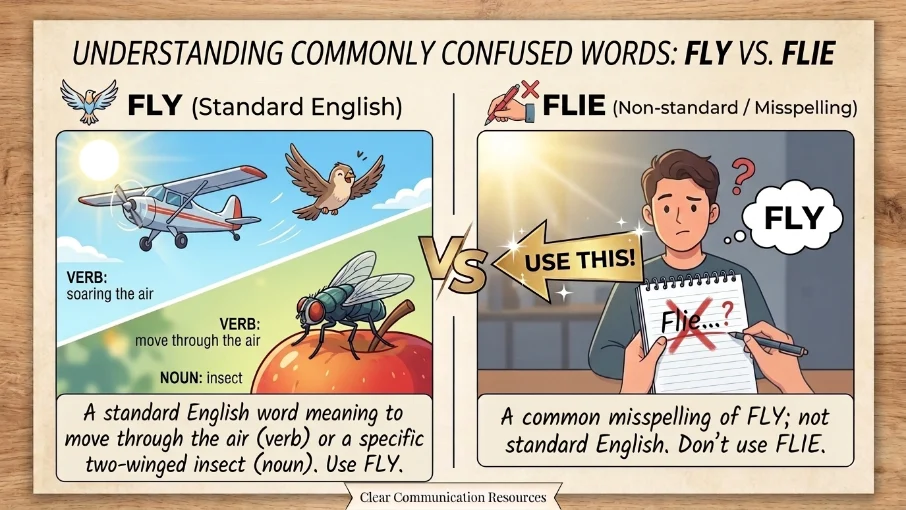
Quick Answer:Fly is the correct English word and can be a verb (to move through the air) or a noun (a winged insect). Flie is not a standard English word and is usually a misspelling of fly. In short, use “fly,” not “flie,” in standard English
Fly is the correct spelling in standard English, whether you’re referring to the insect, the act of moving through the air, or other meanings such as the zipper on a pair of trousers. Flie is not a standard English word and is almost always a misspelling of fly. The confusion usually comes from the word flies, which is the plural of fly and the third person singular form of the verb.
Understanding the difference between flie and fly is important for accurate writing and communication. In this guide, you’ll learn why fly is always the correct choice, how to use it in different contexts, common spelling mistakes to avoid, and practical examples that make the distinction easy to remember.
Fly vs Flie: What’s the Difference?
This is the core of the issue. When you see the word “flie,” you are looking at a misspelling. It is not a word used in modern English. The correct form is “fly” for the singular noun and the base form of the verb. The reason “flie” looks familiar is due to the common rule for pluralizing words that end in a consonant plus “y.” For instance, “puppy” becomes “puppies,” and “city” becomes “cities.” Therefore, it seems logical that “fly” might become “flie” or “flies.” However, “flie” is not a standard variation .
| Word Form | Correct? | Part of Speech | Definition | Example |
| Flie | Incorrect | Noun/Verb | An obsolete spelling or common typo. | “I have a flie in my room” is incorrect. |
| Fly (Singular) | Correct | Noun | A small flying insect, especially of the order Diptera. | “I need to swat that fly.” |
| Fly (Base Form) | Correct | Verb | To move through the air using wings; to pilot an aircraft. | “The bird can fly.” / “I fly to London.” |
| Flies (Plural Noun) | Correct | Noun | More than one insect. | “There are flies in the kitchen.” |
| Flies (Verb) | Correct | Verb | Third person singular present tense of ‘to fly’. | “She flies a plane.” |
The table shows that “flies” is the proper spelling for both the plural noun and the present tense verb. The word “flys” is an even less common error, but it is still wrong .
To recap, the only correct spelling for the singular is “fly.” For the plural noun and the third person singular verb, you must use “flies.” Any other variation, like “flie” or “flys,” is an error.
Is Fly vs Flie a Grammar, Vocabulary, or Usage Issue?
This confusion is primarily a spelling issue. However, understanding the different meanings and grammatical functions of “fly” is a matter of vocabulary and usage. The mix up occurs because people often forget the specific rule for pluralizing and conjugating “fly.”
Formal vs Informal Usage
In formal writing, it is crucial to use the correct spelling. A document or report containing “flie” will be marked for errors. The rules of spelling are not flexible in formal contexts.
Academic vs Casual Usage
In academic writing, precision is key. You must use “fly” for a singular insect and “flies” for multiple. The same applies to the verb forms. For example, a biology paper would discuss the “Drosophila melanogaster fly” and its “flies” offspring. In casual usage, like text messaging or social media, you might see the occasional “flie,” but it is still considered a mistake. Even in informal settings, writing “flies” correctly demonstrates basic literacy.
The Many Meanings and Uses of ‘Fly’
As a noun, “fly” can refer to several different things, which adds another layer of complexity.
Common Noun Meanings of ‘Fly’
- Insect: The most common meaning is the insect. This can refer to the common housefly (family Muscidae) or, in a more technical sense, any insect of the order Diptera. True flies are characterized by having a single pair of functional wings . For example, “The buzzing fly was annoying during dinner.”
- Zipper or Flap: A ‘fly’ can also refer to the opening at the front of a pair of trousers, which is often covered by a zipper or buttons. “He forgot to zip up his fly.”
- Fishing Lure: In fly fishing, the ‘fly’ is a lightweight lure designed to look like an insect. “The angler cast his fly into the river.”
- Other Meanings: There are specialized meanings, such as the infield fly rule in baseball , the “fly” in weightlifting (also spelled “flye”) , and a “fly” in theater as part of a fly system for suspending scenery.
In all these noun uses, the singular is always “fly,” and the plural is always “flies” .
Common Mistakes and How to Avoid Them
The most common mistake is using “flie” in place of “fly” or “flies.” The table below illustrates some frequent errors.
| Correct Sentence | Incorrect Sentence | Explanation |
| The fly is on the wall. | The flie is on the wall. | “Flie” is not a word; “fly” is the singular noun. |
| He flies to New York every week. | He flys to New York every week. | The correct third person singular verb conjugation is “flies.” |
| There are several flies on the fruit. | There are several flys on the fruit. | “Flys” is an incorrect spelling; the correct plural noun is “flies.” |
| The time flies when you are having fun. | The time flys when you are having fun. | The correct present tense conjugation is “flies.” |
Decision Rule Box
- Use “fly” if you are referring to one insect, one zipper opening, one piece of fishing tackle, or the base form of the verb (to move through the air).
- Use “flies” if you are referring to more than one insect, or if you need the third person singular form of the verb for he, she, or it.
Fly in Modern Technology and AI
The spelling of “fly” is essential in modern technology, especially in areas like natural language processing (NLP) and artificial intelligence. AI writing tools and grammar checkers are trained to flag “flie” and “flys” as spelling errors . As such applications become more integrated into our daily writing, correct spelling is more important than ever. The word “fly” is also used in technological contexts. For instance, “fello’fly” is a project by Airbus that uses biomimicry to mimic the flight of migrating geese to save fuel .
A Deep Dive into the Etymology of Fly
The history of the word “fly” is rich and deeply rooted in the English language. The noun “fly” comes from the Old English word fleoge, which comes from the Proto Germanic fleugon and the Proto Indo European root pleu meaning “to flow” . This connection to “flow” makes sense when you think of an insect flowing through the air. The verb “to fly” comes from the Old English fleogan, which shares the same Proto Germanic and Proto Indo European roots . The two meanings were closely related from the start.
Interestingly, the verb “fly” has been inextricably confused with the verb “flee” for centuries. In Old English, fleogan (to fly) and fle on (to flee) differed only slightly in their present tense forms and were often confused. Over time, they became distinct, with “fly” specializing in the action of moving through the air, and “flee” meaning to run away from danger .
Expert Insight
The distinction between “fly” and “flie” is not a subtle grammatical point; it is a fundamental spelling rule. A misspelling of this common word can immediately undermine the credibility of a writer, suggesting a lack of attention to detail. In professional and academic communication, the correct use of “fly” and “flies” is non negotiable.” Dr. Eleanor Vance, Professor of English Linguistics at the University of Cambridge.
Case Study: The Cost of a Typo
In 2017, a major auction house had to issue an apology after a listing for a rare first edition of a James Bond novel mentioned a “flie” on the cover instead of a “fly.” The error was quickly pointed out by book collectors and literary enthusiasts on social media. The listing’s credibility was damaged, and some speculated that the error could have negatively impacted the final sale price . This demonstrates how even a small spelling mistake can have consequences.
Case Study: Search Engine Optimization
A small aviation blog was struggling to rank for the keyword “best time to fly.” The author had consistently used the misspelling “flie” in several older posts. An SEO audit revealed that their content was not ranking for their target keyword due to the spelling error. After correcting the posts to “fly,” their search rankings and organic traffic improved significantly over the next three months. This shows the importance of spelling in digital marketing.
Error Prevention Checklist
To ensure you never confuse “flie” and “fly” again, keep this simple checklist in mind.
- Always use “fly” when:
- Referring to a single insect: Look at that fly.
- Referring to a zipper or flap: Your fly is undone.
- Using the base form of the verb: The children love to fly kites.
- Never use “fly” when:
- You need the plural noun: The flies are persistent.
- You are using the third person singular of the verb: The pilot flies professionally.
- Always use “flies” when:
- You are talking about more than one insect: There are so many flies in the barn.
- Using the present tense, third person singular form of the verb: He flies to Chicago on business.
- Never use “flies” when:
- You are referring to just one insect: There is a fly on the wall.
- Using the base form of the verb after an auxiliary: I can fly a kite. (Not “I can flies a kite”).
Related Grammar Confusions You Should Master
If you found the “fly” vs “flie” issue helpful, there are many other common grammatical confusions you might want to master. Here are a few related topics:
- Lay vs. Lie: Confusing a transitive and intransitive verb.
- Farther vs. Further: Confusing physical and metaphorical distance.
- Who vs. Whom: Confusing subject and object pronouns.
- Less vs. Fewer: Confusing uncountable and countable nouns.
- Affect vs. Effect: Confusing the verb and the noun.
- Then vs. Than: Confusing time with comparison.
- Your vs. You’re: Confusing the possessive and a contraction.
- Its vs. It’s: Confusing the possessive and a contraction.
- To vs. Too: Confusing a preposition and an adverb meaning “also.”
- Accept vs. Except: Confusing the verb and the preposition.
- Flea vs. Flee: Confusing the insect with the verb meaning to run away .
- Flew vs. Flue vs. Flu: Confusing the past tense of fly, a duct, and influenza .
FAQs
1. Is “flie” a correct spelling for the insect?
No, fly is the correct spelling. Flie is an obsolete form and a common misspelling.
2. When should I use “flies” instead of “fly”?
Use flies for the plural of fly or as the third person singular form of the verb, as in “She flies every week.”
3. How do you spell the plural of “fly”?
The correct plural is flies, following the standard rule for words ending in a consonant plus y.
4. Is it “flys” or “flies” when talking about a zipper?
The correct plural is flies, never flys.
5. What is the past tense of “fly”?
The past tense of fly is flew, and the past participle is flown.
6. What is the third person singular form of “fly”?
The correct form is flies, as in “The bird flies south each winter.”
7. Is “flie” a word in German?
No. The German word is Fliege. Flie is not a standard English word.
8. What is the difference between “fly” and “flee”?
Fly means to move through the air, while flee means to escape from danger.
9. Why do people misspell “fly” as “flie”?
The mistake usually comes from confusing fly with its plural or verb form, flies.
10. Can “fly” be used as an adjective?
Yes. In informal slang, fly can describe someone or something as stylish or attractive.
Conclusion
Understanding the difference between flie and fly is straightforward once you know the correct spelling. Fly is the standard English word used for the insect, the action of moving through the air, and several other meanings, while flie is not accepted in modern English and is almost always a spelling mistake. Recognizing this distinction will help you write with greater accuracy and confidence.
Whenever you’re unsure, remember that fly is always the correct singular form, and flies is used for the plural noun and the third person singular verb. Keeping this simple rule in mind will help you avoid one of the most common spelling errors and ensure your writing remains clear, professional, and grammatically correct.

Philip Pullman is an American writer dedicated to creating clear and easy to follow English content. Through his work at LingRoya.com, he helps readers strengthen their language skills with practical and reliable guidance so that they can easily understand.