Quick Answer:
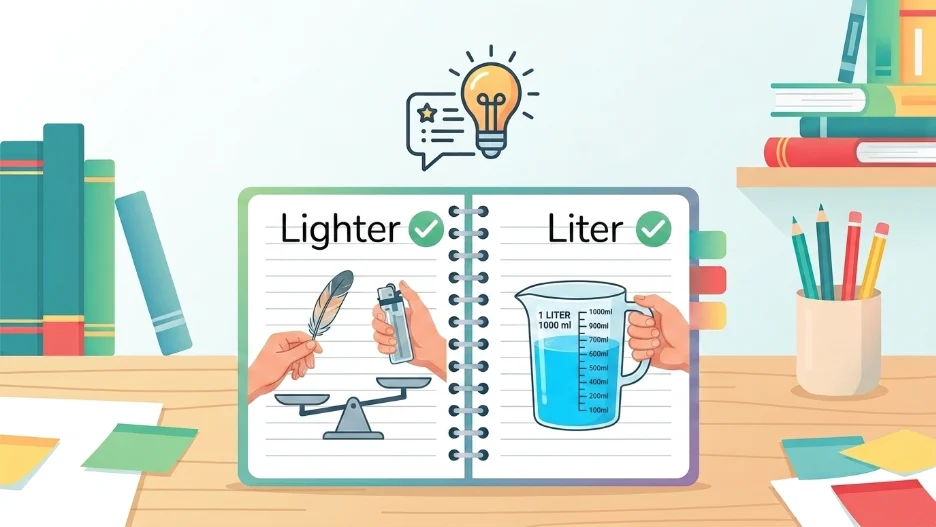
Lighter and liter are different words with different meanings and are not interchangeable. Lighter can refer to something that is less heavy, less dark in color, or a device used to create a flame, while liter is a metric unit of volume equal to 1,000 milliliters. Use lighter when describing weight, color, or a fire-starting tool, and use liter when measuring liquids or other volumes
The confusion between “lighter” and “liter” is a frequent spelling error that can undermine your writing’s credibility, but the solution is simple: a lighter is either a device that produces a flame or a comparative adjective meaning “less heavy,” while a liter is a metric unit of volume. These words sound similar but have entirely different meanings and grammatical functions.
If you have ever typed “lighter” when you meant a unit of measurement or written “liter” when you needed a fire source, you are not alone. This confusion is surprisingly common. It is not just a typo; it is a mix up between two completely different words with distinct origins and uses. Using the wrong one in a professional or academic context can make your work look sloppy and leave readers scratching their heads. This article will clearly explain the difference between these two terms, provide practical examples, and offer a simple rule to ensure you never confuse lighter and liter again.
Lighter vs Liter: What’s the Difference?
At its core, this is a comparison between a word with multiple, common definitions and a word with a single, very specific meaning.
Lighter is a versatile word. Its most common function is as a comparative adjective. This means it is used to describe something that has less weight than another thing. For example, “This box is lighter than that one.” But “lighter” is also a noun. As a noun, it refers to a small, handheld device that produces a flame, typically used to light cigarettes or candles. You might say, “He used a lighter to start the campfire.” Furthermore, in maritime contexts, a “lighter” is a type of flat bottomed barge used for transporting cargo .
Liter on the other hand, is strictly a noun. It is a metric unit of volume used primarily in American English to measure liquids and gases. It is equivalent to approximately 1.057 liquid quarts . In British English, this same unit is spelled “litre.” So, when you are buying a two liter bottle of soda, you are talking about its volume, not its weight or a device for making fire.
Comparison Table: Lighter vs. Liter
| Feature | Lighter | Liter |
| Part of Speech | Noun and Comparative Adjective | Noun |
| Primary Meaning 1 | Device that produces a flame | A metric unit of volume |
| Primary Meaning 2 | Comparative form of “light” (not heavy) | |
| Spelling Variants | None | “Litre” (British spelling) |
| Example Sentence | “My backpack is much lighter this semester.” | “Please buy a one liter bottle of water.” |
Mini Recap: Remember, “lighter” is for things that are less heavy or for starting a fire, while “liter” is for measuring liquid volume.
Is Lighter vs. Liter a Grammar, Vocabulary, or Usage Issue?
The “lighter or liter” question is primarily a vocabulary issue, though it can morph into a usage problem. The two words are not interchangeable. They do not share a root or meaning. The mix up occurs because they are near homophones for many speakers, especially in American English. Since they sound similar, people sometimes write the wrong one out of habit or carelessness.
This is not a grammar rule like subject verb agreement; it is a matter of lexical choice. The problem is simple: you are using the wrong word for the concept you want to express . In formal writing, such as academic papers or professional reports, this error is a clear sign of a proofreading lapse. In casual writing, like a text message, it might go unnoticed. However, in any context where clarity and credibility are important, using “liter” when you mean “lighter” is a significant vocabulary error.
Practical Usage of “Lighter”
Because “lighter” has two main definitions, its usage is broad and appears in many different contexts. Let’s look at how it is used in various settings.
Workplace Example
In a logistics or shipping warehouse, you might hear a manager say, “The new carbon fiber shipping containers are lighter than the old steel ones, which will save us a fortune in fuel costs.” Here, “lighter” is the comparative adjective. However, in the same workplace, a safety memo might read, “All employees are reminded that using a lighter near flammable materials is strictly prohibited.” In this case, “lighter” is the noun referring to a fire source.
Academic Example
In a physics class, a teacher might ask, “Which of these two objects is lighter?” This asks students to compare mass. An academic paper in chemistry would never use “lighter” to describe volume; it would use “liter.” The context of science and measurement often requires precision, making this distinction critical.
Technology Example
Consider the technology sector. Marketing materials for new laptops constantly boast that their product is “lighter and more powerful.” This is the comparative adjective. Conversely, in the manufacturing process, you might see instructions like, “Fill the coolant reservoir with one liter of distilled water.” While not about laptops, the concept of measurement is central to technology.
Lighter Usage Recap: Use “lighter” when comparing weight or referencing a flame producing device.
Practical Usage of “Liter”
The word “liter” has a singular, straightforward purpose: to measure volume. Its application is mainly in scientific, technical, and everyday commercial contexts.
Workplace Example
In a restaurant kitchen, a recipe might call for “one liter of chicken stock.” In a lab, a technician might measure “0.5 liters of a chemical solution.” In the automotive industry, engine displacement is measured in liters, like a “5.0 liter V8 engine.” The context is always about a precise amount of a liquid or gas.
Academic Example
A chemistry or biology student will use liters constantly. A lab report might state, “A 2 liter flask was filled with the solution.” An environmental science paper might discuss how “millions of liters of water are consumed.” In this formal setting, using “lighter” would be an egregious error that confuses weight with volume.
Technology Example
In computing, a “liter” is never used. But in related hardware, such as designing a liquid cooling system for a computer, one would measure the fluid capacity in liters. It’s about the physical quantity of the fluid, not its weight, though of course, they are related concepts.
Liter Usage Recap: Use “liter” exclusively when referring to a metric unit of volume.
When You Should NOT Use “Lighter” or “Liter”
Understanding when not to use each word is just as important as knowing their definitions.
- Do not use “lighter” to mean “less serious” if you are writing formally. While it is often used this way casually (“The tone of the movie was much lighter than the book”), in formal writing, “less serious” is a better choice to avoid ambiguity.
- Do not use “lighter” to describe the color of an object if you are referring to a measurement. For example, “The paint was a liter shade of blue” is incorrect. It should be “lighter shade of blue.”
- Do not use “liter” when you mean a fire source. Can I borrow your liter?” is a common and embarrassing mistake.
- Do not use “liter” as a comparative adjective. “My new phone is liter than my old one” is nonsensical.
- Do not use “liter” to describe something that is not heavy. For example, “I lifted the box, and it was very liter” is incorrect.
- Do not use “lighter” when writing about metric measurements. “I need a lighter of water for the recipe” would be very confusing.
- Avoid using “lighter” or “liter” in situations where the context does not make your meaning clear. Always choose the word that leaves no room for misinterpretation.
- Never use “lighter” or “liter” when an alternative word would be more precise. For example, instead of saying “a lighter car,” you could say “a more fuel efficient car” if you want to emphasize that benefit.
Common Mistakes and Decision Rules
The best way to avoid this error is to understand the concrete rule for using each word.
Common Error Table
| Correct Sentence | Incorrect Sentence | Explanation |
| The shipping crate is lighter than we expected. | The shipping crate is liter than we expected. | “Liter” is a unit of volume, not a comparative adjective. “Lighter” (less heavy) is correct here. |
| Could you pass me the lighter? I need to light a candle. | Could you pass me the liter? I need to light a candle. | “Liter” is a unit of volume. A “lighter” is a device for creating a flame. |
| The prescription calls for 0.75 liters of oxygen. | The prescription calls for 0.75 lighters of oxygen. | Oxygen is a gas measured by volume. “Lighter” has no meaning in this context. |
| This one is lighter than my old backpack. | This one is liter than my old backpack. | You are comparing the weight of backpacks, so the comparative adjective “lighter” is required. |
Decision Rule Box
- If you mean the action of comparing weight or the object that creates a flame, use lighter.
- If you mean the metric unit for measuring the volume of a liquid or gas, use liter.
“Lighter” and “Liter” in Modern Technology and AI Tools
The precision of language is more important than ever in the age of AI. When you interact with AI writing tools, assistants, or search engines, your word choice directly impacts the results you get. Asking an AI to “write a description for a lighter phone” will get you a result about weight, while asking it to “write a description for a liter bottle” will get you a result about volume. The algorithms are highly attuned to these semantic differences. This makes understanding the distinction between “lighter” and “liter” a vital skill in a world where we are increasingly communicating with machines. It ensures your commands are interpreted correctly and your content is accurate.
The Linguistic Roots of the Confusion
The confusion between “lighter” and “liter” is almost purely phonetic. The words are pronounced very similarly in most American dialects. “Lighter” has its origins in Old English (from līhtan) and the Proto Germanic word lingkhtaz, meaning not heavy. The noun form for a fire starter came much later. “Liter” has a different history altogether. It entered English from the French litre, which comes from the Medieval Latin lītra, and ultimately from the Greek, where it was a unit of weight . They are etymologically unrelated, which makes the mix up a testament to the quirks of spoken language and spelling.
Expert Insight
“The best writing is clear writing. When we misuse words like ‘lighter’ and ‘liter,’ we introduce noise into our communication. The burden is on the writer to be precise, not on the reader to decipher a misused term. In professional and academic settings, this precision is not just a nicety—it’s a requirement for trust and clarity.” — Dr. Evelyn Reed, Professor of Linguistics and Communication.
Case Studies
Case Study 1: The Marketing Blunder
A startup was finalizing its marketing copy for a new product, a lightweight, portable water bottle. In the final push to meet a deadline, an overworked junior copywriter wrote, “This bottle is so liter, you’ll forget you’re carrying it!” The CEO caught the error just before the print run and immediately corrected it to “lighter.” While this was corrected, it serves as a powerful reminder of how easily such a mistake can slip through and potentially damage a brand’s credibility.
Case Study 2: The Scientific Paper
A chemistry student submitted a final paper for a class on fluid dynamics. In the introduction, they wrote about how the density of a solution made it “lighter” than others. However, in the methodology section, they repeatedly wrote “lighter” when they meant to say “liter” for the volume of the solution. The professor noted the error in the margins, and while the student received a good grade, they were penalized for a lack of attention to detail. The inconsistency in terminology made the paper seem less professional.
Error Prevention Checklist
Before you hit send or publish, use this checklist to ensure you have used the correct word.
- Always use “lighter” when:
- Comparing the weight of two or more things.
- Referring to the device used to light a cigarette or candle.
- Never use “lighter” when:
- You are referring to a unit of volume.
- You are writing for an academic or scientific audience that expects precise terminology.
- Always use “liter” when:
- You are discussing a metric unit for measuring volume.
- You are following a recipe that uses metric measurements.
- Never use “liter” when:
- You are comparing the weight of objects.
- You are talking about a flame producing device.
- You are using the word as an adjective.
Related Grammar Confusions You Should Master
- Affect vs. Effect
- Principle vs. Principal
- Complement vs. Compliment
- Stationary vs. Stationery
- Its vs. It’s
- Your vs. You’re
- There vs. Their vs. They’re
- To vs. Too vs. Two
- Peek vs. Peak vs. Pique
- Accept vs. Except
Advanced FAQs
What is the difference between lighter and liter in a sentence?
Lighter describes something less heavy or refers to a flame-producing device, while liter is a metric unit used to measure volume.
Can lighter be used as a measurement of volume?
No. Lighter is never a unit of measurement. Use liter when referring to liquid volume.
Is liter the same as litre?
Yes. Liter is the American English spelling, while litre is the British English spelling of the same unit.
How do I remember when to use lighter vs. liter?
Use lighter for weight, color, or a flame-producing device, and liter when measuring liquids or volume.
Is lighter a comparative adjective or a noun?
Both. It can compare weight or brightness (lighter than before) or refer to a device used to create a flame.
Is liter a noun or a verb?
Liter is always a noun. It is the metric unit of volume equal to 1,000 milliliters.
What is the most common mistake with lighter and liter?
Many people accidentally write liter when they mean lighter, especially because the words sound similar.
How can I check if I used the wrong word?
Look at the context. If you’re discussing weight, brightness, or fire, use lighter. If you’re measuring liquid, use liter.
Conclusion
In conclusion, lighter and liter may sound similar, but they have completely different meanings and uses. Lighter refers to something that is less heavy, less dark, or a device used to produce a flame, while liter is a metric unit for measuring volume.
To avoid confusion, always consider the context of your sentence. If you’re talking about weight, color, or fire, use lighter. If you’re measuring liquids or capacity, use liter. Remembering this simple distinction will help you write and speak English more accurately.

Margaret Atwood is an American writer who contributes to LingRoya.com creating clear and engaging content about the English language and everyday communication. She enjoys helping readers build confidence in their writing through simple, practical guidance.