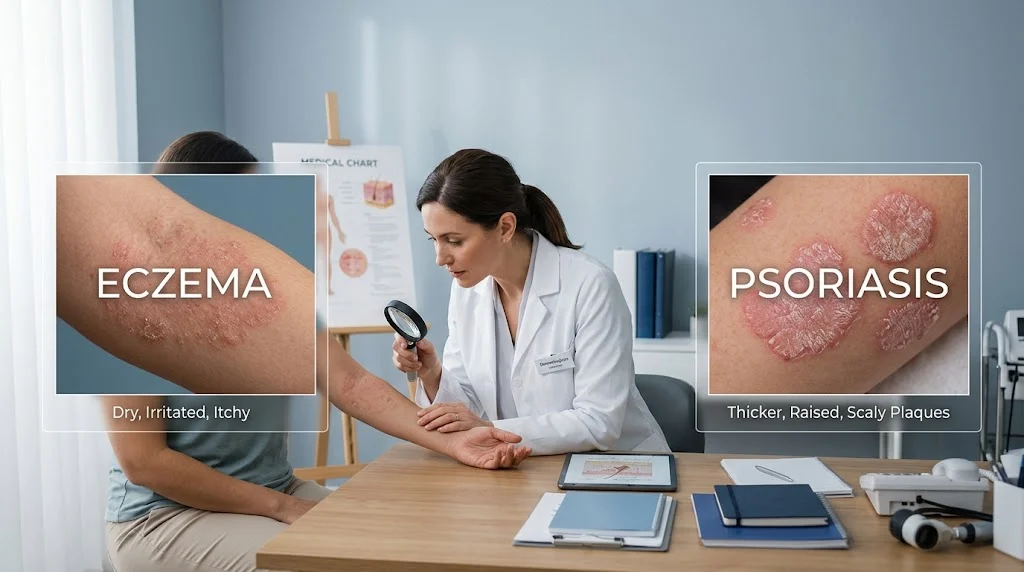
Eczema or psoriasis can both cause itchy, dry, inflamed, and scaly skin, but they are different inflammatory skin conditions. Eczema often causes intense itching and commonly affects skin folds, while psoriasis tends to form thicker, clearly defined plaques, often on the elbows, knees, scalp, or nails.
When people notice a red, dry, or itchy rash, it is easy to wonder whether it is eczema or psoriasis. The two conditions can look surprisingly similar, yet their patterns, triggers, symptoms, and treatment approaches are not identical. The American Academy of Dermatology notes that psoriasis commonly produces thick, well defined, scaly patches, while eczema is often associated with stronger itching and irritated, dry skin.
This distinction is more than a vocabulary question. A mistaken assumption can lead someone to use an unsuitable treatment or delay professional diagnosis. This guide explains the differences clearly, using evidence from dermatology sources and published clinical research.
Eczema vs Psoriasis: What’s the Difference?
Eczema is a noun referring to a group of inflammatory skin conditions that cause symptoms such as itching, dryness, irritation, and rash. Atopic dermatitis is the most common type of eczema, although eczema is a broader term that includes several conditions.
Psoriasis is also a noun. It is a chronic inflammatory skin condition in which skin cells develop much faster than normal, causing them to accumulate and form visible plaques or patches. Plaque psoriasis is the most common form.
| Feature | Eczema | Psoriasis |
| Basic nature | Inflammatory skin condition | Inflammatory and immune mediated skin condition |
| Typical appearance | Dry, irritated, rough or bumpy rash | Thick, raised, clearly defined plaques |
| Itching | Often intense | Can itch, but may also burn or sting |
| Common locations | Skin folds, hands, face, neck | Elbows, knees, scalp, lower back, nails |
| Scaling | May be dry or flaky | Often thicker and more noticeable |
| Triggers | Irritants, allergens, dryness, stress | Stress, infections, skin injury, some medicines |
| Contagious | No | No |
| Can both occur together? | Yes | Yes |
The most useful visual clue is often the quality of the rash. Eczema frequently produces intensely itchy, irritated skin, while psoriasis commonly creates thicker plaques with more clearly defined edges.
However, appearance alone cannot always provide a reliable diagnosis. Some people can have overlapping features or both conditions at the same time.
Mini Recap
Eczema usually emphasizes itching, irritation, and skin barrier problems.
Psoriasis often produces thicker, more sharply defined plaques and scales.
Both conditions involve inflammation and can come and go.
A dermatologist may be needed when the appearance is unclear.
Is Eczema vs Psoriasis a Grammar, Vocabulary, or Usage Issue?
This is primarily a medical terminology and usage issue, not a grammar problem.
The terms are not interchangeable. Saying that someone has eczema does not mean that they have psoriasis, even though the two conditions can resemble each other.
In formal medical writing, the terms should be used precisely. In casual conversation, people may call either condition a rash, skin irritation, or dry skin. Those descriptions are understandable, but they do not identify the underlying condition.
Academic and professional writing should be especially careful. A research paper, medical article, patient record, or educational resource should distinguish between eczema, atopic dermatitis, psoriasis, plaque psoriasis, and other dermatological conditions.
The same principle applies to technology. A symptom checker or health application may display both possibilities, but an algorithmic suggestion is not equivalent to a professional diagnosis.
Eczema: Symptoms, Locations, and Typical Patterns
Eczema commonly causes dry, irritated, itchy skin. Depending on the type and a person’s age, it may appear on the face, hands, neck, inner elbows, behind the knees, or other areas.
Atopic dermatitis frequently begins early in life, although it can develop later as well. The American Academy of Dermatology explains that eczema is a broader category, while atopic dermatitis is one particular type.
One of the strongest clues is itch intensity. Eczema is often extremely itchy, and repeated scratching can further damage the skin barrier. Some forms may also ooze or develop crusting.
Workplace Example
Someone who frequently washes their hands at work may develop irritated, dry, itchy skin from repeated exposure to soaps, detergents, or other irritants. That pattern can be consistent with hand eczema, although other conditions can look similar.
Academic Example
A medical student might write:
“The patient reported intense itching accompanied by dry, inflamed skin in the flexural areas.”
This is more precise than simply describing the patient as having a rash.
Technology Example
A symptom checker may identify eczema as one possibility when someone reports intense itching and dry skin. Such tools can provide general information, but they cannot reliably distinguish every inflammatory skin condition.
Eczema Usage Recap
Use eczema when referring to an eczema condition or eczema related rash.
Do not automatically use the word for every itchy rash.
The exact type of eczema may require professional assessment.
Psoriasis: Symptoms, Locations, and Typical Patterns
Psoriasis occurs when skin cells are produced too rapidly, causing them to build up on the skin surface. Plaque psoriasis commonly produces raised, thick patches covered by scale.
Common locations include the elbows, knees, scalp, lower back, palms, feet, and nails. Psoriasis can occur elsewhere too.
The plaques are often more sharply defined than typical eczema. Their color can also vary depending on skin tone, so relying on redness alone can be misleading.
Psoriasis can affect more than the skin. Some people with psoriasis develop psoriatic arthritis, which causes joint inflammation, pain, and swelling. Cleveland Clinic notes that about one in three people diagnosed with psoriasis will also develop psoriatic arthritis.
Workplace Example
A person may have persistent plaques on the elbows that repeatedly return despite ordinary moisturizers. That pattern may warrant an evaluation for psoriasis rather than assuming the problem is simply dry skin.
Academic Example
A suitable academic sentence would be:
“Psoriasis commonly produces raised, well defined plaques and may involve the scalp, nails, elbows, and knees.”
Technology Example
Modern health applications can recognize visual patterns associated with psoriasis, but image based systems have limitations. Skin tone, lighting, image quality, unusual presentations, and overlapping conditions can all affect automated assessments.
Psoriasis Usage Recap
Use psoriasis when referring to the specific inflammatory skin disease.
Do not treat every scaly rash as psoriasis.
Persistent plaques, nail changes, or joint symptoms deserve professional assessment.
When You Should NOT Use Eczema or Psoriasis
There are several situations in which casually labeling a rash can be misleading.
- Do not call every itchy rash eczema.
Itching has many possible causes, including infections, allergies, irritation, and other skin disorders. - Do not call every scaly patch psoriasis.
Fungal infections and several inflammatory skin conditions can resemble psoriasis. - Do not assume location proves the diagnosis.
Although certain areas are more typical for each condition, either condition can appear in less typical locations. - Do not assume redness means psoriasis.
Skin appearance differs considerably across skin tones. - Do not assume severe itching proves eczema.
Psoriasis can itch substantially too. - Do not use a previous diagnosis forever.
Skin conditions can change over time, and new symptoms may require reassessment. - Do not assume one treatment works for both conditions.
Some treatments overlap, but targeted therapies can differ substantially. - Do not ignore a rash that fails to respond.
Persistent or unusual lesions may need a dermatologist’s evaluation and, in selected cases, additional testing.
Common Mistakes and Decision Rules
| Correct sentence | Incorrect sentence | Explanation |
| She was diagnosed with eczema. | She was diagnosed with psoriasis because it was itchy. | Itching alone does not establish the diagnosis. |
| The patient developed psoriasis plaques. | The patient developed eczema plaques. | Plaques are particularly associated with psoriasis terminology. |
| His eczema became intensely itchy. | His psoriasis must be eczema because it itches. | Both conditions can itch. |
| The dermatologist evaluated the rash. | The patient diagnosed the rash from a photograph. | Diagnosis may require clinical examination. |
| Psoriasis affected the scalp. | Any scalp rash is psoriasis. | Several scalp conditions can resemble one another. |
Decision Rule Box
If the rash is intensely itchy, dry, and irritated, eczema may be one possibility.
If the rash consists of thick, raised, clearly defined plaques with scale, psoriasis may be one possibility.
If the appearance is unusual, persistent, widespread, painful, infected, or resistant to treatment, seek professional medical evaluation rather than relying on a label.
These are practical clues, not a substitute for diagnosis.
Eczema or Psoriasis in Modern Technology and AI Tools
AI powered health tools can increasingly analyze descriptions and images of skin conditions. They may help organize symptoms or suggest possibilities, but they should not be treated as definitive diagnostic systems.
One reason is that eczema and psoriasis can overlap visually. Cleveland Clinic specifically notes that healthcare providers sometimes need to consider the complete clinical picture and, in certain cases, biopsy findings.
AI also faces challenges involving skin tone, image quality, lighting, uncommon disease presentations, and multiple conditions occurring simultaneously.
The safest approach is to use technology as an information aid rather than as a replacement for a dermatologist.
Etymology and Medical Terminology
The word eczema comes from Greek and is associated with the idea of boiling or bubbling over, reflecting the historical description of inflamed skin.
Psoriasis comes from Greek terminology associated with itching and a skin condition resembling a rough or scaly eruption.
The terminology has evolved considerably as dermatology has become more scientifically precise.
Two Case Studies That Show Why the Difference Matters
Case Study 1: Childhood Psoriasis Mistaken for Other Conditions
A published Australian study examined 170 children with psoriasis, atopic dermatitis, or overlapping features. The results showed just 9.4 percent of children with psoriasis were correctly diagnosed by the referring doctor. The study identified clues such as scalp involvement, family history, defined plaques, and particular rash patterns that helped distinguish psoriasis from atopic dermatitis.
The practical lesson is important: children with unusual or persistent rashes may need specialist assessment rather than an assumption based only on itchiness or redness.
Case Study 2: A Rash That Looked Like Psoriasis
A published case from Lahore described a 70 year old man with persistent dry, red patches on his arms and legs. The initial clinical impression was psoriasis, but conventional psoriasis treatment produced only slight improvement. Biopsy revealed granulomatous inflammation, and subsequent testing identified an atypical mycobacterial infection.
The concrete result was a change in diagnosis after further investigation. This illustrates why a rash that does not respond as expected should not automatically be assumed to be a resistant case of psoriasis.
Error Prevention Checklist
Always use eczema when
You are specifically referring to an eczema diagnosis or eczema category.
The clinical context supports an eczema related condition.
You are discussing atopic dermatitis as a type of eczema.
Never use psoriasis when
You have only identified an unexplained itchy rash.
You are assuming that every scaly patch is psoriasis.
You are using the word as a general synonym for dry skin.
A healthcare professional has not confirmed the condition and the presentation is uncertain.
Related Grammar Confusions You Should Master
Although this topic is medical rather than grammatical, English learners often benefit from mastering other easily confused terms:
- Allergy vs intolerance
- Symptom vs sign
- Disease vs disorder
- Infection vs inflammation
- Chronic vs acute
- Treatment vs cure
- Diagnosis vs prognosis
- Medicine vs medication
- Effect vs side effect
- Condition vs symptom
Understanding these distinctions makes health related English more precise.
FAQs
What is the main difference between eczema and psoriasis?
Eczema commonly causes intense itching and irritated, dry skin, while psoriasis often produces thicker, clearly defined plaques covered with scale.
How can you tell if a rash is eczema or psoriasis?
Doctors consider the rash’s appearance, location, symptoms, medical history, and progression. In uncertain cases, additional testing may sometimes be necessary.
Is psoriasis more itchy than eczema?
Both can itch, but eczema is generally associated with more intense itching. Psoriasis may also cause itching, burning, or stinging.
Can you have eczema and psoriasis at the same time?
Yes. Some people have features of both conditions, and medical literature recognizes overlapping presentations.
Is eczema contagious like an infection?
No. Eczema itself is not contagious.
Is psoriasis contagious or infectious?
No. Psoriasis is not contagious and cannot be transmitted through ordinary physical contact.
Does psoriasis affect the nails?
Yes. Nail psoriasis can cause changes such as discoloration, pitting, thickening, or other nail abnormalities.
Conclusion
Understanding eczema or psoriasis starts with recognizing that these are distinct conditions that can nevertheless look remarkably similar. Eczema commonly features intense itching, dryness, and irritation, while psoriasis often produces thicker, sharply defined plaques and may affect the scalp, nails, elbows, or knees.
The most important lesson is not to diagnose a rash from one symptom alone. Location, appearance, severity, history, progression, and response to treatment all matter. When the diagnosis is uncertain, especially when symptoms persist or worsen, professional dermatological assessment is the safest approach.

Margaret Atwood is an American writer who contributes to LingRoya.com creating clear and engaging content about the English language and everyday communication. She enjoys helping readers build confidence in their writing through simple, practical guidance.