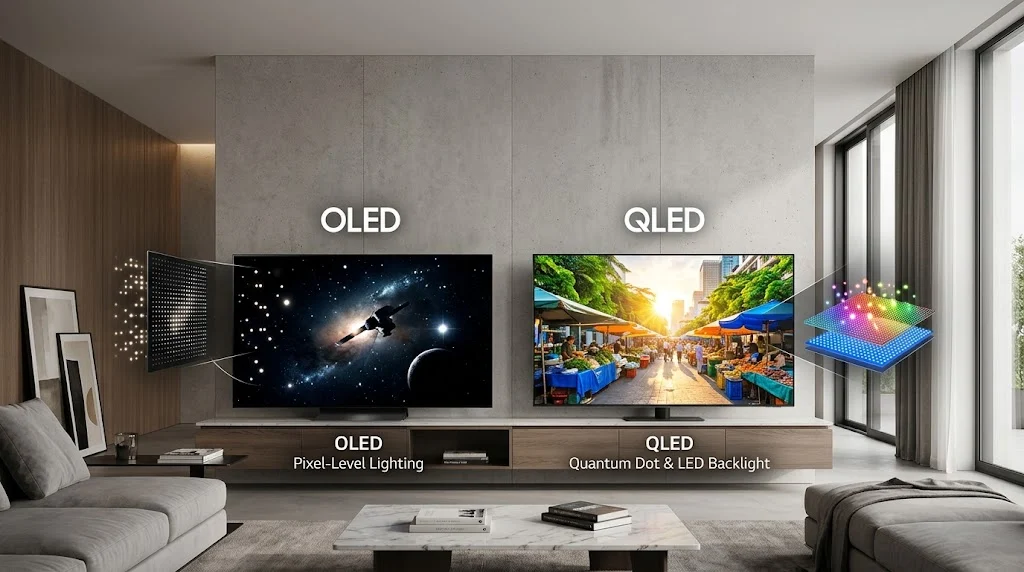
OLED and QLED are both advanced television technologies, but they create images differently. OLED panels control individual pixels, so each pixel can turn completely off. QLED TVs rely on a backlight enhanced by quantum dots. This makes OLED better for deep blacks and contrast, while QLED often wins for brightness and bright room viewing.
Choosing a new TV can become surprisingly confusing when two technologies appear to offer similar premium picture quality. The main question behind OLED or QLED is not simply which abbreviation sounds more advanced. OLED means Organic Light Emitting Diode, a display technology in which individual pixels produce their own light. QLED means Quantum Dot Light Emitting Diode, a technology that uses an LED backlight combined with a quantum dot layer to improve color and brightness.
This distinction matters because choosing the wrong panel can affect black levels, HDR performance, viewing angles, gaming responsiveness, and everyday viewing comfort. Understanding how each technology works makes the decision much easier.
QLED vs OLED: What’s the Difference?
OLED and QLED are display technologies designed to produce high quality television images, but their underlying approaches are fundamentally different.
OLED, a noun referring to a display technology, uses organic compounds that emit light when electrically stimulated. Every pixel can control its own brightness and can switch completely off. As a result, an OLED television can create extremely deep blacks without relying on a separate backlight.
QLED, also a noun referring to a display technology, generally combines a conventional LED backlight with a quantum dot layer. The quantum dots help produce strong color performance and high brightness. Because the screen still depends on a backlight, individual pixels cannot normally achieve the same pixel level black control as OLED.
| Feature | OLED | QLED |
| Light source | Individual pixels | LED backlight |
| Black levels | Excellent | Very good to excellent |
| Contrast | Excellent | Very good |
| Brightness | High | Usually very high |
| Viewing angles | Excellent | Varies by panel |
| HDR | Excellent | Excellent |
| Response time | Extremely fast | Fast |
| Risk of image retention | Possible | Generally lower |
| Bright room performance | Very good | Excellent |
| Typical strength | Contrast and cinematic images | Brightness and vivid color |
Mini Recap
OLED controls light at the pixel level, which gives it exceptional black levels and contrast.
QLED uses a backlight and quantum dots to produce bright, colorful images.
OLED is particularly impressive in dark rooms.
QLED can be a strong choice for bright rooms and high brightness HDR viewing.
Is OLED vs QLED a Grammar, Vocabulary, or Usage Issue?
No. OLED vs QLED is not a grammar or vocabulary confusion in the traditional sense. These are technical terms used to describe different display technologies.
The confusion is mainly a technology usage issue. Both terms appear in television advertisements, product specifications, reviews, and buying guides, so consumers may assume they describe two versions of the same technology.
They aren’t interchangeable. Calling an OLED television a QLED television changes the technical meaning. The terms should therefore be used according to the actual panel technology.
In academic or technical writing, OLED and QLED should be defined clearly when first introduced. In casual conversation, people may simply say OLED TV or QLED TV without explaining the terminology.
What Is OLED?
OLED televisions use pixels that emit their own light. Unlike traditional LCD televisions, OLED does not require a conventional backlight behind the entire panel.
This design creates one of OLED’s biggest advantages: each pixel can turn itself off. When a scene contains a completely black area, those pixels can remain off, producing exceptionally deep blacks.
Workplace Example
Imagine using a large OLED television as a presentation display in a controlled conference room. Dark charts, black backgrounds, and high contrast graphics can appear exceptionally clean, especially when the room isn’t flooded with sunlight.
Academic Example
For students studying photography, cinematography, or visual design, OLED provides an excellent example of pixel level light control. Dark scenes can demonstrate how contrast affects perceived image quality.
Technology Example
OLED is especially attractive for gaming because its pixels can change state extremely quickly. Fast response times can help reduce visible motion blur during rapid gameplay.
Usage Recap
Choose OLED when contrast and black levels are major priorities.
It is particularly compelling for movies, premium gaming, and dark room viewing.
Its pixel level control creates one of its biggest visual advantages.
What Is QLED?
QLED televisions use quantum dots to enhance the performance of an LED based display. The quantum dot layer can help produce strong colors and high brightness.
QLED should not be confused with OLED simply because both names contain the word LED. The technologies work differently. OLED pixels generate their own light, while QLED televisions generally use an LED backlight.
Workplace Example
A QLED television can work well in a bright office where sunlight or overhead lighting makes a darker display harder to see. Higher brightness can help presentations remain visible.
Academic Example
In a classroom, a bright QLED display can be useful when diagrams, charts, and educational videos need to remain clear despite ambient lighting.
Technology Example
QLED technology can be particularly attractive for HDR content because high brightness can make highlights such as sunlight, explosions, reflections, and bright skies appear more intense.
Usage Recap
Choose QLED when brightness is a major priority.
It can be particularly useful in bright rooms.
Its quantum dot technology can deliver vivid colors and strong HDR brightness.
When You Should NOT Use OLED or QLED
There are several situations where choosing a display solely because it is labeled OLED or QLED can lead to disappointment.
- Do not choose OLED solely for brightness. Some QLED models can become substantially brighter, particularly in demanding HDR scenes.
- Do not choose QLED solely because it is brighter. Brightness does not automatically mean better overall picture quality.
- Do not assume every QLED television is identical. Panel type, local dimming, processing, and backlight design can vary considerably.
- Do not assume OLED is automatically perfect for every room. Strong ambient light can reduce the perceived advantage of its excellent black levels.
- Do not treat QLED as a synonym for OLED. They use different methods of producing an image.
- Do not buy based only on the display label. Processing quality, resolution, refresh rate, HDR support, and viewing environment also matter.
- Do not ignore long term usage habits with OLED. Static images displayed repeatedly for very long periods can increase the possibility of image retention or burn in.
Common Mistakes and Decision Rules
| Correct sentence | Incorrect sentence | Explanation |
| This television uses an OLED panel. | This television uses a QLED panel. | The two technologies use different display structures. |
| QLED is useful in bright rooms. | QLED is always better than OLED. | Brightness does not determine every aspect of image quality. |
| OLED can produce deep blacks. | OLED needs a traditional backlight for every pixel. | OLED pixels generate their own light. |
| QLED can deliver high brightness. | QLED pixels always turn completely off individually. | Standard QLED depends on a backlight system. |
| OLED is excellent for contrast. | OLED is automatically the best choice for everyone. | Viewing conditions and priorities vary. |
Decision Rule Box
If you prioritize perfect blacks, exceptional contrast, wide viewing angles, and cinematic picture quality, consider OLED.
If you prioritize high brightness, vivid HDR highlights, and performance in bright rooms, consider QLED.
OLED and QLED in Modern Technology and AI Tools
Modern televisions increasingly combine advanced display technology with intelligent image processing. AI based processors can analyze scenes, improve upscaling, adjust contrast, recognize objects, and optimize picture settings.
However, AI processing does not eliminate the fundamental difference between OLED and QLED.
An intelligent processor can improve the way content is displayed, but an OLED panel still controls individual pixels while a conventional QLED television still depends on a backlight. This means panel technology remains an important part of the overall viewing experience.
For buyers, it is better to consider AI processing as one component of television performance rather than treating it as a replacement for panel technology.
Etymology and Technical Background
The term OLED comes from Organic Light Emitting Diode. The word organic refers to carbon based compounds used in the light emitting structure.
QLED stands for Quantum Dot Light Emitting Diode. Quantum dots are extremely small semiconductor particles that can influence the color of light produced by a display system.
The two names therefore describe different technological ideas. OLED emphasizes organic light emission, while QLED emphasizes quantum dot enhancement within an LED based display.
Expert Perspective
A useful way to think about the distinction is this: OLED gives you control over light at the pixel level, while QLED focuses on enhancing a backlit display with quantum dot technology.
That difference explains why OLED has such a strong reputation for contrast while QLED televisions are frequently recognized for brightness.
Two Practical Case Studies
Case Study 1: Movie Enthusiast
Consider someone who watches films primarily at night in a room with controlled lighting. Dark scenes, shadows, and subtle contrast are important to this viewer.
OLED is likely to be the more attractive choice because individual pixels can turn off completely. A night sky can appear genuinely black rather than slightly illuminated by a backlight.
Case Study 2: Bright Family Room
Now consider a family room with large windows and substantial daylight. The television is used for sports, news, streaming, and gaming throughout the day.
A high brightness QLED model can make more sense because strong brightness helps images remain visible in challenging lighting conditions. For this type of environment, QLED’s brightness advantage can be more meaningful than OLED’s superior black level performance.
Error Prevention Checklist
Always Consider OLED When
You watch many movies in dark rooms.
Deep blacks are extremely important to you.
You want excellent contrast.
You frequently watch from different seating positions.
Gaming response time is a major priority.
Never Choose QLED Simply Because
The name sounds similar to OLED.
It has a higher brightness specification.
An advertisement calls it premium.
You assume every QLED model has the same picture quality.
You believe brightness automatically means superior contrast.
Related Technology Confusions You Should Master
Understanding OLED and QLED is easier when you also understand several related television terms.
- OLED vs LED
- QLED vs LED
- Mini LED vs OLED
- OLED vs Mini LED
- LCD vs LED
- HDR vs SDR
- 4K vs 8K
- Refresh rate vs response time
- Dolby Vision vs HDR10
- Local dimming vs pixel level dimming
These comparisons help buyers understand why two televisions with the same resolution can still produce noticeably different images.
FAQs
Is OLED better than QLED for picture quality?
OLED generally has an advantage in black levels, contrast, and viewing angles, while QLED can offer higher brightness. The better option depends on your room and viewing priorities.
Is QLED brighter than OLED?
Many QLED televisions can achieve higher peak brightness than OLED models, making QLED particularly appealing for bright rooms and intense HDR highlights.
Is OLED better for watching movies?
OLED is often excellent for movies because its pixel level light control creates deep blacks and strong contrast, especially in dark viewing environments.
Is QLED better for bright rooms?
QLED can be an excellent choice for bright rooms because many QLED televisions offer very high brightness that helps overcome ambient light.
Which lasts longer, OLED or QLED?
Both technologies can provide many years of service. Lifespan depends on the specific television, usage pattern, brightness settings, and other factors.
Does OLED have better black levels than QLED?
Yes. OLED pixels can switch completely off, allowing OLED displays to produce exceptionally deep blacks. Standard QLED systems rely on a backlight.
Is QLED good for gaming?
Yes. Many QLED televisions offer high refresh rates, strong brightness, HDR support, and gaming features. The specific model matters more than the QLED label alone.
Can OLED suffer from burn in?
OLED panels can experience image retention and, under certain long term static content conditions, permanent burn in. Modern OLED televisions include features designed to reduce this risk.
Which is better for sports, OLED or QLED?
Both can be excellent. OLED offers very fast response and strong motion performance, while a bright QLED can be especially useful when watching sports in a brightly lit room.
Conclusion
The choice between OLED and QLED ultimately comes down to how and where you watch television. OLED is usually the stronger option when deep blacks, exceptional contrast, cinematic quality, and fast response are your priorities. QLED is often more appealing when high brightness, vivid HDR highlights, and bright room performance matter most.
There is no universal winner because television performance involves more than the panel label. Screen size, image processing, refresh rate, HDR support, viewing distance, room lighting, and the quality of the specific model all influence the final experience.

Philip Pullman is an American writer dedicated to creating clear and easy to follow English content. Through his work at LingRoya.com, he helps readers strengthen their language skills with practical and reliable guidance so that they can easily understand.