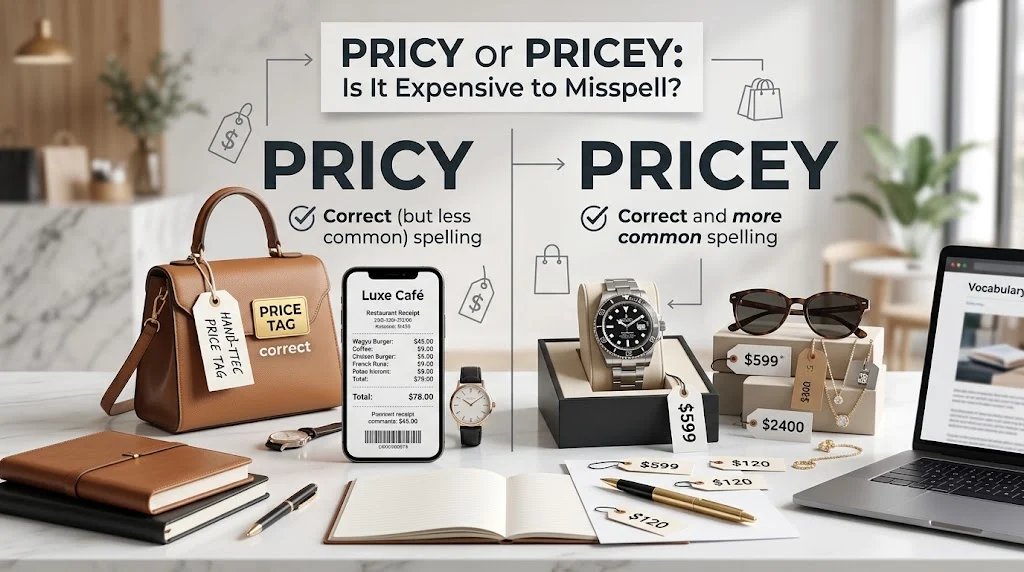
Both pricy and pricey mean expensive or relatively costly. Pricey is the more common spelling in modern English and is generally the safest choice for general, professional, and online writing. Pricy is also correct and appears in dictionaries, but it is less frequently used.
If you’ve ever wondered whether an expensive restaurant is “pricy” or “pricey,” the good news is that you don’t have to choose between a correct and an incorrect word. Both spellings are legitimate. The difference is largely one of spelling preference and frequency rather than meaning. Pricey is the form most readers are likely to encounter, while pricy is a recognized alternative that follows a more economical spelling pattern. For students, bloggers, business writers, editors, and English learners, knowing which version is more familiar can help make writing sound natural and polished without treating the less common form as an error.
Pricy vs Pricey: What’s the Difference?
The words pricy and pricey are adjectives.
Both describe something that costs a relatively large amount of money.
For example:
“That restaurant is pricey.”
“That restaurant is pricy.”
Both sentences communicate essentially the same idea.
The main difference is spelling frequency and preference.
| Word | Part of Speech | Meaning | Usage | Example |
| Pricey | Adjective | Expensive or relatively costly | More common | This hotel is pricey. |
| Pricy | Adjective | Expensive or relatively costly | Less common | The hotel was rather pricy. |
Mini Recap
Pricey and pricy have the same basic meaning.
Both are grammatically correct adjectives.
Pricey is considerably more common in everyday English.
Pricy is an accepted alternative spelling.
For most general writing, pricey is the safer and more familiar choice.
Is Pricy vs Pricey a Grammar, Vocabulary, or Usage Issue?
The distinction between pricy and pricey is primarily a spelling and usage issue, not a difference in grammar or meaning.
Both words function as adjectives and can describe something considered expensive.
For example:
“The tickets are pricey.”
“The tickets are pricy.”
There is no meaningful grammatical difference between these sentences.
The real issue is reader familiarity. Because pricey is much more common, it may look more natural to most English speakers. Pricy can appear unusual to some readers even though it is valid.
Are Pricy and Pricey Interchangeable?
Yes. In ordinary usage, they are interchangeable.
You can describe an expensive car as “pricey” or “pricy,” and the intended meaning remains the same.
However, interchangeable does not necessarily mean equally common. English frequently contains multiple accepted spellings where one form becomes dominant over time.
Formal vs Informal Usage
Both words are generally associated with informal or conversational English because pricey itself has a somewhat conversational tone.
In highly formal financial or academic writing, alternatives such as expensive, costly, high priced, or associated with a high cost may sound more appropriate depending on the context.
For example:
Casual:
“The new laptop is pretty pricey.”
More formal:
“The new laptop has a relatively high purchase cost.”
Academic vs Casual Usage
In academic writing, pricey and pricy are not necessarily wrong, but expensive or costly may be more suitable when a formal tone is expected.
In blogs, product reviews, emails, conversations, and lifestyle writing, pricey is perfectly natural.
How to Use Pricey Correctly
Pricey means expensive, particularly when something costs more than expected, more than one would prefer, or more than comparable alternatives.
It often expresses an opinion rather than an objective measurement.
For example:
“The coffee is pricey.”
This does not necessarily mean the coffee is objectively expensive by a universal standard. It means the speaker considers the price high.
Workplace Example
“The new software subscription is a little pricey for a small company.”
Here, pricey communicates that the subscription costs more than the company would prefer to pay.
Academic Example
“The researchers noted that the equipment was relatively pricey compared with older models.”
The adjective describes a comparatively high cost.
Technology Example
“That smartphone is pricey, but it has a powerful processor and advanced camera system.”
Here, pricey means expensive relative to what the speaker expects.
Usage Recap for Pricey
Use pricey when you want to describe something as relatively expensive.
It is the more familiar spelling.
It works naturally in conversations, reviews, blogs, workplace communication, and general writing.
For formal academic contexts, consider whether expensive or costly better matches the tone.
How to Use Pricy Correctly
Pricy has the same meaning as pricey. It is an accepted spelling of the adjective meaning expensive.
Example:
“The designer furniture is quite pricy.”
There is nothing grammatically wrong with this sentence.
The main consideration is that some readers may be more accustomed to seeing pricey.
The spelling pricy can seem logical because many English adjectives formed with the suffix associated with “y” remove the final e before adding the ending.
Compare:
Noise becomes noisy.
Spice becomes spicy.
Ice becomes icy.
However, price has historically produced variation because both pricy and pricey have developed as accepted spellings.
Workplace Example
“The conference venue is too pricy for our current budget.”
The word communicates that the venue costs more than the organization wants to spend.
Academic Example
“The treatment may be effective but relatively pricy for low income communities.”
The adjective describes a comparatively high cost.
Technology Example
“The premium version of the application is somewhat pricy.”
The meaning is exactly the same as “pricey.”
Usage Recap for Pricy
Pricy is a legitimate spelling.
It means the same thing as pricey.
It is less common, so some readers may find it less familiar.
Use it when the spelling fits your preferred style, but choose pricey when maximum familiarity is your priority.
When You Should NOT Use Pricy or Pricey
There are several situations where neither word may be the best choice.
- Do not use either word when you need an exact financial measurement. Use a specific amount instead.
- Avoid pricey or pricy in highly technical financial statements when “expensive” or a precise cost description would be clearer.
- Do not treat pricey as an objective measurement. It usually expresses the writer’s or speaker’s perception of high cost.
- Do not assume that pricey means unaffordable. Something can be pricey while still being affordable.
- Do not use pricy simply because you think pricey is misspelled. Both forms are accepted.
- Do not switch between the two spellings randomly within the same article or document.
- Avoid casual terms such as pricey when your institution or publication requires a strictly formal vocabulary.
- Do not use either form when you actually mean “valuable.” A valuable product can be expensive, inexpensive, or even free.
Common Mistakes and Decision Rules
| Correct Sentence | Incorrect Sentence | Explanation |
| The restaurant is pricey. | The restaurant is pricey. | Pricey is the standard spelling, not pricey with a different vowel. |
| The restaurant is pricy. | The restaurant is pricyy. | Pricy is an accepted alternative spelling. |
| The laptop is quite pricey. | The laptop is quite pricey. | Pricey is spelled with the sequence “cey.” |
| The hotel was surprisingly pricey. | The hotel was surprisingly price. | Price is a noun or verb, not the adjective intended here. |
| The service is rather pricy. | The service is rather pricie. | Pricy is the recognized shorter spelling. |
Decision Rule Box
If you mean expensive, both pricy and pricey can be correct.
If you want the spelling most readers are familiar with, choose pricey.
A practical rule is simple: pricey is the default choice; pricy is an accepted alternative.
Pricy and Pricey in Modern Technology and AI Tools
The words appear frequently in technology reviews, comparison articles, shopping guides, and AI discussions.
For example:
“The premium AI plan is pricey for casual users.”
This tells readers that the writer considers the subscription expensive.
Likewise:
“The enterprise package is pricy, but it includes advanced features.”
The meaning remains unchanged.
AI writing tools may generate either spelling depending on their training data, language settings, and stylistic preferences. When editing AI generated content, consistency matters more than treating one spelling as inherently correct.
For websites targeting a broad English speaking audience, pricey is usually the more recognizable choice. Searchers are also more likely to encounter this spelling in ordinary product reviews and consumer writing.
Etymology and History of Pricy and Pricey
Both spellings developed from price, combined with the adjective forming suffix that produces words describing a quality or characteristic.
The word pricey became established as a common informal adjective meaning expensive. Pricy developed as a spelling variant.
English has many spelling variations that survive because speakers and writers form words according to slightly different patterns.
The existence of both forms demonstrates that spelling variation does not automatically mean one version is wrong. Dictionary recognition and actual usage are more reliable guides than intuition alone.
An Expert Style Principle
“When two spellings carry the same meaning, usage frequency often determines which form feels most natural.”
That principle is especially useful when choosing between legitimate spelling variants. Correctness and familiarity are related, but they are not always identical.
Two Practical Case Studies
Case Study 1: Product Review
Imagine a technology reviewer writes:
“The latest flagship phone is pricey.”
The sentence immediately tells the reader that the reviewer considers the phone expensive.
Now replace pricey with pricy:
“The latest flagship phone is pricy.”
The meaning remains the same.
Result: Both forms communicate the same evaluation, but pricey is more familiar to a general audience and therefore may feel more natural in a mainstream product review.
Case Study 2: Business Communication
Suppose a manager writes:
“The proposed software package is pricy, so we should compare it with two alternatives.”
The sentence is grammatically correct.
However, changing it to:
“The proposed software package is pricey, so we should compare it with two alternatives.”
makes the wording more familiar to most general readers.
Result: The meaning remains unchanged, while the more common spelling improves immediate reader recognition.
These examples demonstrate an important distinction: pricy is not an error simply because pricey is more common.
Error Prevention Checklist
Always use Pricey when
You want the most familiar spelling.
You are writing for a broad general audience.
You are creating a product review or consumer article.
You want a natural conversational adjective meaning expensive.
You prefer the dominant modern spelling.
Never use Pricy when
You are claiming that it is the only correct spelling.
You are switching between pricy and pricey without a reason.
Your publication style guide specifically requires pricey.
You think pricy and pricey have different meanings. They do not.
Related Grammar Confusions You Should Master
If you are working on English spelling and word choice, these related comparisons are worth learning:
- Costly vs expensive
- Everyday vs every day
- Affect vs effect
- Advice vs advise
- Breathe vs breath
- Lose vs loose
- Compliment vs complement
- Principal vs principle
- Stationary vs stationery
- Practice vs practise
These distinctions can help improve spelling accuracy and vocabulary choices across professional and academic writing.
FAQs
Is pricy or pricey correct?
Both pricy and pricey are correct spellings of an adjective meaning expensive. Pricey is much more common and is usually the safer choice for general writing.
Is pricy a real word?
Yes. Pricy is a recognized spelling variant meaning expensive or relatively costly.
Is pricey spelled with an e?
Yes. The common spelling is pricey, with the letters e and y following the c.
Which is more common, pricy or pricey?
Pricey is considerably more common in modern general English, while pricy is a less frequently used alternative.
Does pricy mean the same as pricey?
Yes. Pricy and pricey have the same basic meaning and can generally be used interchangeably.
Is pricey formal or informal?
Pricey is generally conversational and informal in tone. In highly formal writing, expensive or costly may be more appropriate.
Can I use pricey in academic writing?
Yes, but it may sound conversational. Depending on the subject and tone, expensive, costly, or a precise description of cost may be preferable.
Why are there two spellings of pricy and pricey?
Both spellings developed as accepted variants of an adjective formed from price. English spelling allows some variation, and both forms have remained in use.
Should I use pricy or pricey in an article?
For a broad audience, pricey is generally the better choice because it is more familiar and more widely used.
Is pricey a negative word?
Not necessarily. Pricey usually expresses that something is relatively expensive, but the word itself does not automatically mean that the product or service is bad or not worth buying.
Conclusion
The difference between pricy or pricey is not a difference in meaning. Both words are accepted adjectives meaning expensive or relatively costly. The main distinction is usage frequency: pricey is the much more familiar spelling, while pricy is a legitimate alternative.
If you are writing for a broad audience and want the most recognizable option, choose pricey. If you encounter pricy in edited writing, however, there is no need to assume it is a spelling mistake. Understanding this distinction helps you make confident vocabulary and spelling choices without confusing accepted variation with grammatical error.

Neil Gaiman is an American writer who contributes educational content to LingRoya.com. His work focuses on helping readers improve their English with clear, practical and easy to follow guidance.