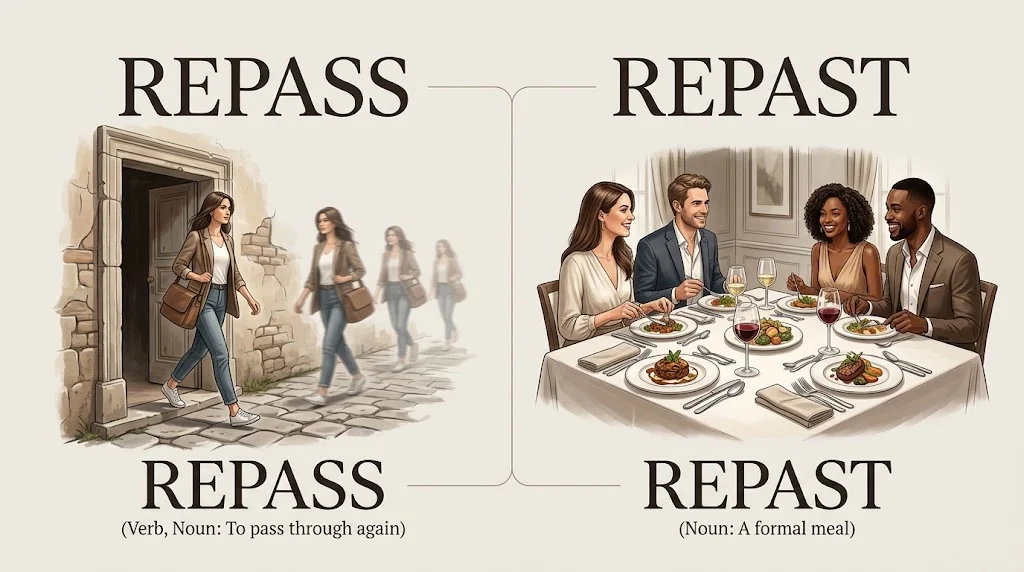
Quick Answer: Repass means to pass again or to go through something another time, while repast is a noun meaning a meal or the food served at a meal. The two words are not interchangeable.
Few English word pairs create confusion simply because they look and sound so similar. Repass or repast is a good example. Repass is generally a verb meaning to pass again, whereas repast is a noun referring to a meal or the act of eating. This small spelling difference can cause genuine mistakes in essays, workplace communication, historical writing, and edited content.
From an English usage perspective, understanding the grammatical role, meaning, and context of each word is more reliable than depending on pronunciation alone. A strong vocabulary strategy is to connect each word with its meaning and grammatical function before using it.
Repass vs Repast: What’s the Difference?
The simplest way to remember the distinction is this: repass describes passing again, while repast refers to a meal.
| Word | Part of Speech | Meaning | Typical Context | Example |
| Repass | Verb | To pass again or go through again | Movement, review, repeated passage | We may repass the same location tomorrow. |
| Repast | Noun | A meal or food eaten at a meal | Formal, literary, historical writing | The guests enjoyed a generous repast. |
Repass is associated with repetition of passing or moving through something.
Repast is associated with eating and nourishment.
They have different grammatical functions and different meanings.
Using one in place of the other can produce an incorrect or unintentionally humorous sentence.
Is Repass vs Repast a Grammar, Vocabulary, or Usage Issue?
This is primarily a vocabulary and usage issue, although grammar also matters because the two words normally perform different roles in a sentence.
Repass is chiefly used as a verb. It describes an action involving passing again. Depending on context, it can refer to physically passing through a place again or figuratively going through something again.
Repast is a noun. It refers to a meal, especially when the writer wants a formal, literary, or somewhat old fashioned tone.
The words are therefore not interchangeable.
In everyday conversation, repast is relatively uncommon. Most speakers simply say meal, lunch, dinner, breakfast, or food. Repass is also less common than ordinary alternatives such as pass again, return, or go through again.
In academic and formal writing, repast may appear in historical, literary, cultural, or descriptive contexts. Repass can occur when describing movement or repeated examination.
The key distinction is meaning, not pronunciation.
How to Use Repass Correctly
Repass works as a verb when something passes again or someone passes through a place again. The exact meaning depends on the surrounding sentence.
Consider this workplace example:
“The delivery team will repass the loading area after completing the first inspection.”
Here, repass indicates that the team will pass through the area again.
An academic example might be:
“The researcher decided to repass the evidence before presenting the final argument.”
In this sentence, the writer uses repass in the sense of going through something again. However, depending on the intended meaning, review, reexamine, or revisit would often sound more natural in modern academic English.
A technology example could be:
“The autonomous vehicle may repass the same checkpoint if its route changes.”
Here, repass describes repeated movement through a particular location.
The word can therefore be grammatically correct while still sounding unusual. Modern English often prefers clearer alternatives such as pass again, return to, review, or revisit.
Usage Recap for Repass
Use repass when you mean passing again.
It normally functions as a verb.
It can describe physical or figurative repetition.
In everyday writing, a simpler alternative may sound more natural.
How to Use Repast Correctly
Repast is a noun meaning a meal or food consumed during a meal. It has a distinctly formal, literary, or historical flavor.
For example, in a workplace setting:
“The conference concluded with a formal repast for the visiting delegates.”
The word refers to the meal provided for the delegates.
In academic writing, you might encounter:
“Historical records describe the elaborate repast served during the ceremony.”
This usage is particularly suitable for discussions of historical customs, social traditions, or literature.
In technology related writing, repast is less common, but it can still be used when a digital publication discusses food culture. For example:
“The application records each repast in the user’s dietary journal.”
Although grammatically possible, a modern technology article would probably use meal instead because it is more familiar and direct.
Repast often works best when the writer deliberately wants a formal or literary tone.
Usage Recap for Repast
Use repast when you mean a meal.
It is a noun.
It is more formal than the everyday word meal.
It frequently appears in literary, historical, and descriptive writing.
When You Should NOT Use Repass or Repast
Understanding when to avoid these words is just as useful as knowing their definitions.
- Do not use repast when you mean passing again.
Incorrect: “The hikers will repast the narrow trail.”
Correct: “The hikers will pass the narrow trail again.”
- Do not use repass when you mean a meal.
Incorrect: “The family prepared a large repass for the guests.”
Correct: “The family prepared a large repast for the guests.”
- Avoid repast in casual conversation when meal is clearer.
Saying “What did you have for repast?” can sound unnecessarily formal. “What did you have for dinner?” is much more natural.
- Avoid repass when review is the intended meaning.
If you mean examining information again, review or revisit may communicate the idea more clearly.
- Do not choose a word simply because it sounds right.
Pronunciation can make these words seem related in meaning, but their definitions are different.
- Do not treat the words as interchangeable spelling variants.
They represent separate vocabulary items.
- Avoid unnecessarily unusual vocabulary in technical writing.
If meal communicates the meaning perfectly, repast may add unnecessary formality.
- Do not assume every dictionary word is equally common.
A word can be correct yet uncommon. Good writing considers both correctness and natural usage.
Common Mistakes and Decision Rules
| Correct sentence | Incorrect sentence | Explanation |
| The travelers passed the village again. | The travelers repasted the village. | Repass is not normally used as a substitute for every form of pass again. |
| The guests enjoyed a lavish repast. | The guests enjoyed a lavish repass. | A meal is a repast. |
| We will pass through the area again. | We will repast through the area. | Repast is a noun, not a verb meaning pass. |
| The historian described the royal repast. | The historian described the royal repass. | The subject is a meal. |
| The vehicle passed the checkpoint again. | The vehicle repasted the checkpoint. | Modern English normally prefers passed again here. |
Decision Rule Box
If you mean passing again, consider repass or the clearer phrase pass again.
If you mean a meal, use repast.
If you mean examining something again, use review, revisit, or reexamine.
If you mean ordinary food or an everyday meal, meal is usually the most natural choice.
Repass and Repast in Modern Technology and AI Tools
Modern technology has changed how quickly unusual vocabulary is encountered. Search engines, grammar checkers, writing assistants, and AI tools can identify spelling patterns, but users still need to understand meaning and context.
An AI writing assistant may recognize repast as a noun connected with meals and identify repass as a verb connected with passing again. However, automated suggestions should not replace human judgment. A technically valid word may still be an awkward choice for the intended audience.
For example, an AI generated sentence containing repast may be grammatically sound but unnecessarily formal for a restaurant review. Similarly, an AI system might suggest repass when the writer really means review.
This illustrates an important principle of modern editing: correct vocabulary is not merely about spelling. It is about meaning, grammatical function, register, and context.
The Etymology Behind the Two Words
The similarity between these words becomes easier to understand when their histories are considered.
Repass is formed from the prefix re, conveying the idea of doing something again, combined with the verb pass. Its basic concept is therefore connected with passing again.
Repast has a different history. It comes through French from Latin roots associated with food and feeding. Its meaning developed around the idea of a meal or food taken at a particular time.
The shared beginning can therefore be misleading. Their histories and meanings developed along different paths.
An Editor’s Perspective
“When two words look alike but mean different things, meaning should always control the choice.”
That principle is particularly useful for repass and repast. Instead of asking which spelling looks familiar, ask what the sentence is actually trying to communicate.
Two Practical Case Studies
Case Study 1: A Historical Description
Suppose a writer describes an elaborate royal dinner and writes:
“The king welcomed his guests to a magnificent repass.”
The reader may understand the intended meaning, but the standard word for a formal meal is repast.
Revised version:
“The king welcomed his guests to a magnificent repast.”
The correction improves both vocabulary accuracy and historical tone.
Case Study 2: A Route Description
Consider this sentence:
“The travelers planned to repast through the village on their return.”
The writer presumably means that the travelers will pass through the village again.
A clearer revision is:
“The travelers planned to pass through the village again on their return.”
Although repass exists, modern writers will often find pass through again much more natural and immediately understandable.
These examples demonstrate an important lesson: the best correction is not always simply replacing one uncommon word with another. Sometimes the strongest edit is to choose the clearest everyday expression.
Author expertise: Written from the perspective of an English language editor and linguistics focused SEO content specialist with extensive experience explaining vocabulary, grammar, spelling, and usage distinctions.
Error Prevention Checklist
Always use Repass when
- You genuinely mean passing again.
- The context involves repeated movement.
- You are using the word as a verb.
- The surrounding sentence makes repeated passage clear.
Never use Repast when
- You mean passing again.
- You mean returning to a location.
- You mean reviewing information.
- You are simply looking for a verb meaning pass again.
Always use Repast when
- You mean a meal.
- You want a formal or literary noun.
- You are discussing historical dining customs.
- The context clearly concerns food or eating.
Never use Repass when
- You mean a meal.
- You mean dinner or lunch.
- You are describing food served to guests.
- The sentence requires a noun referring to a meal.
Related Grammar Confusions You Should Master
Learning this distinction becomes easier when you also understand other commonly confused English words.
- Accept or except
- Affect or effect
- Advice or advise
- Complement or compliment
- Principal or principle
- Stationary or stationery
- Practice or practise
- Then or than
- Lose or loose
- Further or farther
These pairs demonstrate the same broader principle: similar spelling or pronunciation does not guarantee similar meaning.
Frequently Asked Questions
What is the difference between repass and repast?
Repass is generally a verb associated with passing again, while repast is a noun meaning a meal. They have different meanings and grammatical functions and should not be used interchangeably.
Is repast another word for dinner?
Yes. Repast can mean a meal, including dinner, although it is considerably more formal and literary than the everyday word dinner.
Is repass a correct English word?
Yes. Repass is an established English word meaning to pass again or go through again. However, modern writers may prefer clearer expressions such as pass again or return through, depending on context.
Is repast formal English?
Repast is generally considered formal, literary, or somewhat old fashioned. It is much less common in ordinary conversation than meal, lunch, dinner, or food.
Can repass mean review?
In some contexts, repass can convey the idea of going through something again. However, review, revisit, or reexamine is often clearer when discussing information, evidence, or written material.
What is a synonym for repast?
Common synonyms include meal, feast, dinner, food, and refreshment. The best synonym depends on the context and desired level of formality.
What is a synonym for repass?
Depending on context, alternatives include pass again, go through again, return through, revisit, or review. Not every alternative fits every sentence.
Why are repass and repast confused?
They look and sound similar, particularly because both begin with the same letters. Their meanings, however, are different. Repass concerns passing again, while repast concerns a meal.
Which word should I use in everyday English?
For a meal, use meal, lunch, dinner, or breakfast in most everyday situations. For passing again, pass again is often clearer than repass.
Conclusion
The distinction between repass or repast becomes straightforward once you focus on meaning and grammatical function. Repass relates to passing again, while repast is a noun referring to a meal. They are not interchangeable, and choosing the wrong one can produce an inaccurate sentence.
When in doubt, identify what the sentence means first. If the idea involves repeated passage, use a suitable expression such as pass again. If the subject is food or a meal, repast is the formal choice. For everyday writing, simpler alternatives are often preferable because clarity matters more than unnecessarily sophisticated vocabulary.

Margaret Atwood is an American writer who contributes to LingRoya.com creating clear and engaging content about the English language and everyday communication. She enjoys helping readers build confidence in their writing through simple, practical guidance.