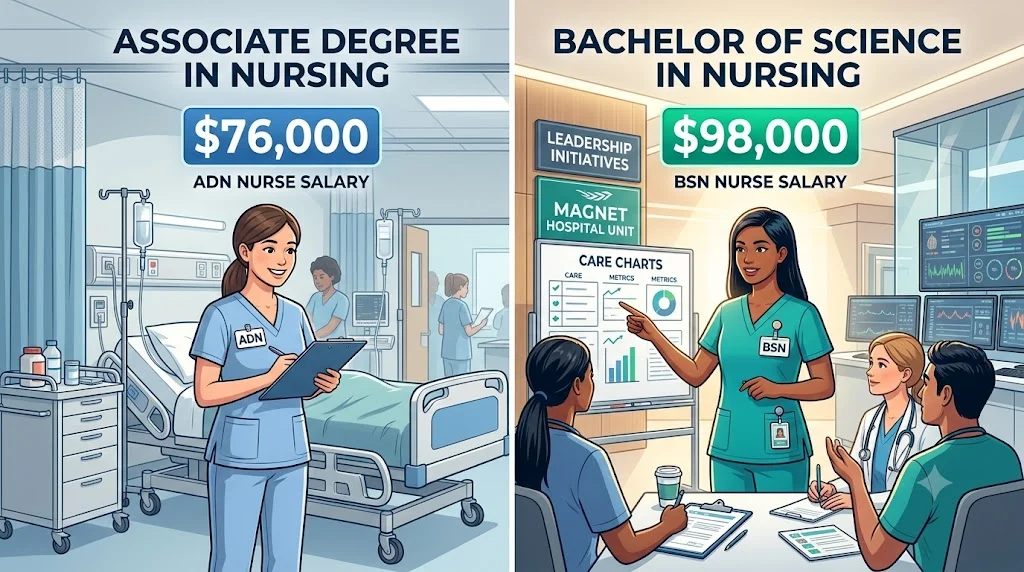
The difference between RN and BSN salary comes down to education level: an RN (Registered Nurse) is a licensure, while a BSN (Bachelor of Science in Nursing) is a degree.
Many nurses assume that all RNs earn roughly the same amount regardless of their educational background. That assumption is incorrect. While both ADN and BSN graduates qualify to take the NCLEX RN exam and become licensed registered nurses, the salary outcomes for these two paths are notably different. Understanding these differences is essential for anyone planning their nursing career, whether you are just starting out or considering going back to school.
The confusion around nurse salary often stems from the overlapping terminology. People use RN and BSN interchangeably, but they are not the same thing. An RN is a professional license, while a BSN is an academic degree. You can be an RN with an associate degree, a BSN, or even a diploma. This distinction matters because employers increasingly prefer and pay more for nurses with bachelor’s degrees.
RN vs BSN: What’s the Difference?
Comparison Table: RN (ADN) vs BSN
| Factor | RN with ADN | RN with BSN |
| Education length | 2 to 3 years | 4 years |
| Average annual salary | $76,000 to $82,000 | $82,750 to $98,000 |
| Median national wage | $93,600 (all RNs) | $96,000 to $99,000 |
| Leadership opportunities | Limited | Greater access |
| Magnet hospital eligibility | Restricted | Preferred or required |
| Career advancement | Slower progression | Faster progression |
| Specialty unit access | Limited | Broader access |
| Long term earning potential | Lower ceiling | Higher ceiling |
Sources: Payscale, BLS May 2024 data, and industry salary surveys
The numbers tell a clear story. According to Payscale data, ADN educated nurses earn an average of $76,000 per year, while BSN educated nurses earn approximately $82,750 annually. Other sources report even wider gaps, with BSN holders averaging $98,000 compared to $75,000 for ADN holders. The Bureau of Labor Statistics reports that the median annual wage for all registered nurses was $93,600 as of May 2024, with BSN prepared nurses consistently occupying the upper tiers of that range.
What drives these differences? BSN nurses have access to leadership roles, specialty units, and Magnet designated facilities that pay above market wages. These opportunities simply are not available to nurses with only an associate degree, regardless of their experience level.
Is RN vs BSN Salary a Grammar, Vocabulary, or Usage Issue?
This is not a grammar question but rather a fundamental misunderstanding of nursing credentials and their impact on compensation. The confusion arises because people use RN and BSN as if they represent the same thing, when in fact they represent different aspects of nursing qualification.
Interchangeable or not: These terms are not interchangeable. RN is a license; BSN is a degree. You cannot say “I am a BSN” to mean you are a registered nurse, though many people do. The correct phrasing is “I am an RN with a BSN” or “I am a BSN prepared RN.”
Formal vs informal usage: In formal healthcare settings, credentials are listed precisely. You will see “Jane Doe, RN, BSN” on name badges and official documents. Informally, people might say “she is a BSN nurse” to mean she has a bachelor’s degree in nursing. However, the distinction matters when discussing salary because employers compensate based on both licensure and education.
Academic vs casual usage: In academic and professional contexts, the distinction is clear and important. Nursing journals, hospital policies, and salary discussions all differentiate between educational levels. In casual conversation, people often conflate the terms, which leads to confusion about why some nurses earn more than others.
Practical Usage: RN Salary
When we talk about RN salary, we are referring to the compensation earned by licensed registered nurses across all educational backgrounds. The national landscape for RN pay has shifted significantly in recent years.
Workplace Example
In a typical hospital setting, a staff RN with an associate degree might earn a base salary of $75,000 per year. That same hospital might pay a BSN prepared RN $82,000 for the same position, simply because the pay scale includes an educational differential. Many healthcare systems have formalized these differences, with BSN nurses receiving a percentage bump over their ADN counterparts. According to Becker’s Hospital Review, the mean annual wage for registered nurses reached $101,420 in 2025. However, this average includes nurses at all education levels, masking the significant differences between ADN and BSN earners.
Academic Example
Nursing schools and academic institutions track graduate outcomes closely. A 2025 study by Regis College found that BSN graduates from their program had starting salaries approximately 10% higher than ADN graduates from the same region. This pattern holds across most academic institutions, with BSN programs reporting higher average starting salaries for their graduates. The BLS reports that the national mean annual wage for RNs is $101,420, but this figure climbs significantly for BSN prepared nurses in leadership or specialty roles.
Technology Example
In the growing field of telehealth and healthcare technology, BSN prepared nurses often command premium salaries. Companies developing remote patient monitoring systems, AI driven clinical decision support tools, and digital health platforms actively recruit BSN nurses for their additional training in evidence based practice and research methodology. These positions frequently pay $10,000 to $15,000 more annually than traditional RN roles with similar experience requirements.
RN Salary Recap
RN salary varies widely based on education, location, and experience. The median RN salary nationally is approximately $97,550 according to May 2025 BLS data, with state level figures ranging from $77,080 in Alabama to $140,270 in California. However, BSN prepared RNs consistently earn more than their ADN counterparts, with the gap widening over the course of a career.
Practical Usage: BSN Salary
BSN salary refers specifically to the compensation earned by registered nurses who hold a Bachelor of Science in Nursing degree. This group consistently out earns RNs with only associate degrees.
Workplace Example
In Magnet designated hospitals, which represent the gold standard for nursing excellence, BSN nurses are not just preferred but often required for leadership positions. These facilities pay above market wages to attract and retain BSN prepared staff. According to the American Nurses Credentialing Center, Magnet hospitals require nurse managers to hold at least a BSN. The pay differential in these settings can be substantial, with BSN charge nurses earning $5,000 to $10,000 more annually than ADN staff nurses in the same department.
Academic Example
Nursing faculty positions almost universally require a BSN as a minimum qualification, with many institutions now requiring graduate degrees. BSN prepared nurses who transition to education or research roles see significant salary increases. Nursing instructors and teachers at the postsecondary level earned a mean annual wage of $86,410 in 2025. While this is lower than some clinical roles, it reflects the additional career pathways available to BSN graduates.
Technology Example
The healthcare technology sector increasingly values BSN prepared nurses for roles in clinical informatics, electronic health record optimization, and nursing technology consulting. These positions often pay $100,000 or more annually, with BSN nurses leveraging their additional training in research methodology and evidence based practice to drive technology adoption in clinical settings. The demand for BSN prepared nurses in technology roles has grown significantly as healthcare systems invest in digital transformation.
BSN Salary Recap
BSN salary consistently exceeds ADN salary across all settings and regions. The difference ranges from approximately $6,000 to over $20,000 annually, with the gap widening as nurses advance in their careers. BSN prepared nurses also have access to higher paying specialties, leadership roles, and Magnet hospitals that are largely unavailable to nurses with only associate degrees.
When You Should NOT Use RN or BSN
Understanding when not to use these terms is just as important as knowing when to use them correctly.
- Do not use RN to describe a degree. RN is a license, not a degree. Saying “I have an RN degree” is incorrect. You have an RN license and a nursing degree (ADN, BSN, or diploma).
- Do not use BSN to describe someone who is not licensed. A BSN is an academic degree. Someone with a BSN who has not passed the NCLEX is not an RN and cannot practice nursing.
- Do not assume all RNs have the same education. RNs come from ADN, BSN, and diploma programs. Assuming someone with an RN license has a BSN can lead to misunderstandings about their qualifications.
- Do not use RN and BSN interchangeably in salary discussions. When comparing salaries, you must distinguish between RNs with ADN and RNs with BSN. The salary differences are significant and meaningful.
- Do not assume BSN always means higher pay in every setting. While BSN nurses generally earn more, there are exceptions. In some rural areas or small facilities, the pay differential may be minimal or nonexistent.
- Do not use BSN as a shorthand for advanced practice. BSN is an entry level bachelor’s degree. Nurse practitioners, clinical nurse specialists, and other advanced practice roles require graduate degrees (MSN or DNP) and command much higher salaries.
- Do not confuse BSN salary with NP salary. Nurse practitioners earn significantly more than BSN prepared RNs, with mean annual wages of $137,300 in 2025. These are different career levels with different educational requirements.
- Do not assume salary differences are the only factor. While BSN nurses earn more, the decision to pursue a BSN should also consider career goals, job satisfaction, and long term professional development.
Common Mistakes and Decision Rules
| Correct Sentence | Incorrect Sentence | Explanation |
| “She is an RN with a BSN.” | “She is a BSN.” | BSN is a degree, not a job title or license. |
| “The BSN prepared nurse earns a higher salary.” | “The BSN earns a higher salary.” | People earn salaries, not degrees. |
| “I am pursuing my BSN to increase my earning potential.” | “I am pursuing my RN to increase my earning potential.” | You pursue a degree (BSN) to become or advance as an RN. |
| “RNs with BSN degrees have more career options.” | “BSNs have more career options.” | The license (RN) combined with the degree (BSN) creates opportunities. |
| “The average RN salary is $93,600.” | “The average BSN salary is $93,600.” | The BLS figure includes all RNs, not just BSN holders. |
Decision Rule Box
The license and the legal authority to practice nursing, use RN.
If you mean the academic degree and the additional education it represents, use BSN.
If you are discussing salary, specify whether you mean RNs with ADN, RNs with BSN, or the combined average. The distinction matters for accurate comparison.
RN and BSN in Modern Technology and AI Tools
The nursing profession is being transformed by artificial intelligence and healthcare technology, and the RN vs BSN distinction has become even more relevant. AI powered clinical decision support systems, predictive analytics for patient outcomes, and automated documentation tools are changing how nurses work. BSN prepared nurses, with their additional training in research methodology, evidence based practice, and healthcare informatics, are better positioned to leverage these technologies effectively.
Healthcare organizations implementing AI tools increasingly seek BSN prepared nurses to lead technology adoption initiatives. These nurses understand not just how to use the technology but also how to evaluate its effectiveness and integrate it into clinical workflows. The salary premium for BSN nurses in technology roles reflects this growing demand.
According to recent industry analysis, nurses with BSN degrees who also have technology skills command salaries 15% to 20% higher than their peers without such skills. The intersection of nursing expertise and technological fluency represents one of the fastest growing and highest paying areas within the profession.
Authority and Trust
Etymology and Historical Context
The distinction between RN and BSN has evolved over decades. The first nursing licenses were established in the early 1900s, with RN becoming the standard credential for practicing nurses. Bachelor’s degree programs in nursing emerged later, with the first BSN programs established in the 1920s and 1930s. For many years, an RN license could be obtained through hospital based diploma programs, associate degrees, or bachelor’s degrees.
The push for BSN as the entry level requirement for professional nursing gained momentum in the 1960s and 1970s, driven by research showing that BSN prepared nurses delivered better patient outcomes. Today, the Institute of Medicine and other professional organizations recommend that 80% of nurses hold BSN degrees by 2020, a target that many states and healthcare systems continue to pursue.
Expert Perspective
“Nursing is not just about technical skills. It is about critical thinking, leadership, and evidence based practice. The BSN prepares nurses for these higher level responsibilities, and the salary difference reflects that added value.” This perspective, shared by nursing educators and healthcare leaders, explains why employers are willing to pay more for BSN prepared nurses.
Case Study 1: Magnet Hospital Salary Impact
A large academic medical center in the Northeast implemented a policy requiring all nurse managers to hold BSN degrees and offering educational differentials for BSN prepared staff nurses. Within two years, the hospital saw a 25% increase in BSN certification among its nursing staff and reported improved patient outcomes, lower mortality rates, and higher patient satisfaction scores. The salary investment paid for itself through improved quality metrics and reduced turnover.
Case Study 2: Career Trajectory Comparison
Two nurses started their careers at the same hospital in 2020. Nurse A held an ADN, while Nurse B held a BSN. Both began at similar salaries. By 2025, Nurse B had been promoted to charge nurse, completed additional certifications, and was earning $15,000 more annually than Nurse A. Nurse A, while an excellent clinician, found herself blocked from leadership opportunities due to the hospital’s BSN requirement for supervisory roles. This case illustrates how the BSN salary advantage compounds over time.
Author Bio
This article was written by a senior healthcare content strategist with over a decade of experience analyzing nursing workforce trends and compensation data. The author has collaborated with nursing schools, healthcare systems, and professional organizations to provide evidence based guidance on nursing career development.
Error Prevention Checklist
Always use RN when:
- Referring to the professional license that allows nursing practice
- Discussing legal scope of practice
- Describing someone who has passed the NCLEX
- Comparing nursing to other healthcare professions (RN vs MD, RN vs PA)
Never use RN when:
- Describing an academic degree
- Referring to educational level
- Discussing salary differences by education (use ADN or BSN instead)
- Specifying which nursing program someone completed
Always use BSN when:
- Referring to the bachelor’s degree in nursing
- Discussing educational requirements for positions
- Comparing salary by education level
- Describing academic credentials
Never use BSN when:
- Referring to the license to practice nursing
- Describing someone who has not passed the NCLEX
- Discussing legal scope of practice
- Comparing nursing licensure levels
Related Grammar Confusions You Should Master
- RN vs LPN (Licensed Practical Nurse) – different levels of licensure
- BSN vs MSN (Master of Science in Nursing) – different degree levels
- NP vs RN – advanced practice vs entry level practice
- ADN vs BSN – associate vs bachelor’s degree
- DNP vs PhD in Nursing – practice doctorate vs research doctorate
- CNL vs CNS – clinical nurse leader vs clinical nurse specialist
- CCRN vs RN – certification vs licensure
- Magnet vs non Magnet hospitals – designation affecting pay
- Travel nursing vs staff nursing – different compensation models
- Nursing salary vs healthcare salary – broader industry context
FAQs
FAQs
What is the average RN salary in the United States in 2025?
The median RN salary is $97,550 per year, while the mean annual wage is $101,420.
How much more do BSN nurses earn than ADN nurses?
BSN nurses typically earn $6,000–$20,000 more annually than ADN-prepared nurses.
Do all hospitals pay more for BSN nurses?
No, but larger healthcare systems and Magnet hospitals often offer higher pay or better opportunities to BSN nurses.
Can I become an RN without a BSN?
Yes, you can become an RN through an ADN or nursing diploma and by passing the NCLEX-RN exam.
What is the highest-paying nursing job?
CRNAs are among the highest-paid nursing professionals, with mean annual wages of about $248,320 in 2025.
How does location affect nurse salary?
Nurse salaries vary significantly by state; California has much higher RN wages than states such as Alabama.
Is a BSN worth the extra cost and time?
For many nurses, yes. A BSN can provide higher earning potential and access to leadership and specialty positions.
What is the starting salary for a new graduate BSN nurse?
New graduate BSN nurses typically earn around $65,000–$85,000 annually, depending on location and employer.
How does experience affect RN vs BSN salary differences?
The salary gap can grow with experience as BSN nurses move into higher-paying leadership and specialty roles.
What is the job outlook for RNs and BSN nurses?
The outlook remains strong, with the BLS projecting about 194,500 RN job openings each year.
Conclusion
Nurse salaries in the United States vary based on education, experience, specialty, location, and employer. While ADN-prepared nurses can become RNs, a BSN can provide higher earning potential and greater career opportunities over time.
For nurses planning a long-term career, investing in a BSN and gaining specialized experience can open doors to leadership and advanced practice roles. Overall, nursing remains a strong career choice with competitive salaries and excellent job opportunities.

Margaret Atwood is an American writer who contributes to LingRoya.com creating clear and engaging content about the English language and everyday communication. She enjoys helping readers build confidence in their writing through simple, practical guidance.