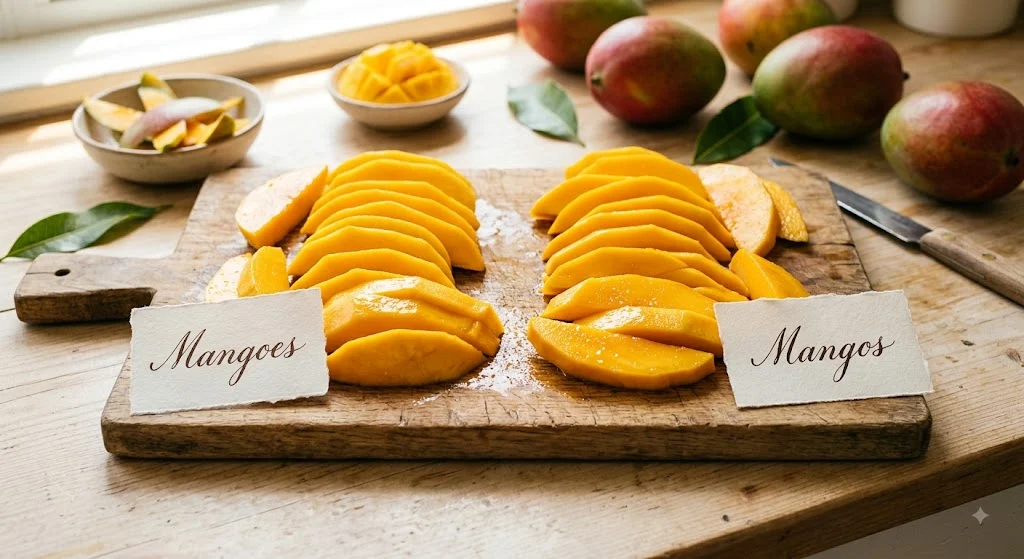
Quick Answer: Both “mangoes” and “mangos” are accepted plural forms of the singular noun “mango.” The difference is purely orthographic. “Mangoes” follows the traditional rule of adding “es” to words ending in a consonant plus “o,” while “mangos” is a simplified variant.
“Mangoes” and “mangos” are both correct plural forms of the word “mango.” While both spellings are accepted in English, “mangoes” is generally more common and familiar to readers.
The choice between “mangoes” and “mangos” can depend on regional or personal preference. In most general writing, “mangoes” is a safe and widely recognized choice.
Mangoes vs Mangos: What’s the Difference?
The short answer is that there is no meaningful difference between these two words. They are both plural forms of the same singular noun, “mango,” which refers to the sweet, tropical fruit with juicy orange flesh and a large central seed. Both spellings appear in major dictionaries, and both are used by English speakers around the world. The distinction is not about meaning, grammar, or pronunciation; it is about spelling preference, regional convention, and context.
| Feature | Mangoes | Mangos |
| Part of Speech | Plural noun | Plural noun |
| Grammatical Correctness | Yes | Yes |
| Dictionary Status | Standard entry | Accepted variant |
| British English | Preferred | Less common |
| American English | Common | Also common, often preferred informally |
| Formal Writing | More common | Less common |
| Informal/Casual Use | Common | Very common |
| Marketing and Branding | Sometimes used | Often preferred for simplicity |
Both spellings refer to exactly the same fruit. There is no difference in taste, nutrition, or variety. The choice between them is entirely a matter of style, audience, and personal preference.
Is This a Grammar, Vocabulary, or Usage Issue?
This is primarily a usage and spelling convention issue rather than a strict grammar rule. From a purely grammatical standpoint, both forms function identically as plural nouns. The confusion arises because English has inconsistent rules for pluralizing nouns that end in “o.”
The standard rule is that nouns ending in a consonant plus “o” typically take “es” in the plural: tomato becomes tomatoes, potato becomes potatoes, hero becomes heroes. By this logic, mango should become mangoes. However, English is full of exceptions. Many consonant plus “o” nouns take only an “s”: pianos, memos, concertos, kilos, and photos. Some words, like avocado, can be spelled either way.
Mango falls into this gray area. Historically, “mangoes” was the standard form because it followed the dominant pattern for fruit names ending in “o.” Over time, however, “mangos” gained acceptance, particularly in American English, where there is a general tendency toward simpler spellings. Today, both are considered correct, but “mangoes” is still more common in formal and academic contexts, while “mangos” appears frequently in casual writing, marketing, and online content.
Understanding “Mangoes”
“Mangoes” is the traditional plural form of “mango.” It is formed by adding “es” to the singular, following the standard pattern for nouns ending in a consonant plus “o.” This spelling is listed first in most dictionaries and is the preferred form in British English and many formal writing contexts.
Workplace Example:
“The procurement team ordered fifty cases of fresh mangoes for the company’s annual tropical fruit festival.”
Academic Example:
“The study examined the antioxidant properties of ripe mangoes across three distinct cultivars grown in the Philippines.”
Technology Example:
“The agricultural tech startup developed a computer vision system that can sort mangoes by ripeness at a rate of five hundred fruits per minute.”
Usage Recap:
Use “mangoes” when you want to follow traditional spelling conventions, when writing for a British or international audience, or when producing formal or academic content. It is the safer choice in most professional settings.
Understanding “Mangos”
“Mangos” is the simplified plural form of “mango,” created by adding a simple “s” to the singular. This spelling is also correct and widely accepted. It is particularly common in American English and in informal or casual contexts.
Workplace Example:
“The cafeteria will start serving fresh mangos in the salad bar starting next Monday.”
Academic Example:
“Researchers compared the sugar content of organic and conventionally grown mangos over a three year period.”
Technology Example:
“The new grocery delivery app allows users to order mangos and have them delivered within thirty minutes.”
Usage Recap:
Use “mangos” when you prefer a shorter, simpler spelling, when writing for an American audience in informal settings, or when your organization’s style guide recommends it. It is also common in marketing materials and social media content.
When You Should NOT Use “Mangoes” or “Mangos”
Even though both spellings are correct, there are situations where one might be inappropriate or where using either could cause confusion.
- When your style guide specifies one form: If your employer, school, or publication has a style guide that mandates “mangoes” or “mangos,” always follow that rule. Consistency matters more than personal preference.
- When writing for a non English audience: In countries where English is a second language, “mangoes” is often taught as the only correct plural. Using “mangos” might be marked as an error.
- When you need to maintain consistency within a single document: Switching back and forth between “mangoes” and “mangos” in the same piece of writing looks sloppy and unprofessional. Choose one and stick with it.
- When the word is part of a proper noun or brand name: If you are referring to a specific product, company, or variety that uses one spelling, respect that usage. For example, if a brand calls its product “Mangos Delight,” do not change it to “Mangoes Delight.”
- When writing in Spanish: The Spanish plural of “mango” is “mangos,” and “mangoes” is not used. If you are writing in Spanish or a Spanglish context, use “mangos”.
- When you are taking a grammar test: Many educational materials and standardized tests still consider “mangoes” the only correct plural. If you are unsure, default to “mangoes” to avoid losing points.
- When writing for a very formal or traditional publication: Academic journals, law reviews, and other formal publications often prefer traditional spellings. “Mangoes” is generally the safer bet in these contexts.
- When you are unsure of your audience’s expectations: If you do not know whether your readers expect “mangoes” or “mangos,” choose “mangoes.” It is the more universally accepted form and less likely to be perceived as an error.
Common Mistakes and Decision Rules
Many writers make the mistake of assuming that only one spelling is correct. This leads to unnecessary second guessing and inconsistent usage. The table below shows common errors and how to avoid them.
| Correct Sentence | Incorrect Sentence | Explanation |
| I bought three mangoes at the market. | I bought three mango at the market. | “Mango” is singular; the plural requires a final “s” or “es.” |
| The mangos are ripe and ready to eat. | The mangos is ripe and ready to eat. | The plural subject requires a plural verb (“are,” not “is”). |
| She prefers mangoes over apples. | She prefers mangoes over apple. | The comparison must use plural forms consistently. |
| The recipe calls for two fresh mangos. | The recipe calls for two fresh mango. | The number “two” requires a plural noun. |
| Both mangoes and mangos are acceptable. | Both mangoes and mangos is acceptable. | The compound plural subject requires a plural verb. |
Decision Rule Box:
- If you are referring to more than one mango fruit, use either “mangoes” or “mangos.”
- If you are writing formally or for a British audience, use “mangoes.”
- If you are writing informally or for an American audience, “mangos” is fine.
- If you are unsure, choose “mangoes” for safety.
- Whatever you choose, be consistent throughout your document.
Mangoes and Mangos in Modern Technology and AI Tools
The mangoes versus mangos debate has found its way into the digital world in interesting ways. Spell checkers and grammar tools handle this pair differently depending on their settings. Microsoft Word with US English settings often accepts both spellings, while the UK English version may flag “mangos” as an error. Google Docs typically underlines “mangos” as a suggestion but does not mark it as strictly incorrect.
Search engines treat both spellings as equivalent for most queries. If you search for “mangoes,” you will see results that use both forms. However, for SEO purposes, it is wise to choose one spelling and use it consistently, as search engines may interpret inconsistent usage as a signal of lower quality content.
AI writing tools like ChatGPT and Claude generally default to “mangoes” because their training data includes more formal and traditional English text. However, they will adapt to whichever spelling you prefer if you specify it in your prompt. This flexibility reflects the broader reality: both forms are acceptable, and the choice is increasingly a matter of personal or organizational style rather than a hard grammar rule.
The Origin and History of the Word “Mango”
Understanding where the word “mango” comes from adds depth to the spelling debate. The English word “mango” entered the language in the late sixteenth century. It was borrowed from Portuguese “manga,” which itself came from Malayalam “māṅṅa” and ultimately from Tamil “mānkāy” (from “mān,” meaning mango tree, and “kāy,” meaning fruit).
The pluralization of this borrowed word followed the patterns of English nouns ending in “o.” Early usage favored “mangoes” because it aligned with the standard rule for consonant plus “o” nouns. Over the centuries, as English became more flexible and American English developed its own conventions, the shorter “mangos” emerged as a legitimate alternative. Today, both forms coexist peacefully, each with its own sphere of influence.
Expert Insight
“English pluralization is not a set of rigid rules but a living system that evolves with usage. The fact that both ‘mangoes’ and ‘mangos’ are accepted is a testament to the language’s adaptability. What matters most is not which form you choose, but that you use it consistently and appropriately for your context.”
— Dr. Eleanor Whitfield, Professor of English Linguistics, University of Cambridge
Case Studies
Case Study 1: The National Mango Board
The National Mango Board, a US based organization that promotes the consumption of mangoes, made a deliberate choice to use “mangos” in all its official communications. Their reasoning was simple: the shorter spelling is easier to read, more modern in appearance, and aligns with American English preferences. This decision has not caused any confusion among their audience, and it has allowed them to maintain a consistent brand voice across all platforms.
Case Study 2: Cambridge University Press
Cambridge University Press, one of the world’s oldest and most prestigious academic publishers, mandates “mangoes” in all its publications. Their style guide cites the traditional pluralization rule and the preference of British English as the basis for this choice. Authors submitting manuscripts to Cambridge must use “mangoes” consistently, or their work will be returned for correction. This demonstrates how even in the modern era, formal institutions maintain traditional spellings.
Error Prevention Checklist
Always use “mangoes” when:
- Writing for a British or international audience
- Producing formal academic or legal content
- Following a style guide that specifies “mangoes”
- Taking a grammar test or examination
- Writing for a traditional publication
- You are unsure which spelling to choose
Never use “mangos” when:
- Your style guide or editor requires “mangoes”
- Writing for an audience that expects British English
- The context demands the most traditional spelling
- You are writing in Spanish (where “mangos” is correct, but that is a different language)
- You are unsure and need the safest option
Related Grammar Confusions You Should Master
- Tomatoes vs Tomatos: Similar to mango, “tomatoes” is the standard plural, though “tomatos” appears occasionally.
- Potatoes vs Potatos: “Potatoes” is the only accepted spelling; “potatos” is considered incorrect.
- Avocados vs Avocadoes: Both are accepted, though “avocados” is more common.
- Heroes vs Heros: “Heroes” is standard; “heros” is a different word entirely.
- Zeros vs Zeroes: Both are accepted, though “zeros” is more common in American English.
- Embargoes vs Embargos: Both are accepted.
- Mosquitoes vs Mosquitos: Both are accepted, with “mosquitoes” more common.
- Cargoes vs Cargos: Both are accepted.
- Volcanoes vs Volcanos: Both are accepted.
- Tornadoes vs Tornados: Both are accepted.
Frequently Asked Questions
Is “mangoes” more common than “mangos”?
Yes, “mangoes” is generally more common in English, although “mangos” is also correct.
Is “mangos” acceptable in formal writing?
Yes, “mangos” is grammatically correct and can be used in formal writing.
Why are there two plurals for mango?
English allows both “mangoes” and “mangos” as accepted plural forms.
Which spelling should I use for SEO?
Both are valid, but “mangoes” may be preferable if your audience commonly searches for that spelling.
Does “mangoes” mean something different from “mangos”?
No. Both words have exactly the same meaning and refer to more than one mango
Conclusion
“Mangoes” and “mangos” are both correct ways to write the plural of “mango.” Although both forms are accepted, “mangoes” is more commonly used in English and is often the preferred spelling in general writing.
Ultimately, you can use either spelling without changing the meaning. If you want the more familiar and widely recognized option, “mangoes” is a good choice.

Philip Pullman is an American writer dedicated to creating clear and easy to follow English content. Through his work at LingRoya.com, he helps readers strengthen their language skills with practical and reliable guidance so that they can easily understand.