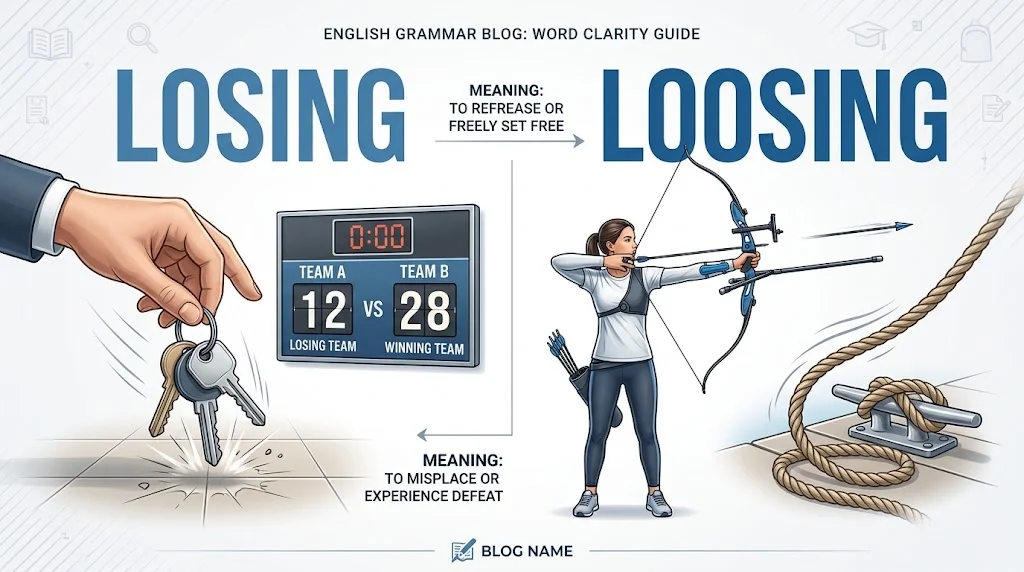
The correct choice depends entirely on meaning. Losing is the present participle of lose and describes no longer having something, being defeated, or failing to win. Loosing is the present participle of loose and means releasing, freeing, or making something less tight. They are not interchangeable.
A single extra letter can completely change the meaning of a sentence. This is why the losing or loosing confusion deserves more attention than a simple spelling correction. Losing belongs to the verb lose, as in “I am losing my keys,” while loosing comes from loose, as in “The guard is loosing the dogs.” For students, professionals, bloggers, and everyday writers, knowing this distinction improves grammatical accuracy and prevents meaning changing mistakes.
The difference is straightforward once you connect each word to its base verb, and understanding that relationship gives you a reliable way to choose the right spelling every time.
Losing vs Loosing: What’s the Difference?
The simplest way to understand these words is to look at their base verbs.
Losing is the present participle or gerund form of lose. It can describe failing to win, no longer possessing something, misplacing something, or experiencing a reduction.
Examples include:
“I am losing my patience.”
“She is losing the competition.”
“He keeps losing his phone.”
“We are losing valuable time.”
Loosing is the present participle or gerund form of loose. It means releasing something, setting something free, or making something less tight.
Examples include:
“The soldier is loosing the arrow.”
“The workers are loosing the rope.”
“The movement is loosing the knot.”
Although loosing is grammatically valid, it is much less common in modern everyday English.
Mini Recap
Losing comes from lose.
Loosing comes from loose.
Losing is common in everyday English.
Loosing is correct but comparatively rare.
They have different meanings and should not be substituted for one another.
Is Losing vs Loosing a Grammar, Vocabulary, or Usage Issue?
This confusion is primarily a spelling and vocabulary usage issue, although grammar helps determine how each word functions within a sentence.
The two forms are not interchangeable. You cannot use loosing simply because it resembles losing. Likewise, losing cannot replace loosing when the intended meaning is releasing or freeing something.
In formal writing, academic work, workplace communication, and published content, choosing the correct word is particularly important. A spelling mistake can make an otherwise polished sentence appear careless.
In casual communication, readers may understand what you mean from context. However, understanding the difference is still worthwhile because autocorrect does not always identify the intended meaning.
A useful mental connection is this:
Lose → losing
Loose → loosing
Once you remember the base verb, the correct spelling becomes much easier to identify.
How to Use Losing Correctly
Losing is extremely common in modern English. It describes situations involving possession, success, control, time, opportunities, relationships, confidence, and many other things.
Workplace Example
“ Our team is losing valuable time because the approval process is taking too long.”
Here, losing means the team is failing to retain or make effective use of time.
Another example is:
“The company is losing customers because of poor service.”
The company is experiencing a reduction in customers, so losing is correct.
Academic Example
“Students may be losing valuable marks by failing to explain their evidence.”
The students are not literally dropping their marks. They are failing to retain or obtain them.
Technology Example
“I keep losing my internet connection during video calls.”
Here, losing describes the disappearance or interruption of a connection.
You might also see:
“The application is losing unsaved data.”
Again, the meaning involves something disappearing or no longer being retained.
Usage Recap for Losing
Use losing when something is being misplaced, reduced, defeated, abandoned, or no longer retained. If the base verb in your sentence is lose, the correct form is losing.
How to Use Loosing Correctly
Loosing is a legitimate English word, but it is far less common than losing. It comes from the verb loose, which means to release, free, or make something less tight.
For example:
“The archer was loosing an arrow.”
This means the archer was releasing the arrow.
“The farmer was loosing the horses.”
This means the farmer was setting the horses free.
“The rope is loosing its grip.”
In this context, the intended idea is becoming released or less firmly held.
Workplace Example
“The technician is loosing the cable from its fastening.”
The action involves releasing the cable rather than misplacing it.
Academic Example
“The historical account describes soldiers loosing arrows toward the opposing army.”
The word refers to the release of arrows.
Technology Example
“A system may begin loosing its connection to an external device” would generally be an unusual choice in contemporary technical writing. In most such contexts, writers would instead say that the system is losing its connection.
This illustrates an important point. Even when loosing is technically possible, modern writers often prefer a clearer alternative such as releasing, unlocking, or loosening, depending on the intended meaning.
Usage Recap for Loosing
Use loosing only when you mean releasing or setting something free. Because the word is uncommon, consider whether releasing, freeing, or loosening communicates your meaning more naturally.
When You Should NOT Use Losing or Loosing
Several recurring mistakes cause writers to choose the wrong form.
- Do not use loosing when you mean failing to win.
Incorrect idea: “Our team is loosing the match.”
Correct: “Our team is losing the match.”
- Do not use loosing when you mean misplacing an object.
Incorrect idea: “I am loosing my wallet.”
Correct: “I am losing my wallet.”
- Do not use losing when you mean releasing something.
Incorrect idea: “The soldier is losing the arrow.”
If the intended meaning is releasing the arrow, loosing may be appropriate.
- Do not assume the extra letter makes the word grammatically stronger.
Loosing is not a more formal version of losing.
- Do not choose a word based only on pronunciation.
The similar pronunciation does not make the words interchangeable.
- Do not rely completely on autocorrect.
Spell checkers may accept both forms because both are legitimate English words.
- Do not use loosing in everyday situations where you actually mean loosening.
For example, “She is loosening the screw” is normally more natural than “She is loosing the screw.”
- Do not treat every spelling difference as a regional English variation.
Unlike some British and American spelling differences, this is a difference in meaning.
Common Mistakes and Decision Rules
Decision Rule
If you mean the action of no longer having, failing to win, or experiencing a reduction, use losing.
If you mean releasing or freeing something, use loosing.
A second memory trick is even easier: lose becomes losing, while loose becomes loosing.
Losing and Loosing in Modern Technology and AI Tools
Modern technology creates many situations where losing is the correct choice.
You can lose a password, lose an internet connection, lose unsaved work, lose access to an account, or lose data. AI systems can also be described as losing context, losing information from a conversation, or losing accuracy under certain conditions.
For example:
“ The AI assistant is losing context during a long conversation.”
Here, losing describes the failure to retain information.
Loosing is much less common in technology writing because modern technical language normally uses alternatives such as releasing, unlocking, disengaging, or loosening.
This distinction matters for technical documentation because precise vocabulary reduces ambiguity.
Etymology: Where Do These Words Come From?
Lose has a long history in English and is related to older Germanic words associated with loss, destruction, and separation.
Loose has a different historical development and is connected with the idea of being free, unrestrained, or not tightly fastened.
Their similar appearance today can therefore be misleading. They are related to different word families and developed with different meanings.
The spelling of losing also follows a useful pattern. When lose takes the ending used to form the present participle, the final silent e is removed, producing losing.
By contrast, loose becomes loosing when the participial ending is added.
Expert Style Insight
“The fastest way to distinguish these words is not to memorize their spelling. Identify the base verb first, then ask what action the sentence describes.”
This approach is especially useful because it works even when you encounter the words in unfamiliar contexts.
Two Practical Case Studies
Case Study One: Workplace Communication
Consider an employee writing:
“We are loosing clients because our response times are slow.”
The sentence contains a spelling error if the intended meaning is that customers are leaving or no longer being retained.
The corrected sentence is:
“We are losing clients because our response times are slow.”
The correction changes only one letter, but it restores the intended meaning and makes the professional communication credible.
Case Study Two: Academic Writing
Suppose a student writes:
“The experiment resulted in the researcher loosing valuable data.”
If the intended meaning is that data disappeared or was no longer retained, the correct sentence is:
“The experiment resulted in the researcher losing valuable data.”
This demonstrates why contextual reasoning is more reliable than choosing a word based on visual similarity.
These examples are editorial case studies designed to illustrate common real world errors rather than claims from a controlled research study.
Error Prevention Checklist
Always use Losing when
☑ You mean failing to win.
☑ You mean misplacing something.
☑ You mean no longer possessing something.
☑ You mean experiencing a reduction.
☑ You mean failing to retain information.
☑ You mean becoming deprived of something.
Never use Loosing when
☑ You mean losing a game.
☑ You mean losing your keys.
☑ You mean losing money.
☑ You mean losing data.
☑ You mean losing confidence.
☑ You mean losing an opportunity.
Remember that loosing should be reserved for the relatively specific idea of releasing or freeing something.
Related Grammar Confusions You Should Master
Understanding this distinction is useful, but English contains many other commonly confused words.
- Loose vs lose
- Affect vs effect
- Advice vs advise
- Then vs than
- Their vs there vs they’re
- Your vs you’re
- Its vs it’s
- Accept vs except
- Principal vs principle
- Complement vs compliment
These pairs create similar problems because pronunciation, spelling, or meaning can overlap. Learning the underlying grammatical function of each word is usually more effective than memorizing isolated rules.
FAQs
Is losing the correct spelling?
Yes. Losing is the correct spelling when you mean misplacing something, being defeated, failing to retain something, or experiencing a reduction. For example, “I am losing my keys” and “We are losing the game” are correct.
Is loosing a real word?
Yes. Loosing is a legitimate word formed from the verb loose. It means releasing or freeing something. However, it is uncommon in modern everyday English, so many writers rarely encounter it.
Is loosing the same as losing?
No. Losing means no longer having something, failing, or being defeated. Loosing means releasing or freeing something. Because their meanings are different, they cannot normally be used interchangeably.
Why do people confuse losing and loosing?
People often confuse them because the words look and sound very similar. The presence of loose as a familiar word can also encourage writers to add an extra letter when they actually mean losing.
How do you remember losing versus loosing?
Start with the base verb. If your meaning comes from lose, write losing. If your meaning comes from loose, write loosing. A useful association is “lose a game” and “loose an arrow.”
Conclusion
The key distinction is simple: losing comes from lose, while loosing comes from loose. Use losing when something is being misplaced, reduced, defeated, or no longer retained. Use loosing when something is being released or freed.
Once you identify the base verb before writing, the losing or loosing confusion becomes much easier to avoid. This small distinction can make your academic work, workplace communication, website content, and everyday English noticeably more accurate.

Philip Pullman is an American writer dedicated to creating clear and easy to follow English content. Through his work at LingRoya.com, he helps readers strengthen their language skills with practical and reliable guidance so that they can easily understand.