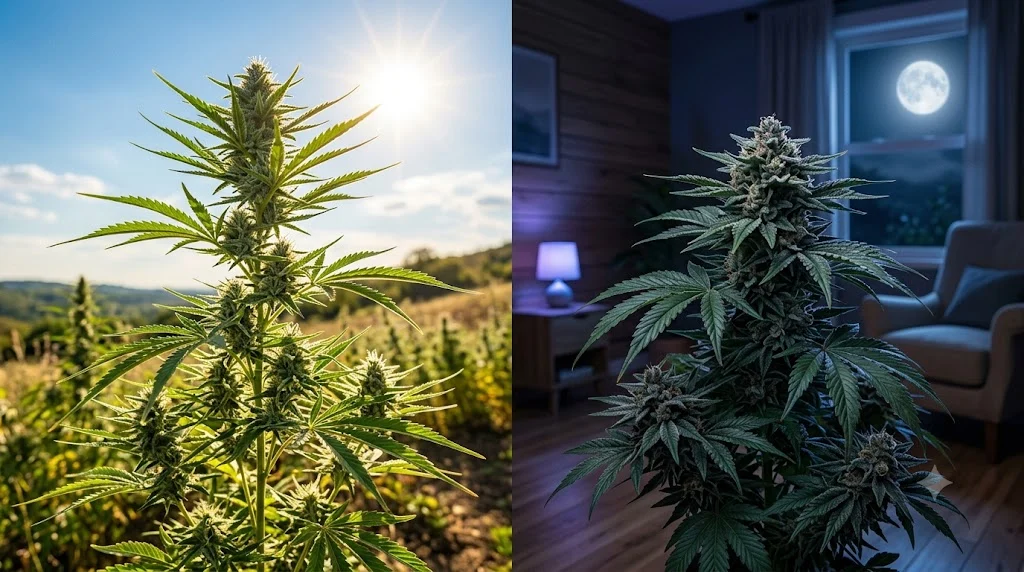
Sativa = more energetic/alert, Indica = more relaxing/sedating.
Sativa is generally associated with a more uplifting, energetic, and alert experience. People often describe it as being more suitable for daytime use or activities that require focus and creativity.
Indica is generally associated with a more relaxing and calming experience. It’s often described as better suited for winding down or evening use, although individual effects can vary depending on the specific cannabis product and person.
Sativa vs Indica: What’s the Difference?
At their most basic level, Cannabis sativa and Cannabis indica are two taxonomic classifications of the cannabis plant, first defined by their physical characteristics rather than their effects.
Cannabis sativa (from the Latin sativa, meaning “cultivated”) was named by Swedish botanist Carl Linnaeus in 1753 to describe the tall, fibrous hemp plants grown across Europe for their strong fibers and nutritious seeds. These plants typically grow tall and lanky with narrow, finger like leaves.
Cannabis indica (from the Latin indica, meaning “of India”) was identified in 1785 by French naturalist Jean Baptiste Lamarck, who described shorter, bushier plants with broad leaves and woody stems that originated from the Indian subcontinent.
| Feature | Sativa | Indica |
| Plant height | Tall (up to 20 feet) | Short and bushy |
| Leaf shape | Thin, narrow, finger like | Broad, wide leaflets |
| Stem type | Fibrous | Woody |
| Growth rate | Slower, longer flowering | Faster, shorter flowering |
| Origin | Europe, Eurasia | India, Afghanistan, Pakistan |
| THC to CBD ratio | Higher THC, lower CBD | Lower THC, higher CBD |
| Traditional use | Fiber, seed, medicine | Hashish, psychoactive use |
The mini recap: Sativa plants are tall and thin with narrow leaves, originally cultivated for fiber and seed. Indica plants are short and bushy with broad leaves, originating from regions like Afghanistan and India and traditionally used for their psychoactive properties. However, these physical differences have little to do with how the plant will make you feel.
Is Sativa vs Indica a Grammar, Vocabulary, or Usage Issue?
This is not a grammar question but rather a vocabulary and usage confusion rooted in scientific taxonomy that has been repurposed by popular culture.
The terms sativa and indica are not interchangeable. They refer to distinct botanical classifications with different Latin meanings: sativa means “cultivated” and indica means “of India.” Using one when you mean the other is factually incorrect in a botanical sense.
In formal, academic contexts such as botany or medical research, these terms should be used precisely to refer to the plant species or subspecies being discussed. In casual conversation, however, people frequently use them as shorthand for expected effects, which is scientifically questionable but socially common. A medical professional writing a research paper would correctly use Cannabis sativa and Cannabis indica to denote specific plant varieties. A dispensary employee, on the other hand, might casually ask whether a customer prefers “sativa or indica” as a way of gauging whether they want something uplifting or relaxing.
The confusion arises because the terms have taken on a secondary, colloquial meaning that does not align with their botanical definitions. This is a classic case of semantic drift, where words acquire new meanings through common usage, even when those meanings are not scientifically accurate.
Practical Usage: Sativa in Context
Workplace Example
“I have a big presentation this afternoon, so I am looking for a sativa or a sativa dominant hybrid that can help me stay focused without making me feel jittery.” In this workplace scenario, the person is using sativa as shorthand for an energizing, mentally clarifying experience. However, the actual effects will depend more on the strain’s terpene profile than on its sativa label.
Academic Example
“The research team analyzed the chemical composition of Cannabis sativa samples from three different European regions to determine variability in cannabidiol content.” Here, sativa is used in its proper botanical sense, referring to the specific plant species under study.
Technology Example
“Machine learning algorithms are now being trained to classify cannabis strains as sativa or indica based on volatile organic compound signatures detected by sensor arrays.” In this technological application, the labels serve as classification categories for a machine learning model, even though the scientific validity of those categories is debated.
Usage recap for sativa: Use sativa when referring to the tall, narrow leaf cannabis plant originally classified by Linnaeus. In casual conversation, it is commonly understood to mean an energizing or uplifting experience, though this usage is not scientifically reliable.
Practical Usage: Indica in Context
Workplace Example
“After a long week, I plan to unwind with an indica or an indica dominant hybrid to help me relax and get some rest.” The speaker is using indica as a shorthand for relaxation and sedation, which is how the term is most commonly understood in consumer settings.
Academic Example
“The study compared the anti inflammatory effects of Cannabis indica extracts with those of Cannabis sativa in animal models of arthritis.” This academic usage is precise and botanical, referring to the specific subspecies being tested.
Technology Example
“Recent advances in CRISPR gene editing are being applied to Cannabis indica to modify cannabinoid and terpenoid pathways, potentially creating strains with tailored medicinal properties.” In this context, indica refers to the specific plant species being genetically modified.
Usage recap for indica: Use indica to refer to the short, broad leaf cannabis plant from the Indian subcontinent. In everyday conversation, it is widely associated with relaxation and sleep, although this association is not scientifically definitive.
When You Should NOT Use Sativa or Indica
Avoid using sativa or indica in the following situations:
- When predicting effects with certainty. Scientific research shows that indica and sativa labels are poor predictors of how a strain will affect you.
- When discussing pure strains. Almost all cannabis on the market today is hybridized. Pure indica or pure sativa strains are increasingly rare.
- When making medical decisions. Relying solely on sativa or indica labels for medical treatment is not recommended; the chemical profile matters more.
- When you mean cannabinoids or terpenes. If you are actually referring to THC, CBD, or specific terpenes like myrcene or limonene, use those precise terms instead.
- When generalizing about all users. Different people respond differently to the same strain. A sativa that energizes one person might cause anxiety in another.
- When discussing industrial hemp. The hemp plant is Cannabis sativa but contains very low THC and produces no intoxicating effects. Using sativa to mean “energizing” in this context would be misleading.
- When shopping at a dispensary without asking about terpenes. Many dispensaries now provide terpene profiles. Ask for these instead of relying on the sativa or indica label.
- When writing academically about cannabis. Use the full botanical names (Cannabis sativa and Cannabis indica) and be precise about what you are referring to.
Common Mistakes and Decision Rules
| Correct Sentence | Incorrect Sentence | Explanation |
| “This Cannabis sativa plant has narrow leaves and grows tall.” | “This sativa will definitely make me energetic.” | The first is a factual botanical statement; the second assumes an effect that cannot be guaranteed. |
| “I prefer indica dominant hybrids for evening use.” | “Indica is the only strain that helps with pain.” | The first acknowledges the hybrid nature of modern strains; the second makes an unsupported generalization. |
| “The terpene profile matters more than the sativa or indica label.” | “Sativa is for daytime and indica is for nighttime.” | The first reflects current scientific understanding; the second is an oversimplified rule of thumb. |
| “This strain has a high myrcene content, which may promote relaxation.” | “This indica will make me sleepy because it is an indica.” | The first identifies the actual compound responsible for the effect; the second relies on an unreliable label. |
Decision Rule Boxt
The plant’s physical characteristics or botanical classification, use sativa or indica with precision.
If you mean the expected psychoactive or therapeutic effects, look at the cannabinoid and terpene profile instead. The sativa or indica label is at best a rough guide and at worst completely misleading.
If you are shopping for cannabis, ask your budtender about the strain’s chemical composition, not just whether it is sativa or indica.
Sativa and Indica in Modern Technology and AI
Artificial intelligence and machine learning are reshaping how we understand and classify cannabis strains. Researchers are developing sensor based systems that can classify cannabis as sativa, indica, or hybrid by analyzing the odors emitted from dried flowers and leaves. Meanwhile, AI breeding engines can now predict plant traits such as potency, flavor, flowering time, and yield with remarkable precision.
These technological advances may eventually render the sativa versus indica debate obsolete. Instead of relying on imprecise labels, consumers and researchers will be able to access detailed chemical profiles that predict effects with far greater accuracy. The future of cannabis classification lies not in a binary choice between sativa and indica, but in the complex interplay of cannabinoids, terpenes, and individual biology.
The Origins: A Brief Etymology
The story of sativa and indica begins in the 18th century. In 1753, Carl Linnaeus published the name Cannabis sativa in his landmark work Species Plantarum. The Latin sativa means “cultivated,” reflecting the plant’s long history of agricultural use across Europe.
Thirty two years later, in 1785, Jean Baptiste Lamarck described a second species, Cannabis indica, meaning “Cannabis from India.” Lamarck’s specimens came from the Indian subcontinent and displayed different physical characteristics from the European hemp Linnaeus had described.
The idea that sativa is uplifting and indica is sedating emerged much later, not from botany but from smoker slang and marketing. This colloquial classification has persisted despite mounting scientific evidence that it is largely meaningless.
Expert Perspective
Dr. Ethan Russo, a board certified neurologist and psychopharmacology researcher, has called the sativa or indica distinction “total nonsense” and “nomenclature that is meaningless” as a predictor of effects. He argues that one cannot accurately guess the biochemical content of a cannabis plant based on its height, branching, or leaf morphology.
Case Studies
Case Study 1: The AK 47 Anomaly
In 1999, a cannabis strain named “AK 47” won the Sativa Cup at the Cannabis Cup, despite being widely considered an indica dominant hybrid. This illustrates how inconsistent and unreliable sativa and indica labels can be. The same strain can be classified differently by different people, and awards meant to celebrate a particular category often go to strains that do not fit the label.
Case Study 2: Pain Management Preferences
A web survey of 95 medical cannabis users found that indica was statistically preferred for pain management, sedation, and sleep, while sativa was favored for euphoria and energy enhancement. However, the researchers noted that these preferences were based on user experience rather than any inherent chemical difference between the two types. The study highlights how the sativa or indica distinction persists in consumer behavior even as science questions its validity.
Error Prevention Checklist
Always use sativa or indica correctly when:
- Referring to the botanical species or subspecies of the cannabis plant
- Discussing the physical characteristics of the plant (height, leaf shape, growth pattern)
- Writing academically or scientifically about cannabis taxonomy
- Quoting or referencing historical botanical texts
Never rely on sativa or indica labels when:
- Trying to predict how a strain will make you feel
- Making medical or therapeutic decisions
- Assuming a product will be energizing or sedating
- Generalizing about how all users will respond
- Ignoring the strain’s cannabinoid and terpene profile
Related Grammar Confusions You Should Master
- Affect vs Effect – Commonly confused words with different grammatical functions
- Its vs It’s – Possessive versus contraction
- Your vs You’re – Possessive versus contraction
- There vs Their vs They’re – Location, possession, and contraction
- To vs Too vs Two – Preposition, adverb, and number
- Then vs Than – Time versus comparison
- Who vs Whom – Subject versus object
- Which vs That – Nonrestrictive versus restrictive clauses
- Lay vs Lie – Transitive versus intransitive verbs
- Fewer vs Less – Countable versus uncountable nouns
- Between vs Among – Two items versus three or more
- Further vs Farther – Figurative versus physical distance
Advanced FAQs
What is the difference between sativa and indica?
Sativa and indica are traditional cannabis classifications based mainly on plant characteristics. Their labels are not reliable predictors of effects.
Does sativa or indica matter for medical cannabis?
The cannabinoid and terpene profile is generally more useful than the sativa or indica label when considering effects.
Is sativa or indica better for anxiety?
It depends on the individual and product. THC levels and the terpene profile may be more relevant than the label.
Can I tell if a strain is sativa or indica by looking at it?
Plant features like leaf shape can offer clues, but appearance cannot reliably predict its effects.
Why do dispensaries still use sativa and indica labels?
They provide consumers with a simple way to categorize products, even though the science behind these labels is limited.
Are there pure sativa or pure indica strains anymore?
Pure varieties are relatively uncommon, as much of modern cannabis has been crossbred and hybridized.
Which is better for sleep: sativa or indica?
Indica is traditionally associated with relaxation, but actual effects depend more on the product’s chemical profile.
What is a hybrid?
A hybrid is cannabis bred from sativa- and indica-associated genetics, often described as sativa-dominant, indica-dominant, or balanced.
Is the sativa vs. indica debate settled?
Research suggests these labels are poor predictors of effects, although they remain widely used in cannabis culture.
What should I look for instead of sativa or indica?
Consider the cannabinoid content and terpene profile, as these provide more useful information about a product’s potential effects.
Conclusion
Sativa and indica labels can provide a general starting point, but they do not reliably predict how cannabis will affect someone. For a more informed choice, it is better to consider the product’s cannabinoid and terpene profile, along with individual response.

Neil Gaiman is an American writer who contributes educational content to LingRoya.com. His work focuses on helping readers improve their English with clear, practical and easy to follow guidance.