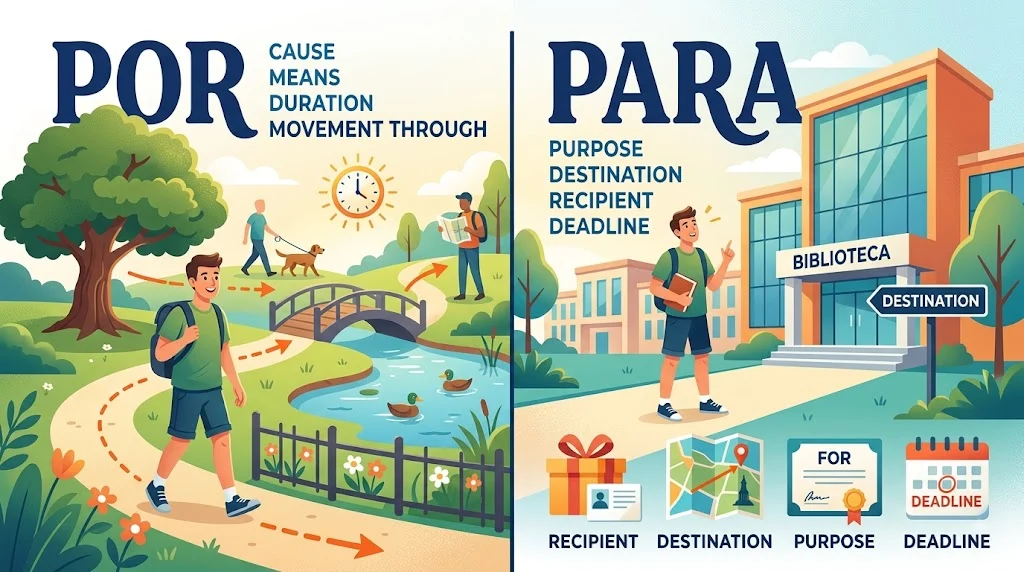
Por looks backward to explain the cause, reason, means, or duration of an action think “because of,” “through,” or “by.” Para looks forward to express purpose, destination, recipient, or deadline think “in order to,” “toward,” or “for the benefit of.” Choosing correctly changes your meaning entirely.
The Spanish prepositions “por” and “para” can be confusing for English learners because both words are often translated as “for.” However, they are not interchangeable and are used in different situations. Por is commonly used to express reasons, causes, movement through a place, duration, exchange, or means of communication.
In contrast, para is generally used to express purpose, destination, deadlines, recipients, or intended use. Learning the basic differences between por and para can make Spanish sentences more accurate and help learners communicate their ideas more naturally.
Por vs Para: What’s the Difference?
At their core, these two prepositions operate on completely different logical frameworks. Por is the preposition of cause, means, and movement. It answers questions like “why?,” “through what?,” “by what means?,” and “how long?” Para is the preposition of purpose, destination, and effect. It answers questions like “for what purpose?,” “to whom?,” “by when?,” and “toward where?”
Here is a side by side comparison to make the distinction crystal clear:
| Context | Use Por When… | Use Para When… |
| Reason vs Purpose | Expressing the cause or motive (Lo hice por amor — I did it out of love) | Expressing the goal or intention (Estudio para aprender — I study in order to learn) |
| Movement | Describing movement through a place (Caminamos por el parque — We walked through the park) | Indicating the final destination (Salimos para Madrid — We’re leaving for Madrid) |
| Time | Talking about duration (Trabajé por tres horas — I worked for three hours) | Setting a deadline (La tarea es para el lunes — The homework is due Monday) |
| Recipient vs Exchange | Indicating an exchange or substitution (Pagué veinte euros por el libro — I paid twenty euros for the book) | Indicating the recipient of something (Este regalo es para ti — This gift is for you) |
| Means | Describing the method or medium (Hablamos por teléfono — We spoke by phone) | Not typically used for means |
| Opinion | Not typically used for opinions | Giving an opinion (Para mí, es demasiado caro — In my opinion, it’s too expensive) |
| Agent | In passive voice, indicating the doer (Fue escrito por Cervantes — It was written by Cervantes) | Not used for passive agent |
Mini Recap: Think of por as the path and para as the destination. Por explains how or why something happens; para explains what it is for or where it is going. If you remember nothing else, remember this: por looks back at the cause, para looks forward to the goal.
Is Por vs Para a Grammar, Vocabulary, or Usage Issue?
This question gets to the heart of why these two prepositions cause so much trouble. The por vs para distinction is primarily a usage issue rather than a strict grammar rule or a vocabulary choice. Both words are grammatically correct prepositions—they function the same way in a sentence structure. They are not interchangeable synonyms, nor are they governed by a single hard and fast grammatical rule like verb conjugation.
Are they interchangeable? Absolutely not. Swapping por for para changes the meaning of your sentence completely, as we saw with “el regalo es por ti” versus “el regalo es para ti.”
Formal vs informal usage: Both prepositions appear in formal and informal Spanish equally. However, certain fixed expressions are strongly associated with one or the other. Por favor (please), por ejemplo (for example), and por supuesto (of course) are used everywhere. Para que sepas (just so you know) is more common in casual speech.
Academic vs casual usage: In academic writing, the distinction becomes even more critical because precision matters. A research paper might say “los datos fueron analizados por el equipo” (the data were analyzed by the team) versus “los datos son para el estudio” (the data are for the study). The same rules apply across registers—the difference is simply that academic contexts demand greater accuracy.
The challenge arises because English collapses all these meanings into the single word “for.” As one linguist aptly put it, “The fix is to stop translating and start identifying the relationship: endpoint (para) vs cause/path/exchange (por).”
When to Use Por: The Path, the Cause, the Means
Por is the older of the two prepositions, with deep roots in Latin pro and per. It has accumulated a wide range of uses over centuries, but they all share a common thread: por looks backward to explain what came before or what enabled an action.
Workplace Example
Scenario: You need to explain why you are attending a conference.
“Viajo a Barcelona por trabajo.” (I’m traveling to Barcelona for work.)
Here, work is the cause—the reason you are traveling. You are not traveling in order to create work; work is the motivating factor behind the trip.
Academic Example
Scenario: You are thanking a professor in an email.
“Gracias por su ayuda con mi tesis.” (Thank you for your help with my thesis.)
Gratitude always takes por. The help is the cause of your thanks.
Technology Example
Scenario: You are explaining how you submitted an assignment.
“Envié el documento por correo electrónico.” (I sent the document by email.)
Por indicates the means or medium of communication.
Key Uses of Por at a Glance
| Use | Example | Translation |
| Cause or reason | Lo hizo por miedo | He did it out of fear |
| Duration | Viví allí por dos años | I lived there for two years |
| Movement through | Paseamos por la playa | We walked along the beach |
| Means or medium | Hablamos por videollamada | We spoke by video call |
| Exchange | Te doy diez euros por el libro | I’ll give you ten euros for the book |
| Substitution | Fui yo por mi hermano | I went instead of my brother |
| Frequency | Dos veces por semana | Twice a week |
| Approximate location | Hay un café por aquí | There’s a café around here |
Usage Recap: Use por whenever you are explaining the “why” behind an action (cause), the “how” (means), the “how long” (duration), or the “through where” (movement). If you can replace the word with “because of,” “through,” “by,” or “during” in English, por is almost certainly correct.
When to Use Para: The Purpose, the Destination, the Goal
Para emerged later in Spanish linguistic history, evolving from the old Spanish pora (a fusion of Latin pro and ad). It was created specifically to express direction and purpose more clearly. While por traces the journey, para marks the finish line.
Workplace Example
Scenario: You are explaining why you are learning a new software.
“Aprendo este programa para ser más eficiente.” (I’m learning this program to be more efficient.)
Para expresses the purpose—the goal you want to achieve.
Academic Example
Scenario: You are telling a classmate about a book you bought.
“Compré este libro para mi curso de historia.” (I bought this book for my history course.)
The course is the recipient or intended use of the book.
Technology Example
Scenario: You are setting a deadline for a project.
“El informe es para el viernes.” (The report is due Friday.)
Para sets a deadline—a specific point in time by which something must be completed.
Key Uses of Para at a Glance
| Use | Example | Translation |
| Purpose or goal | Estudio para ser médico | I study to become a doctor |
| Destination | El tren sale para Valencia | The train leaves for Valencia |
| Recipient | Este regalo es para María | This gift is for María |
| Deadline | La tarea es para mañana | The homework is due tomorrow |
| Opinion | Para mí, es perfecto | In my opinion, it’s perfect |
| Comparison | Para un principiante, habla bien | For a beginner, he speaks well |
| Intended use | Una taza para café | A cup for coffee |
Usage Recap: Use para whenever you are expressing the “what for” (purpose), the “to whom” (recipient), the “to where” (destination), or the “by when” (deadline). If you can replace the word with “in order to,” “for the benefit of,” “toward,” or “by” (as in a deadline), para is your choice.
When You Should NOT Use Por or Para
Even advanced learners fall into certain traps. Here are the most common scenarios where learners misuse these prepositions:
- Do not use por for purpose. “Estudio por aprender” is wrong. The purpose of studying is learning, so you need para: “Estudio para aprender.”
- Do not use para for cause. “Llegué tarde para el tráfico” is incorrect. Traffic is the reason you were late, so use por: “Llegué tarde por el tráfico.”
- Do not use por for recipients. “Compré un regalo por mi madre” means you bought a gift because of your mother (perhaps she asked you to), not that you bought it to give to her. If she is the recipient, use para: “Compré un regalo para mi madre.”
- Do not use para for duration. “Trabajé para tres horas” is wrong. Duration takes por: “Trabajé por tres horas.”
- Do not use por for deadlines. “La tarea es por el lunes” is incorrect. Deadlines take para: “La tarea es para el lunes.”
- Do not use para for means of communication. “Hablamos para teléfono” is wrong. Por indicates the medium: “Hablamos por teléfono.”
- Do not use por for destinations. “Voy por Madrid” means you are going through Madrid (passing by), not that Madrid is your final destination. For the destination, use para: “Voy para Madrid.”
- Do not use para for exchange. “Pagué veinte euros para el libro” is incorrect. Transactions and exchanges take por: “Pagué veinte euros por el libro.”
Common Mistakes and Decision Rules
Here is a practical table showing correct versus incorrect usage with explanations:
| Correct Sentence | Incorrect Sentence | Explanation |
| Este regalo es para ti. | Este regalo es por ti. | Recipient needs para; por would mean “because of you” |
| Estudio para aprobar el examen. | Estudio por aprobar el examen. | Purpose needs para; por would mean “because of passing” |
| Llegué tarde por el tráfico. | Llegué tarde para el tráfico. | Cause needs por; para would mean “for the purpose of traffic” |
| La tarea es para el lunes. | La tarea es por el lunes. | Deadline needs para; por would mean “during Monday” |
| Caminamos por el parque. | Caminamos para el parque. | Movement through needs por; para would mean “toward the park” (destination) |
| Gracias por la ayuda. | Gracias para la ayuda. | Gratitude always takes por |
| Voy para la oficina. | Voy por la oficina. | Destination needs para; por would mean “through the office” |
Decision Rule Box
If you mean the action, use por. Por explains the action itself—the cause, the means, the duration, the movement.
If you mean the person, tool, or outcome, use para. Para points to the recipient, the destination, the purpose, or the deadline.
Another way to think about it: por is about the journey; para is about the destination.
Por and Para in Modern Technology and AI Tools
The por vs para distinction has taken on new significance in the age of artificial intelligence and machine translation. Language models and translation tools frequently stumble over these prepositions because they rely on statistical patterns rather than true understanding of meaning.
A fascinating case study: when one language learner asked ChatGPT to explain the difference between por and para in Spanish, the AI apologized multiple times for giving incorrect answers and kept switching its recommended preposition. This illustrates a crucial point: even advanced AI systems struggle with this distinction because it requires understanding intent and context, not just pattern matching.
Machine translation systems like Google Translate have improved significantly, but they still make errors with por and para in complex sentences. A 2023 study found that translation systems produced a “sizeable number of mistranslations and grammatical errors” when handling these prepositions.
For language learners, this is actually encouraging. If AI still gets it wrong sometimes, you should not feel bad about struggling with it. The solution is the same for humans and machines: stop translating word for word and start understanding the underlying relationship between the elements of the sentence.
The Origin Story: Why Two Words for “For”?
Understanding where these prepositions come from can help solidify their meanings in your mind.
Por comes from the Latin pro (meaning “for, on behalf of”) and per (meaning “through, by means of”). Over time, these two Latin prepositions merged in Spanish into a single word that carries both meanings—hence por can mean both “because of” (pro) and “through” (per).
Para, on the other hand, evolved from the old Spanish pora, which itself came from Latin per + ad (“through” + “toward”). The * a* at the end originally indicated direction or movement toward something. So para literally meant “through toward”—a preposition that inherently points to a destination.
In medieval Spanish, the overlap between por and para was much larger. Over centuries, their meanings diverged and became more specialized. Por kept the causal and means related meanings, while para claimed purpose, destination, and recipient. This historical separation explains why they feel so distinct to native speakers today.
“As a general rule, por is used to express movement, duration, exchange, and cause, while para is the preposition of purpose, destination, recipient, and deadlines.” — Spanish Grammar Reference, Royal Spanish Academy
Case Study 1: The Professional Email That Changed Everything
A marketing executive named Sarah had been learning Spanish for two years. She was comfortable with everyday conversation but kept making por/para errors. One day, she needed to email a Spanish client to explain why a deliverable would be late. She wrote: “El informe está retrasado para los problemas técnicos.” (The report is delayed for the technical problems.)
Her Spanish colleague gently corrected her: “El informe está retrasado por los problemas técnicos.” The technical problems were the cause of the delay, not the purpose. That single correction changed how the client perceived her professionalism. After that, Sarah made a point of mastering the distinction, and within three months, her business Spanish improved dramatically. She now trains new team members on this exact topic.
Case Study 2: The Mistranslated Product Description
A small e commerce company selling handmade goods in Latin America used automated translation for their product descriptions. One listing read: “Este producto es por ti” (This product is because of you). Customers were confused—were these products made in response to customer demand? Were they blaming customers for something?
The company hired a professional translator who changed it to “Este producto es para ti” (This product is for you). Sales increased by 40% within two weeks. The lesson? A single preposition can make or break your message.
Error Prevention Checklist
Always use por when:
- Expressing the cause or reason for something (por el mal tiempo)
- Talking about duration of time (por dos horas)
- Describing movement through a place (por el parque)
- Indicating the means or method (por teléfono)
- Talking about an exchange or transaction (diez euros por el libro)
- Expressing gratitude (gracias por)
- Indicating frequency (dos veces por semana)
- Talking about substitution (por mi hermano)
Never use por when:
- Expressing purpose or goal (use para)
- Indicating a recipient (use para)
- Setting a deadline (use para)
- Giving an opinion (use para)
- Indicating a destination (use para)
- Describing intended use (una taza para café — use para)
Related Grammar Confusions You Should Master
Once you have conquered por vs para, these related topics will deepen your Spanish precision:
- Ser vs estar — the other great Spanish prepositional challenge
- Saber vs conocer — knowing facts versus knowing people and places
- Pedir vs preguntar — asking for something versus asking a question
- Tener vs haber — possession versus existence
- Hacer vs realizar — doing versus carrying out
- Llevar vs traer — taking versus bringing (direction matters!)
- Quedar vs quedarse — remaining versus staying (reflexive changes meaning)
- Poder vs saber — ability versus knowledge
- Decir vs contar — saying versus telling/narrating
- Mirar vs ver vs buscar — looking at, seeing, and looking for
Each of these pairs presents a similar challenge: English collapses multiple concepts into single words, while Spanish maintains crucial distinctions.
FAQs
How can I remember the difference between por and para?
Think of por as the path (cause, means, duration, movement) and para as the destination (purpose, recipient, deadline, goal). A common memory aid: “Por looks back, para looks forward.”
Is it “gracias por” or “gracias para”?
Always gracias por. Gratitude expresses the reason for your thanks, so it takes por.
Is it “para mí” or “por mí” when giving an opinion?
Use para mí for opinions (“in my opinion”). Por mí means “because of me” or “as far as I’m concerned” in a different sense.
What does “por qué” vs “para qué” mean?
¿Por qué? asks about the cause or reason (“why?” as in “what caused this?”). ¿Para qué? asks about the purpose or goal (“what for?” as in “what is the intended outcome?”).
Can por and para ever be used interchangeably?
No. While there are rare cases where either could work with slightly different meanings, they are never truly interchangeable. Using the wrong one changes the meaning of your sentence.
What are the most common mistakes with por and para?
The most frequent errors are using por for purpose (estudio por aprender), using para for cause (llegué tarde para el tráfico), using por for recipients (un regalo por ti), and using por for deadlines (la tarea es por el lunes.
Conclusion
In conclusion, “por” and “para” may both translate to “for” in English, but they serve different purposes in Spanish. Por is commonly used to describe reasons, causes, duration, movement through a place, exchanges, and means, while para is often used for purpose, destination, recipients, deadlines, and intended use.
Understanding when to use por and para takes practice, but learning their main patterns can make Spanish much easier. By paying attention to the context and the relationship between the words in a sentence, you can choose the correct preposition with greater confidence.

Philip Pullman is an American writer dedicated to creating clear and easy to follow English content. Through his work at LingRoya.com, he helps readers strengthen their language skills with practical and reliable guidance so that they can easily understand.