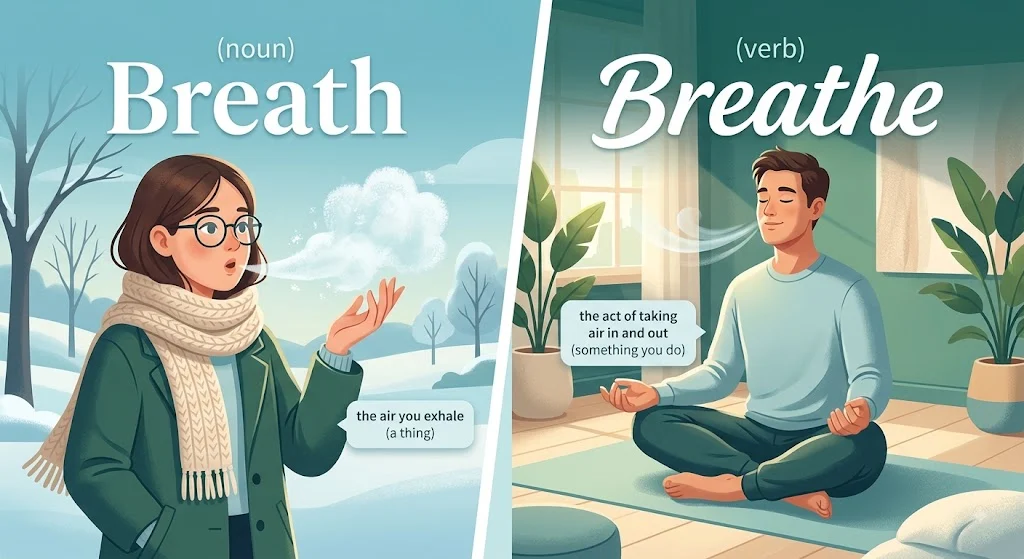
Quick Answer: Breath (pronounced “breth”) is a noun that refers to the air you inhale or exhale, or the act of taking that air in. Breathe (pronounced “breeth”) is a verb that means the action of inhaling and exhaling..
Breath vs. Breathe are two commonly confused English words because they look and sound very similar. However, they have different meanings and grammatical uses. Breath is a noun that refers to the air you take in or let out, while breathe is a verb that describes the action of taking air in and out.
Knowing the difference between breath and breathe can help you avoid common spelling and grammar mistakes. Although the difference may seem small, using the correct word is important for clear communication. In this guide, we’ll explain their meanings, pronunciation, and usage with simple examples.
Breath vs Breathe: What’s the Difference?
The core difference between breath and breathe is a matter of grammar, not just spelling. One is a noun; the other is a verb. That distinction determines how and when you use each word.
Breath (noun) refers to the air that moves in and out of your lungs during respiration. It can also mean a single act of breathing or a short pause for rest. Think of breath as a thing—something you can take, hold, or catch.
Breathe (verb) describes the action of drawing air into the lungs and releasing it. It is the process itself—something you do. Think of breathe as an action—something you perform.
| Feature | Breath | Breathe |
| Part of speech | Noun | Verb |
| Pronunciation | Rhymes with “death” (/breθ/) | Rhymes with “seethe” (/briːð/) |
| Meaning | The air inhaled/exhaled; a single cycle of breathing | The act of inhaling and exhaling |
| Spelling | No “e” at the end | Has an “e” at the end |
| Example | “She took a deep breath.” | “She paused to breathe deeply.” |
| Common with | Articles (a, the), possessives (my, your) | Modals (can, could, should), infinitives (to) |
Mini recap: Breath is the noun—the air or the act itself. Breathe is the verb—the action of moving that air. If you are naming something, use breath. If you are describing an action, use breathe. Simple as that.
Is Breath vs Breathe a Grammar, Vocabulary, or Usage Issue?
This confusion sits at the intersection of grammar and usage. Grammatically, the issue is part of speech: breath is a noun and breathe is a verb. You cannot use one in place of the other without breaking the rules of English sentence structure.
From a vocabulary perspective, these are related words with distinct meanings. They are not synonyms, nor are they interchangeable. They belong to the same semantic field (respiration) but occupy different grammatical roles.
Usage wise, the choice between breath and breathe depends on context, formality, and whether you are writing or speaking. In spoken English, the pronunciation difference (/breθ/ vs /briːð/) makes confusion unlikely. In writing, however, the single letter difference creates a common trap. Formal writing, academic papers, and professional emails all demand the correct choice. Casual writing, including social media and text messages, often shows errors but that does not make them acceptable. Both formal and informal contexts require proper usage if you want to be taken seriously.
When to Use Breath (Noun)
Use breath when you are referring to the air itself, a single cycle of breathing, or a pause for rest. Breath is always a noun, so it will typically follow an article (a, the), a possessive (my, your, his), or an adjective (deep, short, heavy).
Workplace Example
“Before delivering the quarterly report, she took a deep breath and walked confidently to the podium.” Here, breath is the air she inhaled to calm her nerves.
Academic Example
“In the study, participants were asked to hold their breath for thirty seconds while their oxygen levels were monitored.” Breath refers to the air being held, not the action of holding.
Technology Example
“The smartwatch tracks your respiratory rate by counting each breath you take during sleep.” Breath is the unit being counted.
Common Phrases with Breath
- Take a breath
- Hold your breath
- Catch your breath
- Out of breath
- Bad breath
- Under your breath
- A breath of fresh air
Usage recap: Use breath when you are talking about the air itself, a single inhalation or exhalation, or a short rest. If the word follows “a,” “the,” or a possessive pronoun, breath is almost certainly correct.
When to Use Breathe (Verb)
Use breathe when you are describing the action of inhaling and exhaling. Breathe is always a verb, so it will typically follow a modal verb (can, could, should, must), an infinitive (to), or a subject performing the action.
Workplace Example
“During the high stress meeting, I reminded myself to breathe slowly and stay composed.” Breathe is the action the speaker performs to manage stress.
Academic Example
“Patients with respiratory conditions often find it difficult to breathe in polluted environments.” Breathe describes the physiological process being studied.
Technology Example
“The new air purifier allows you to breathe cleaner air by filtering out ninety nine percent of airborne particles.” Breathe is the action enabled by the technology.
Common Phrases with Breathe
- Breathe deeply
- Breathe in and out
- Breathe easily
- Breathe new life into
- Breathe down someone’s neck
- Breathe a sigh of relief
Usage recap: Use breathe when you are describing the action of taking air in and out. If the word follows “to,” “can,” “could,” or “should,” breathe is almost certainly correct.
When You Should NOT Use Breath or Breathe
Knowing when not to use each word is just as important as knowing when to use them. Here are common scenarios where writers get it wrong:
- Do not use breath as a verb. Incorrect: “I need to breath.” Correct: “I need to breathe.” If you are describing an action, breathe is the only choice.
- Do not use breathe as a noun. Incorrect: “Take a deep breathe.” Correct: “Take a deep breath.” If you are naming the air or the act, breath is required.
- Do not use breath when you mean the process of respiration over time. Incorrect: “She could not breath during the asthma attack.” Correct: “She could not breathe during the asthma attack.”
- Do not use breathe when you mean a single intake of air. Incorrect: “He took one last breathe before diving.” Correct: “He took one last breath before diving.”
- Do not use breath in progressive tenses. Incorrect: “I am breath ing deeply.” Correct: “I am breathing deeply.” The present participle always comes from the verb breathe.
- Do not use breathe in the plural form as a noun. Incorrect: “She counted five deep breathes.” Correct: “She counted five deep breaths.” The plural noun is breaths, not breathes.
- Do not use breath when giving a command to perform the action. Incorrect: “Breath slowly and relax.” Correct: “Breathe slowly and relax.”
- Do not use breathe when referring to the air that comes out of your mouth. Incorrect: “His breathe smelled like coffee.” Correct: “His breath smelled like coffee.”
Common Mistakes and Decision Rules
| Correct Sentence | Incorrect Sentence | Explanation |
| “I could hardly breathe after the race.” | “I could hardly breath after the race.” | Breathe is the verb needed after “could.” |
| “Take a deep breath before you start.” | “Take a deep breathe before you start.” | Breath is the noun needed after “a.” |
| “She held her breath for thirty seconds.” | “She held her breathe for thirty seconds.” | Breath is the thing being held. |
| “Remember to breathe during the yoga pose.” | “Remember to breath during the yoga pose.” | Breathe is the action being remembered. |
| “His breath smelled of garlic.” | “His breathe smelled of garlic.” | Breath is the air being smelled. |
| “They breathed a sigh of relief.” | “They breath a sigh of relief.” | Breathed is the past tense of the verb breathe. |
Decision Rule Box:
- If you mean the action of taking air in and out, use breathe.
- If you mean the air itself, a single intake, or a pause, use breath.
Still unsure? Try this substitution test: replace the word with “inhale” or “exhale.” If the sentence still makes sense, you need breathe. Replace it with “air.” If that works, you need breath.
Breath and Breathe in Modern Technology and AI Tools
The breath versus breathe confusion has not escaped the notice of modern technology. AI writing assistants, grammar checkers, and spell checkers now routinely flag incorrect usage. Tools like Grammarly, LanguageTool, and even basic word processors will underline “breath” when it appears where “breathe” should be.
This is a perfect example of how AI can support better writing. These tools do not just catch the error; they often explain the rule, helping writers learn over time. However, technology is not foolproof. Context dependent errors can still slip through, especially in complex sentences. Relying solely on spell check is risky because “breath” and “breathe” are both correctly spelled words. The error is one of usage, not spelling. That is why understanding the rule matters more than trusting the tool.
In the age of AI generated content, human editors and knowledgeable writers have an advantage. Machines can catch many errors, but they cannot replace the judgment of someone who truly understands the difference between a noun and a verb.
The Etymology of Breath and Breathe
Both words trace back to Old English, but they developed along different paths. Breath comes from the Old English “bræth,” meaning a puff of air or the act of breathing. It has always functioned as a noun, describing something tangible or measurable.
Breathe comes from the Old English “brēathan,” a verb meaning to draw air in and out of the lungs. Over centuries, it retained its action oriented form. Understanding their origin helps reinforce the distinction: breath is static (the air itself), while breathe is dynamic (the action of moving that air).
In literature from the fourteenth century, poets used breath to symbolize life itself. Meanwhile, breathe was already tied to the act of living or existing, emphasizing action and vitality.
Expert Insight
As Dr. Anne Curzan, Professor of English Linguistics at the University of Michigan and member of the American Heritage Dictionary Usage Panel, explains: “The breath/breathe distinction is one of those subtle but important features of English spelling that reflects a deeper pattern in the language. When we add a silent ‘e’ to a word, we often change not just the pronunciation but the part of speech. Understanding that pattern helps writers avoid errors across many similar word pairs.”
Case Studies
Case Study 1: The Marketing Email That Lost Credibility
A mid sized technology company sent a promotional email to its entire customer base with the subject line: “Take a deep breathe and explore our new features.” Within hours, the company received dozens of replies pointing out the error. Some customers questioned the company’s attention to detail. The marketing team quickly issued a correction, but the damage to their professional image was done. The simple mistake of using breathe instead of breath undermined the credibility of an otherwise polished campaign.
Case Study 2: The Job Application That Made the Wrong Impression
A job seeker submitted a cover letter that included the sentence: “I can breath easy knowing I have the skills for this role.” The hiring manager, who had a background in editing, noticed the error immediately. While the candidate was qualified, the mistake suggested a lack of attention to detail. The application was set aside. In a competitive job market, small errors can have outsized consequences. Using breath instead of breathe in a professional context signals carelessness, whether fair or not.
Error Prevention Checklist
Always use breath when:
- You are referring to the air itself (“His breath was visible in the cold”)
- You are counting cycles of breathing (“Take five deep breaths”)
- You are describing a pause or rest (“She stopped for a breath”)
- You are using common phrases like “out of breath” or “bad breath”
- The word follows an article (a, the) or possessive (my, your)
Never use breath when:
- You are describing the action of inhaling and exhaling
- The word follows a modal verb (can, could, should, must)
- The word follows “to” in an infinitive (“to breathe”)
- You are giving a command (“Breathe slowly”)
- You are using a progressive tense (“I am breathing”)
- You are using the past tense (“I breathed”)
Related Grammar Confusions You Should Master
Once you have mastered breath versus breathe, consider tackling these similar confusing pairs:
- Affect vs effect
- Your vs you’re
- Their vs there vs they’re
- Its vs it’s
- Then vs than
- Who vs whom
- Which vs that
- Lay vs lie
- Bring vs take
- Farther vs further
- Fewer vs less
- Who’s vs whose
- Me vs I
- Good vs well
- To vs too vs two
Each of these pairs follows a similar pattern: the words are related in meaning but serve different grammatical functions. Mastering one makes the next easier.
Frequently Asked Questions
1. What is the difference between breath and breathe?
Breath is a noun for the air you inhale or exhale, while breathe is the verb for inhaling and exhaling.
2. Can breath and breathe be used interchangeably?
No. Breath is a noun, while breathe is a verb, so they have different grammatical uses.
3. How can I remember when to use breath vs. breathe?
Use breath for the air itself and breathe for the action of inhaling or exhaling.
4. Is it “take a deep breath” or “take a deep breathe”?
The correct phrase is “take a deep breath” because breath is the noun.
5. Is it “I can’t breathe” or “I can’t breath”?
The correct phrase is “I can’t breathe” because breathe is the verb.
6. What is the plural of breath?
The plural of breath is breaths. “Breathes” is the third-person singular form of the verb breathe
Conclusion
In conclusion, breath and breathe have different meanings and grammatical roles. Breath is a noun for the air you inhale or exhale, while breathe is a verb that describes the act of taking air in and releasing it.
Remembering this simple difference can help you use both words correctly. If you mean the air, use breath; if you mean the action, use breathe. With a little practice, the difference becomes easy to remember.

Philip Pullman is an American writer dedicated to creating clear and easy to follow English content. Through his work at LingRoya.com, he helps readers strengthen their language skills with practical and reliable guidance so that they can easily understand.