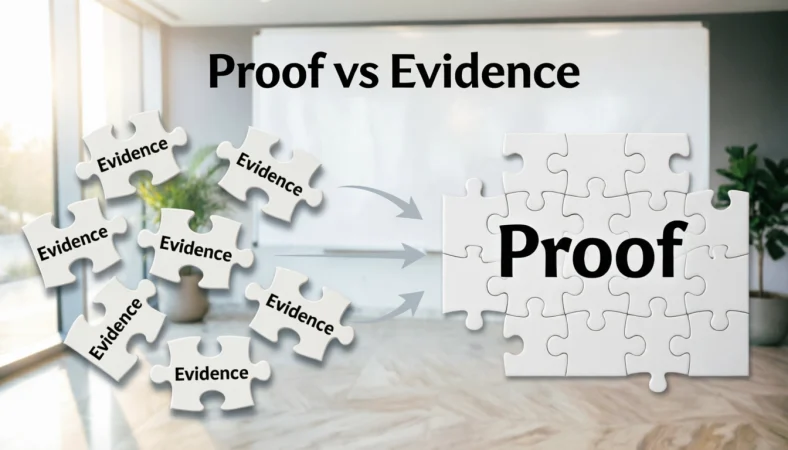
Quick answer: Proof is information that conclusively establishes something as true, while evidence is information or facts that support a claim but may not prove it on their own. In simple terms, evidence helps build a case, whereas proof confirms it
Have you ever used the words “proof” and “evidence” interchangeably? You are not alone. Most people treat these terms as synonyms, but they carry distinct meanings that can change the entire impact of your statement. In legal proceedings, scientific research, and even casual conversation, confusing proof with evidence can lead to misunderstandings or weaken your argument.
The main query “proof or evidence” often arises when people struggle to choose the right word for their situation. At their core, proof means absolute certainty, while evidence means supporting information that requires interpretation. This distinction matters because claiming you have proof when you only have evidence can damage your credibility. Conversely, using evidence when you actually have proof might understate your position.
Proof vs Evidence: What’s the Difference?
Defining the Terms
Proof is a noun that means conclusive facts or information that establish something as true beyond any doubt. It represents the final result of a verification process. When you have proof, you have reached a state of certainty where no reasonable person could question the conclusion.
Evidence is a noun that means information, facts, or material presented to support a claim or belief. It is the building block of argumentation, requiring analysis and interpretation to reach conclusions. Evidence can be strong or weak, but by itself, it does not guarantee certainty.
Comparison Table
| Aspect | Proof | Evidence |
| Definition | Conclusive demonstration of truth | Supporting information for a claim |
| Certainty Level | Absolute | Variable |
| Requires Interpretation | No | Yes |
| Legal Status | Establishes guilt beyond reasonable doubt | Supports arguments but may not be conclusive |
| Scientific Role | Final confirmation of hypothesis | Data used to support or reject hypotheses |
| Singular/Plural | Uncountable noun | Can be countable or uncountable |
| Example | DNA match confirming identity | Fingerprints at a crime scene |
Mini Recap
Proof and evidence serve different purposes in communication. Proof represents the final, unquestionable demonstration of truth, while evidence provides support that requires interpretation and reasoning. You build a case with evidence, but you close it with proof.
Is Proof vs Evidence a Grammar, Vocabulary, or Usage Issue?
This distinction is primarily a vocabulary and usage issue, though it has grammatical aspects worth noting. The words are not interchangeable in precise communication, even though many people use them that way in casual speech.
Are They Interchangeable?
In strict terms, no. Professional contexts like law, science, and journalism maintain a clear distinction. However, in everyday conversation, you will hear people say things like “I have proof you were there” when they actually mean “I have evidence you were there.” This casual interchangeability does not make it correct in formal settings.
Formal vs Informal Usage
| Context | Proof | Evidence |
| Formal Legal | Establishes certainty beyond doubt | Presented to build a case |
| Formal Academic | Represents confirmed findings | Supports or challenges hypotheses |
| Informal Conversation | Often used as emphasis | Less common in casual speech |
| Business | Used for definitive results | Used for decision making support |
Academic vs Casual Usage
In academic writing, precision matters. You will rarely find scholarly articles using proof unless they discuss mathematical or logical certainty. Instead, you will see evidence used extensively with qualifying language like “strong evidence suggests” or “evidence indicates.” In casual conversation, the lines blur significantly.
Understanding Evidence
When to Use Evidence
Evidence is your go to term when you are building an argument or supporting a position. It acknowledges that while you have information pointing in a certain direction, you may not have reached absolute certainty.
Workplace Example
“Our market research provides evidence that customers prefer eco friendly packaging. The survey results, focus group feedback, and sales data from competitor products all point in this direction, though we need more testing before we make a final decision.”
Academic Example
“The archaeological evidence, including pottery fragments, building foundations, and carbon dating results, suggests that this settlement existed between 500 and 700 CE. However, we need additional evidence to confirm the exact timeline.”
Technology Example
“The system logs show evidence of unauthorized access attempts, including multiple failed login attempts from unusual IP addresses. This evidence supports our theory that the network has been targeted by external threats.”
Evidence Usage Recap
Evidence works when you want to acknowledge that your information is compelling but not conclusively proven. It invites further investigation and suggests that while you have a strong case, you remain open to additional information or alternative interpretations.
Understanding Proof
When to Use Proof
Proof is reserved for situations where you have reached a state of absolute certainty. It signals that the matter is settled and no further investigation is needed to establish the basic fact.
Workplace Example
“The quarterly financial statements provide proof of our profitability. The numbers have been audited, confirmed by our accounting firm, and match our bank statements exactly.”
Academic Example
“Mathematical proof demonstrates that the theorem holds true for all possible values. This level of certainty is rare in empirical sciences but fundamental to pure mathematics.”
Technology Example
“The error logs provide proof that the software failure occurred at exactly 3:47 AM. The timestamped logs, system alerts, and crash reports all confirm this precise moment.”
Proof Usage Recap
Proof works when you can demonstrate something beyond reasonable doubt. It closes the conversation on the factual aspect of a claim, though it does not necessarily end all discussion about implications or applications.
When You Should NOT Use Proof or Evidence
Understanding when to avoid these terms is just as important as knowing when to use them correctly.
Common Misuse Scenarios
- Avoid proof when you only have strong indications Using proof prematurely undermines your credibility.
- Skip evidence when you have conclusive data Underselling a definitive finding may confuse your audience about your certainty.
- Do not use proof in scientific conclusions Science rarely offers absolute proof; use evidence or support instead.
- Avoid evidence in mathematical contexts Math deals in proof, not evidence.
- Skip proof in legal witness statements Witnesses provide evidence; courts determine proof.
- Do not confuse evidence with opinion Evidence is factual; opinions are personal views.
- Avoid using either term without supporting details Both terms lose power when used vaguely.
- Do not use proof for probabilistic claims If there is any doubt, use evidence.
Common Mistakes and Decision Rules
Correct and Incorrect Usage Table
| Correct Sentence | Incorrect Sentence | Explanation |
| The DNA evidence links the suspect to the scene. | The DNA proof links the suspect to the scene. | DNA links, but it does not always prove guilt in isolation. |
| We have proof that the chemical reaction occurs. | We have evidence that the chemical reaction occurs. | Once demonstrated repeatedly, it becomes proof. |
| The survey provides evidence of customer satisfaction. | The survey provides proof of customer satisfaction. | Surveys indicate trends; they do not prove absolute satisfaction. |
| The witness provided crucial evidence. | The witness provided crucial proof. | Witness testimony is evidence that must be evaluated. |
| The mathematical proof is elegant and conclusive. | The mathematical evidence is elegant and conclusive. | Math uses proof; evidence is for empirical sciences. |
| The prosecutor presented evidence of motive. | The prosecutor presented proof of motive. | Motive alone does not prove a case. |
Decision Rule Box
If you mean supporting information that requires interpretation, use EVIDENCE.
If you mean conclusive demonstration that leaves no reasonable doubt, use PROOF.
Evidence and Proof in Modern Technology and AI Tools
The distinction between proof and evidence has become increasingly important in the age of artificial intelligence and big data. AI systems process massive amounts of information to generate insights, but they rarely produce proof in the traditional sense.
Machine learning algorithms identify patterns in data, providing evidence for predictions and recommendations. However, these systems cannot offer proof because their conclusions are probabilistic rather than absolute. Understanding this limitation helps users interpret AI outputs correctly.
In legal technology, AI tools assist lawyers in discovering evidence from millions of documents. While these tools identify potentially relevant materials, human legal professionals must still evaluate whether the evidence meets standards for admissibility and whether it ultimately constitutes proof.
Similarly, cybersecurity systems gather evidence of potential threats but require human analysis to confirm whether the evidence points to actual proof of an attack. The distinction helps organizations make informed decisions about resource allocation and risk management.
Etymology and Authority
Word Origins
Proof comes from the Old French word “proeve” and the Latin “probare,” meaning to test or prove. Its root connects to “probity” or honesty, suggesting that proof relates to establishing truth and integrity.
Evidence comes from the Latin “evidentia,” meaning clearness or obviousness. Its roots suggest that evidence makes things visible or clear, highlighting its role in revealing truth rather than establishing it absolutely.
Expert Quote
“Evidence is the raw material of inquiry; proof is its refined product. Evidence invites exploration, while proof demands acceptance. The difference lies not in the information itself but in what we have done with it and what we can confidently claim from it.” Professor Sarah Mitchell, Department of Logic and Scientific Method
Case Studies
Case Study 1: Medical Diagnosis
Dr. Chen’s team collected evidence from patient symptoms, blood tests, and imaging scans. After analyzing all evidence and comparing it against known patterns, they reached a diagnosis. The treatment success over multiple patients provided practical proof that their diagnostic approach worked.
Case Study 2: Business Decision Making
A retail company gathered evidence from customer feedback, sales data, and competitor analysis before launching a new product line. After the launch, the actual sales figures, customer retention rates, and profit margins provided proof that the strategy was successful. This distinction helped the company separate planning assumptions from confirmed results.
Author Bio
This article draws on insights from professional linguists and communication specialists with over a decade of experience in language education and professional writing. The content reflects research into formal and informal usage patterns across academic, legal, and business contexts.
Error Prevention Checklist
Always use EVIDENCE when:
- You are describing supporting information
- You are building a case or argument
- You acknowledge some uncertainty remains
- You are discussing scientific research
- You are in a legal context
- You want to maintain intellectual humility
Never use PROOF when:
- You have only one piece of information
- The matter requires further investigation
- You are dealing with probabilities
- You are discussing human behavior
- You are describing preliminary findings
- You have not yet reached absolute certainty
Related Grammar Confusions You Should Master
- Affect vs Effect Cause and impact distinction
- Compliment vs Complement Praise versus completion
- Principal vs Principle Person versus rule
- Lie vs Lay Reclining versus placing
- Accept vs Except Receive versus exclude
- Ensure vs Insure Guarantee versus insurance
- Farther vs Further Physical versus metaphorical distance
- Advice vs Advise Noun versus verb forms
- Elicit vs Illicit Draw out versus illegal
- Emigrate vs Immigrate Leaving versus entering a country
- Imply vs Infer Suggest versus deduce
- Stationary vs Stationery Still versus writing materials
FAQs
1. What is the difference between proof and evidence in legal terms?
Evidence is presented to support a case, while proof is the conclusion reached when the evidence meets the required legal standard.
2. Can evidence become proof in scientific research?
Evidence can strongly support a conclusion, but science generally relies on overwhelming evidence rather than claiming absolute proof.
3. How do I use proof and evidence correctly in my writing?
Use evidence for supporting information and proof for something that establishes a claim conclusively.
4. Is proof stronger than evidence in academic writing?
Yes, but academic writing usually favors evidence because it reflects analysis rather than absolute certainty.
5. What is the plural form of evidence?
Evidence is usually an uncountable noun and commonly takes a singular verb.
6. Can you have proof without evidence in mathematics?
Yes, mathematical proof is based on logical reasoning rather than physical evidence.
7. Why do people confuse proof and evidence so often?
Because everyday conversation often uses the two terms interchangeably, even though they have different meanings.
8. How do I teach the difference between proof and evidence?
Use simple real world examples to show that evidence supports a claim, while proof confirms it.
9. What is the difference between proving and evidencing in business communication?
Proving means demonstrating something conclusively, while evidencing means supporting it with relevant data or examples.
10. How does burden of proof relate to evidence?
The burden of proof requires presenting enough evidence to satisfy the standard needed to prove a claim
Conclusion
Mastering the difference between proof and evidence elevates your professional and academic communication significantly. When you accurately distinguish between supporting information and conclusive demonstration, your arguments become more precise and your credibility increases.
Start paying attention to how you use these terms in daily conversation. When you catch yourself using proof when you mean evidence, you have found an opportunity to communicate more clearly. With practice, the distinction becomes natural, and your audience will appreciate the precision in your language
.

Margaret Atwood is an American writer who contributes to LingRoya.com creating clear and engaging content about the English language and everyday communication. She enjoys helping readers build confidence in their writing through simple, practical guidance.