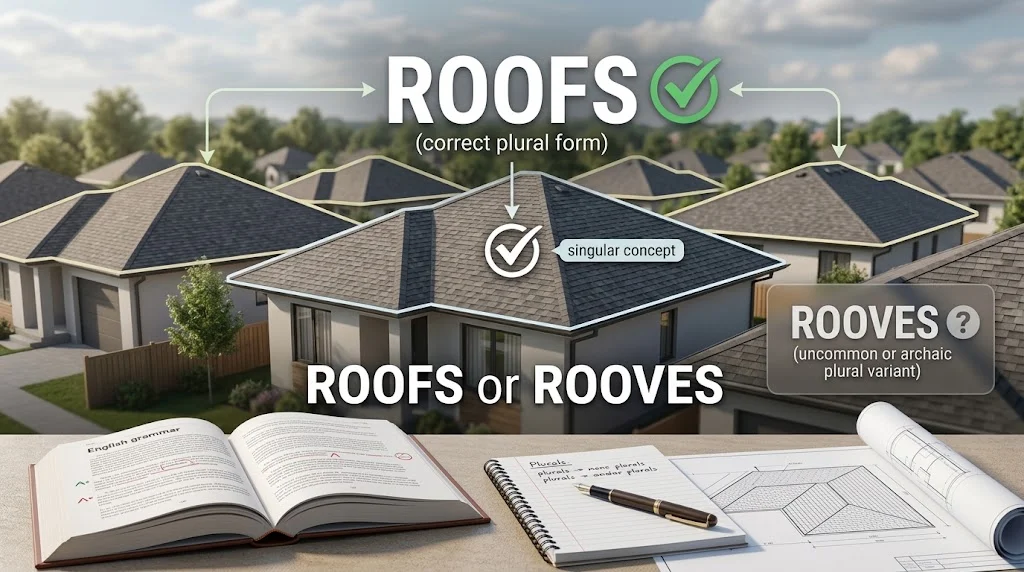
Roofs is the standard and overwhelmingly preferred plural form in modern English, while rooves is an uncommon historical or dialectal variant.
Some English plurals follow familiar patterns, while others seem to invite a different spelling because of the way a word sounds. Roof is one of those words. Many writers wonder whether its plural should be formed with the familiar ending that produces roofs or with a vowel change that produces rooves.
The confusion is understandable because English has several irregular plurals, such as feet from foot and teeth from tooth. However, roof behaves differently in modern standard English. Knowing the accepted plural is useful for students, editors, architects, construction professionals, technical writers, and anyone who wants polished and accurate English.
Roofs vs Rooves: What’s the Difference?
Rooves & Roofs are both forms that have appeared as plurals of the noun roof, but they do not have equal status in contemporary English.
Roofs is the standard plural noun. It refers to two or more structures or coverings forming the upper surface of buildings or other structures.
Example:
“The houses have new roofs.”
Rooves is a rare alternative plural. It has appeared historically and can still be found in some regional or specialized usage, but it is not the normal plural form in contemporary standard English.
Example:
“The village had several old roofs.”
The form roofs is therefore the safest choice whenever you need the ordinary plural of roof.
| Word | Part of Speech | Number | Meaning | Example |
| Roof | Noun | Singular | The upper covering of a building or structure | The roof needs repair. |
| Roofs | Noun | Plural | Two or more roofs | The roofs were damaged. |
| Rooves | Noun | Plural variant | An uncommon plural form of roof | Rooves appears in some older usage. |
Mini Recap
Roof is singular.
Roofs is the standard modern plural.
Rooves is an uncommon variant.
For general writing, roofs is the recommended form.
Is Roofs vs Rooves a Grammar, Vocabulary, or Usage Issue?
The distinction between roofs and rooves is primarily a grammar and usage issue involving plural formation.
The question is not whether both forms have existed. They have. The more important question is which form is appropriate for modern standard English.
In contemporary English, roofs is overwhelmingly preferred. Dictionaries and major usage references generally recognize roofs as the normal plural, while rooves is generally treated as rare, archaic, dialectal, or less common.
Are They Interchangeable?
In a broad historical sense, both forms can refer to multiple roofs. However, they are not equally appropriate in modern standard writing.
If your goal is clear contemporary English, choose roofs.
Formal vs Informal Usage
In formal writing, roofs is the obvious choice. It is appropriate for contracts, reports, academic assignments, news writing, technical documents, business communication, and educational material.
Rooves may appear in historical material, quotations, regional writing, or older publications. Using it in ordinary modern prose can make the writing look unusual or archaic.
Academic vs Casual Usage
Academic writing should generally use roofs because it is the established modern plural.
Casual writing also normally uses roofs. A speaker might occasionally encounter rooves in regional speech or older literature, but it is not the form learners should normally adopt.
How to Use Roofs Correctly
Use roofs whenever you are referring to more than one roof in ordinary modern English.
For example:
“The roofs of the houses were covered with snow.”
“The contractor inspected several roofs.”
“The buildings have flat roofs.”
The plural is formed simply by adding the standard plural ending to roof.
Workplace Example
“The maintenance team inspected all the roofs before the winter season.”
Here, roofs refers to multiple building coverings.
Academic Example
“The study compared the energy efficiency of green roofs and traditional roofs.”
The word is plural because the researchers are discussing multiple roof structures.
Technology Example
“Modern sensors can monitor the condition of roofs and detect moisture.”
The sentence refers to more than one roof, so roofs is the natural plural.
Usage Recap for Roofs
Use roofs for two or more roofs.
It is the standard plural in contemporary English.
It works naturally in formal, academic, professional, and casual writing.
When you are unsure, roofs is almost always the correct choice.
How to Use Rooves Correctly
Rooves is an uncommon plural variant of roof.
You may encounter it in older literature, historical documents, regional English, or sources that preserve unusual plural formations.
Its existence is partly understandable because English contains several words where the vowel changes when the noun becomes plural. Writers may naturally compare roof with words such as foot and tooth.
However, modern English does not generally require this vowel change for roof.
For example:
“Several roofs were damaged by the storm.”
This is the normal modern form.
“The rooves were damaged by the storm.”
This may be understandable, but it is unusual and can look incorrect to many contemporary readers.
Workplace Example
In a professional construction report, use:
“The roofs require structural inspection.”
Using rooves would be unnecessarily unusual.
Academic Example
An academic paper discussing historical English might mention rooves as a historical or variant form. In that context, the unusual spelling may itself be relevant to the discussion.
Technology Example
A modern building management system might monitor multiple roofs for leaks, temperature changes, or structural problems. Technical documentation would normally use roofs.
Usage Recap for Rooves
Rooves is a recognized but uncommon variant.
It is not the normal plural recommended for contemporary standard English.
It may appear in historical or regional contexts.
For ordinary writing, replace it with roofs.
When You Should NOT Use Roofs or Rooves
Understanding when each form should be avoided can prevent unnecessary errors.
- Do not use rooves simply because other words have irregular plurals.
- Do not use rooves in ordinary academic writing when you simply mean multiple roofs.
- Do not use rooves in professional construction documents unless you are intentionally discussing historical or regional usage.
- Do not assume that every noun ending in a similar sound requires a vowel change in the plural.
- Do not write roofes as an alternative plural. The standard form is roofs.
- Do not write roof’s when you mean more than one roof. The apostrophe indicates possession, not ordinary plurality.
- Do not confuse roofs with roof’s. “The roofs are damaged” means multiple roofs are damaged, while “the roof’s surface is damaged” means the surface belongs to one roof.
- Do not use rooves merely to make your writing sound sophisticated or literary. Unusual vocabulary is not automatically better vocabulary.
Common Mistakes and Decision Rules
| Correct Sentence | Incorrect Sentence | Explanation |
| The roofs need repairs. | The rooves need repairs. | Roofs is the standard modern plural. |
| Several roofs were damaged. | Several roof’s were damaged. | An apostrophe is not used to form an ordinary plural. |
| The roofs are made of metal. | The roofs is made of metal. | A plural subject requires a plural verb. |
| The roof’s design is modern. | The roofs design is modern. | Roof’s shows singular possession. |
| The roofs of the houses were painted. | The rooves of the houses were painted. | Rooves is an uncommon variant. |
Decision Rule Box
If you mean two or more roof structures, use roofs.
If you encounter rooves, understand it as a rare or historical plural variant rather than the normal modern form.
The easiest rule is this: one roof, two roofs.
Roofs and Rooves in Modern Technology and AI Tools
The distinction appears in modern technology whenever software, engineering systems, or artificial intelligence discusses buildings.
Smart building platforms may monitor roofs for leaks, temperature, solar panel performance, or structural changes. Technical documentation generally uses roofs because it is the established plural.
AI writing tools can also encounter the word rooves in historical or unusual text. A language model may recognize it as a possible plural, but recognition does not mean it is the preferred modern form.
For contemporary content, an AI generated sentence such as “Solar panels were installed on several roofs” is preferable to “Solar panels were installed on several rooves.”
Writers should therefore evaluate both context and modern usage rather than assuming that every dictionary recognized form is equally common.
Etymology of Roofs and Rooves
The word roof has a long history in English and is related to older Germanic forms.
The standard plural roofs follows the common English pattern of adding the plural ending to the noun.
The variant rooves reflects an older tendency toward vowel changes in plural formation. English once had more variation in how nouns formed their plurals, and some unusual forms survived for a time.
This history helps explain why rooves exists, even though roofs became the dominant modern form.
English has retained other vowel changing plurals, such as:
Foot becomes feet.
Goose becomes geese.
Tooth becomes teeth.
Man becomes men.
However, not every noun follows this pattern. Roof is normally pluralized as roofs in modern English.
An Expert Style Principle
“A word can have historical variants without every variant being equally appropriate in modern English.”
This principle is especially useful when dealing with irregular plurals and older forms.
Two Practical Case Studies
Case Study 1: Construction Report
Imagine a construction company preparing a formal inspection report.
The original sentence reads:
“The rooves of several buildings require immediate inspection.”
Although readers can understand the sentence, the unusual plural can distract from the technical message.
A clearer modern version is:
“The roofs of several buildings require immediate inspection.”
Result: The revised sentence uses the standard plural and sounds natural in professional construction writing.
Case Study 2: Academic Writing
Consider a student writing:
“The research examined how green rooves affect urban temperatures.”
The intended meaning is clear, but roofs is the standard choice for modern academic English.
A stronger version is:
“The research examined how green roofs affect urban temperatures.”
Result: The standard plural improves grammatical consistency and aligns the sentence with contemporary academic usage.
These examples demonstrate an important principle: choosing the standard form can improve clarity even when an alternative form is technically recognizable.
Error Prevention Checklist
Always use Roofs when
You mean more than one roof.
Writing an academic paper.
You are preparing a business document.
Writing technical or construction content.
You are creating modern website content.
Want the standard contemporary English form.
Never use Rooves when
You simply need the ordinary modern plural.
Writing formal professional content.
You are writing for students or English learners.
Unsure whether the unusual form is appropriate.
You are trying to make ordinary writing sound more sophisticated.
Related Grammar Confusions You Should Master
Learning the difference between roofs and rooves can lead to a broader understanding of English plural forms. Other useful distinctions include:
- Roof vs roof’s
- Man vs men
- Woman vs women
- Foot vs feet
- Tooth vs teeth
- Mouse vs mice
- Goose vs geese
- Child vs children
- Person vs people
- Cactus vs cacti
These examples demonstrate that English uses several different strategies for forming plurals. Some nouns follow regular patterns, while others retain historical irregular forms.
FAQs
What is the correct plural of roof?
The standard plural of roof is roofs.
Is rooves a correct word?
Rooves is a recognized but uncommon plural variant of roof. It is not the normal choice in contemporary standard English.
Is roofs or rooves more common?
Roofs is overwhelmingly more common in modern English and is the preferred form for general writing.
Why do people say rooves instead of roofs?
Rooves may arise because English has several irregular plurals involving vowel changes, such as foot and feet. Historical usage also accounts for the existence of the variant.
Is rooves grammatically wrong?
It is better described as an uncommon variant rather than simply an impossible form. However, roofs is the standard modern plural and should normally be preferred.
What is the plural of roof in American English?
The normal plural in American English is roofs.
What is the plural of roof in British English?
The standard plural in British English is also roofs.
Should I use rooves in academic writing?
Generally, no. Use roofs unless your academic discussion specifically concerns historical, dialectal, or variant English usage.
Why is the plural roofs instead of rooves?
Modern English normally forms the plural of roof by adding the plural ending, producing roofs. The historical variant rooves did not become the dominant modern form.
Is roof’s the plural of roof?
No. Roof’s normally indicates possession or can represent a contraction in a different context. The ordinary plural is roofs.
Conclusion
The difference between roofs or rooves is straightforward once modern usage is separated from historical variation. Roofs is the standard plural of roof and is the form you should normally use in academic, professional, technical, and everyday writing.
Rooves exists as an uncommon variant and may appear in older or regional material, but it is not the preferred contemporary form. Remember the simple rule: one roof, two roofs. Following this rule will keep your writing natural, clear, and grammatically appropriate.

Philip Pullman is an American writer dedicated to creating clear and easy to follow English content. Through his work at LingRoya.com, he helps readers strengthen their language skills with practical and reliable guidance so that they can easily understand.