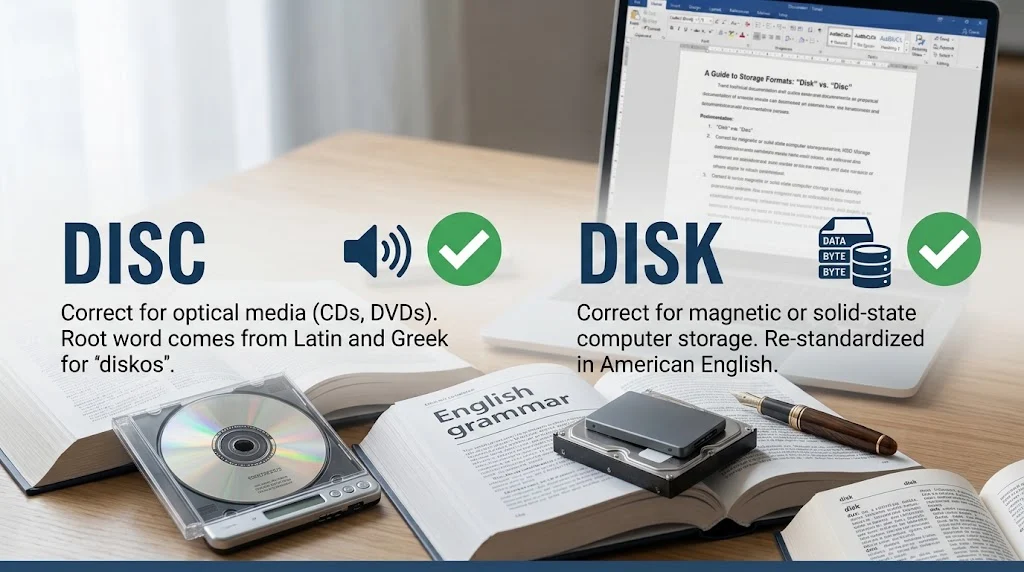
Disc is traditionally preferred for optical media such as a compact disc or DVD and is common in British English. Disk is widely used in American English, especially for computer storage such as a hard disk or disk drive. Both spellings are correct, but they are not always interchangeable in established technical terms.
A single letter can change the way a technical term sounds to a reader, especially when established terminology is involved. If you have ever wondered whether you should write “hard disc” or “hard disk,” you have encountered one of English’s most context dependent spelling differences. Both forms describe a flat, circular object or storage medium, but professional usage has developed different preferences around them.
In this guide, we will examine disc or disk, explain their meanings, trace their history, compare British and American usage, and show you how to choose the correct form in everyday writing, academic work, and modern technology. The goal is not simply to memorize a spelling, but to understand the convention behind it.
Disc or Disk: What’s the Difference?
Disc and disk are both nouns. They generally refer to a thin, flat, circular object, particularly one used for recording, storing, or carrying information.
The difference is primarily based on language variety, established terminology, and technical convention rather than a difference in basic meaning.
| Feature | Disc | Disk |
| Part of speech | Noun, sometimes verb | Noun, sometimes verb |
| Basic meaning | A flat circular object or medium | A flat circular object or medium |
| British English | Very common | Also used in technical contexts |
| American English | Common in some established terms | Very common |
| Optical media | Common | Less common |
| Computer storage | Used in some contexts | Very common |
| Common examples | compact disc, disc brake | hard disk, disk drive |
| Pronunciation | Usually the same | Usually the same |
Mini Recap
Disc and disk have essentially the same basic meaning.
Disc is strongly associated with optical media and many British English expressions.
Disk is especially common in American English and computing.
Established expressions should generally keep their conventional spelling.
Is Disc vs Disk a Grammar, Vocabulary, or Usage Issue?
The difference between disc or disk is primarily a usage and vocabulary issue, not a grammar problem.
You generally will not change the grammatical structure of a sentence simply because you choose one spelling instead of the other. The important question is whether the spelling fits the established expression and the variety of English you are using.
For example:
I bought a compact disc yesterday.
This is completely natural.
I replaced the computer’s hard disk.
This is also completely natural.
Changing these terms to “compact disk” or “hard disc” does not necessarily make the sentence grammatically wrong. However, the alternative may sound less conventional depending on the audience, region, or technical field.
In British English, disc appears frequently in expressions such as “disc brake” and “compact disc.” In American English, disk has become particularly established in computing.
In academic writing, consistency matters. If your institution follows British English, use the terminology expected in that variety. If you are writing for an American technology audience, disk will usually be the more familiar spelling for computer storage.
When to Use Disc
Disc is particularly common when discussing optical media, certain mechanical objects, and British English terminology.
Workplace Example
A workplace document might say:
Please insert the disc into the optical drive.
This wording is appropriate when the physical medium is a CD, DVD, or similar optical format.
Academic Example
A history or media studies paper might state:
The compact disc changed the way consumers purchased recorded music.
Here, disc is the conventional spelling in the established term “compact disc.”
Technology Example
A technology article could say:
The software is distributed on an installation disc.
The word refers to a physical optical medium.
Usage Recap
Use disc when you are referring to established expressions such as compact disc, particularly when writing in British English or discussing optical media.
When to Use Disk
Disk is especially common in American English and in computer terminology.
Workplace Example
An IT employee might write:
The technician replaced the damaged disk.
The word refers to computer storage hardware or a storage medium.
Academic Example
A computer science textbook might explain:
The operating system stores data on a disk.
Here, disk fits standard computing terminology.
Technology Example
You are likely to encounter:
The computer’s disk is almost full.
Similarly, expressions such as hard disk, disk drive, and disk space are highly established in computing.
Usage Recap
Use disk when discussing computer storage, particularly in American English. Terms such as hard disk, disk drive, and disk space strongly favor this spelling.
When You Should NOT Use Disc or Disk Interchangeably
Although both spellings are legitimate, blindly replacing one with the other can make writing sound unusual or technically inconsistent.
Here are several situations where you should be careful.
1. Established technical terms
Do not casually rewrite hard disk as hard disc when following standard American computing terminology.
2. Optical media terminology
Do not automatically change compact disc to compact disk if you are following the conventional expression used by your publication or audience.
3. Brand and product terminology
A product name may use one particular spelling. Preserve the official spelling when referring to a named product.
4. British English writing
If your entire article follows British English, randomly switching between disc and disk can create inconsistency.
5. American technology writing
American technical documentation generally favors disk for computer storage.
6. Academic terminology
Follow the terminology established by your field, textbook, journal, or style guide.
7. Medical terminology
Certain medical expressions traditionally use disc, such as spinal disc and slipped disc in common British usage.
8. Mixed terminology
Avoid changing spelling merely to make every occurrence identical. Context can legitimately determine the preferred form.
Common Mistakes: Disc or Disk
| Correct sentence | Incorrect or less suitable sentence | Explanation |
| The computer has a hard disk. | The computer has a hard disc. | Disk is strongly established in American computing. |
| I bought a compact disc. | I bought a compact disk. | Compact disc is the conventional expression. |
| The disk drive needs repair. | The disc drive needs repair. | Disk drive is standard computing terminology. |
| The music is stored on a disc. | The music is stored on a disk. | Disc is conventional for optical music media. |
| The disk is nearly full. | The disc is nearly full. | Disk is standard for computer storage. |
| He inserted the disc into the player. | He inserted the disk into the player. | Disc is conventional for optical media. |
Decision Rule Box
If you mean optical media such as a CD or DVD, “disc” is usually the conventional choice. If you mean computer storage, especially in American English, “disk” is usually the conventional choice. When following British English, check the established term and keep your spelling consistent.
This rule is more reliable than trying to decide based only on pronunciation because both words normally sound the same.
Disc and Disk in Modern Technology and AI Tools
Modern computing has made disk especially prominent in technical language.
You will frequently encounter terms such as disk space, disk storage, hard disk, disk drive, and virtual disk. Cloud computing and artificial intelligence systems also use storage terminology derived from computing.
For example:
The application requires additional disk space to store its data.
AI systems can involve enormous quantities of stored information, so technical documentation may discuss disk capacity, storage devices, databases, and virtual disks.
Meanwhile, disc remains important for physical optical media and certain established noncomputing expressions.
This distinction demonstrates an important principle of modern English: technology does not always create completely new vocabulary. Sometimes it develops a specialized convention around an existing word.
The Etymology of Disc and Disk
The two spellings have a shared history.
Both ultimately relate to the Latin discus, referring to a circular object associated with throwing. The word entered English through forms influenced by French and Latin.
Over time, English developed both disc and disk as spelling variants.
British English has traditionally retained disc more widely, while American English increasingly favored disk in certain contexts. The rise of computer technology further strengthened disk in American technical vocabulary.
This historical development explains why neither spelling can simply be labeled universally correct or incorrect.
Two Practical Case Studies
Case Study 1: A Technology Blog
Imagine an American technology website publishing an article about upgrading computer storage.
A sentence such as:
The new solid state drive provides faster access than a traditional hard disk.
fits familiar American computing terminology.
Replacing disk throughout the article with disc would create terminology that many technology readers may find less conventional.
Case Study 2: A Music Article
Now imagine a British English article discussing the history of recorded music.
The sentence:
Compact discs transformed the music industry.
uses the established spelling disc.
Switching randomly between “compact disc” and “compact disk” could make the article look inconsistent even though readers would understand both.
These examples show why context is more useful than memorizing a single universal rule.
Error Prevention Checklist
Always use disc when
- You are referring to a compact disc or similar optical medium.
- You are following an established expression that traditionally uses disc.
- Your British English context calls for the conventional spelling.
- Your subject involves terminology such as certain medical or mechanical expressions where disc is established.
Never use disk when
- You are deliberately following a fixed expression spelled with disc.
- You are changing an official product or technical name.
- Your publication style guide specifically requires disc.
- You are trying to replace every occurrence of disc simply for consistency.
Likewise, use disk confidently when discussing established computer storage terminology.
Related Grammar Confusions You Should Master
Understanding disc or disk can lead naturally to other commonly confused English terms. Writers should also learn the differences between:
- advice or advise
- affect or effect
- breath or breathe
- practice or practise
- further or farther
- principal or principle
- compliment or complement
- stationary or stationery
- ensure or insure
- loose or lose
These pairs demonstrate that spelling, pronunciation, meaning, and usage can interact in different ways.
Frequently Asked Questions
Is disc or disk correct?
Both disc and disk are correct spellings. The appropriate choice depends on context, regional English, and established terminology.
Is it hard disk or hard disc?
Hard disk is the standard and highly established form in American computer terminology. British technical usage can vary, but hard disk is widely recognized.
Is it compact disc or compact disk?
Compact disc is the conventional spelling of the optical music and data format commonly known as a CD.
What is the difference between a disc and a disk?
There is no major difference in their basic physical meaning. The distinction is primarily based on spelling conventions, regional usage, and specialized terminology.
Do British people use disc or disk?
British English commonly uses disc, although disk also appears in technical and computing contexts. The established expression determines the appropriate choice.
Do Americans say disc or disk?
Americans use both spellings, but disk is particularly common in computing. Disc remains common in expressions associated with optical media and certain established terms.
Is disk space or disc space correct?
Disk space is the standard computing expression, especially in American English.
Is a CD a disc or a disk?
A CD is conventionally called a compact disc, so disc is the standard spelling in that expression.
Should I use disc or disk in academic writing?
Use the spelling required by your subject area, institution, regional English standard, or style guide. Most importantly, remain consistent throughout the document.
Conclusion
The choice between disc or disk is rarely about grammar. It is primarily about established vocabulary, regional English, and context. Disc is strongly associated with optical media such as compact discs and is common in British English. Disk is especially established in American computing, where terms such as hard disk, disk drive, and disk space are standard.
When you are unsure, look at the complete expression rather than the individual word. Established terminology usually provides the clearest answer. For professional writing, consistency and audience expectations should guide your final choice.

Neil Gaiman is an American writer who contributes educational content to LingRoya.com. His work focuses on helping readers improve their English with clear, practical and easy to follow guidance.