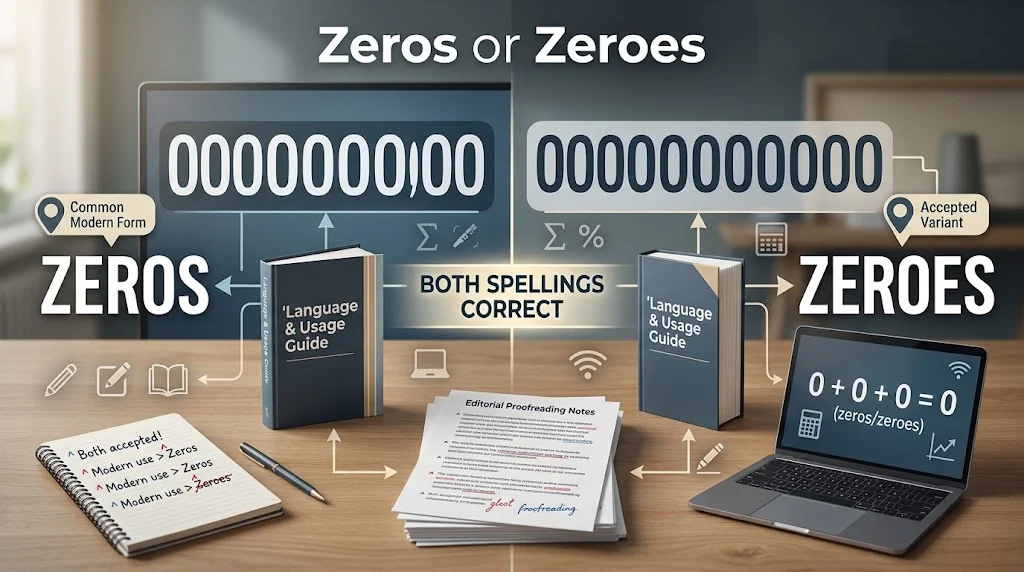
The plural of zero can be written as zeros or zeroes. Both forms are grammatically correct, but zeros is generally more common in modern English, particularly in American English, mathematics, computing, and technical contexts. Zeroes is also correct and appears frequently in British English and traditional writing.
Few spelling questions look as simple as the difference between zeros and zeroes, yet both forms appear in newspapers, textbooks, financial documents, computer code discussions, and everyday writing. Because English allows two accepted plural spellings, writers may wonder whether one is technically wrong. It isn’t.
The real issue is understanding which form is more appropriate for a particular audience and context. From a linguistic perspective, zero is unusual because English has developed more than one accepted plural pattern for the word. Knowing the difference helps writers make confident choices while avoiding unnecessary corrections of a form that is already grammatically valid.
Zeros vs Zeroes: What’s the Difference?
Zeros and zeroes are both plural nouns formed from zero.
The word zero refers to the numerical value representing no quantity or the absence of an amount. When referring to more than one zero, both zeros and zeroes can be used.
For example:
“The number contains three zeros.”
“The number contains three zeroes.”
Both sentences are correct.
| Form | Part of Speech | Number | Meaning | Example |
| Zero | Noun | Singular | The number 0 | The answer is zero. |
| Zeros | Noun | Plural | More than one zero | The number has three zeros. |
| Zeroes | Noun | Plural | More than one zero | The number has three zeroes. |
The principal difference is spelling preference rather than meaning.
Mini Recap
Zeros and zeroes have the same meaning.
Both forms are accepted English plurals.
Zeros is generally more common in contemporary usage.
Zeroes remains completely valid, especially in some varieties and styles of English.
Consistency is more important than switching between the two forms.
Is Zeros vs Zeroes a Grammar, Vocabulary, or Usage Issue?
The difference between zeros and zeroes is primarily a spelling and usage issue, not a difference in meaning.
Both forms function as plural nouns. Neither is inherently incorrect.
English normally forms many plurals by adding an s, as in books, cars, and numbers. However, words ending in certain sounds sometimes develop an es spelling. Zero has historically appeared with both plural patterns, allowing both zeros and zeroes to survive in standard English.
Formal vs Informal Usage
Both forms can appear in formal writing. However, zeros is now widely preferred in many modern style guides, particularly in American English.
Zeroes may sound slightly more traditional to some readers, but that does not make it incorrect or informal.
Academic vs Casual Usage
In mathematics and scientific writing, zeros is often the more practical choice because it is concise and widely recognized.
For example:
“The polynomial has two real zeros.”
Zeroes can also be used:
“The polynomial has two real zeroes.”
The important point is consistency. A writer should generally select one spelling and use it consistently throughout a document.
How to Use Zeros Correctly
Zeros is the most common plural form of zero in many modern contexts.
Use it when referring to multiple instances of the number 0.
Workplace Example
“The financial report contains several zeros in the revenue column.”
Here, zeros refers to multiple numerical characters or values.
Academic Example
“The equation has two zeros within the specified interval.”
In mathematics, zeros can refer to values at which a function equals zero.
Technology Example
“The system automatically removes leading zeros from the identification number.”
Here, zeros refers to multiple occurrences of the numerical character 0.
Usage Recap for Zeros
Use zeros when you want the most widely recognized modern plural form.
It works naturally in mathematics, finance, technology, education, journalism, and everyday writing.
It is especially common in American English and contemporary technical writing.
How to Use Zeroes Correctly
Zeroes is also a legitimate plural form of zero.
For example:
“The password contains several zeroes.”
This sentence is grammatically correct.
Zeroes may be preferred by writers who follow British English conventions or who favor the traditional spelling.
Workplace Example
“The invoice numbers contain several zeroes.”
The word describes multiple occurrences of 0.
Academic Example
“The sequence begins with two zeroes before the first nonzero value.”
The spelling is fully acceptable in an academic context.
Technology Example
“The program checks whether the input contains leading zeroes.”
Again, zeroes is grammatically valid.
Usage Recap for Zeroes
Use zeroes when it matches your preferred variety or editorial style.
It has the same meaning as zeros.
It should not be treated as a spelling mistake simply because zeros is more common.
When You Should NOT Use Zeros or Zeroes
Understanding what these words mean also prevents several unnecessary corrections.
- Do not assume that zeroes is always incorrect. It is a recognized plural form.
- Do not assume that zeros is grammatically inferior. It is standard and extremely common.
- Do not switch randomly between zeros and zeroes within the same article.
- Do not use either plural form when you mean only one zero. In that case, use zero.
- Do not change zeroes to zeros solely because a spell checker prefers one form. Check the style and audience first.
- Do not use zeroes when your publication has specifically adopted zeros as its house style.
- Do not use zeros when a quoted source or established title deliberately uses zeroes and you are preserving its original wording.
- Do not confuse the plural noun with other forms of the word zero used in expressions such as “zero tolerance” or “zero chance.”
Common Mistakes and Decision Rules
| Correct Sentence | Incorrect Sentence | Explanation |
| The number contains three zeros. | The number contains three zero. | More than one requires a plural form. |
| The number contains three zeroes. | The number contains three zero. | Zeroes is also a correct plural. |
| The answer is zero. | The answer is zeros. | One numerical value requires the singular form. |
| The program removes leading zeros. | The program removes leading zero. | Multiple characters require a plural. |
| The equation has two zeros. | The equation has two zero. | Two requires a plural noun. |
| The equation has two zeroes. | The equation has two zero. | Zeroes is an accepted plural spelling. |
Decision Rule Box
If you mean more than one instance of the number 0, use zeros or zeroes.
If you mean the single numerical value 0, use zero.
When choosing between zeros and zeroes, consider your audience and style guide. If no specific preference exists, zeros is generally the safest modern choice.
Zeros and Zeroes in Modern Technology and AI Tools
The distinction between zeros and zeroes appears frequently in technology.
Computers regularly work with strings of zeros, binary numbers, numerical identifiers, timestamps, and formatted data. Technical documentation therefore tends to favor zeros, particularly because the shorter spelling is widely used.
For example:
“The system pads the number with leading zeros.”
In programming discussions, “zeros” is also common when describing arrays or numerical data containing repeated zero values.
AI writing tools encounter the same spelling variation. A language model may produce either zeros or zeroes depending on the context, training patterns, regional spelling preferences, and surrounding text.
Neither spelling should automatically be flagged as an error. Editors should instead check the intended audience and publication style.
Etymology of Zero, Zeros, and Zeroes
The word zero entered English through a long linguistic journey involving Arabic and European languages. Its history is connected with the development and transmission of the concept of a numerical placeholder representing nothing.
English eventually established zero as the ordinary name for the number 0. As the word became widely used, both zeros and zeroes developed as plural forms.
The existence of two spellings reflects a broader feature of English: some words allow competing plural patterns that remain standard over time.
An Expert Style Principle
“When two spellings carry the same meaning, consistency and audience should guide the final choice.”
That principle is especially useful for zeros and zeroes because neither spelling changes the underlying meaning.
Two Practical Case Studies
Case Study 1: Financial Reporting
Imagine a financial analyst writing:
“The spreadsheet contains several zeroes in the expense column.”
The sentence is correct. However, if the company’s style guide uses zeros throughout its reports, an editor may change the sentence to:
“The spreadsheet contains several zeros in the expense column.”
Result: The meaning remains exactly the same, while the document becomes consistent with the organization’s preferred spelling.
This illustrates that editorial consistency, rather than grammatical correction, is often the real reason for changing zeroes to zeros.
Case Study 2: Technical Documentation
Suppose a software manual says:
“The application adds leading zeroes to dates.”
There is nothing grammatically wrong with the sentence. A technical team that prefers contemporary American technical style might instead write:
“The application adds leading zeros to dates.”
Result: The revised sentence follows a common technical convention without changing the meaning or instruction.
These examples demonstrate why writers should distinguish between an actual error and a legitimate spelling variation.
Author expertise: This guide combines established English usage principles with practical editing conventions for educational, academic, professional, and technology focused writing.
Error Prevention Checklist
Always use Zeros when
You want the most widely recognized modern plural form.
You are writing technical or mathematical content.
Your publication style prefers the shorter plural spelling.
You are writing for a broad international audience and want a highly familiar form.
Never use Zeroes when
Your style guide explicitly requires zeros.
You are using it merely because you believe zeros is incorrect.
You are switching spelling randomly within the same document.
However, remember that zeroes itself is not an error. It is an accepted plural form.
Related Grammar Confusions You Should Master
Once you understand zeros and zeroes, several other English spelling and usage questions are worth studying:
- Potato vs potatoes
- Tomato vs tomatoes
- Hero vs heroes
- Bus vs buses
- Gas vs gases
- Focus vs focuses
- Cactus vs cactuses
- Octopus vs octopuses
- Indexes vs indices
- Data vs datum
These examples show how English allows different plural patterns depending on word history, pronunciation, technical tradition, and regional usage.
FAQs
Is zeros or zeroes correct?
Both zeros and zeroes are correct plural forms of zero. Zeros is generally more common in modern English, while zeroes remains an accepted alternative.
Which is more common, zeros or zeroes?
Zeros is generally more common, particularly in American English, mathematics, technology, and contemporary writing.
Is zeroes a real word?
Yes. Zeroes is a standard and accepted plural form of zero.
Is zeros grammatically correct?
Yes. Zeros is a standard plural form and is widely used in modern English.
Should I write zeros or zeroes in academic writing?
Either can be correct, but zeros is often the more common choice in contemporary academic and technical writing. Follow your institution or publication style guide when one exists.
Is zeros or zeroes preferred in American English?
Zeros is generally preferred in American English, although zeroes is still understood and accepted.
Is zeroes preferred in British English?
Zeroes appears more frequently in British English than in American English, but zeros is also widely recognized and used.
Should I use zeros or zeroes in programming?
Zeros is generally the more common choice in programming and technical documentation, particularly in phrases such as “leading zeros” and “an array of zeros.”
Does zeros mean the same thing as zeroes?
Yes. In ordinary usage, zeros and zeroes have the same meaning and refer to multiple instances of the number zero.
Conclusion: Zeros or Zeroes
The choice between zeros or zeroes is not a matter of right versus wrong. Both are accepted plural forms of zero. Zeros is generally the more common modern spelling and is particularly frequent in American English, mathematics, technology, and technical documentation.
Zeroes remains fully valid and may be preferred in British English or by writers following a traditional style. The most important rule is to choose a form that suits your audience and use it consistently. When no style preference exists, zeros is usually the simplest and most widely recognized option.

Margaret Atwood is an American writer who contributes to LingRoya.com creating clear and engaging content about the English language and everyday communication. She enjoys helping readers build confidence in their writing through simple, practical guidance.