Quick Answer: Analogs and analogues are both correct spellings. Analogs is the preferred spelling in American English, while analogues is more common in British English. Both words have the same meaning and can refer to things that are similar or comparable
The words analogs and analogues often confuse English learners because they have the same meaning but different spellings. Both are plural forms of analog and analogue, and they are used to describe things that are similar to or comparable with something else. The main difference between them is regional spelling rather than meaning.
In American English, analogs is the more common spelling, while analogues is preferred in British English and other varieties that follow British spelling conventions. Understanding this difference can help you choose the right form for your audience and avoid spelling mistakes in formal or academic writing. In this guide, we’ll explore the meanings, differences, and correct usage of analogs and analogues with clear examples.
Analog vs Analogue: What is the Difference?
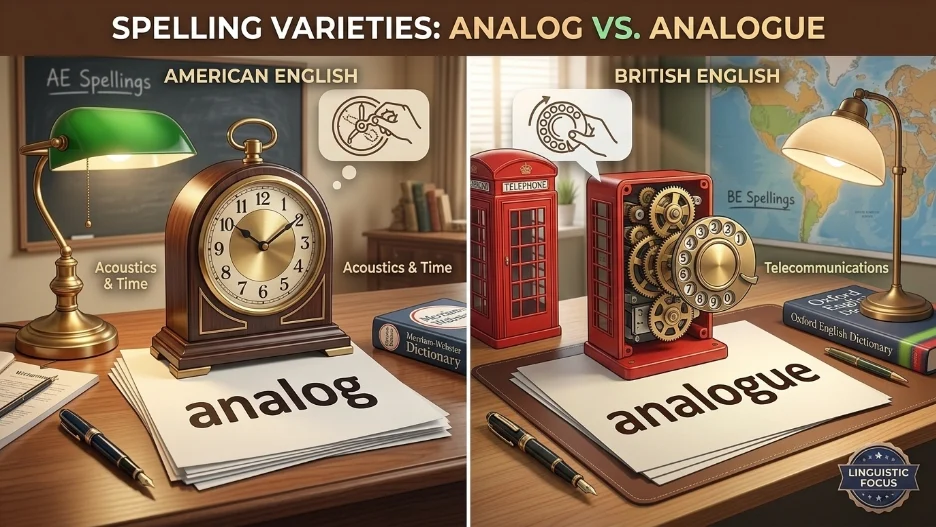
The core difference between these two spellings is purely regional. Think of it like “color” versus “colour” or “favorite” versus “favourite.” The word has exactly the same meaning in both forms, so you do not need to worry about using the wrong word in terms of definition.
Here is a quick breakdown:
| Feature | Analog | Analogue |
| Primary Usage | American English | British English |
| Meaning | Same as analogue | Same as analog |
| Part of Speech | Noun and Adjective | Noun and Adjective |
| Used in Technology | Yes, preferred in computing | Yes, used in UK tech contexts |
| Example | The analog clock | The analogue clock |
The spelling “analog” is standard in American English and has become the preferred form in computing and technology sectors worldwide, largely due to the influence of American tech companies. “Analogue” remains the standard spelling in British English, Australian English, and most other Commonwealth English varieties.
Is This a Grammar, Vocabulary, or Usage Issue?
This question falls squarely into the category of a usage issue rather than a grammar or vocabulary distinction. Both words share the same vocabulary meaning, and they function identically as parts of speech. The choice between them depends entirely on your audience and context.
In formal versus informal usage, the distinction remains the same. Whether you are writing a casual email or a formal academic paper, the regional preference applies consistently. However, there is one notable exception: in the technology industry, “analog” has become the internationally accepted form, even in British publications that might otherwise use British spellings for other words.
Academic writing tends to follow the conventions of the publication or institution. If you are submitting to an American journal, use “analog.” For a British journal, use “analogue.” The same rule applies to casual writing, blog posts, and professional communications.
Using “Analog” in Practice
When you use “analog” in American English, it can function as both a noun and an adjective. As an adjective, it describes something that operates using continuous signals or physical quantities. As a noun, it refers to something that is similar to something else or a physical representation of a continuous signal.
Workplace Example
“The company decided to upgrade its analog phone system to a digital one because the old system could not handle the volume of remote calls.” In this example, analog describes the traditional phone system that uses continuous electrical signals to transmit voice.
Academic Example
“In her research, Dr. Chen studied the analog signals produced by neurons to better understand how the brain processes sensory information.” Here, the term appears in a neuroscience context where continuous biological signals are measured.
Technology Example
“The analog to digital converter transforms the continuous waveform into a discrete digital signal that computers can process.” This example shows how the term functions in technical documentation.
In American English, “analog” is the spelling you will encounter most frequently. It is the preferred form in the computer industry, and most American style guides recommend it.
Using “Analogue” in Practice
“Analogue” follows the same rules as “analog” but is used in British English and other Commonwealth varieties. The part of speech and meaning remain identical.
Workplace Example
“The IT department recommended replacing the old analogue telephone system with a modern digital network that offers better security and flexibility.” In the UK, this would be the standard spelling for describing traditional phone systems.
Academic Example
“The study examined how analogue signals degrade over long cable distances, which has implications for telecommunications infrastructure.” British academic writing would consistently use this spelling.
Technology Example
“The analogue signal from the sensor was too weak to be processed reliably, so we installed an amplifier.” Even in technical contexts, British English maintains the longer spelling.
When You Should NOT Use “Analog” or “Analogue”
While these spellings are generally interchangeable across regions, there are specific situations where one form is more appropriate than the other.
- Do not use “analog” when writing for a British publication or audience that expects UK spelling conventions.
- Avoid using “analogue” in American English contexts, particularly in technology writing where “analog” is standard.
- Never use both spellings in the same document unless you are intentionally highlighting regional variations for discussion.
- Do not mix “analog” and “analogue” when referring to the same item in a single piece of writing. Consistency is key.
- When writing for international audiences, consider using “analog” as it is more widely recognized and accepted globally.
- If you are writing about the technology industry, “analog” is generally preferred even in British publications.
- Do not use “analog” when referring to chemical compounds in British English contexts, where “analogue” remains the standard.
- In legal or official documents, follow the spelling conventions of the country where the document will be used.
Common Mistakes and Decision Rules
| Correct Sentence | Incorrect Sentence | Explanation |
| The analog clock in the classroom | The analogue clock in the American classroom | In American English, “analog” is correct |
| The analogue radio was a gift from my grandfather | The analog radio was a gift from my grandfather | In British English, “analogue” is standard |
| This drug is an analog of the original compound | This drug is an analogue of the original compound | In a US chemistry journal, use “analog” |
| The company developed a new analogue computer system | The company developed a new analog computer system | In a UK tech context, either could work, but “analogue” follows British conventions |
The decision rule is simple:
If you are writing for an American audience or in an American context, use analog.
If you are writing for a British audience or in a British context, use analogue.
In technology writing globally, analog is usually the safer choice.
Analog and Analogue in Modern Technology and AI Tools
The distinction between analog and analogue becomes particularly interesting in modern technology. AI tools and natural language processing systems have to account for these regional variations. When you use AI writing assistants, they typically default to one spelling based on your settings. Most AI tools are trained on American English datasets, so they tend to recommend “analog” automatically.
In technology discussions, “analog” increasingly refers not just to traditional continuous signals but also to non digital approaches. For example, analog computing is experiencing a revival in certain AI applications because it can process certain types of problems more efficiently than digital computing. The analogue approach to problem solving, by contrast, might refer to using physical models to understand complex systems.
The differences matter in scientific computing, where analog computational modelling and analogue physical modelling serve distinct purposes. While the spellings differ, they both represent ways of understanding the world that predate digital technology.
The Etymology and Authority Behind the Terms
The word “analog” entered English in the 19th century from the French word “analogue,” which comes from the Greek “analogos” meaning proportionate or corresponding. The original definition refers to something that is similar to something else, which is where we get the word “analogy.” This connection between analogy and analog helps explain why the terms are so important in fields from linguistics to biology.
As linguist Raimo Anttila emphasizes, “similarity relations exist in both form and meaning,” and analogical reasoning is a fundamental cognitive faculty that shapes how we learn language and understand the world.
One case study involves a software company that had to update its entire documentation when expanding into the UK market. The company discovered that using “analog” in British English materials created confusion among users who expected “analogue.” The cost of this oversight included lost productivity and customer service calls.
Another case study comes from an academic journal that rejected a paper because the author inconsistently used both spellings. The reviewers noted that this inconsistency distracted from the research quality, highlighting the importance of choosing one spelling and sticking with it.
Error Prevention Checklist for Writers
When you are writing about analogs or analogues, keep this checklist handy:
- Always use analog when writing for American audiences
- Always use analogue when writing for British audiences
- Never use analogue in American technology publications
- Consider using analog for international audiences
- Check your style guide before starting a new project
- Use the same spelling consistently throughout your document
- Never mix both spellings in the same piece
- In tech contexts globally, analog is usually the safer choice
Related Grammar Confusions You Should Master
The analog versus analogue distinction is just one of many usage questions that can trip up writers. Here are related topics worth mastering:
- Color vs Colour
- Favor vs Favour
- Digital vs Numerical
- Continuous vs Discrete
- Homologous vs Analogous Structures
- Discrete vs Discreet
- Affect vs Effect
- Stationary vs Stationery
- Principle vs Principal
- Complement vs Compliment
Understanding these distinctions can significantly improve your writing quality across different English varieties.
Advanced FAQs
Is “analogue” still commonly used in British English?
Yes, analogue remains the standard spelling in British English. It is commonly used in general, academic, and technical contexts.
Is “analog” only used in American English?
No, analog is widely used outside the United States, especially in technology and computing. However, analogue remains preferred in traditional British English.
What is the plural of “analog”?
The plural form of analog is analogs. It refers to multiple similar or comparable things.
What is the plural of “analogue”?
The plural form of analogue is analogues. This spelling is especially common in British English.
Should I use “analogs” or “analogues” in academic writing?
Choose the spelling that matches your preferred English variety and use it consistently. Analogs suits American English, while analogues suits British English.
Conclusion
The choice between analog and analogue ultimately comes down to knowing your audience and following consistent spelling conventions. While this might seem like a small detail, getting it right shows attention to detail and respect for your readers. Remember that in American English, “analog” is standard, while “analogue” is preferred in British English. For the technology industry globally, “analog” has become the default.

Margaret Atwood is an American writer who contributes to LingRoya.com creating clear and engaging content about the English language and everyday communication. She enjoys helping readers build confidence in their writing through simple, practical guidance.