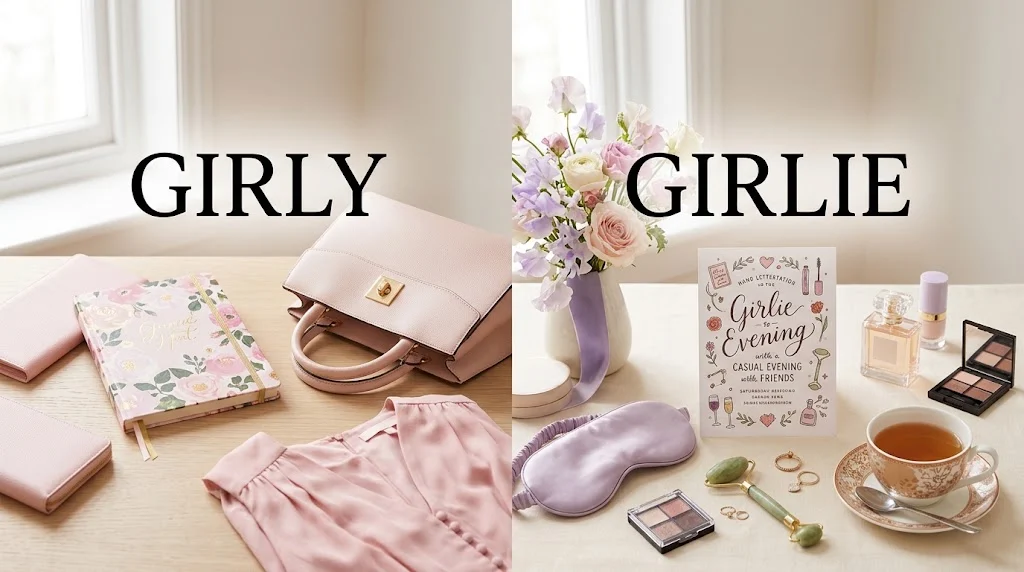
Girly or girlie are both correct English spellings used to describe something associated with girls, femininity, or traditionally feminine styles. The word girly is more common in everyday writing, while girlie is also accepted and appears in informal expressions and certain established phrases.
Have you ever hesitated before writing girly or girlie in a text, social media caption, or article? Both spellings are acceptable, and they generally share the same meaning. However, choosing the right form can make your writing look more natural and consistent
. In modern English, girly is the more common choice for describing feminine clothing, colors, accessories, or behavior, while girlie appears in expressions such as girlie night and girlie magazine. Understanding their spelling, tone, and context helps students, writers, and English learners use these words confidently without creating unnecessary confusion.
Girly vs Girlie: What’s the Difference?
The main difference between girly and girlie is spelling and usage preference, not meaning. Both words can function as adjectives describing something traditionally associated with girls or femininity. They can also appear as nouns in informal contexts, although the meaning and tone depend on the sentence.
| Feature | Girly | Girlie |
|---|---|---|
| Part of speech | Adjective, occasionally noun | Adjective, occasionally noun |
| Main meaning | Feminine or associated with girls | Feminine or associated with girls |
| Spelling status | Correct | Correct |
| General usage | Common in everyday English | Also accepted, sometimes less common |
| Typical examples | Girly clothes, girly colors | Girlie night, girlie magazines |
| Tone | Casual and conversational | Casual and conversational |
| Best use | General descriptions of feminine styles | General descriptions and established expressions |
Quick Recap
- Girly and girlie are both acceptable spellings.
- Both can describe traditionally feminine styles or characteristics.
- Girly is a common choice in everyday writing.
- Girlie appears in informal expressions and some established phrases.
- Neither spelling is universally wrong, so context and consistency matter.
What Does Girly Mean?
Girly is an adjective that describes something associated with girls or qualities traditionally considered feminine. Depending on the context, it may refer to clothing, colors, decorations, interests, or behavior.
For example, a person might describe a pink bedroom with floral patterns as girly. Someone else might use the word for a fashion style featuring ribbons, dresses, and delicate accessories.
Examples:
- She chose a girly pink dress for the birthday party.
- My sister loves girly accessories and colorful handbags.
- The bedroom has a girly design with flowers and pastel colors.
- Her writing style is playful and girly.
The word doesn’t necessarily imply anything negative. Its tone depends on how it’s used. In a friendly conversation, it may express affection or enthusiasm. In another situation, it could sound dismissive if someone uses it to suggest that a person’s interests are childish or unimportant.
What Does Girlie Mean?
Girlie is an alternative spelling of girly. It can describe feminine styles, interests, or characteristics, and it appears in informal expressions such as girlie night or girlie magazine.
Examples:
- We’re planning a girlie night with movies and snacks.
- She bought a girlie dress for the summer party.
- The shop sells girlie accessories, including bows and bracelets.
- They organized a girlie weekend at a spa.
The spelling girlie can sometimes sound more playful or distinctive, particularly in casual expressions. However, this isn’t a strict rule. Many writers use it simply as an alternative spelling.
It’s also important to recognize that the word can have different connotations in different settings. For instance, girlie magazine has historically referred to certain magazines featuring photographs of women, sometimes with suggestive content. Therefore, the context matters when interpreting the word.
Is Girly vs Girlie a Grammar, Vocabulary, or Usage Issue?
The distinction between girly and girlie is primarily a spelling and usage issue. Both words can communicate the same basic idea, and neither is grammatically incorrect simply because of its spelling.
Are Girly and Girlie Interchangeable?
In many sentences, yes. Both can describe feminine clothing, decorations, accessories, or styles.
For example:
- She likes girly clothes.
- She likes girlie clothes.
Both sentences are understandable and acceptable.
However, some established expressions favor one spelling over the other. A writer might naturally choose girlie night or girly girl, depending on personal preference and the expression being used.
Formal vs Informal Usage
Both forms are informal in tone. They’re common in everyday conversations, lifestyle writing, fashion discussions, and social media posts.
In formal academic or professional writing, more precise alternatives may be preferable. Instead of describing an office design as girly, for example, you could call it feminine, delicate, floral, or pastel themed, depending on what you mean.
Academic vs Casual Usage
In an academic paper about fashion or cultural stereotypes, traditionally feminine may communicate the intended meaning more precisely than either spelling.
In casual conversation, however, both girly and girlie sound natural.
The important point is that these words describe cultural associations rather than fixed characteristics. Not every girl prefers traditionally feminine styles, and these interests aren’t exclusive to girls.
When to Use Girly
Use girly when you want a straightforward, conversational word for something associated with traditionally feminine styles or interests. It’s a practical choice for everyday writing, blogs, captions, and general descriptions.
Workplace Example
A fashion consultant might write:
“Our latest collection includes girly accessories, pastel handbags, and floral dresses.”
This sentence communicates a particular style to customers. For a more formal business description, feminine accessories might be more suitable.
Academic Example
A student researching fashion preferences might write:
“The survey examined how participants interpreted girly clothing and traditionally feminine design.”
In academic writing, it’s useful to define what girly means in the research rather than assume everyone interprets it in the same way.
Technology Example
A designer working on a shopping application might describe a collection as:
“Explore girly phone cases featuring flowers, hearts, and pastel patterns.”
The term helps communicate a recognizable aesthetic to users.
Usage recap: Girly is a convenient everyday spelling for feminine styles, fashion, decorations, and interests. Consider a more precise alternative when writing formally.
When to Use Girlie
Use girlie when it fits your preferred writing style or a familiar informal expression. It can be especially natural in phrases such as girlie night, girlie weekend, and girlie magazine.
Workplace Example
A lifestyle blogger might write:
“Join us for a girlie weekend filled with shopping, good food, and relaxation.”
The expression creates a friendly, informal tone. In a corporate announcement, a more neutral phrase such as friends’ weekend retreat might suit a broader audience.
Academic Example
A researcher examining popular culture might write:
“The article explored the historical use of the term girlie in magazine publishing.”
Here, the spelling is appropriate because the researcher is discussing the word itself and its cultural context.
Technology Example
A social media creator might caption a video:
“Planning the perfect girlie night with my best friends.”
The wording suits a casual post about spending time with friends.
Usage recap: Girlie is correct and useful in informal expressions and discussions of established terminology. Choose it when it suits the context, and maintain consistent spelling.
When You Should NOT Use Girly or Girlie
Although both spellings are correct, the words aren’t suitable for every situation.
1. Don’t use them when precision matters. In a research paper, terms such as traditionally feminine or gender associated may communicate your meaning more clearly.
2. Don’t use them to stereotype people. Assuming that every girl likes pink, makeup, or dresses oversimplifies individual preferences.
3. Don’t use them as insults. Calling someone’s interests girly to belittle them can sound dismissive or disrespectful.
4. Don’t assume they describe only girls. People of any gender can enjoy clothing, accessories, or activities traditionally associated with femininity.
5. Don’t use them in professional descriptions without considering the audience. A product description may benefit from specific details about color, fabric, shape, or design.
6. Don’t confuse the word with girlie as a reference to a particular publication. In expressions such as girlie magazine, the meaning may be more specific than simply feminine.
7. Don’t switch spellings randomly. Although both forms are correct, consistent spelling makes articles and other long documents easier to read.
8. Don’t assume that girlie always sounds more affectionate. Its tone depends on the expression, audience, and surrounding words.
Common Girly and Girlie Mistakes
The following table shows how to use both spellings naturally and how to avoid problems with meaning or grammar.
| Correct sentence | Incorrect sentence | Explanation |
|---|---|---|
| She likes girly dresses. | She likes girli dresses. | Girli is not the standard spelling of the word. |
| We planned a girlie night. | We planned a girlie nights. | The singular article a requires the singular noun night. |
| Her room has a girly design. | Her room have a girly design. | The singular subject room requires has. |
| They enjoy traditionally feminine styles. | They enjoys traditionally feminine styles. | The plural subject they requires enjoy. |
| He likes pink accessories. | He must like girly accessories because he is a girl. | Clothing preferences don’t establish a person’s gender. |
Decision Rule
If you want a common everyday adjective, use girly.
If girlie fits a familiar expression or your preferred informal style, use girlie.
Both spellings are correct. Choose the version that sounds natural for your context, and prioritize clear, respectful language over assumptions about gender.
Girly and Girlie in Modern Technology and AI Tools
The words girly and girlie frequently appear in social media captions, online fashion stores, product descriptions, image searches, and AI generated design prompts.
For example, a user might request a girly birthday invitation with pastel colors, flowers, and elegant lettering. Another might search for girlie night ideas or create a mood board for a feminine bedroom.
AI writing tools generally recognize both spellings, but their output may vary depending on the language settings and training examples. Neither spelling guarantees better search performance.
For content creators, the best approach is to use the spelling that fits the intended meaning and audience. Describe the actual design elements when possible, such as floral patterns, pink backgrounds, delicate typography, or decorative bows. Specific descriptions help readers and design tools understand the intended aesthetic.
Etymology: Where Do Girly and Girlie Come From?
Both words developed from girl with the addition of a suffix used to form familiar or descriptive words.
The word girl has a long history in English, with its earliest recorded meanings not always limited to the modern meaning of a female child or young woman. Over time, its meaning became more closely associated with female children and young women.
The suffix y commonly forms adjectives in English, as in cloudy, rainy, and messy. In girly, it creates a descriptive word associated with girls or femininity. The spelling girlie represents an alternative form that has also become established in English usage.
The two forms have overlapping meanings, and their spelling difference doesn’t establish a difference in grammatical correctness.
Expert Insight: Choosing Words That Fit Your Audience
A useful principle in professional writing is to choose language that conveys the intended meaning without relying on assumptions.
For example, instead of writing, “The product is perfect for girly people,” a writer could say, “The product suits anyone who enjoys floral designs and pastel colors.”
The second sentence is more specific and inclusive. It describes the product’s features and intended aesthetic rather than suggesting that certain interests belong to one group.
Two Practical Case Studies
Case Study 1: A Fashion Blog
Imagine a fashion blogger preparing an article about pastel dresses, floral handbags, and delicate jewelry. The draft uses girly in some headings and girlie in others.
The editor chooses girly as the preferred spelling for general descriptions and reserves girlie for established phrases such as girlie night.
Result: The article follows a clearer editorial convention, and readers encounter more consistent terminology. This is an illustrative example, not a report of measured SEO results.
Case Study 2: An Online Accessories Store
Consider an online store that markets phone cases, bracelets, and stationery with floral patterns and pastel colors. Its original product descriptions repeatedly use the word girlie without explaining the designs.
The content team revises the descriptions to use specific terms such as floral, pastel, delicate, and feminine where appropriate. It retains girly in a few informal collection titles that suit the brand’s voice.
Result: Product descriptions communicate more concrete visual details, helping customers understand the style before browsing. This is an illustrative scenario rather than a documented conversion study.
Error Prevention Checklist
Always Use Girly When
- You want a common, straightforward adjective for traditionally feminine styles.
- You’re writing a casual caption or lifestyle article.
- Your publication has selected girly as its preferred spelling.
- You want to maintain consistency with other content on your website.
Never Use Girlie When
- Your organization’s style guide specifically requires girly.
- You’re editing a document that consistently uses girly and have no reason to change the spelling.
- The word could create confusion in a formal context where a more precise description is available.
These guidelines concern editorial consistency, not universal correctness. Girlie remains a valid spelling, and it may be the better option in certain expressions or contexts.
Before publishing, read the sentence aloud, check its intended tone, and consider whether the word accurately describes the person, product, or style.
Related Grammar Confusions You Should Master
Learning the difference between girly and girlie can help you understand other spelling and vocabulary questions.
- Gray vs Grey: American and British spelling preferences.
- Color vs Colour: Regional spelling differences.
- Favorite vs Favourite: The use of the letter u.
- Everyday vs Every Day: An adjective compared with a two word expression.
- Woman vs Women: Singular and plural forms.
- Girl vs Girls: Singular and plural nouns.
- Feminine vs Girly: Differences in tone and precision.
- Childish vs Childlike: Negative and positive connotations.
- Cute vs Pretty: Similar descriptions with different shades of meaning.
- Affect vs Effect: Commonly confused words with different grammatical functions.
These comparisons are useful for students, writers, and English learners who want to improve spelling, vocabulary, and sentence clarity.
Frequently Asked Questions
1. Is girly or girlie the correct spelling?
Both spellings are correct. Girly is a common everyday form, while girlie is an accepted alternative used in informal expressions and other contexts.
2. What is the difference between girly and girlie?
Both generally describe something associated with girls or traditionally feminine styles. The difference is mainly spelling preference and context rather than meaning.
3. Is girly a real word?
Yes, girly is a recognized English word. It is commonly used as an adjective to describe feminine clothing, decorations, accessories, or interests.
4. Is girlie a real word?
Yes, girlie is also a recognized English word. It can describe feminine styles and appears in expressions such as girlie night and girlie magazine.
5. Should I write girly girl or girlie girl?
Girly girl is a familiar expression and a common choice in everyday English. Girlie girl is also understandable, but girly girl is generally the more natural option for many writers.
6. Is girlie more feminine than girly?
Not necessarily. Both words can describe feminine styles or characteristics. Any difference in tone depends on the speaker, audience, and context rather than a fixed rule.
7. Can a boy or man be described as girly?
Yes. The word can describe a person’s style, interests, or behavior regardless of gender. However, consider whether the description is welcome and whether a more precise term would be appropriate.
8. Is girly informal or formal English?
Girly is primarily informal and conversational. In formal writing, alternatives such as feminine, floral, or traditionally feminine may provide greater precision.
9. What does girlie night mean?
A girlie night is an informal expression for a social evening often spent with female friends, sometimes involving movies, food, beauty activities, or conversation. The phrase doesn’t imply that every participant must enjoy traditionally feminine activities.
Conclusion
When deciding between girly or girlie, remember that both spellings are accepted English forms with closely related meanings. Girly is a common choice for everyday descriptions of feminine styles, clothing, accessories, and interests. Girlie is also correct and appears naturally in informal expressions such as girlie night.
The best choice depends on your sentence, audience, and preferred writing style. In formal writing, consider whether a more precise word would communicate your meaning better. In casual writing, either spelling can work as long as it sounds natural and fits the context.

Philip Pullman is an American writer dedicated to creating clear and easy to follow English content. Through his work at LingRoya.com, he helps readers strengthen their language skills with practical and reliable guidance so that they can easily understand.