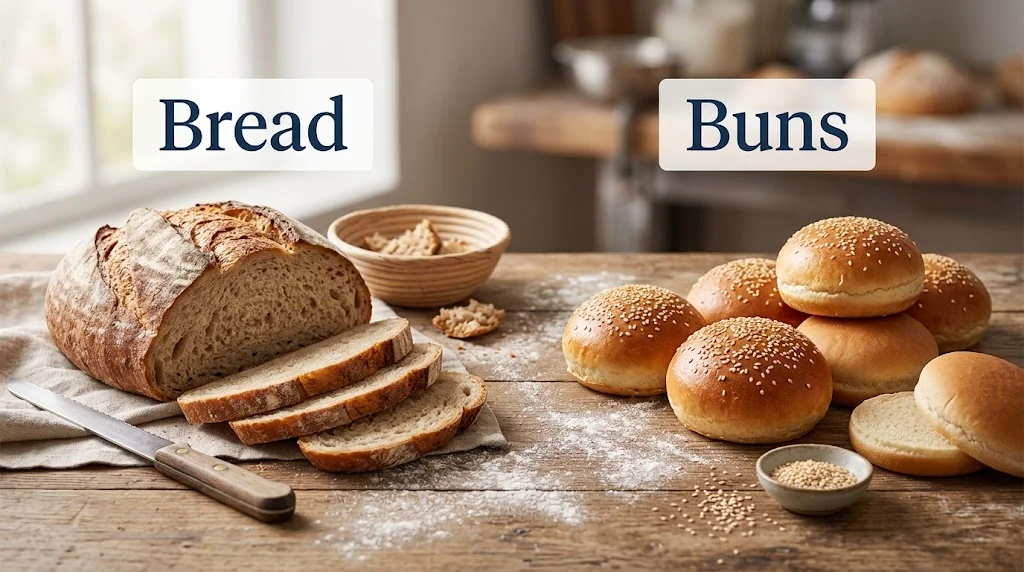
Quick Answer: Bread is the general term for a baked food made primarily from flour and liquid, while a bun is usually a smaller, individual piece of bread made for serving or filling. A hamburger bun, for example, is bread, but a whole loaf of sliced bread isn’t normally called a bun.
The confusion between bread and buns is common because both are made from dough and share many ingredients, yet they serve different roles in everyday language and food culture. Bread usually describes a broad category that includes loaves, slices, rolls, and other baked products, whereas bun generally identifies a smaller individual bread product.
Understanding the distinction is useful when writing recipes, ordering food, describing products, creating menus, or choosing precise vocabulary. From a language and culinary perspective, the key difference is not simply the ingredients but how the product is shaped, portioned, prepared, and traditionally used.
Bread or Buns: What’s the Difference?
The most important point is that bread is the broader category, while a bun is a particular type or form of bread.
Bread is a noun referring to a baked food generally made from flour and water or another liquid. Yeast, salt, sugar, fat, eggs, or other ingredients may also be included depending on the recipe.
Examples include:
I bought a loaf of bread for breakfast.
Whole wheat bread contains more fiber than some refined varieties.
The word bread can describe an enormous range of products, including white bread, whole grain bread, sourdough, rye bread, flatbread, and many regional varieties.
Bun is also a noun. It usually refers to a small, individual bread product, often round or oval in shape. Buns can be plain, sweet, savory, filled, glazed, or sliced horizontally for sandwiches.
Examples include:
She ordered a chicken sandwich on a toasted bun.
The bakery sells fresh cinnamon buns every morning.
| Term | Part of speech | General meaning | Typical form | Common examples |
| Bread | Noun | A broad category of baked dough based food | Loaf, slice, flat shape, roll, or other form | White bread, sourdough, rye bread |
| Bun | Noun | A small individual bread product | Usually round or oval | Burger bun, hot dog bun, cinnamon bun |
Mini Recap
Bread is the broader culinary category.
A bun is generally a smaller individual bread product.
Most buns can be considered bread, but most bread isn’t called a bun.
Shape, size, serving style, and culinary tradition influence the terminology.
Is Bread or Buns a Grammar, Vocabulary, or Usage Issue?
This is primarily a vocabulary and usage issue, not a difficult grammar problem.
The words aren’t completely interchangeable. Calling every type of bread a bun would sound unnatural to most English speakers.
For example:
I bought a loaf of bread.
sounds normal.
I bought a loaf of buns.
doesn’t normally make sense unless you’re specifically referring to several bun products.
Likewise:
Put the burger in a bun.
is natural.
Put the burger in bread.
is understandable, but it usually isn’t the expected expression when referring to the specific bread product designed to hold a hamburger.
Formal and Informal Usage
In formal writing, food descriptions should use the most specific appropriate term. A bakery menu might distinguish between loaves, rolls, buns, and pastries because each represents a different product.
In casual speech, people sometimes use bread broadly for almost any baked dough product. Context usually makes the meaning clear.
Academic Usage
Academic food writing may use bread as a category and bun as a specific product within that category. Food science, nutrition, culinary studies, and agricultural research often require more precise terminology.
Practical Rule
Think of bread as the category and bun as a specific form or product. This relationship is similar to saying that a particular apple is fruit, but fruit isn’t necessarily an apple.
How to Use Bread Correctly
Bread is appropriate when referring to the general food category or a larger loaf or sliced product.
Workplace Example
Please order enough bread for the office breakfast.
Here, bread refers broadly to the food rather than a particular shape.
A catering manager might also say:
We need three loaves of bread for tomorrow’s meeting.
This is more specific because the quantity and form are known.
Academic Example
The researchers compared the nutritional composition of whole grain bread with refined bread.
Here, bread works as a broad food category.
A nutrition article might discuss carbohydrates, dietary fiber, protein, calories, and ingredients while using bread as the general term.
Technology Example
The grocery delivery app lets customers filter bread by type.
The word bread makes sense because the application may include many products, including loaves, rolls, buns, and specialty varieties.
Usage Recap
Use bread for the broad category.
Use bread for loaves and slices when that is what you’re describing.
Use the more specific product name when shape or purpose matters.
Bread can include many different varieties and forms.
How to Use Buns Correctly
Bun is most useful when describing a small, individual bread product, particularly one designed to be served separately.
Workplace Example
The restaurant ordered two hundred burger buns for the weekend.
The term is appropriate because the restaurant needs individual bread products specifically designed for hamburgers.
Academic Example
The study compared the moisture content of sweet buns and standard bread.
The word bun identifies a particular product category rather than bread in general.
Technology Example
The food delivery application allows customers to choose sesame buns or brioche buns for their burgers.
Here, bun is more precise because the customer is choosing the specific bread surrounding the filling.
Usage Recap
Use bun for individual bread products.
Burger buns and hot dog buns are common examples.
Sweet buns can contain sugar, spices, fruit, or fillings.
A bun can be savory or sweet depending on the recipe.
When You Should NOT Use Bread or Buns
Understanding inappropriate usage helps prevent awkward food descriptions.
1. Don’t call a whole loaf a bun
A large loaf is normally called bread or a loaf of bread.
2. Don’t call every bread product a bun
Bread is a broad category, so the terms aren’t perfect substitutes.
3. Don’t call a burger bun simply a loaf
A burger bun is individually portioned and specifically shaped.
4. Don’t assume every bun is sweet
Some buns are sweet, but burger buns and sandwich buns can be savory or only mildly sweet.
5. Don’t assume every roll is a bun
Roll and bun can overlap in meaning, but regional usage varies.
6. Don’t use bun when referring to bread as a general food
If you’re discussing bread consumption, nutrition, baking, or grains broadly, bread is usually more appropriate.
7. Don’t assume shape alone determines the word
Culinary tradition and regional English also influence whether something is called a bun, roll, or bread.
8. Don’t confuse culinary terminology with grammar
There is no grammatical rule requiring one term in every situation. The issue is primarily meaning and conventional usage.
Common Mistakes and Decision Rules
| Correct sentence | Incorrect sentence | Explanation |
| I bought a loaf of bread. | I bought a loaf of buns. | A loaf normally refers to bread in loaf form. |
| Put the burger in a bun. | Put the burger in a loaf. | A bun is the expected individual bread product for a burger. |
| The bakery sells fresh buns. | The bakery sells fresh loaves for burgers. | Buns are commonly used for individual sandwiches. |
| Bread is a staple food in many cultures. | Buns are a staple food in every culture. | Bread is the broader category. |
| We need six burger buns. | We need six loaves for the burgers. | Burger buns are specifically portioned for individual burgers. |
Decision Rule Box
If you mean the broad baked food category, use bread.
If you mean a small individual bread product, use bun.
If the product has a specific name, such as burger bun or cinnamon bun, use that more precise term.
Bread or Buns in Modern Technology and AI Tools
Food technology has made these terms increasingly important.
Grocery websites classify products into categories such as bread, rolls, buns, pastries, and specialty baked goods. Search engines and AI systems also need to understand the relationship between broad and specific food terms.
For example, someone asking an AI assistant:
What should I buy for homemade hamburgers?
will usually receive a recommendation for burger buns rather than a standard loaf of sliced bread.
Similarly, a grocery search for “bread” may return a broad collection of products. A search for “burger buns” is more specific.
This demonstrates an important semantic relationship. Bread is a broader concept, while buns represent a narrower product category.
Etymology of Bread and Bun
The word bread has very old Germanic roots and is related to words found in several Germanic languages. Its history reflects how fundamental bread has been across European cultures for centuries.
The word bun has a less certain history. English usage developed around the idea of a small baked item, with historical connections to European words referring to cakes or rounded baked products.
Over time, bun developed several meanings in English. It can describe savory products such as hamburger buns and sweet foods such as cinnamon buns.
Expert Style Insight
“The safest distinction is simple: bread names the broad food category, while bun usually identifies an individual bread product.”
That rule isn’t absolute because food terminology varies between regions, but it provides a reliable foundation for standard English usage.
Two Practical Case Studies
Case Study 1: Restaurant Menu
Imagine a restaurant menu offering:
Grilled chicken served with bread.
This tells the customer relatively little about the specific product.
Now consider:
Grilled chicken served on a toasted brioche bun.
The second description is much more precise. It communicates the form, style, and intended use of the bread product.
The practical result is better customer understanding because the restaurant has moved from a broad category to a specific description.
Case Study 2: Grocery Shopping
Suppose someone needs bread for a family breakfast. Searching for “bread” makes sense because the shopper may want sliced bread, whole grain bread, sourdough, or another loaf.
If the shopper is preparing hamburgers, however, searching specifically for “burger buns” produces a more useful result.
The concrete improvement is search precision. A broad query retrieves a broad category, while a specific query identifies the intended product.
Author expertise: Written by an English vocabulary and usage specialist with expertise in semantic distinctions, grammar, food terminology, and search focused educational content.
Error Prevention Checklist
Always use bread when
- You’re discussing the general food category.
- You’re referring to a loaf or sliced product.
- You’re discussing bread as a staple food.
- You’re writing about bread nutrition or baking in general.
- The exact form isn’t important.
Never use bun when
- You’re referring to an ordinary loaf.
- You’re describing bread as a broad category.
- The product isn’t individually portioned or traditionally described as a bun.
- You are discussing bread consumption generally.
Use bun when the specific individual product is relevant, especially for burgers, hot dogs, sandwiches, and certain sweet baked goods.
Related Grammar Confusions You Should Master
Understanding bread and bun is part of a broader vocabulary skill. These related distinctions are also useful:
- Bread and bred
- Roll and bun
- Cake and pastry
- Dessert and desert
- Flour and flower
- Loaf and loafs
- Advice and advise
- Affect and effect
- Compliment and complement
- Practice and practise
Learning these distinctions helps writers choose words based on meaning rather than simply relying on pronunciation.
FAQs
Are bread and buns the same thing?
No. They overlap, but they aren’t exact synonyms. Bread is a broader category, while bun usually refers to a specific small bread product.
Is a hamburger bun bread?
Yes. A hamburger bun is a type of bread specifically shaped and prepared for serving with a hamburger.
Why is it called a bun instead of bread?
The term bun developed as a specific name for certain small baked products. Size, shape, preparation, and culinary tradition helped establish bun as a distinct everyday term.
Are buns always sweet?
No. Many buns are savory or neutral. Hamburger buns and hot dog buns are common savory examples, while cinnamon buns and sticky buns are sweet examples.
Can you call a loaf a bun?
Usually not. A loaf is normally a larger shaped quantity of bread, whereas a bun is generally an individual portion.
Conclusion
The difference between bread or buns is mainly one of category and specificity. Bread is the broader term for baked food made from dough, while a bun is generally a smaller individual bread product. A hamburger bun is bread, but a loaf of bread isn’t normally called a bun. When writing menus, recipes, academic material, product descriptions, or everyday English, choose the word that best describes the actual food. When in doubt, remember that bread is the larger category and buns are one of its familiar forms.

Margaret Atwood is an American writer who contributes to LingRoya.com creating clear and engaging content about the English language and everyday communication. She enjoys helping readers build confidence in their writing through simple, practical guidance.