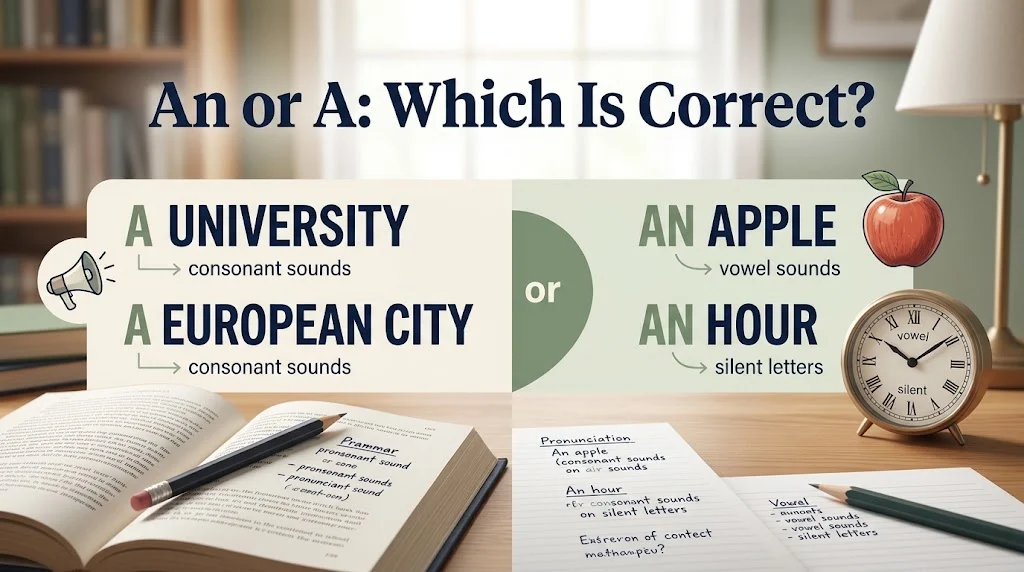
An or a are both indefinite articles in English, but the correct choice depends on the initial sound of the word that follows. Use a before a consonant sound, as in “a university,” and an before a vowel sound, as in “an apple.”
Have you ever paused while writing because you weren’t sure whether to use a or an? This small grammatical choice can affect the clarity and correctness of everything from school assignments to professional emails. The rule is simple once you understand it: English uses a before consonant sounds and an before vowel sounds, regardless of the first letter.
For example, we say “a European country” but “an honest person.” As an English grammar principle, this distinction is based on pronunciation rather than spelling, making it essential for students, writers, teachers, and anyone who wants to communicate confidently.
An vs A: What’s the Difference?
The main difference between a and an is the sound that begins the next word. Both are indefinite articles, a type of determiner used before a singular countable noun when the person or thing isn’t being identified as a specific one.
What Does A Mean?
A is an indefinite article used before a word that begins with a consonant sound. It introduces one person, object, place, or idea without identifying a particular one.
Examples:
- She adopted a puppy.
- He is a teacher.
- We visited a university.
- I need a useful reference book.
In each example, the following word begins with a consonant sound, even when its spelling might suggest otherwise.
What Does An Mean?
An is an indefinite article used before a word that begins with a vowel sound. It makes the transition between words easier to pronounce.
Examples:
- She ate an orange.
- He is an engineer.
- I waited for an hour.
- They watched an interesting film.
Notice that hour begins with a written h, but the h is silent. Its first pronounced sound is a vowel sound, so an is correct.
An vs A Comparison Table
| Feature | A | An |
| Part of speech | Indefinite article | Indefinite article |
| Main rule | Before a consonant sound | Before a vowel sound |
| Example | A book | An apple |
| Special example | A university | An umbrella |
| Silent letter example | A hotel, when the h is pronounced | An honest person |
| Typical function | Introduces a singular countable noun | Introduces a singular countable noun |
Quick Recap
- Use a before consonant sounds.
- Use an before vowel sounds.
- Focus on pronunciation rather than the first written letter.
- Both articles refer to one nonspecific person or thing.
- The correct article makes speech smoother and writing more accurate.
Is An vs A a Grammar, Vocabulary, or Usage Issue?
The difference between a and an is primarily a grammar issue involving article selection and pronunciation. It isn’t a difference in vocabulary because the two words have the same basic grammatical function.
Are A and An Interchangeable?
No. Although both are indefinite articles, they generally cannot be substituted for each other without creating a grammatical error.
For example:
Correct: She bought an umbrella.
Incorrect: She bought a umbrella.
The word umbrella begins with a vowel sound, so an is required.
Formal vs Informal Usage
The same rule applies in formal and informal English. Whether you’re speaking with friends, writing a business proposal, or preparing an official report, the choice depends on the sound that follows the article.
Academic vs Casual Usage
In academic writing, correct article usage is important because repeated grammatical mistakes can affect readability and the perceived quality of a paper. In casual conversation, listeners may still understand an incorrect article, but the standard rule remains unchanged.
When to Use A
Use a before a singular countable noun or noun phrase that begins with a consonant sound. The first letter can be a vowel if its pronunciation begins with a consonant sound.
Workplace Example
“The manager scheduled a meeting for Monday.”
The word meeting begins with the consonant sound /m/, so a is correct.
Academic Example
“The researcher proposed a new method for analyzing the data.”
The word new begins with a consonant sound.
Technology Example
“We developed a user friendly application for students.”
The word user begins with the consonant sound /j/, similar to the initial sound in yes. Therefore, a is correct.
Usage recap: Choose a before consonant sounds, including the initial /j/ sound in words such as university, European, and user.
When to Use An
Use an before a singular countable noun or noun phrase that begins with a vowel sound. This includes words that begin with a silent consonant letter.
Workplace Example
“She prepared an estimate for the new project.”
The word estimate begins with a vowel sound.
Academic Example
“The professor conducted an experiment to test the hypothesis.”
The word experiment begins with a vowel sound, so an is appropriate.
Technology Example
“The company introduced an AI assistant to help customers.”
In this example, AI is pronounced “ay eye.” Its first sound is a vowel sound, so an is correct.
Usage recap: Choose an before vowel sounds, including those in hour, honest, engineer, and the spoken abbreviation AI.
When You Should NOT Use A or An
Although the sound based rule is straightforward, several situations require special attention.
1. Don’t use either article before most plural nouns when speaking generally. Write “Dogs need exercise,” not “A dogs need exercise.”
2. Don’t use a or an directly before an uncountable noun in its ordinary sense. Write “I need information,” not “I need an information.”
3. Don’t choose the article based only on spelling. A word beginning with a vowel letter may require a, as in “a one time offer.”
4. Don’t use a before a vowel sound. Write “an apple,” not “a apple.”
5. Don’t use an before a consonant sound. Write “a university,” not “an university.”
6. Don’t automatically treat every abbreviation as beginning with the sound of its first letter. Choose the article based on how the abbreviation is pronounced. For example, “an FBI agent” is correct because F is spoken as “eff.”
7. Don’t confuse an indefinite article with a definite article. Use the when referring to a particular identifiable person or thing, as in “Please close the door.”
8. Don’t ignore the noun phrase that follows the article. The sound of the next pronounced word matters, not necessarily the sound of the noun itself. Write “an unusual event” but “a very unusual event.”
Common Mistakes and Decision Rules
The following table highlights frequent article errors and their corrections.
| Correct sentence | Incorrect sentence | Explanation |
| She ate an apple. | She ate a apple. | Apple begins with a vowel sound. |
| He attends a university. | He attends an university. | University begins with a consonant sound. |
| We waited for an hour. | We waited for a hour. | The h in hour is silent. |
| She is a European citizen. | She is an European citizen. | European begins with the consonant sound /j/. |
| He is an honest man. | He is a honest man. | Honest begins with a vowel sound because h is silent. |
| It was a one day event. | It was an one day event. | One begins with the consonant sound /w/. |
| She is an FBI agent. | She is a FBI agent. | F is pronounced “eff,” beginning with a vowel sound. |
The Decision Rule
Use A: When the next pronounced word begins with a consonant sound.
Examples: a book, a uniform, a European city, a one time offer.
Use An: When the next pronounced word begins with a vowel sound.
Examples: an egg, an hour, an MBA, an honest answer.
Remember: The sound matters more than the spelling.
An and A in Modern Technology and AI Tools
Modern technology introduces many abbreviations, technical terms, and borrowed words that can make article selection less obvious. The same pronunciation rule still applies.
Consider these examples:
- An AI model, because AI is pronounced “ay eye.”
- A URL, when pronounced “you are el.”
- An HTML document, when H is pronounced “aitch.”
- A USB device, when U is pronounced “you.”
- An API, when A is pronounced “ay.”
AI writing assistants and grammar checkers can identify many article errors, but they may struggle when a word or abbreviation has multiple pronunciations. Always consider how the expression is actually spoken in the intended context.
Etymology: Why Do English Have Both A and An?
The English articles a and an developed from older forms of the word one. In Old English, the related word ān meant “one” and eventually developed into the modern indefinite article.
Historically, an was used more broadly before nouns. Over time, English speakers commonly dropped the final n before consonant sounds because the shorter form was easier to pronounce. The n remained before vowel sounds, helping maintain a smooth transition between words.
This historical development explains why the two forms still exist today. They perform the same grammatical role but appear in different sound environments.
Expert Insight: A Simple Pronunciation Principle
A useful grammar principle is this: “Choose the article your pronunciation requires, not the article your spelling suggests.”
This is a practical teaching rule rather than a quotation attributed to a particular linguist. It captures the central principle behind correct indefinite article usage and helps learners remember unusual examples.
Two Practical Case Studies
Case Study 1: An English Learner Preparing an Assignment
Imagine a student writing an academic assignment that includes phrases such as “a experiment,” “an university,” and “a honest answer.”
During proofreading, the student learns to identify the first pronounced sound of each following word. The sentences are corrected to “an experiment,” “a university,” and “an honest answer.”
Result: The revised assignment contains fewer article errors and demonstrates a clearer understanding of English grammar. This is an illustrative teaching scenario, not a measured research finding.
Case Study 2: A Technology Company Editing Its Website
Consider a technology company preparing product descriptions that mention AI, URLs, and user accounts. Its first draft includes inconsistent phrases such as “a AI assistant” and “an URL.”
The editorial team checks how each abbreviation is pronounced and changes the phrases to “an AI assistant” and “a URL,” assuming URL is pronounced “you are el.”
Result: The published descriptions follow standard article usage and provide more polished, professional copy. This example illustrates the editing process rather than a documented business outcome.
Error Prevention Checklist
Use these reminders when proofreading your writing.
Always Use A When
- The following pronounced word begins with a consonant sound.
- You write phrases such as a book, a university, or a European country.
- An abbreviation begins with a consonant sound when spoken, as in a URL.
- A word begins with a vowel letter but a consonant sound, as in a one time offer.
Never Use An When
- The following pronounced word begins with a consonant sound.
- You’re writing phrases such as a uniform or a useful tool.
- An abbreviation is pronounced with an initial consonant sound, as in a USB device.
Remember that an is still correct before silent h words such as honest and hour. The rule is based on the spoken word, not the written letter.
Related Grammar Confusions You Should Master
Learning how articles work can also help you understand other common English grammar distinctions.
- Affect vs Effect: Understanding the difference between a verb and a noun in common contexts.
- Your vs You’re: Distinguishing possession from a contraction.
- Its vs It’s: Understanding possessive forms and contractions.
- There vs Their vs They’re: Recognizing location, possession, and contraction.
- Much vs Many: Choosing expressions for uncountable and countable nouns.
- Less vs Fewer: Understanding quantity expressions.
- Who vs Whom: Using subject and object forms correctly.
- This vs These: Matching demonstratives to singular and plural nouns.
- Some vs Any: Choosing determiners according to context.
- Few vs A Few: Understanding how small quantities can convey different meanings.
Frequently Asked Questions
1. Should I use an or a before a vowel?
Use an before a vowel sound, as in “an orange” or “an idea.” However, a vowel letter alone doesn’t determine the article. Write “a university” because university begins with a consonant sound.
2. Why do we say an hour instead of a hour?
We say “an hour” because the h is silent. The word begins with a vowel sound, so an is the grammatically correct article.
3. Is it a university or an university?
The correct phrase is “a university.” Although university begins with the vowel letter u, its initial sound is /j/, which is a consonant sound.
4. Is it an honest person or a honest person?
“An honest person” is correct because the h in honest is silent. The word begins with a vowel sound.
5. Do I use an or a before abbreviations?
Choose the article according to how the abbreviation is pronounced. Write “an FBI agent” because F sounds like “eff,” but “a URL” when URL is pronounced “you are el.”
6. Is it an AI tool or a AI tool?
“An AI tool” is correct because AI is pronounced “ay eye,” which begins with a vowel sound.
7. Can I use a or an before plural nouns?
Generally, no. The indefinite articles a and an are used with singular countable nouns. For example, write “a book” but “books” when referring to books in general.
8. Can I use a or an before uncountable nouns?
Not when the noun is used in its ordinary uncountable sense. Write “some advice” or “a piece of advice,” rather than “an advice.”
9. What is the easiest way to remember the difference between a and an?
Listen to the first sound of the following word. Use a before a consonant sound and an before a vowel sound, regardless of the first written letter.
Conclusion
Choosing between an or a becomes easy when you focus on pronunciation rather than spelling. Use a before consonant sounds and an before vowel sounds. This rule applies to ordinary words, silent letters, technical terms, and abbreviations.
Whether you’re preparing an academic assignment, writing professional content, or improving your everyday English, the correct article makes your sentences sound natural and grammatically accurate. Remember examples such as “a university,” “an hour,” “a URL,” and “an AI tool.” With regular practice, you’ll recognize the correct form instinctively and avoid one of the most common English grammar mistakes.

Margaret Atwood is an American writer who contributes to LingRoya.com creating clear and engaging content about the English language and everyday communication. She enjoys helping readers build confidence in their writing through simple, practical guidance.