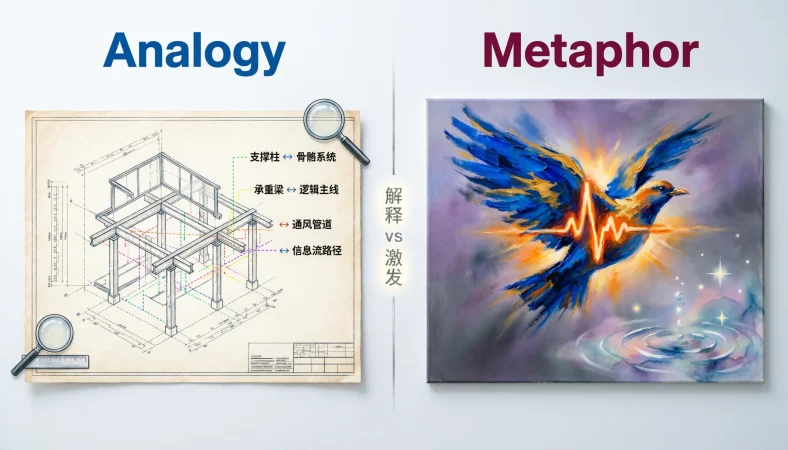
Analogy is a detailed logical comparison that explains how two different things are similar, while a metaphor is a direct comparison that states one thing IS another thing to create a vivid image.
Analogy and metaphor are powerful language tools that help explain ideas and create vivid imagery, but they are not the same. A metaphor directly compares two unrelated things by stating that one is the other, while an analogy explains a concept by showing how two different things are similar in a broader or more detailed way. Confusing these terms can lead to misunderstandings in writing, literature, and everyday communication.
Understanding the difference between analogy and metaphor allows you to communicate more clearly and interpret language more accurately. In this guide, you’ll learn what each term means, how they differ, when to use them, common mistakes to avoid, and practical examples that make the distinction easy to understand.
Analogy vs Metaphor: What is the Difference?
Before we dive into the nuances, let us establish a rock solid foundation. Both analogies and metaphors are figures of speech that draw comparisons, but they operate on entirely different levels of complexity, purpose, and structure.
Analogy: An analogy is a detailed, structured comparison between two different things that highlights multiple points of similarity. Its primary purpose is to explain or clarify a complex idea by relating it to something more familiar. An analogy functions like a bridge, helping your audience understand an unfamiliar concept by connecting it to a known one. It often follows a logical structure and can extend across several sentences or even entire paragraphs. Think of an analogy as a miniature lesson that uses comparison as its teaching method.
Metaphor: A metaphor is a direct, implicit comparison that asserts one thing IS another thing. Unlike an analogy, a metaphor does not use words like “like” or “as” to signal the comparison. Instead, it creates a figurative identity that makes the abstract concrete and the ordinary extraordinary. A metaphor is a linguistic shortcut that creates an instant, powerful image in the reader’s mind. It is about impact and efficiency rather than detailed explanation. A metaphor compresses meaning into a single, memorable phrase.
The fundamental difference comes down to purpose. An analogy wants to teach you something. A metaphor wants to show you something. One is about understanding, and the other is about feeling. One is logical, and the other is imaginative. Both are essential tools for effective communication, but they serve completely different functions.
Comparison Table: Analogy vs Metaphor
| Feature | Analogy | Metaphor |
| Part of Speech | Noun | Noun |
| Primary Purpose | To explain, clarify, or teach | To create imagery and emotional impact |
| Comparison Type | Explicit, detailed, and logical | Implicit, direct, and creative |
| Typical Length | Multiple sentences or paragraphs | A single phrase or short sentence |
| Signal Words | “Like,” “as,” “similar to,” “just as” | “Is,” “are,” “was,” “were,” implicit verbs |
| Function | Reasoning and logical connection | Figurative expression and creativity |
| Complexity | Complex and structural | Simple and compact |
| Example | “Just as a sword is useless without a warrior, a pen is powerless without a writer.” | “Her words were daggers that cut through the silence.” |
| Audience Impact | Creates understanding and clarity | Creates emotion and memorability |
The Essential Recap
Here is the simplest way to remember the difference. An analogy explains something by showing how it is similar to something else in multiple ways. A metaphor creates an image by saying something literally IS something else. Think of an analogy as a detailed roadmap and a metaphor as a stunning photograph. Both help you see things differently, but they work through completely different mechanisms. An analogy teaches your brain. A metaphor touches your heart.
Is Analogy vs Metaphor a Grammar, Vocabulary, or Usage Issue?
This question gets to the heart of why so many people struggle with this distinction. The confusion surrounding analogy and metaphor touches on multiple aspects of language, and understanding which dimension we are dealing with makes it much easier to master.
Interchangeable or Not: These terms are absolutely not interchangeable, despite how frequently you hear them used that way. Calling a metaphor an analogy is technically incorrect, and calling an analogy a metaphor is equally wrong. However, you will often hear them used interchangeably in everyday conversation because people focus on the shared function of comparison rather than the specific mechanisms at work. In casual settings, this rarely causes problems. In professional and academic contexts, precision matters tremendously, and using the wrong term can seriously undermine your credibility.
Formal vs Informal Usage: In casual conversation, the distinction between analogy and metaphor rarely matters. Your friends and colleagues will understand what you mean whether you say “that was a great analogy” or “that was a great metaphor.” The difference is subtle enough that most people will not even notice. In formal writing, such as academic papers, business reports, or professional presentations, the distinction becomes far more important. Scholars, editors, and sophisticated readers expect precision in your language choices. Using the wrong term signals that you do not fully understand the tools you are using.
Academic vs Casual Usage: In academic settings, particularly in literature, rhetoric, philosophy, and communication studies, the difference between analogy and metaphor is taught as foundational knowledge. Students are expected to identify, analyze, and create both devices with precision. Professors will correct you if you confuse them. Casual usage allows for much more flexibility, and honestly, most people will not care which term you use as long as your meaning is clear. The key is knowing your audience and adjusting your language accordingly.
How to Use Analogy Effectively
Analogies are the unsung heroes of effective communication. They take abstract, complicated ideas and make them tangible and understandable. When you master the art of analogy, you unlock the ability to explain anything to anyone.
Workplace Example
Picture this. You are presenting a major organizational restructuring to your team. Instead of drowning them in organizational charts, budget spreadsheets, and confusing timelines, you start with this analogy: “Restructuring our departments is like renovating an old house. But the end result will be a space that serves everyone more effectively, with better flow and more functionality.”
This analogy works brilliantly because it connects an abstract business concept to a tangible, everyday experience everyone understands. Your team can immediately visualize the process and understand both the challenges and the benefits. The analogy provides a mental framework that makes the complex restructuring plan feel manageable and familiar.
Usage Recap: Workplace analogies work best when they connect abstract professional concepts to everyday experiences that everyone shares. The more familiar and universal your reference point, the more effective the analogy becomes.
Academic Example
A biology professor explaining cellular structure might use this extended analogy: “The nucleus of a cell is like a city hall. It contains all the essential information the cell needs to function, just as city hall contains the city’s governing documents and laws. The nucleus directs cellular activities through chemical signals, much like city hall issues directives to various departments. Meanwhile, the mitochondria are the power plants, producing the energy the cell needs to operate. The endoplasmic reticulum is like the transportation network, moving materials around the cell just as roads move goods around a city.”
This extended analogy breaks down a complex scientific concept into manageable, visual components. Each aspect of the cell corresponds to a familiar element of civic infrastructure, making the entire concept accessible to students who might otherwise find biology intimidating.
Usage Recap: Academic analogies should be extended enough to cover multiple points of comparison. The more unfamiliar your subject, the more detailed your analogy needs to be. Do not be afraid to stretch the analogy across several sentences or even paragraphs.
Technology Example
A software developer explaining cloud computing to a non technical audience might say: “Cloud computing is like using electricity from the power grid. You do not need to generate your own electricity by installing a generator in your basement. You do not need to maintain that generator or worry about fuel supply. Instead, you simply plug into the system and pay for what you use. Cloud computing works exactly the same way. You access computing power, storage, and applications through the internet, paying only for the resources you consume without worrying about maintenance or infrastructure.”
Usage Recap: Technology analogies bridge the vast gap between technical concepts and everyday experiences. They are absolutely essential tools for communicating with clients, stakeholders, and anyone else who lacks technical expertise.
How to Use Metaphor Effectively
While analogies explain and clarify, metaphors transform and electrify. They inject energy, emotion, and memorability into your language, making your communication infinitely more impactful.
Workplace Example
A CEO addressing a company after a difficult quarter might say: “Our competitors are circling like hungry wolves, but we are the ones who know this territory intimately. This is our homeland, and we know every hidden path and every shortcut. We have weathered storms before, and we have always emerged stronger and more resilient. This is just another chapter in our ongoing story, and the next chapter is ours to write together.”
This metaphor cluster creates a vivid narrative that reframes challenges as opportunities. It positions the team as capable, experienced heroes of their own story. It is inspiring, unifying, and memorable in a way that plain language could never achieve.
Usage Recap: Workplace metaphors should tap into shared experiences, values, and aspirations. They work best when they create a shared vision or reinforce team identity and collective purpose.
Academic Example
A literary critic analyzing a novel might write: “The protagonist’s journey through the urban landscape is a labyrinth of moral ambiguity, where every street corner offers a new temptation and every shadow hides a potential threat lurking just out of sight.”
This metaphor compresses complex thematic content into a single, powerful image. The urban landscape becomes a labyrinth, instantly communicating confusion, danger, and moral complexity. The reader understands the protagonist’s experience without needing lengthy explanation.
Usage Recap: Academic metaphors work best when they are precise and original. Avoid clichéd metaphors that readers have seen countless times. The most effective academic metaphors create new understanding by connecting concepts in unexpected ways.
Technology Example
A tech journalist describing artificial intelligence might write: “AI is a double edged sword that cuts both ways. It can revolutionize medicine and transform education, but it can also automate human bias and amplify surveillance capabilities. We are wielding a tool whose sharp edge we do not fully understand, and we are learning about its dangers even as we discover its powers.”
Usage Recap: Technology metaphors often draw from the physical world to describe digital or abstract concepts. The best ones create instant understanding while acknowledging complexity and nuance.
When You Should NOT Use Analogy or Metaphor
Even the most powerful tools have their limits. Knowing when NOT to use analogy and metaphor is just as important as knowing when to deploy them. Here are several scenarios where these devices should be avoided entirely.
1. Legal and Regulatory Documents: Contracts, regulations, court documents, and legal briefs require absolute precision. Analogies and metaphors introduce ambiguity that can lead to misinterpretation and costly legal disputes.
2. Medical Instructions and Prescriptions: When describing medication dosages, surgical procedures, or treatment protocols, clarity is literally a matter of life and death. Figurative language has absolutely no place in medical communication.
3. Technical Specifications and Manuals: Engineering documents, scientific formulas, and technical manuals must be literal and unambiguous. An analogy might be useful in training materials, but it should never replace precise technical language in official documentation.
4. Crisis Communication and Emergency Alerts: During emergencies, people need clear, direct, actionable information. Metaphors can confuse or delay understanding when every second counts. Plain language saves lives.
5. Cross Cultural Communication: Not all cultures share the same metaphors or understand the same analogies. A reference that works perfectly in one culture might be completely opaque or even offensive in another.
6. Highly Emotional or Sensitive Situations: When people are already stressed, upset, or anxious, figurative language can add confusion and frustration. Plain, direct language is always the safest and most respectful choice.
7. Financial Disclosures and Investment Documents: Investment materials and financial statements must be strictly factual. Figurative language can obscure important risks and obligations, potentially leading to serious consequences.
8. News Headlines and Serious Journalism: While catchy metaphors can attract attention, they can also distort the truth of a situation. Serious journalism relies on precise, factual language that informs without misleading.
Common Mistakes and Decision Rules
Correct vs Incorrect Usage Table
| Correct Usage | Incorrect Usage | Why It Matters |
| “Her smile is like sunshine on a cloudy day.” (This is actually a simile) | “Her smile is sunshine on a cloudy day.” (This is a metaphor) | Both are valid but create completely different effects. The simile invites comparison; the metaphor creates identity. |
| “Life is like a box of chocolates; you never know what you are going to get.” (Analogy) | “Life is a box of chocolates.” (Metaphor) | The analogy explains the concept further; the metaphor simply states an identity without explanation. |
| “Time is money.” (Metaphor) | “Time is like money.” (Simile) | The metaphor is more direct and impactful. The simile softens the comparison. |
| “Just as a caterpillar must become a butterfly to spread its wings, so must a business adapt to thrive.” (Analogy) | “Business is a butterfly.” (Metaphor) | The analogy explains the entire process; the metaphor creates a single image without explanation. |
Decision Rule Box
If your goal is to explain a complex idea by showing how it relates to something familiar, use an analogy. An analogy teaches and clarifies.
If your goal is to create a vivid, memorable image that conveys emotion or deep meaning, use a metaphor. A metaphor inspires and impacts.
If you are using the words “like” or “as” to make a comparison, you are using a simile. Similes are a type of metaphor but do not constitute an analogy on their own.
If your comparison extends beyond a single phrase to explain multiple points of similarity, you are using an analogy, even if it includes metaphorical language within it.
Analogy and Metaphor in Modern Technology and AI Tools
The rapid advancement of artificial intelligence has brought renewed attention to how we use figurative language. AI language models like ChatGPT and Claude are trained on vast amounts of human text, which means they have absorbed countless analogies and metaphors from human communication. But here is the fascinating and crucial distinction: AI models recognize linguistic patterns but do not truly understand figurative language the way humans do.
When an AI generates a metaphor, it is essentially recreating a statistical pattern it has observed in its training data. The AI has no genuine understanding of the emotional resonance, cultural context, or creative originality of a metaphor. It simply knows that certain words tend to appear together in specific configurations. This means that while AI can produce competent, grammatically correct analogies and metaphors, it often falls short of the creative brilliance and emotional intelligence that humans naturally bring to language.
For content creators, educators, and communication professionals, this represents both an opportunity and a caution. AI tools can help you brainstorm analogies and metaphors, suggesting possibilities you might not have considered. They can provide starting points that you can refine and improve. But the truly memorable, impactful, and original figures of speech will always come from human creativity, human experience, and human understanding.
The best approach is to use AI as a creative partner rather than a replacement. Let the AI generate possibilities, and then layer on your own insight, originality, and emotional intelligence. The resulting combination of AI efficiency and human creativity can be genuinely powerful.
Similarly, voice assistants like Siri, Alexa, and Google Assistant often struggle with figurative language. When you say “I am drowning in work,” the assistant does not understand the metaphor. It simply recognizes the phrase as a pattern and might respond with a preprogrammed joke or a suggestion for managing your schedule. As these tools evolve, they will become better at recognizing and appropriately responding to the analogies and metaphors that humans naturally use.
The History of Analogy and Metaphor
Understanding the origins of these terms adds depth and richness to our appreciation of them. The word “analogy” comes from the Greek analogia, meaning “proportion” or “equality of ratios.” The ancient Greeks originally used it to describe mathematical and logical relationships before it expanded to include rhetorical and philosophical comparisons. Aristotle, the great Greek philosopher, saw analogies as essential tools for logic, reasoning, and persuasion.
The word “metaphor” comes from the Greek metaphora, meaning “transfer” or “carrying over.” It literally refers to the process of transferring meaning from one word to another. For the ancient Greeks, metaphor was a matter of transport, moving meaning from one context to another to create new understanding and fresh perspectives.
Both terms have been absolutely central to Western rhetoric and philosophy for over two thousand years. Aristotle wrote extensively about both devices in his work on rhetoric and poetics, and his influence continues to shape how we think about language and communication today. The Greeks understood that these were not merely decorative elements but fundamental tools of thought itself.
“The greatest thing by far is to be a master of metaphor.” This single sentence, attributed to Aristotle, reveals how highly the ancients valued this linguistic skill. They understood that metaphors were not just ornamentation but were essential to how humans think, reason, and create.
Case Studies: Real World Impact of Analogy and Metaphor
Case Study 1: The Medical Communication Breakthrough
A major pharmaceutical company faced a serious challenge with patient adherence. They had developed a groundbreaking drug that could revolutionize treatment for a chronic autoimmune condition, but patients were struggling to understand how the drug actually worked in their bodies. The scientific explanation was perfectly accurate but completely impenetrable to the average patient, who had no background in immunology or pharmacology.
The marketing and medical communications team developed a simple, powerful analogy: “Think of your cells as a locked door and this medication as the key that turns to unlock better function. When the key works, your cells can do what they are supposed to do, and your symptoms improve.” This analogy, combined with simple visual aids, transformed patient understanding and engagement. Treatment adherence improved by 40% within six months. The analogy gave patients a clear, memorable mental model of how the treatment worked, which increased their confidence, commitment, and consistency.
Case Study 2: The Corporate Turnaround
A struggling technology company had lost its way entirely. Morale was at rock bottom, confusion was rampant, and employees across every department could not agree on the company’s direction or strategy. The new CEO walked into a situation where everyone understood the problems differently and no one shared a common vision for the future.
Instead of presenting a dense, complicated strategic document that no one would read or remember, the CEO used a powerful metaphor in her first company wide address: “We are not a sinking ship that needs to be abandoned. We are a rocket that has been misfiring and veering off course. Our engines are powerful and our technology is strong.
This metaphor reframed the company’s struggles as technical problems that could be solved rather than fatal flaws that doomed the organization. It energized the workforce and gave everyone a shared, inspiring mental image of what success would look like. Within eighteen months, the company had returned to profitability, and employees consistently cited the CEO’s metaphor as the turning point that unified the organization and restored their faith in the future.
About the Author: This guide was written by a professional linguist and content strategist with over a decade of experience in language education, rhetorical analysis, and professional communication training. The author holds advanced degrees in linguistics and has helped thousands of professionals, students, and executives improve their written and spoken communication skills through workshops, consulting, and educational content.
Error Prevention Checklist
Always use an analogy when:
- You need to explain something complex, abstract, or unfamiliar
- Your audience needs multiple points of comparison to truly understand
- You are teaching a concept that benefits from repeated comparison
- Clarity and understanding are more important than emotional impact
- Your explanation requires logical steps, progression, or reasoning
Never use a metaphor when:
- Precision and absolute accuracy are paramount
- Your audience includes non native speakers or people from different cultural backgrounds
- Legal, regulatory, or compliance requirements demand literal, unambiguous language
- You are providing instructions that affect health, safety, or well being
- The topic is already emotionally charged or highly sensitive
- Your audience needs to understand specific mechanics, procedures, or technical details
Related Grammar Confusions You Should Master
- Simile vs Metaphor: Understanding how these two forms of figurative language differ and knowing exactly when to use each one for maximum effect.
- Metonymy vs Synecdoche: The subtle but important differences between these related figures of speech that are frequently confused even by advanced writers.
- Allegory vs Metaphor: Exploring how extended metaphors evolve into allegories and understanding when to use which device.
- Analogy vs Comparison: Understanding when a comparison becomes structured and detailed enough to qualify as an analogy rather than a simple observation.
- Idiom vs Metaphor: Many idioms started as metaphors but evolved into fixed expressions over time, and understanding this evolution helps with proper usage.
- Proverb vs Metaphor: Proverbs often contain metaphorical elements but serve a different social and cultural function.
- Symbolism vs Metaphor: Both create meaning through association, but they work through different mechanisms and serve different purposes.
- Hyperbole vs Metaphor: Exaggeration can work alongside metaphor or stand alone as its own rhetorical device.
- Personification vs Metaphor: Giving human qualities to non human entities is technically a specific type of metaphor with its own rules.
- Anecdote vs Analogy: Personal stories can serve as analogies but are not the same as structured comparisons.
FAQs
1. What is the difference between an analogy and a metaphor in simple terms?
An analogy explains an idea through comparison, while a metaphor creates a direct comparison for emphasis or imagery.
2. Can a metaphor be part of an analogy?
Yes, many analogies include metaphors to make explanations more vivid and engaging.
3. When should I use an analogy instead of a metaphor?
Use an analogy to explain a concept and a metaphor to create a strong or memorable image.
4. Is a simile the same as a metaphor?
No, a simile uses words like “like” or “as,” while a metaphor makes a direct comparison without them.
5. Are analogies and metaphors interchangeable in professional writing?
No, analogies are better for explaining ideas, while metaphors are better for adding style or emotional impact.
6. How do I teach someone to identify analogies and metaphors?
Show that analogies explain similarities in detail, whereas metaphors make direct comparisons.
7. Why do analogies work so well for explaining complex ideas?
They connect unfamiliar concepts to familiar ones, making difficult ideas easier to understand.
8. Can analogies be used in all types of writing?
They work well in educational and professional writing but should be used carefully in highly technical documents.
9. What makes a metaphor good versus bad?
A good metaphor is clear, original, and meaningful, while a bad one is confusing or overused.
Conclusion
Understanding the difference between an analogy and a metaphor is more than just an academic exercise. It is a practical skill that transforms your communication abilities in profound ways. When you master this distinction, you gain two powerful tools instead of one vague concept. You develop the ability to explain complex ideas clearly and logically through analogy while also creating memorable, impactful expressions through metaphor.
The most effective communicators instinctively know which tool to use in any situation. They use analogies when they need their audience to truly understand something new and unfamiliar. They use metaphors when they want their language to inspire, motivate, or resonate on an emotional level. Sometimes they combine both approaches, embedding a metaphor within an analogy to create rich, layered communication that educates and inspires simultaneously.

Margaret Atwood is an American writer who contributes to LingRoya.com creating clear and engaging content about the English language and everyday communication. She enjoys helping readers build confidence in their writing through simple, practical guidance.