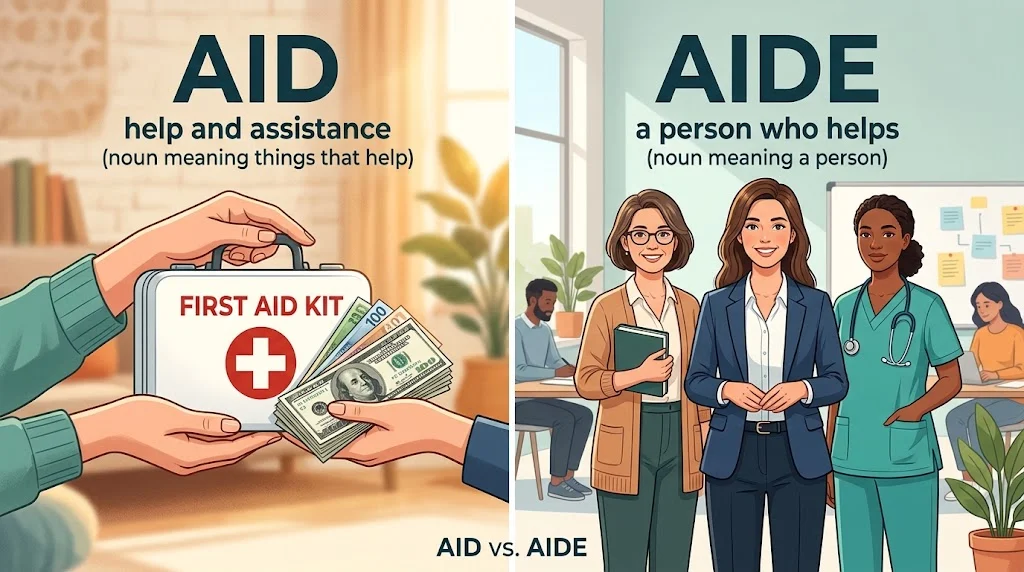
These two words sound exactly the same when spoken, and their spellings differ by just one little letter. But that single “e” changes everything. Mixing them up can make your writing look careless, and in professional settings, it can even undermine your credibility.
At the most basic level, aid is about the help itself, and aide is about the person giving the help.
Aid can function as a noun meaning assistance, support, or relief. It can also function as a verb meaning to help or assist someone. Think of aid as the action, the resource, or the thing that provides help.
Aide is always a noun. It refers to a person who acts as an assistant or helper. An aide is the individual who provides aid.
Here is a quick comparison to make it crystal clear:
| Feature | Aid | Aide |
| Part of Speech | Noun and verb | Noun only |
| Meaning | Help, assistance, support, or relief | A person who assists or helps |
| Refers to | An action, a resource, or a thing | A person |
| Examples | Financial aid, first aid, hearing aid, to aid someone | Teacher’s aide, nurse’s aide, presidential aide |
Mini Recap: Aid is the help. Aide is the helper. If you can replace the word with “assistance,” use aid. If you can replace it with “assistant,” use aide.
Is Aid vs Aide a Grammar, Vocabulary, or Usage Issue?
This confusion sits at the intersection of vocabulary and usage. From a strict grammar perspective, both words are correct English. The issue is not about right or wrong grammar but about choosing the precise word for your intended meaning. It is a vocabulary problem because the words have distinct definitions, and it is a usage problem because they are used in different contexts.
Are they interchangeable? Absolutely not. Despite sounding identical and having closely related meanings, they cannot be used interchangeably. Using “aide” when you mean “aid” changes your sentence from referring to help itself to referring to a person, which can confuse your reader or make your statement factually incorrect.
In terms of formality, “aid” is generally more formal than “help” but is perfectly acceptable in both casual and professional writing. “Aide” is also formal and is commonly used in professional titles and official capacities. In academic writing, you will frequently encounter “aid” in contexts like “financial aid” or “visual aids.” In casual conversation, you are more likely to hear “help” than “aid,” but both are understood. “Aide” appears in both formal and informal contexts when referring to a specific role, such as a “teacher’s aide” in a school setting.
Practical Usage of Aid
As we have established, “aid” can be a noun or a verb. Let us explore how it works in different settings.
Workplace Example
In the workplace, “aid” often appears in discussions of resources, support systems, or collaborative efforts. For instance, a manager might say, “We will use these new software tools to aid our team in meeting the quarterly targets.” Here, “aid” is a verb meaning to help or assist. Alternatively, a company might announce, “The board approved additional financial aid for the research department.” In this case, “aid” is a noun referring to the monetary assistance provided.
Academic Example
In academic contexts, “aid” is everywhere. Students apply for financial aid to help cover tuition costs. Teachers use visual aids like charts and diagrams to enhance learning. A professor might say, “These reference materials will aid you in writing your thesis.” The word functions smoothly as both a noun and a verb in educational settings.
Technology Example
In the tech world, “aid” often describes tools or features that assist users. For example, “The new navigation system aids drivers by providing real time traffic updates.” You might also hear about “decision aids” or “AI aided design.” Hearing aids and mobility aids are common examples of devices that provide assistance.
Usage Recap for Aid: Use “aid” whenever you are talking about help, assistance, or support itself. It can be the action of helping or the thing that provides help. Remember, if you mean “help” or “assistance,” “aid” is your word.
Practical Usage of Aide
“Aide” is simpler because it only has one job: to refer to a person who helps. Let us see it in action.
Workplace Example
In a professional environment, an “aide” is a specific role. A busy executive might have an administrative aide who handles scheduling and correspondence. In healthcare, a nurse’s aide provides basic care to patients under the supervision of a registered nurse. For example, “The nurse’s aide brought the patient his medication.”
Academic Example
In schools, teacher’s aides are invaluable. They assist the lead teacher with classroom management, grading, and providing extra support to students. A sentence like “The teacher’s aide worked with small groups of students on their reading skills” clearly refers to a person.
Technology Example
While “aide” is less common in tech as a general term, it appears in job titles. A company might hire a “technical aide” to assist the IT department. In AI, some tools are named “Aide” to suggest they are helpful assistants, but the grammatical rule remains the same: it refers to the entity (often a person or persona) providing assistance.
Usage Recap for Aide: Use “aide” only when you are referring to a person who is an assistant or helper. If you are not talking about a person, you need “aid.”
When You Should NOT Use Aid or Aide
Even with a solid understanding of the definitions, it is easy to slip up. Here are some common scenarios where writers often use the wrong word.
- When referring to humanitarian assistance: Do not write “humanitarian aide.” The correct term is “humanitarian aid” because you are talking about the assistance itself, not a person.
- When talking about financial support: Always use “financial aid,” never “financial aide.” You are referring to money or resources, not a person.
- When describing a device that helps: Use “hearing aid,” “visual aid,” or “teaching aid.” These are things, not people.
- When you mean the action of helping: Use “aid” as a verb. For example, “The medication will aid in your recovery.” Do not use “aide” as a verb because it is not one.
- When referring to a person in a general sense: If you say “She was a great aid to me,” it sounds like you are calling her a thing. The correct phrasing is “She was a great aide to me” because she is a person.
- When using “first aid”: This is always “first aid,” never “first aide.” You are referring to emergency medical assistance, not a person.
- In legal contexts: The phrase is “aiding and abetting,” not “aiding and abetting” (which is correct) but definitely not “aiding and abetting” with an “e” on “aiding.” The verb form is always “aid”.
- When describing a person who assists a politician: This is the classic use of “aide.” Say “the senator’s aide,” not “the senator’s aid”.
Common Mistakes and Decision Rules
To help you avoid common pitfalls, here is a table of correct and incorrect usage.
| Correct Sentence | Incorrect Sentence | Explanation |
| The country received humanitarian aid. | The country received humanitarian aide. | Aid is assistance; aide is a person. |
| The senator’s aide attended the meeting. | The senator’s aid attended the meeting. | Aide is the person who assists; aid is the help itself. |
| I need a hearing aid. | I need a hearing aide. | A hearing aid is a device, not a person. |
| The teacher received aid from the school. | The teacher received aide from the school. | Aid is the support provided; aide is a person. |
| She will aid me with my project. | She will aide me with my project. | Aid is a verb meaning to help; aide is not a verb. |
| The nurse’s aide checked on the patient. | The nurse’s aid checked on the patient. | Aide is the person; aid is the help given. |
Clear Decision Rule Box
- If you mean the action, the assistance, or the thing that helps, use AID.
- If you mean the person who helps or the assistant, use AIDE.
Keep this rule in mind, and you will never go wrong.
Aid and Aide in Modern Technology and AI Tools
The digital age has brought new life to these words, though the grammatical rules remain unchanged. In the world of artificial intelligence, we see terms like “AI aided design” and “decision aid tools.” Here, “aid” correctly refers to the assistance provided by technology.
Interestingly, some AI products and platforms use the name “Aide” to position themselves as helpful assistants. For example, “Aider” is an AI pair programming tool that assists developers. While “Aider” is a brand name, it plays on the traditional meaning of “aide” as a helper. This shows how the core distinction between “aid” (the help) and “aide” (the helper) remains relevant even in cutting edge fields. When you are writing about technology, apply the same rule: use “aid” for the assistance or tools, and use “aide” if you are referring to a person (or a named AI entity) that provides help.
Authority and Trust
Understanding the roots of these words can deepen your appreciation for their proper use.
Etymology: Both words trace back to French and Latin origins. “Aid” came into English in the 15th century from the Old French “aide,” meaning help or assistance, which itself came from the Latin “adiutare,” meaning to help. “Aide” entered English slightly later, likely as a shortened form of the French phrase “aide de camp,” which means “camp assistant” and referred to a military officer who assisted a superior. This historical context explains why “aide” has always been tied to a person.
Expert Insight: As grammar expert Bryan Garner notes in his “Modern American Usage,” the distinction between “aid” and “aide” is well established in edited English. While some dictionaries list “aid” as a variant of “aide,” careful writers keep them separate.
Case Study 1: International Aid Organization
A major international relief organization revised its external communications after noticing frequent misuse of “aide” in press releases. By implementing a style guide that clearly distinguished between “aid” (the assistance provided) and “aide” (the staff member providing it), they improved the clarity and professionalism of their public messaging. This small change enhanced their credibility with donors and partner organizations.
Case Study 2: School District Communication
A large school district found that parents and staff were confused by communications that used “aid” and “aide” interchangeably. After a district wide training session on the correct usage, all official documents, from parent newsletters to staff memos, used the terms correctly. This reduced confusion about roles (who is an aide) and resources (what aid is available), leading to smoother operations and better community relations.
Error Prevention Checklist
Before you hit send on that email or publish that article, run through this quick checklist.
Always use AID when:
- You are talking about help, assistance, or support.
- You are referring to a resource or device that helps (e.g., hearing aid, visual aid).
- You are using the word as a verb meaning to help.
- You are discussing financial, humanitarian, or legal assistance.
Never use AIDE when:
- You are talking about a thing or an action.
- You are using the word as a verb.
- You are referring to assistance itself, not the person providing it.
Always use AIDE when:
- You are referring to a person who is an assistant or helper.
- You are using the word as a noun to describe a role (e.g., teacher’s aide, nurse’s aide).
Related Grammar Confusions You Should Master
Mastering “aid” vs “aide” is a great start. Here are other common word pairs that often trip people up.
- Affect vs Effect: Affect is usually a verb meaning to influence; effect is usually a noun meaning a result.
- Complement vs Compliment: Complement means to complete or enhance; compliment means to praise.
- Principle vs Principal: Principle is a rule or belief; principal is a leader or main thing.
- Stationary vs Stationery: Stationary means not moving; stationery refers to writing materials.
- Advice vs Advise: Advice is a noun meaning a recommendation; advise is a verb meaning to recommend.
- Elicit vs Illicit: Elicit is a verb meaning to draw out; illicit is an adjective meaning illegal.
- Farther vs Further: Farther refers to physical distance; further refers to metaphorical or figurative distance.
- Who vs Whom: Who is a subject; whom is an object.
- Lay vs Lie: Lay means to place something down; lie means to recline or to tell a falsehood.
- Imply vs Infer: Imply means to suggest; infer means to deduce.
FAQs
- What is the difference between “aid” and “aide”? — “Aid” means help or assistance, while “aide” means a person who provides assistance.
- Is “aid” a noun or a verb? — “Aid” can be used as both a noun and a verb, depending on the sentence.
- What does “aide” mean? — “Aide” refers to someone whose role is to help or assist another person.
- Are “aid” and “aide” pronounced the same? — Yes, they are usually pronounced the same but have different meanings and spellings.
- Can “aid” refer to a person? — Usually, no. “Aid” refers to help or assistance, whereas “aide” refers to a person.
- Which should I use for financial assistance? — Use “aid,” as in “financial aid,” because it refers to help or support.
Conclusion
In conclusion, “aid” and “aide” may sound alike, but they have different meanings. “Aid” refers to help, support, or assistance, while “aide” refers to a person who provides assistance. Knowing this distinction makes it easier to use both words correctly.
The choice between “aid” and “aide” depends on what you want to describe. Use “aid” when referring to help or assistance, and use “aide” when referring to someone whose job or role is to assist another person.

Neil Gaiman is an American writer who contributes educational content to LingRoya.com. His work focuses on helping readers improve their English with clear, practical and easy to follow guidance.