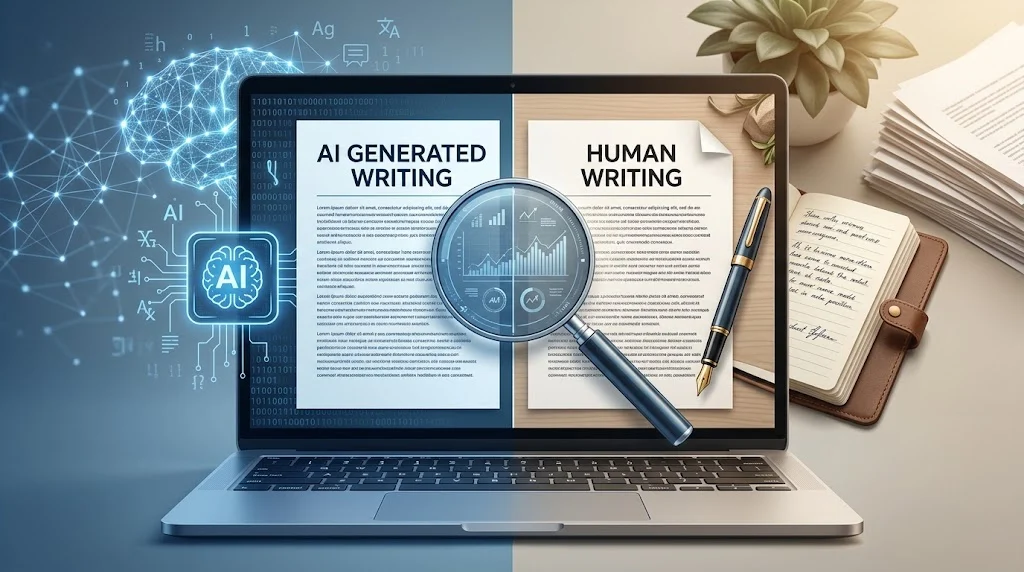
AI or not means determining whether content was generated by an artificial intelligence system or written by a human. AI writing often has predictable patterns such as uniform sentence structure, generic phrasing, and highly polished transitions, but these clues are not conclusive.
The question of AI or not has become important in education, publishing, workplaces, journalism, and online content creation. A teacher may want to know whether an essay reflects a student’s own work. An editor may need to assess whether an article has been generated automatically. A business may want to understand how much of its customer communication is produced by AI.
The problem is that human writing can look like AI writing, while AI generated text can be edited to look convincingly human. Current research supports caution: AI detectors can be useful, but they should not be treated as definitive proof of authorship.
AI or Not vs Human Writing: What’s the Difference?
The first thing to understand is that AI and not AI are not two grammatical forms of the same word. AI is a noun and acronym for artificial intelligence. In the context of writing, it usually refers to content generated or substantially produced by an artificial intelligence system.
Not AI is a descriptive phrase rather than a formal vocabulary category. It means that the content was not generated by AI, although a human writer may still have used ordinary digital tools such as a spell checker or word processor.
| Feature | AI Writing | Human Writing |
| Meaning | Content generated with an AI system | Content produced by a person |
| Grammar | Usually grammatically controlled | May contain natural variation or mistakes |
| Sentence style | Often consistent and predictable | More likely to vary naturally |
| Personal voice | Can sound generic | Often reflects individual experience |
| Editing | May be highly polished | Can contain revisions and imperfections |
| Detection | Can sometimes be identified by detectors | Can sometimes be falsely flagged |
Mini Recap
AI writing is produced with the help of an artificial intelligence system.
Human writing originates from a person, even when digital editing tools are used.
Neither style has a single feature that proves authorship.
The strongest assessment considers several forms of evidence together.
Is AI or Not a Grammar, Vocabulary, or Usage Issue?
The phrase AI or not is primarily a usage and classification issue, not a traditional grammar problem. AI is a noun, while not is an adverb used to express negation. The phrase is commonly used as a question about classification, especially when discussing AI generated content.
It is also important to distinguish between AI assistance and complete AI authorship. A writer who asks an AI tool to suggest several titles but writes the article independently has used AI assistance. That is different from asking an AI system to generate the entire article and submitting it without meaningful human revision.
In formal academic settings, the distinction can matter greatly because institutions may have specific policies governing AI assistance. In casual communication, people may use AI for brainstorming, rewriting, translation, or proofreading without considering the resulting text entirely AI authored.
How to Recognize AI Writing
There is no universal formula for recognizing AI generated text. However, several characteristics can provide useful clues.
AI writing may use highly balanced sentence structures, repeated transitions, broad generalizations, and predictable explanations. It can also sound unusually polished while saying relatively little that is specific. Repeated phrases such as “in today’s rapidly changing world” or excessive use of formal transitions can sometimes make text feel machine generated.
However, these clues are not proof. Experienced writers can naturally produce polished prose, and AI systems can be prompted to produce varied and personal sounding writing.
Workplace Example
Imagine an employee submits a customer report containing perfectly organized paragraphs, repetitive sentence patterns, and generic recommendations. Those characteristics may justify asking how the report was prepared, but they do not prove that AI generated it.
A better approach is to examine the employee’s normal writing style, document history, notes, research process, and ability to explain the conclusions.
Academic Example
A professor notices that a student’s essay is dramatically different from previous assignments. The essay contains sophisticated vocabulary and an unusually consistent style.
That difference can justify a conversation with the student. It should not automatically become a misconduct finding based solely on an AI detector score.
Technology Example
A company may use AI to generate first drafts of product descriptions. An editor then checks every claim, rewrites the language, adds product specific information, and approves the final version.
The final text has a mixed production history. Calling it simply AI or human can therefore oversimplify what actually happened.
Usage Recap
Look for patterns rather than one suspicious sentence.
Consider how the text was created and edited.
Use detection software as supporting evidence rather than a final verdict.
How to Recognize Human Writing
Human writing often contains personal experiences, unusual phrasing, specific memories, inconsistent sentence rhythms, and context that is difficult to reproduce without knowing the writer’s background.
Still, human writing can also be extremely polished. Professional editors, journalists, academics, and experienced copywriters may produce text that looks highly structured and predictable.
This is one reason AI detection is difficult. A detector is attempting to infer authorship from linguistic patterns rather than directly observing who typed the words.
When You Should NOT Assume AI or Not
Several situations make automatic classification especially unreliable.
- Do not assume polished writing is AI writing. Professional writers can produce highly refined prose.
- Do not assume mistakes prove human authorship. AI systems can intentionally generate informal or imperfect writing.
- Do not treat an AI detector score as absolute proof. Research has repeatedly identified false positives and false negatives.
- Do not confuse editing with authorship. A person can heavily edit AI generated material.
- Do not assume unusual vocabulary proves AI use. Writers have different levels of education, experience, and vocabulary.
- Do not judge multilingual writers using simplistic rules. Language background can influence writing patterns and detector performance.
- Do not assume a human sounding paragraph is definitely human. Modern AI systems can produce natural sounding prose.
- Do not ignore document history. Drafts, revisions, notes, and version history can provide stronger contextual evidence than stylistic guesses.
Common Mistakes and Decision Rules
| Correct approach | Incorrect approach | Explanation |
| Treat detector results as one signal | Treat the score as proof | Detection is probabilistic |
| Review drafts and revision history | Judge only the final document | Process evidence can clarify authorship |
| Compare writing samples carefully | Assume style changes prove AI use | People naturally change styles |
| Ask how AI was used | Ask only whether AI was used | AI assistance can take many forms |
| Consider institutional policy | Apply one universal rule | Rules differ between organizations |
Decision Rule Box
If you need to determine authorship, examine multiple forms of evidence rather than relying on a single AI score.
If you need to determine responsible AI use, examine how the tool was used, what the human contributed, and whether the use followed the relevant policy.
AI or Not in Modern Technology and AI Tools
Modern AI tools have made the distinction increasingly complicated because content creation is no longer simply human versus machine.
A person can ask an AI system for an outline, write the article independently, use AI to correct grammar, and then ask another tool to improve clarity. The resulting document contains both human and machine contributions.
AI detectors also continue to evolve. Turnitin, for example, has changed its reporting approach partly to reduce the risk of false positives and does not surface numerical scores for detected AI content below its current reporting threshold.
OpenAI provides an important historical example. Its own AI text classifier was withdrawn in July 2023 because of its low accuracy. The original evaluation identified only 26 percent of AI written text as likely AI written while incorrectly labeling human writing as AI written 9 percent of the time.
The lesson is straightforward: even organizations building AI systems recognize that determining whether text came from AI is technically difficult.
Etymology: Where Did AI Come From?
AI stands for artificial intelligence. The term artificial refers to something produced by human activity rather than occurring naturally, while intelligence refers broadly to the ability to learn, reason, solve problems, or perform tasks associated with human cognition.
The modern field of artificial intelligence developed as a formal area of research during the twentieth century. Today, the phrase commonly includes machine learning systems, language models, computer vision systems, recommendation systems, and generative AI applications.
The expression “AI or not” is comparatively informal. It reflects a modern need to classify digital content according to how it was produced.
Expert Takeaway
“A detector can provide a signal about authorship, but a signal is not the same thing as proof.”
This principle is especially important when the consequences of a wrong decision are serious. Recent research continues to show that detection tools can be helpful while still producing errors.
Two Case Studies: What Research Shows
Case Study 1: University Student Writing
Researchers at Arizona State University studied 190 students who completed human written and AI generated writing tasks. A sample of 50 essays was evaluated using four AI detectors, while another group of essays was assessed by human raters.
The strongest detectors correctly classified most essays at rates between 93 percent and 98 percent. Importantly, individual detectors still produced false positives. The researchers reported false positive rates of approximately 1.3 percent for detectors and 5 percent among human raters. Combining detector outcomes reduced the observed false positive rate to nearly zero in that study.
The practical lesson is that multiple signals can be more informative than one automated result.
Case Study 2: Student Essays and Detector Errors
A Frontiers study involving 153 students examined both human and AI generated essays. Across the tested systems, detectors correctly distinguished the writing origins about 88 percent of the time.
However, individual tools produced very different false positive rates. The reported false positive rates for human writing ranged from 9.8 percent to 45.8 percent among several detectors. When two detectors were combined under a stricter rule, one observed false positive rate fell to 5.2 percent.
These results show why a detector should support an investigation rather than replace human judgment.
Error Prevention Checklist
Always use evidence that
- Includes the writing process when available
- Considers previous writing samples
- Separates AI assistance from full AI generation
- Uses detector results as supporting information
- Follows the relevant academic or workplace policy
Never rely on assumptions that
- Perfect grammar automatically means AI
- Informal grammar automatically means human
- One detector score proves authorship
- A sudden style change proves misconduct
- AI assistance means the entire document was AI generated
Related Grammar Confusions You Should Master
Understanding AI writing also benefits from stronger control over common English usage questions. Useful topics include:
- AI vs artificial intelligence
- affect vs effect
- advice vs advise
- its vs it’s
- your vs you’re
- then vs than
- farther vs further
- fewer vs less
- who vs whom
- imply vs infer
These distinctions improve clarity regardless of whether the final content is written by a human, generated with AI, or created through a combination of both.
FAQs
What does AI or not mean?
AI or not means determining whether a piece of content was generated by artificial intelligence or created without generative AI assistance.
How can I tell if text is AI generated?
Look for linguistic patterns, compare the text with known writing samples, examine revision history when available, and use AI detection tools only as supporting evidence.
Can AI detectors accurately identify AI writing?
AI detectors can identify patterns associated with AI generated writing, but they are not perfectly reliable. Studies have found both false positives and false negatives.
Can human writing be mistaken for AI writing?
Yes. Human writing can be incorrectly classified as AI generated, particularly when the writing is highly structured, formal, predictable, or produced by writers whose language patterns differ from detector training data.
Can AI writing be made to look human?
AI generated writing can be substantially edited or transformed, making automated identification more difficult. Recent research has found that even advanced detection systems can struggle with modified AI content.
Is an AI detector score proof that someone used AI?
No. A detector score is an indicator, not definitive proof. High stakes decisions should consider additional evidence.
Can teachers use AI detectors to identify cheating?
Teachers can use detectors as one part of an investigation, but relying exclusively on an automated score can create unfair outcomes. Evidence should be evaluated alongside institutional policy and the student’s writing process.
Conclusion
The most accurate answer to AI or not is rarely found in a single detector score or a single writing characteristic. AI generated content and human writing can overlap substantially in vocabulary, grammar, organization, and tone. A reliable assessment considers the writing itself, the writer’s normal style, document history, editing process, relevant policies, and detector results together. Research shows that automated tools can provide useful signals, but they can also make mistakes.
The safest principle is simple: use AI detection to ask better questions, not to make automatic accusations.

Philip Pullman is an American writer dedicated to creating clear and easy to follow English content. Through his work at LingRoya.com, he helps readers strengthen their language skills with practical and reliable guidance so that they can easily understand.