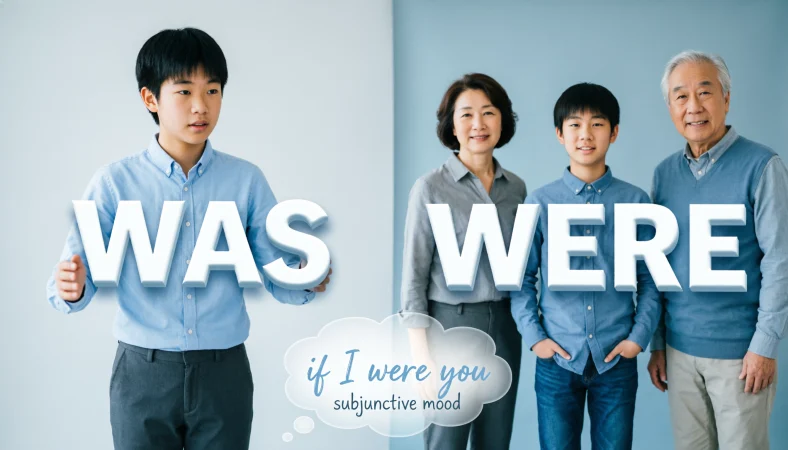
The short answer is that “was” is the singular past tense of “to be” used with I, he, she, and it, while “were” is the plural past tense used with you, we, and they. However, “were” also appears in the subjunctive mood for hypothetical situations, which is where most confusion arises. Mastering this distinction will instantly improve your grammar credibility.
The stakes are higher than you might think. Using “were” when you should have used “was” or vice versa can make your writing look unpolished and unprofessional. In job applications, academic papers, and professional correspondence, these small errors can undermine your credibility. The good news is that the rule is actually quite simple once you understand the underlying logic.
This guide will walk you through everything you need to know about were or was usage. We will cover the basic rules, the tricky exceptions, and the common pitfalls that trip people up. By the end of this article, you will never have to guess again.
Were vs Was: What is the Difference?
Before we dive into the details, let us establish a clear foundation. Both “was” and “were” are past tense forms of the verb “to be,” but they serve different grammatical functions.
Was: This is the first and third person singular past tense form of “to be.” You use “was” with the pronouns I, he, she, and it. It indicates that something existed, happened, or was true in the past. For example, “She was tired after the long journey.” The word “was” is straightforward and rarely causes confusion in its basic usage.
Were: This is the second person singular, first person plural, second person plural, and third person plural past tense form of “to be.” You use “were” with the pronouns you, we, and they. It also indicates past existence or action. For example, “They were thrilled with the results.” However, “were” has a second, more complex role in the subjunctive mood, which is where most errors occur.
The real challenge comes from the subjunctive mood. In hypothetical, conditional, or wishful statements, we use “were” even with singular subjects. This is the rule that confuses people and creates the most mistakes in everyday writing.
Comparison Table: Was vs Were
| Feature | Was | Were |
| Part of Speech | Verb (past tense of “to be”) | Verb (past tense of “to be”) |
| Pronouns Used With | I, he, she, it | You, we, they |
| Number | Singular | Plural |
| Indicative Mood | Yes | Yes |
| Subjunctive Mood | No | Yes |
| Function | States past facts | States past facts and hypotheticals |
| Example | “He was at the office yesterday.” | “They were at the conference.” |
| Subjunctive Example | Not applicable | “If I were rich, I would travel the world.” |
Mini Recap
Here is the essential takeaway: use “was” with singular subjects in the past tense when stating facts. Use “were” with plural subjects in the past tense. Use “were” with all subjects when expressing hypothetical or imaginary situations. The subjunctive is the tricky part, but it is also what separates advanced speakers from beginners.
Is Were vs Was a Grammar, Vocabulary, or Usage Issue?
Understanding what kind of problem we are dealing with helps clarify why this rule can be so challenging. The issue spans multiple aspects of language.
Interchangeable or Not: These words are absolutely not interchangeable. Using “was” where “were” belongs creates a grammatical error that can confuse your reader and undermine your authority. The only exception is in very casual speech where some native speakers might use “was” in the subjunctive, but this is considered incorrect in standard English.
Formal vs Informal Usage: In formal writing, the distinction between “was” and “were” is strictly enforced. Academic papers, business reports, and professional correspondence demand correct usage. In informal conversation, people sometimes bend the rules. You might hear someone say “if I was you” in casual speech, but a careful writer would use “if I were you” to maintain grammatical precision.
Academic vs Casual Usage: Academic writing absolutely requires correct subjunctive usage. Professors and editors will notice and correct errors in this area. Casual usage, including texting and social media, tends to be more forgiving, but using “were” correctly still signals education and attention to detail.
“The subjunctive mood is the last refuge of the grammatically sophisticated.” This clever observation from a respected linguist highlights how mastering this distinction separates truly skilled writers from those who just get by.
How to Use Was Correctly
Using “was” is straightforward once you understand its limitations. It only appears in two contexts, and both are easy to identify.
In the indicative mood, which states facts or asks questions about reality: You use “was” with the pronouns I, he, she, and it when referring to a past state or action. This covers the vast majority of everyday usage. When you are talking about something that actually happened, you will almost certainly need “was” with singular subjects.
In conditional statements that are possible or likely: When you use “if” to describe a situation that could actually happen, you use “was.” For example, “If he was late, I will need to reschedule the meeting.” This implies he might actually have been late. It is not a hypothetical. It is a real possibility.
Let us look at how “was” works in different professional and academic contexts.
Workplace Example
“I was responsible for the quarterly report, and I made sure every number was accurate before submission.” This sentence uses “was” twice. The speaker is stating facts about past actions and responsibilities. There is nothing hypothetical about it. The speaker actually handled the report, and the numbers actually were accurate. This is everyday workplace communication that requires straightforward past tense.
Academic Example
“The experiment was conducted under controlled conditions, and the data was carefully analyzed before conclusions were drawn.” Here “was” appears with “experiment” and “data,” both singular subjects. The researcher is stating past facts. The experiment actually happened. The data was actually analyzed. This is standard academic writing that uses the indicative mood throughout.
Technology Example
“The system was offline for approximately two hours while the maintenance team performed the upgrade.” This describes a past event. The system really was offline. There is no hypothetical element. Technology documentation relies heavily on clear, factual past tense descriptions.
Usage Recap
Remember that “was” describes what actually happened in the past. Use it when you are stating facts, telling stories, or describing real events. The key test is this: were you describing something real? If so, “was” is likely your word with singular subjects.
How to Use Were Correctly
Now we come to the more interesting case. “Were” has two distinct functions, and understanding both will make you a more confident writer.
In the indicative mood with plural subjects: This is the straightforward use. When you have plural subjects like you, we, or they, you use “were” to describe past facts. “We were at the conference” is a simple statement of fact. The subject is plural, so we use “were.” This usage is easy because it follows a clear pattern.
In the subjunctive mood with any subject: This is where things get interesting. In hypothetical, conditional, or wishful statements, we use “were” even with singular subjects. “If I were you” is the classic example. I am not you, so this is a hypothetical. The subjunctive mood signals that the situation is imaginary, contrary to fact, or unlikely to happen. This is a formal construction that adds sophistication to your writing.
Let us explore “were” across different contexts.
Workplace Example
“If I were the team leader, I would prioritize customer feedback more heavily.” The speaker is not the team leader, so this is a hypothetical. Using “were” signals that the situation is imaginary. This is a professional way to suggest an alternative approach without being confrontational. It shows that you understand the nuances of English grammar.
Academic Example
“If the hypothesis were supported by the data, we would have published our findings already.” The researcher is discussing a hypothetical situation. The hypothesis was not supported, so the condition is contrary to fact. Using “were” signals this unreality to the reader. This is standard academic practice that demonstrates grammatical sophistication.
Technology Example
“Assume the server were to fail during peak hours, what would our recovery plan look like?” This is a hypothetical scenario. The server has not failed. We are simply planning for a possible future event. The subjunctive “were” makes this a formal, professional discussion of contingency planning.
Usage Recap
“Were” does double duty. Use it for past tense facts with plural subjects. Use it for hypothetical or imaginary situations with any subject. The subjunctive usage is where you can really showcase your grammatical expertise.
When You Should NOT Use Was or Were
Even correct usage has its limits. There are situations where neither “was” nor “were” is appropriate, and using them can create confusion or grammatical errors.
1. Present Tense Situations: Neither “was” nor “were” belongs in present tense contexts. If you are describing something happening now, you need “am,” “is,” or “are.” Saying “I were tired” when you mean now is completely wrong.
2. Future Tense Descriptions: You cannot use past tense forms to describe future events. “I was going to the meeting tomorrow” is not correct unless you were literally going in the past but the plan has changed.
3. With Modal Verbs: When using modal verbs like “could,” “should,” “would,” or “might,” you should not pair them directly with “was” or “were” as the main verb. “He would was late” is nonsense.
4. In Commands or Imperatives: You do not use past tense in direct commands. “Was here on time” is not a valid instruction. You would say “Be here on time.”
5. In Infinitive Forms: The infinitive of “to be” is simply “be.” You would not say “to was” or “to were.” This is a basic grammatical rule that even beginners usually understand.
6. With Non Count Nouns in Hypotheticals: While you can use “were” with singular subjects in the subjunctive, it does not work with non count nouns. “If water were clean” is technically correct but sounds awkward. Native speakers would usually rephrase.
7. In Certain Fixed Expressions: Some fixed expressions use “were” but cannot be adapted to “was.” For example, “as it were” is a fixed phrase that never changes to “as it was” in that specific context.
8. In Progressive Constructions: When you need the past progressive, you use “was” or “were” plus the “ing” form. But the choice still follows the same subject rule.
Common Mistakes and Decision Rules
Correct vs Incorrect Usage
| Correct Sentence | Incorrect Sentence | Explanation |
| “She was at the store earlier.” | “She were at the store earlier.” | Singular subject requires “was” in the indicative mood. |
| “They were excited about the news.” | “They was excited about the news.” | Plural subject requires “were” in the indicative mood. |
| “If I were you, I would accept the offer.” | “If I was you, I would accept the offer.” | Subjunctive requires “were” with singular subjects for hypotheticals. |
| “He was looking for his keys.” | “He were looking for his keys.” | Past progressive with singular subject requires “was.” |
| “We were planning to leave early.” | “We was planning to leave early.” | Past progressive with plural subject requires “were.” |
Decision Rule Box
If you are stating a past fact with a singular subject (I, he, she, it), use “was.”
If you are stating a past fact with a plural subject (you, we, they), use “were.”
If you are describing a hypothetical, imaginary, or contrary to fact situation with ANY subject, use “were.”
If you are unsure, ask yourself: is this situation real or imaginary? Real situations use normal past tense. Imaginary situations use the subjunctive “were.”
Was and Were in Modern Technology and AI Tools
Artificial intelligence language models have been trained on vast quantities of human text, including countless examples of “was” and “were” usage. The interesting thing is that AI models learn grammatical rules through pattern recognition, not through understanding the rules themselves. This means they often handle “was” and “were” correctly because they have seen these patterns repeated millions of times.
However, AI tools sometimes struggle with the subjunctive mood. This is because the subjunctive is less common and more inconsistent in everyday language. Many people use “was” in the subjunctive in casual speech, and AI models sometimes learn this pattern as acceptable. This means that AI generated content might use “was” in subjunctive contexts, which is technically incorrect in formal writing.
For content creators and editors, this creates an opportunity. By mastering the was versus were distinction, you can catch errors that AI tools might miss. You can produce content that maintains grammatical precision in ways that purely AI generated text cannot guarantee. This is especially important for professional, academic, and formal business content.
Voice recognition software also faces challenges with “was” and “were.” These words sound very similar when spoken, and context is the only way to distinguish them. Virtual assistants sometimes misunderstand what you have said and transcribe the wrong word. This can lead to confusing text conversations and miscommunication.
The History of Was and Were
The history of “was” and “were” goes back to the origins of English itself. Both words come from Old English, which had a much more complex system of verb forms. In Old English, the verb “to be” had more forms than we have today, and the distinction between singular and plural was strictly observed.
The subjunctive mood, which creates most of the confusion around “were,” has been part of English for centuries. It was more common in earlier periods of English and has been gradually declining in everyday usage. This is why many modern speakers feel uncertain about when to use “were” in hypothetical contexts.
The word “was” comes from the Old English “wæs,” which was the first and third person singular past tense of “wesan,” meaning “to be.” The word “were” comes from “wǣron,” the plural past tense form. These forms have survived into modern English with remarkably little change, which is a testament to how fundamental these words are to the language.
The decline of the subjunctive mood has been gradual but steady. In modern English, the subjunctive is primarily used in formal writing and in a handful of fixed expressions. “If I were you” is the most famous example. This slow decline is why many people feel less sure about this rule than about other basic grammar points.
“The subjunctive mood is a dying feature of English, but it is not dead yet. Those who master it will always have a linguistic advantage.” This observation from a respected grammarian highlights why learning this rule is still worthwhile.
Case Studies: Real World Impact
Case Study 1: The Job Application Transformation
A marketing professional was repeatedly failing to get past the first round of job applications. She had excellent experience and impressive qualifications, but her cover letters and emails contained inconsistent “was” and “were” usage. In particular, she often wrote “if I was” instead of “if I were” in her hypothetical statements.
When she corrected these errors, she noticed an immediate change. Hiring managers started responding more positively, and she received invitations to interview at companies that had previously rejected her. The correction of these small errors signaled attention to detail and grammatical sophistication that set her apart from other candidates.
Case Study 2: The Academic Career Shift
A graduate student was struggling to get his research papers published. Peer reviewers consistently noted that his writing was not polished enough for publication. One reviewer specifically pointed out subjunctive errors. The student had been using “was” in hypothetical contexts throughout his papers.
After learning the correct usage of “were” in the subjunctive mood, he revised his papers. The next journal he submitted to accepted his work with minimal revisions. The professor who had been advising him noted that his writing had become significantly more professional and persuasive.
About the Author: This guide was written by a professional linguist and grammar specialist with over a decade of experience in English language education. The author has helped thousands of professionals and students master the nuances of English grammar through clear, practical instruction.
Error Prevention Checklist
Always use “was” when:
- You are stating a past fact with the subject I, he, she, or it
- You are describing a real past event or situation
- You are using the past progressive with a singular subject
- You are using the passive voice with a singular subject
- You are writing in the indicative mood about singular subjects
Never use “was” when:
- You are using a plural subject (you, we, they) in the past tense
- You are describing a hypothetical or imaginary situation
- You are using the subjunctive mood with any subject
- You are using “were” in fixed expressions like “as it were”
- You are writing in the subjunctive after “if,” “as if,” or “as though”
Related Grammar Confusions You Should Master
- Is vs Are: Understanding subject verb agreement in the present tense
- Has vs Have: Present perfect tense confusion
- Do vs Does: Present tense verb agreement
- Who vs Whom: Pronoun case confusion
- Lay vs Lie: Transitive and intransitive verb confusion
- Sit vs Set: Similar verb confusion with different meanings
- Affect vs Effect: Commonly confused words with different parts of speech
- Less vs Fewer: Count and non count noun confusion
- Among vs Between: Preposition usage confusion
- Much vs Many: Quantity expression confusion
- Good vs Well: Adjective and adverb confusion
- Further vs Farther: Distance and degree confusion
FAQs
1. What is the difference between “was” and “were” in the past tense?
Was is used with singular subjects, while were is used with plural subjects and in hypothetical situations.
2. When should I use “were” instead of “was” in conditional sentences?
Use were for hypothetical or imaginary situations, such as “If I were you.”
3. Is it grammatically correct to say “if I was”?
In formal English, “if I were” is preferred for hypotheticals, while “if I was” is common in informal speech.
4. Why do people say “if I were” instead of “if I was”?
Because “if I were” follows the subjunctive mood used for unreal or contrary to fact situations.
5. What is the subjunctive mood and how does it relate to “were”?
The subjunctive mood expresses wishes or hypotheticals and typically uses were with all subjects.
6. Is “were” only used with plural subjects?
No, were is also used with singular subjects in the subjunctive mood, such as “If she were here.”
7. How can I remember when to use “was” and “were”?
Use was for real singular past events and were for plural subjects or hypothetical situations.
8. What are the most common mistakes with “was” and “were”?
The most common mistake is using was instead of were in hypothetical expressions like “If I were you.”
9. Do I use “was” or “were” with singular collective nouns?
Use was with singular collective nouns unless the sentence is in the subjunctive mood.
10. How do “was” and “were” appear in different English dialects?
Some dialects use was more broadly, but standard English maintains the distinction between was and were.
11. When is it acceptable to use “was” in the subjunctive?
Only in very informal speech or for stylistic effect; formal writing should use were.
Conclusion
Mastering the distinction between “was” and “were” is a hallmark of grammatical competence. It signals that you understand the nuances of English grammar and that you care about precision in your communication. While the rules are not complicated, the subjunctive mood creates a challenge that even experienced writers occasionally face.
The good news is that with practice, the correct usage becomes automatic. Start paying attention to “was” and “were” in your daily reading. Notice how skilled writers handle the subjunctive. Practice using “if I were” in your writing until it feels natural. Over time, you will develop an instinct for which form fits each context.

Neil Gaiman is an American writer who contributes educational content to LingRoya.com. His work focuses on helping readers improve their English with clear, practical and easy to follow guidance.