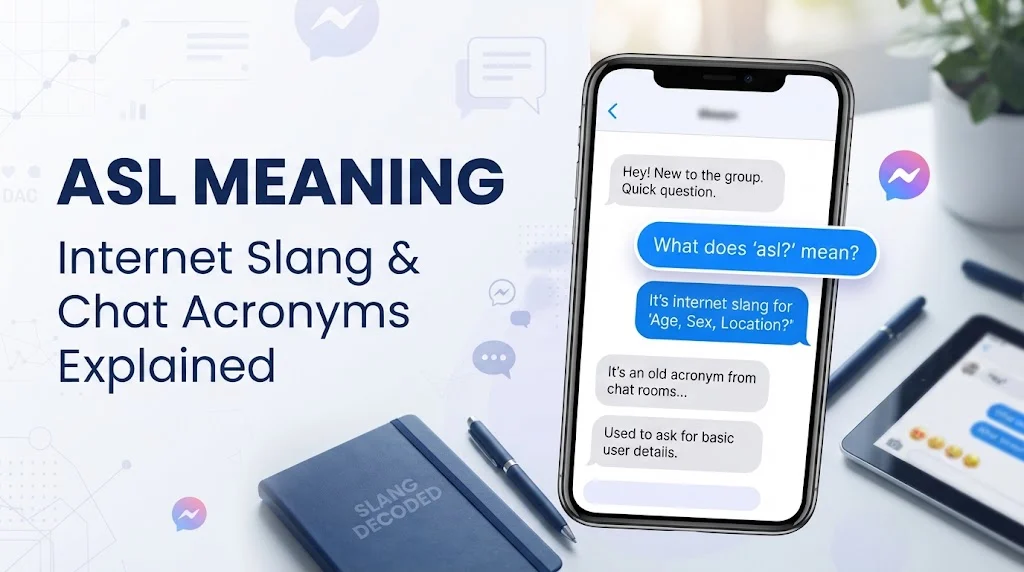
The ASL meaning depends on the conversation: in traditional online chat, it commonly stands for “age, sex, location,” while modern slang users may use “asl” to mean “as hell,” meaning “extremely” or “very.” The surrounding sentence usually reveals which meaning applies.
ASL has two widely recognized meanings in informal online communication: “age, sex, location” and “as hell.” The first is an older internet chat abbreviation used to ask about someone’s age, sex, and location. The second appears in modern slang as an intensifier that emphasizes a feeling or description.
For example, “asl?” may be asking for personal information, while “I’m tired asl” means “I’m extremely tired.”
| Detail | Explanation |
|---|---|
| Common chat meaning | Age, sex, location |
| Modern slang meaning | As hell, meaning very or extremely |
| Tone | Curious, casual, emphatic, or intrusive |
| Common platforms | Text messages, Snapchat, TikTok, Discord, and online chats |
| Formal or informal | Informal |
It is also worth knowing that ASL is the established abbreviation for American Sign Language, a visual language used by many Deaf and hard of hearing people. This meaning is common in educational, linguistic, and accessibility contexts rather than ordinary slang conversations.
The Two Main ASL Slang Meanings
ASL Meaning: Age, Sex, Location
The traditional ASL meaning in chat is “age, sex, location.” Someone uses it to ask how old you are, what your sex is, and where you are located.
This abbreviation became associated with early online chat rooms and instant messaging, where people often exchanged basic personal details to introduce themselves.
Example:
Person A: “Hey, asl?”
Person B: “I’m 22, male, and from Chicago.”
Meaning: Person A is asking for Person B’s age, sex, and location.
Although this usage is recognizable in older internet culture, it can feel outdated or intrusive in some modern conversations. You are not obligated to share personal details with strangers online.
ASL Meaning: As Hell
In contemporary informal slang, “asl” can stand for “as hell.” It works as an intensifier, adding emphasis to an adjective or description.
For example:
“I’m hungry asl.”
This means “I’m extremely hungry.”
Other examples include:
- “That test was hard asl.” This means the test was extremely difficult.
- “She’s funny asl.” This means she is very funny.
- “It’s cold asl outside.” This means it is extremely cold outside.
In this usage, ASL does not ask for personal information. It simply makes the statement more emphatic.
The spelling may appear as “asl” or “ASL,” although lowercase is common in casual texting. Capitalization alone is not enough to determine the intended meaning.
What Does ASL Mean on Different Platforms?
The meaning of ASL can vary with the platform and the type of conversation. However, there is no universal platform specific definition that applies to every message.
ASL Meaning on Snapchat
On Snapchat, ASL may mean “age, sex, location” when someone sends it as a standalone question. It can also mean “as hell” when it follows an adjective.
Example: “I’m bored asl.”
Meaning: The sender is saying they are extremely bored.
If an unfamiliar person sends you “asl?”, consider your privacy before answering.
ASL Meaning on TikTok
On TikTok, users may write “asl” in comments, captions, or messages to emphasize a description. In that context, it often means “as hell.”
Example: “This song is catchy asl.”
Meaning: The song is extremely catchy.
A standalone “asl?” in a conversation may have the older meaning, depending on the context.
ASL Meaning on Discord
On Discord, the intended meaning depends on the server and the conversation. Someone might use ASL to ask for personal details in a casual chat or use it as an intensifier in a gaming discussion.
Example: “That final boss was difficult asl.”
Meaning: The final boss was extremely difficult.
In a community focused on accessibility or language learning, ASL may instead refer to American Sign Language.
ASL Meaning in Text Messages
In ordinary texting, look at the words around ASL to identify the meaning.
Example 1: “asl?”
Likely meaning: Age, sex, location.
Example 2: “I’m excited asl.”
Likely meaning: I’m extremely excited.
Example 3: “I’m learning ASL.”
Likely meaning: American Sign Language.
These examples show why the abbreviation should not be interpreted without considering the complete message.
Real Conversation Examples of ASL
Here are three realistic conversations showing how ASL can communicate different things.
Example 1: Meeting Someone Online
Person A: “Hey, asl?”
Person B: “I’m 19, female, and from Texas.”
Meaning: Person A is asking about age, sex, and location.
Example 2: Talking About School
Person A: “How was your math exam?”
Person B: “It was stressful asl.”
Meaning: Person B means the exam was extremely stressful.
Example 3: Discussing a Language Course
Person A: “What are you studying this semester?”
Person B: “I’m taking an ASL class.”
Meaning: Person B is studying American Sign Language, not using internet slang.
How Context Changes the Meaning of ASL
The easiest way to interpret ASL is to examine the wording, conversation topic, and relationship between the people chatting.
Here are four useful clues:
1. ASL appears by itself. If someone opens a conversation with “asl?”, they are probably asking for age, sex, and location.
2. ASL follows an adjective. In a sentence such as “I’m happy asl,” it likely means “as hell.”
3. The conversation concerns language or accessibility. If someone discusses interpreting, signing, or a language class, ASL probably refers to American Sign Language.
4. The sender is a stranger. A standalone “asl?” may be a request for personal information. Consider whether you want to share those details before replying.
Emojis and punctuation can offer additional clues, but they do not establish the meaning on their own. When a message remains unclear, asking the sender what they mean is the simplest solution.
Is ASL Rude or Offensive?
ASL is not automatically rude or offensive. Its tone depends on the meaning and the situation.
When ASL means “as hell,” it is usually casual slang. Some people use it freely among friends, while others may dislike its informal style.
When ASL means “age, sex, location,” it can sound direct or intrusive, especially when a stranger asks for personal details without introducing themselves.
The abbreviation itself is not necessarily offensive, but the request may make someone uncomfortable. You can decline to answer or ask why the person wants to know.
When ASL refers to American Sign Language, it is a standard abbreviation for a language and is not slang in that context.
How to Reply to ASL
Your response should match the meaning of the message and your comfort level.
Friendly Replies
If the sender is using ASL to mean “as hell,” you can respond naturally to the statement.
- “Honestly, same.”
- “Right? It really is.”
- “I know, it’s choatic.”
- “For real!”
These replies work when the conversation is casual and you understand the intended meaning.
Replies to “ASL?” When Asked for Personal Information
If someone asks for your age, sex, and location, you can choose how much to share.
- “Why do you ask?”
- “I’d rather get to know you first.”
- “I’m not comfortable sharing that information.”
- “Can you tell me a little about yourself first?”
You do not have to provide personal details simply because someone asks.
Replies When You Are Confused
If you cannot determine what ASL means, ask for clarification.
- “Do you mean age, sex, location?”
- “Do you mean ‘as hell’?”
- “What does ASL mean in your message?”
A brief question can prevent an unnecessary misunderstanding.
When to Use ASL and When to Avoid It
ASL can be appropriate in casual text messages, online communities, and conversations with friends who understand the slang. Using it as “as hell” may suit an informal comment such as “That movie was good asl.”
However, avoid relying on ASL when writing professional emails, academic assignments, formal announcements, or messages to people who may not recognize internet slang.
If you are asking someone for personal information, consider using a more considerate question and explaining why you are asking.
For example, “How old are you, and where are you from, if you don’t mind sharing?” sounds clearer than simply sending “asl?”
When discussing American Sign Language, write the full name when the audience may not know the abbreviation.
Common Mistakes About ASL
| Common Mistake | Correct Understanding |
|---|---|
| Assuming ASL always means age, sex, location | It can also mean “as hell” or American Sign Language |
| Thinking “asl” after an adjective requests personal details | It usually intensifies the adjective, as in “tired asl” |
| Assuming every use of ASL is internet slang | In educational and accessibility contexts, it often means American Sign Language |
Another mistake is treating capitalization as a reliable clue. People may type the abbreviation in uppercase or lowercase, so the surrounding words are usually more helpful.
ASL and Similar Internet Slang
These abbreviations can appear in similar conversations, but their meanings differ.
| Term | Meaning | Main Difference |
|---|---|---|
| ASL | Age, sex, location; or as hell | Meaning depends strongly on sentence structure |
| AF | As fuck | Another intensifier used after adjectives |
| FR | For real | Expresses agreement, sincerity, or emphasis |
| WYD | What are you doing? | Asks about someone’s current activity |
| WYA | Where are you at? | Asks about someone’s location |
For example, “I’m tired asl” and “I’m tired AF” both express strong tiredness. By contrast, “WYA?” is a question about location rather than an intensifier.
Origin and Popularity of ASL
The use of ASL to mean “age, sex, location” is associated with early internet chat rooms and instant messaging, where users often asked these questions when meeting strangers online. The abbreviation made it possible to request three basic details in a short message.
The slang meaning “as hell” follows a different pattern: it uses the same letters as a short form of an intensifying phrase. Its interpretation comes from how people use it in a sentence.
ASL also has a separate, established meaning in American Sign Language. This is why readers should pay attention to context rather than assuming that every occurrence refers to online slang.
Quick Recap: ASL Meaning
- ASL can mean “age, sex, location” when someone asks about personal details.
- In modern slang, ASL can mean “as hell,” or extremely.
- In language and accessibility contexts, ASL commonly means American Sign Language.
- The words surrounding the abbreviation help identify the intended meaning.
- If someone asks for personal information, share only what you feel comfortable sharing.
Frequently Asked Questions
What does ASL mean in text?
ASL usually means “age, sex, location” as a standalone chat question or “as hell” when emphasizing an adjective.
What does ASL mean on TikTok?
On TikTok, ASL often means “as hell” in casual comments, although other meanings remain possible depending on the conversation.
What does ASL stand for?
ASL can stand for “age, sex, location” in chat, “as hell” in slang, or American Sign Language in language contexts.
Is ASL rude?
ASL is not inherently rude, but asking strangers for personal details may feel intrusive, and slang usage may be inappropriate in formal settings.
How should you reply to ASL?
Check the context first, then respond naturally to the slang or ask what the sender means before sharing personal information.
Final Thoughts
The ASL meaning depends on how the abbreviation appears in a conversation. It can stand for “age, sex, location” in traditional online chats, mean “as hell” as a modern slang intensifier, or refer to American Sign Language in educational and accessibility settings. The surrounding words usually help you identify the correct interpretation.
If someone sends you “asl?”, consider whether they are asking for personal details before replying. Once you understand the context, you can respond naturally, avoid confusion, and use the abbreviation appropriately in casual online conversations.
Discover More Articles:
- Raven or Crow: Key Differences & Identification for 2026
- Allie or Ally: How to Use Each Word Correctly In 2026
- Sink or Swim: How to Use the Idiom Correctly In 2026

Margaret Atwood is an American writer who contributes to LingRoya.com creating clear and engaging content about the English language and everyday communication. She enjoys helping readers build confidence in their writing through simple, practical guidance.