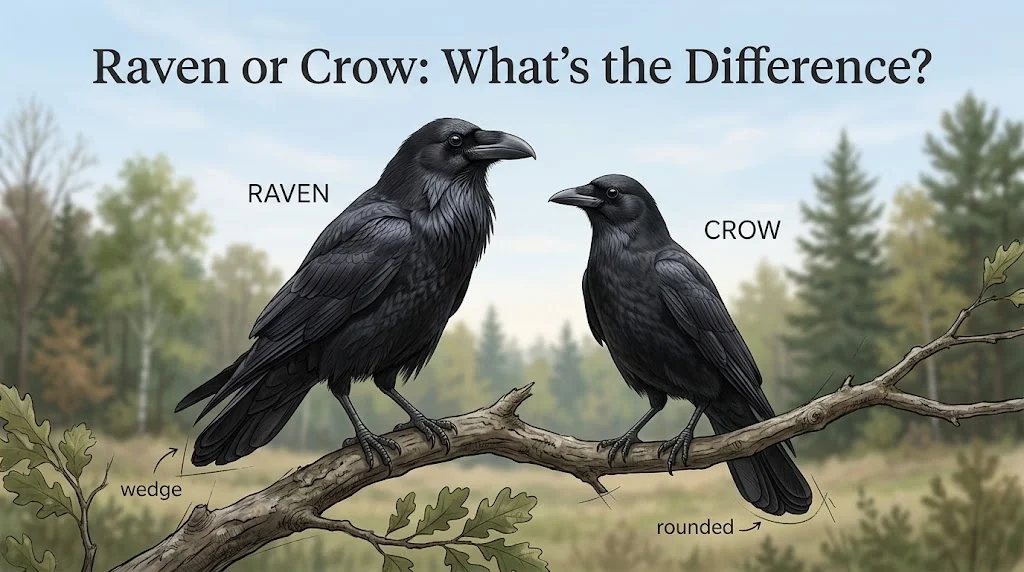
A raven or crow can be identified by comparing size, beak shape, tail structure, calls, and behavior. Ravens are generally larger, with heavier bills, shaggy throat feathers, and wedge shaped tails. Crows are usually smaller, with slimmer bills and fan shaped tails. Both birds belong to the corvid family and are known for their intelligence.
Have you ever spotted a large black bird and wondered whether it was a raven or a crow? These birds look remarkably similar, so even experienced birdwatchers sometimes need a closer look. The main differences involve their size, calls, tail shape, and behavior. Ravens are typically bigger and have deeper, rougher calls, while crows are smaller and often produce familiar cawing sounds.
Understanding these characteristics helps you identify them more accurately in gardens, forests, cities, and open countryside. This guide explains the key differences using observable features, practical examples, and reliable bird identification principles.
Raven vs Crow: What’s the Difference?
A raven is a large bird belonging to the genus Corvus, known for its powerful bill, shaggy throat feathers, and impressive flying ability. A crow is also a member of the genus Corvus, but the name commonly refers to several generally smaller species with slimmer bills and more familiar cawing calls.
Both belong to the corvid family, which also includes jays and magpies. Their shared appearance and close relationship explain why people often confuse them.
| Feature | Raven | Crow |
|---|---|---|
| Scientific classification | Genus Corvus | Genus Corvus |
| Typical size | Larger and heavier | Generally smaller |
| Beak | Thick and powerful | Usually slimmer |
| Throat feathers | Often shaggy | Usually smoother |
| Tail shape in flight | Wedge shaped | Fan shaped |
| Voice | Deep croaks and resonant calls | Familiar caws and sharper calls |
| Flight style | Often soars and glides | Frequently uses steady flapping |
| Social behavior | Often travels in pairs or small groups | Many species gather in larger groups |
| Habitat | Mountains, forests, coasts, and open landscapes | Cities, farms, forests, and varied habitats |
| Diet | Omnivorous | Omnivorous |
Quick Recap
Ravens are generally larger, with heavier bills and wedge shaped tails.
Crows are usually smaller, with slimmer bills and fan shaped tails.
Both birds are highly intelligent and adaptable.
Their calls can help with identification, but they vary between species.
Size and tail shape are useful clues when several features are considered together.
How to Identify a Raven


6
The common raven (Corvus corax) is one of the largest members of the crow family. Its size, bill, throat feathers, and flight behavior make it easier to distinguish from many crow species.
Size and Appearance
Ravens have substantial bodies, broad wings, and thick bills. Their throat feathers often appear shaggy, particularly when the bird calls or ruffles its plumage.
An adult common raven typically measures around 56 to 69 centimeters in length, although size varies by population and individual.
Tail Shape
A raven’s tail often appears wedge shaped when spread during flight. The middle feathers extend farther than the outer feathers, producing a tapered outline.
This feature is especially useful when observing a bird soaring overhead.
Voice and Behavior
Ravens often produce deep croaks, grunts, and resonant calls. They can soar for long periods and perform aerial rolls or other impressive maneuvers.
They also show complex social behavior, problem solving, and the ability to learn from experience.
Usage recap: When identifying a raven, look for a large body, heavy bill, shaggy throat, wedge shaped tail, and deep call. No single feature guarantees identification.
How to Identify a Crow


Crows are familiar birds found in many environments, from busy urban neighborhoods to agricultural fields and wooded areas. The American crow (Corvus brachyrhynchos) is a well known example, although other crow species have different physical characteristics.
Size and Appearance
American crows generally have compact bodies, black plumage, and relatively slender bills compared with common ravens.
They typically measure about 40 to 53 centimeters in length. This makes them noticeably smaller than common ravens in many side by side comparisons.
However, body size varies across species, and some crows can look surprisingly large.
Tail Shape
A crow’s tail usually looks more rounded or fan shaped when spread in flight. Its outline is generally less pointed than that of a raven.
If you can observe the bird from below against the sky, the tail may offer a useful identification clue.
Voice and Behavior
Crows are well known for their familiar cawing calls. They may gather in family groups, defend nesting territories, and form large communal roosts outside the breeding season.
Like ravens, crows can recognize individual people, solve problems, and adapt to changing environments.
Usage recap: Look for a relatively compact body, slimmer bill, fan shaped tail, and cawing call. Compare several features rather than relying on color alone.
Is Raven vs Crow a Grammar, Vocabulary, or Usage Issue?
The difference between raven and crow is primarily a vocabulary and scientific identification issue, not a grammar problem. Both are correct English nouns, but they refer to different common categories of birds.
Are Raven and Crow Interchangeable?
Not when precise identification matters. A raven and a crow are closely related, but they are not simply two names for the same bird.
In casual conversation, people sometimes use the terms loosely for large black birds. In wildlife writing, birdwatching reports, and scientific discussions, identifying the species accurately is more appropriate.
Formal vs Informal Usage
In formal writing, use raven or crow according to the bird you have identified. For example, a wildlife report should not label a common raven as an American crow simply because both have black feathers.
In everyday conversation, a general description such as “a black bird” may be sufficient when the species is unknown.
Academic vs Casual Usage
Academic writing may require the common name and scientific name together. For example, “The common raven (Corvus corax) is widely distributed across the Northern Hemisphere.”
Casual writing usually needs only the common name. The important point is to avoid claiming a precise identification when the available evidence is uncertain.
Raven or Crow: Differences in Everyday Situations
Workplace Example
A wildlife photographer preparing a field report might write:
“An adult common raven was observed soaring above the rocky hillside.”
Calling it a crow without checking its features could reduce the accuracy of the report.
Academic Example
A biology student might compare the problem solving abilities of ravens and crows. The student should specify the species studied because intelligence, social behavior, and experimental results cannot automatically be generalized to every member of the corvid family.
Technology Example
A bird identification application might analyze a photograph and suggest either a raven or a crow. The result is a prediction, not guaranteed proof. Image quality, viewing angle, lighting, and the species available in the application’s database can affect the result.
When You Should NOT Use Raven or Crow
There are several situations where choosing one label too quickly can lead to inaccurate information.
1. When the bird has not been identified. Use “large black bird” until you have enough evidence to make a reasonable identification.
2. When size is your only clue. Distance can make a crow look larger than it is, while a raven seen from far away may appear smaller.
3. When relying only on color. Many raven and crow species have black plumage, so color alone is rarely enough.
4. When the bird is a different corvid. Rooks, jackdaws, and other related birds may be mistaken for crows or ravens.
5. When a call is heard without seeing the bird. Calls vary by species, individual, and situation.
6. When interpreting symbolic meanings as scientific facts. Cultural associations with wisdom, death, or mystery do not establish a bird’s identity or behavior.
7. When using a photograph with no sense of scale. Perspective and camera distance can distort apparent body size.
8. When treating all species as behaviorally identical. Different corvid species have distinct ecological and social characteristics.
Common Raven and Crow Identification Mistakes
| Correct statement | Incorrect statement | Explanation |
|---|---|---|
| A common raven is generally larger than an American crow. | Every raven is larger than every crow. | Size varies among species and individuals. |
| A raven often has a wedge shaped tail. | Every black bird with a pointed tail is a raven. | Tail shape is a clue, not definitive proof. |
| Crows and ravens belong to the corvid family. | Crows and ravens are unrelated birds. | Both are members of the family Corvidae. |
| Ravens and crows can solve problems. | Only ravens are intelligent corvids. | Several corvid species demonstrate sophisticated cognition. |
| A deep croak may suggest a raven. | A deep sound always proves it is a raven. | Calls vary, and other birds can produce similar sounds. |
Decision Rule
If the bird is very large, has a heavy bill, shaggy throat feathers, and a wedge shaped tail, consider a raven.
If the bird is smaller, has a slimmer bill, and shows a fan shaped tail, consider a crow.
Confirm your identification using multiple features, location, habitat, and, where possible, a reliable field guide.
Raven and Crow in Modern Technology and AI Tools
Bird identification has become easier with digital field guides, wildlife databases, camera applications, and AI powered image recognition tools.
These systems may compare photographs with known species and return a likely match. Some also use location, season, and habitat to narrow the possibilities.
However, automated identification has limitations. A photograph taken from an unusual angle may hide the tail shape or make the bill appear larger or smaller than it really is. Young birds and unfamiliar regional species can also complicate identification.
For a more reliable result, compare multiple photographs, record the location, listen to the bird’s call when possible, and check the suggested identification against a trusted bird guide.
Etymology: Where Do the Words Raven and Crow Come From?
The words raven and crow have different linguistic histories, even though they describe closely related birds.
Raven comes from Old English hræfn, a word used for the bird. Its history is connected with older Germanic words associated with ravens and their calls.
Crow comes from Old English crāwe. The word is associated with the bird’s characteristic vocalization, reflecting a common pattern in which animal names imitate or evoke their sounds.
Both words have existed in English for centuries. Their long histories explain why they have distinct names despite the birds’ similarities.
Expert Insight: The Best Way to Tell a Raven From a Crow
A useful principle for bird identification is to combine independent clues rather than relying on one visual detail. Size, bill proportions, tail shape, voice, flight behavior, and geographic range work together to build a stronger identification.
This approach is especially important when birds are seen briefly or from a distance. A careful observer records what can actually be seen instead of assuming that every large black bird belongs to the same species.
Two Practical Case Studies
Case Study 1: Identifying a Large Black Bird in the Countryside
Imagine a birdwatcher observing a large black bird above a rocky landscape. At first, the bird appears to be an ordinary crow.
The observer notices its broad wings, heavy bill, shaggy throat feathers, and wedge shaped tail. Its deep croaking call provides another clue.
Together, these characteristics strongly suggest a common raven rather than an American crow.
Result: Combining several observable features produces a more defensible identification than judging the bird by its black plumage alone. This is an illustrative example, not a reported field study.
Case Study 2: Identifying Birds in an Urban Park
A student photographs several black birds gathered near a park. An image recognition application labels one of them as a raven.
Before accepting the result, the student checks the birds’ relative sizes, bill shapes, tails, and local species distribution. The photographs show compact bodies, slimmer bills, and rounded tails, which support identifying the birds as crows.
Result: Reviewing the AI suggestion against physical characteristics helps prevent a possible misidentification. This is an illustrative scenario, not a measured experiment.
Error Prevention Checklist
Always Consider a Raven When
- The bird appears substantially larger than nearby crows.
- It has a thick, powerful bill.
- Its throat feathers appear shaggy.
- Its tail looks distinctly wedge shaped in flight.
- Its deep calls and soaring behavior support the identification.
Never Identify a Crow Solely Because
- The bird has black feathers.
- It is seen near houses or roads.
- It makes a sound that resembles a familiar caw.
- An image recognition tool provides a single unverified result.
Remember that both birds occupy a range of habitats, and their characteristics vary by species. Use a combination of evidence whenever possible.
Related Bird Identification Confusions You Should Master
If you enjoy learning about ravens and crows, these comparisons can help you recognize other birds and understand their differences.
- Crow vs Rook: Differences in appearance, bill shape, and social behavior.
- Raven vs Rook: How to distinguish two large black corvids.
- Crow vs Jackdaw: Size, eye color, and head markings.
- Raven vs Blackbird: Differences in size, body shape, and family classification.
- Crow vs Grackle: Plumage, tail shape, and regional distribution.
- Hawk vs Eagle: Differences in size, proportions, and hunting behavior.
- Owl vs Hawk: Differences in activity patterns, hearing, and hunting adaptations.
- Vulture vs Raven: Differences in body structure, flight, and feeding habits.
- Magpie vs Crow: Contrasting plumage, tail length, and behavior.
- Jay vs Crow: Differences in appearance, vocalization, and habitat.
Frequently Asked Questions
1. What is the difference between a raven and a crow?
Ravens are generally larger and have heavier bills, shaggy throat feathers, wedge shaped tails, and deeper calls. Crows are typically smaller and have slimmer bills and fan shaped tails.
2. Is a raven bigger than a crow?
A common raven is generally larger than an American crow. However, size varies across species, so it is best to compare other physical characteristics as well.
3. How can you tell a raven from a crow in flight?
Look at the tail, wing shape, and flight behavior. Ravens often have wedge shaped tails and broad wings, while crows usually have fan shaped tails and a more compact appearance.
4. Are ravens and crows the same species?
No. Both belong to the genus Corvus, but ravens and crows include different species. The common raven and American crow are two distinct examples.
5. Which bird is more intelligent, a raven or a crow?
Both ravens and crows demonstrate advanced problem solving and learning abilities. Their performance depends on the species, the task, and the individual bird, so there is no simple universal winner.
6. Do ravens and crows sound different?
Yes. Common ravens often produce deep croaks and resonant calls, while American crows are known for their familiar cawing. However, both produce varied sounds, so calls should not be used alone.
7. Can a raven be mistaken for a crow?
Yes. Their black plumage, similar body structure, and shared habitats can make them difficult to distinguish, especially from a distance. Size, tail shape, and bill proportions provide useful clues.
8. Are ravens and crows found in the same places?
Yes, their ranges overlap in some regions, although their distributions and habitat preferences vary. The species present in a particular area can help narrow down an identification.
9. What does seeing a raven or crow symbolize?
Symbolic meanings depend on cultural traditions and personal beliefs. Ravens and crows are associated with wisdom, mystery, transformation, and death in different stories, but these associations are cultural interpretations rather than scientific facts.
Conclusion
Choosing between raven or crow becomes easier when you focus on observable differences instead of relying on color alone. Ravens are generally larger, with heavier bills, shaggy throat feathers, wedge shaped tails, and deep calls. Crows are usually smaller, with slimmer bills, fan shaped tails, and familiar cawing sounds.
Both birds belong to the corvid family and display remarkable intelligence and adaptability. Their similarities explain why they are frequently confused, but careful observation can help you distinguish them. When the evidence is incomplete, consult a field guide or bird identification tool and describe the bird as unidentified rather than making an uncertain claim.

Margaret Atwood is an American writer who contributes to LingRoya.com creating clear and engaging content about the English language and everyday communication. She enjoys helping readers build confidence in their writing through simple, practical guidance.