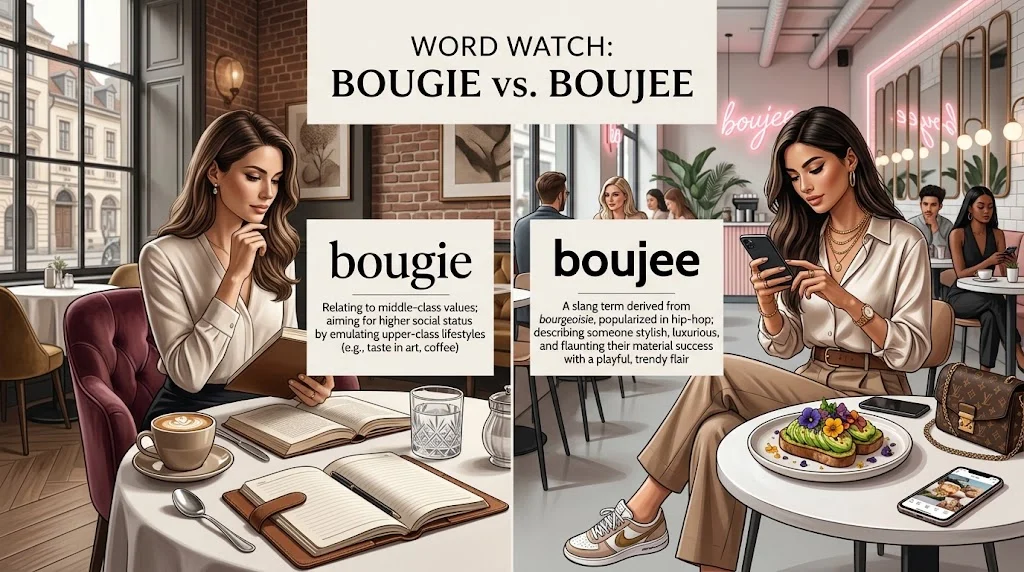
Bougie is the more established spelling and is generally used as an adjective meaning luxurious, upscale, pretentious, or overly concerned with wealth and status. Boujee is a slang variant strongly associated with popular culture, hip hop, social media, and a playful attitude toward luxury.
Have you ever seen someone describe a brunch spot, apartment, vacation, outfit, or lifestyle as “bougie” and wondered whether “boujee” is actually the correct spelling? The confusion exists because both forms are widely visible in contemporary English, especially online. Bougie has a direct connection to the French concept of bourgeois, while boujee developed as a stylized slang form that became especially prominent in African American English, hip hop culture, and social media.
Today, both forms can describe luxury or status conscious behavior, but they don’t always create exactly the same impression. Understanding their origins, pronunciation, tone, and cultural context helps you choose the form that fits your audience instead of treating them as simple spelling alternatives.
Bougie vs Boujee: What’s the Difference?
Bougie is an adjective, and in some contexts it can also function informally as a noun when referring to a person with supposedly upscale or status conscious tastes. It describes something luxurious, refined, expensive, fashionable, or perceived as trying too hard to appear sophisticated.
For example:
That restaurant is incredibly bougie.
Here, bougie describes the restaurant.
Boujee is primarily an informal slang spelling and adjective. It carries a similar general idea of luxury, wealth, stylishness, or an elevated lifestyle. However, it often has a more playful, ironic, or culturally specific flavor.
For example:
She loves her little boujee apartment.
The speaker may be describing the apartment affectionately rather than criticizing it.
| Feature | Bougie | Boujee |
| Part of speech | Mainly adjective | Mainly adjective |
| Meaning | Upscale, luxurious, status conscious, sometimes pretentious | Luxurious, fashionable, affluent, often playful or slangy |
| Origin | Related to French bourgeois | Slang development associated with popular culture |
| Tone | Informal, sometimes mildly critical | Highly informal, playful, expressive |
| Formal writing | Usually avoided | Usually avoided |
| Social media | Common | Very common |
| Academic writing | Generally inappropriate unless discussing the term | Generally inappropriate unless discussing the term |
| Standard spelling | More established | Slang variant |
The important distinction is not simply spelling.
Bougie tends to feel more established in written English.
Boujee tends to signal slang, internet culture, and a playful attitude.
Neither form should automatically be treated as a mistake when used intentionally in an informal context.
Is Bougie vs Boujee a Grammar, Vocabulary, or Usage Issue?
This is mainly a vocabulary and usage issue, rather than a grammar problem.
The two forms can be used in very similar sentences. For instance:
She has a bougie taste in home décor.
She has a boujee taste in home décor.
Both sentences can communicate the idea that she likes expensive or fashionable décor. The second version sounds more deliberately casual.
The distinction becomes more important when considering audience and register.
In a university essay about socioeconomic identity, you might discuss the word itself, but you would normally explain its meaning rather than casually insert it into an argument without context.
In a text message, Instagram caption, conversation, or humorous post, either spelling may work naturally.
Bougie can also carry a slightly negative implication. Someone might call a person bougie because they believe that person is overly concerned with expensive restaurants, designer clothing, exclusive neighborhoods, or status symbols.
Boujee can soften that criticism. A person might proudly call themselves boujee as a humorous way of saying they enjoy nice things.
How to Use Bougie Correctly
Bougie is useful when you want to describe something as upscale, luxurious, fashionable, or associated with a higher social class.
Workplace Example
Imagine coworkers discussing a company dinner.
The new restaurant looks pretty bougie, but the reviews are excellent.
The speaker isn’t necessarily insulting the restaurant. They may simply mean that it looks sophisticated and expensive.
However, using bougie in a formal business report would sound unnecessarily casual.
Academic Example
In an academic discussion of language or social class, the word can appear as the subject of analysis.
The term bougie is often used to discuss perceptions of class, wealth, and lifestyle.
This is appropriate because the writer is analyzing the vocabulary itself.
Technology Example
A technology reviewer might write:
The new smartphone has a surprisingly bougie design.
This would be suitable for a casual technology blog or social media review. A formal engineering specification would normally use terms such as premium, sophisticated, or high end instead.
Usage Recap
Use bougie when describing an upscale lifestyle, expensive taste, fashionable surroundings, or behavior associated with status. It works especially well in conversational and editorial writing, but it isn’t ideal for highly formal prose.
How to Use Boujee Correctly
Boujee has a stronger slang identity. It frequently appears in social media captions, memes, music discussions, lifestyle content, and casual conversations.
It can describe expensive preferences without necessarily being negative.
Workplace Example
A colleague might jokingly say:
Our team dinner is getting boujee this year.
This works in a casual workplace conversation, although it would be inappropriate in a formal corporate announcement.
Academic Example
An academic paper discussing contemporary slang might use the term as an object of linguistic study.
Boujee became a recognizable slang expression in popular culture.
The important point is that academic writing can discuss slang without adopting slang as its general writing style.
Technology Example
A casual reviewer could say:
This laptop is too boujee for my budget.
The meaning is immediately understandable. The reviewer is saying that the laptop feels excessively premium or expensive.
Usage Recap
Use boujee when you want a distinctly casual, slang oriented, playful, or culturally expressive tone. It works especially well in informal digital communication.
When You Should NOT Use Bougie or Boujee
There are situations where these terms can create the wrong impression.
- Avoid them in formal legal documents. Use precise descriptive language instead.
- Avoid them in technical specifications. Terms such as premium, luxurious, or high quality may be more precise.
- Avoid them in formal academic arguments unless you’re analyzing the term itself.
- Don’t assume every audience understands the cultural nuance. Slang can be unfamiliar to international readers.
- Don’t use either term as a neutral synonym for wealthy. Someone can have money without being bougie or boujee.
- Don’t automatically use boujee whenever something is expensive. The word often involves lifestyle, attitude, or presentation.
- Don’t use the terms to stereotype people based solely on income or appearance. Their meanings are subjective and can be humorous, complimentary, or critical.
- Don’t assume boujee is simply an incorrect spelling of bougie. It has developed its own cultural associations and stylistic identity.
Common Mistakes and Decision Rules
| Correct sentence | Incorrect or misleading sentence | Explanation |
| That café feels bougie. | That café is bougie because it is expensive. | Bougie can imply more than price alone. |
| She has a boujee aesthetic. | She has a boujee salary. | Boujee usually describes lifestyle, taste, or presentation rather than income itself. |
| The term boujee appears frequently online. | Boujee is the formal spelling of bougie. | Boujee is a slang variant, not a formal replacement. |
| The restaurant looks bougie. | The restaurant is officially classified as bougie. | Bougie is generally an informal descriptive term. |
| He jokingly calls himself boujee. | Everyone who likes luxury is boujee. | The term is subjective and context dependent. |
Decision Rule Box
If you want a more established informal expression for upscale or status conscious, use bougie.
If you want a highly casual, playful, slang oriented expression, use boujee.
If you’re writing formal content, consider replacing either word with a precise term such as luxurious, upscale, sophisticated, premium, or status conscious.
Bougie and Boujee in Modern Technology and AI Tools
Modern technology has helped both forms spread rapidly.
Social media platforms make slang visible across countries and age groups. A word that once belonged primarily to particular cultural communities can quickly become familiar to a global online audience.
AI tools also encounter these terms in social media posts, music lyrics, lifestyle articles, comments, product reviews, and conversational datasets. This means an AI system may recognize both spellings while interpreting their tone from context.
For example, a user asking an AI assistant to recommend a “boujee brunch place” probably wants something fashionable, attractive, upscale, or luxurious rather than merely expensive.
Context is therefore essential. AI generated writing should also consider audience. Using slang without understanding its cultural meaning can make content sound forced or insensitive.
Etymology: Where Does Bougie Come From?
The story of bougie is connected to the French word bourgeois, historically associated with the middle class and later with social attitudes involving conventional respectability, material comfort, and class status.
The English slang form developed from this broader cultural idea. Over time, bougie became associated with people, places, and things perceived as upscale or concerned with status.
Boujee developed later as a stylized slang form. Its popularity grew through hip hop and popular culture, especially after the expression became widely recognizable through music and internet culture.
The two forms therefore overlap significantly, but their histories and cultural associations are not identical.
What Does Bougie Mean in Slang?
In slang, bougie can mean someone is fancy, upscale, particular about quality, or attracted to expensive experiences.
It can be positive:
I feel bougie tonight, so let’s get the expensive dessert.
It can be negative:
He’s acting too bougie for this neighborhood.
It can also be self mocking:
I know I’m bougie, but I need good coffee.
This flexibility is one reason the term remains popular.
What Does Boujee Mean in Slang?
Boujee generally communicates a similar idea but often with more playful energy.
Someone might say:
We got a boujee hotel for the weekend.
The speaker may be celebrating the experience rather than criticizing it.
The word can therefore function as a form of humorous self expression. Context, speaker intention, and cultural background all influence how it is interpreted.
Two Practical Case Studies
Case Study 1: Lifestyle Content
Imagine a lifestyle creator reviewing an expensive rooftop restaurant.
Calling it boujee makes the post sound playful and conversational:
This place is so boujee, and honestly, I’m here for it.
The wording creates an informal personality that fits social media.
Replacing the term with luxurious would communicate the basic meaning but remove much of the slang driven personality.
Result: The slang form adds attitude and social tone rather than simply describing price.
Case Study 2: Professional Writing
Now imagine a hotel preparing a formal brochure.
Writing:
Enjoy our boujee luxury suites.
would create a casual and potentially awkward tone.
A more professional sentence would be:
Enjoy our luxurious suites with premium amenities and elegant furnishings.
Result: Replacing slang with precise descriptive vocabulary makes the message more appropriate for a formal commercial audience.
Expert Style Explanation
The key difference is not simply spelling; it is register, cultural association, and tone.
Bougie and boujee can overlap in meaning, but writers should choose between them according to audience and purpose rather than assuming one is universally correct.
Error Prevention Checklist
Always use bougie when:
☑ You want the more established informal spelling.
☑ You’re describing an upscale or status conscious lifestyle.
☑ You want a mildly critical or humorous tone.
☑ You’re discussing luxury in conversational English.
Never use boujee when:
☒ You need formal academic terminology.
☒ You’re writing legal or technical documentation.
☒ Your audience may not understand contemporary slang.
☒ You are using it merely as a synonym for wealthy.
☒ You are trying to sound formal or objective.
Related Grammar Confusions You Should Master
If you’re interested in vocabulary distinctions like this one, several other commonly confused expressions are worth learning:
- Affect or effect
- Compliment or complement
- Advice or advise
- Practice or practise
- Principal or principle
- Stationary or stationery
- Everyday or every day
- Further or farther
- Lay or lie
- Fewer or less
These pairs demonstrate an important principle of English: words that look or sound similar can have different meanings, histories, grammatical functions, and levels of formality.
FAQs
Is bougie or boujee the correct spelling?
Both forms appear in contemporary informal English, but they have different stylistic associations. Bougie is the more established spelling, while boujee is a slang variant strongly associated with popular culture and social media.
What does bougie mean?
Bougie generally means upscale, luxurious, fashionable, or concerned with status. Depending on context, it can be complimentary, humorous, or mildly critical.
What does boujee mean in slang?
Boujee is an informal slang term for someone or something perceived as luxurious, fancy, fashionable, affluent, or status conscious. It often has a playful or self aware tone.
Are bougie and boujee pronounced the same?
They are often pronounced similarly in everyday speech, although individual speakers may vary. The main distinction is generally spelling, cultural association, and tone rather than pronunciation.
Does bougie mean rich?
Not exactly. Bougie can relate to wealth and expensive tastes, but it more specifically describes perceived lifestyle, taste, behavior, sophistication, or concern with status.
Can you use bougie in academic writing?
You can use it when discussing the word, slang, class identity, language change, or popular culture. In ordinary formal academic prose, more precise vocabulary is usually preferable.
Conclusion
The difference between bougie or boujee is less about one spelling being universally right and the other being wrong. Bougie is the more established informal form, while boujee is a highly recognizable slang variant with strong connections to popular culture, music, and social media.
Use bougie when you want an established informal description of upscale or status conscious taste. Choose boujee when a more playful, slang oriented, or culturally expressive tone fits the situation. For formal academic, professional, legal, or technical writing, clearer words such as luxurious, sophisticated, premium, or upscale are usually better choices.

Philip Pullman is an American writer dedicated to creating clear and easy to follow English content. Through his work at LingRoya.com, he helps readers strengthen their language skills with practical and reliable guidance so that they can easily understand.