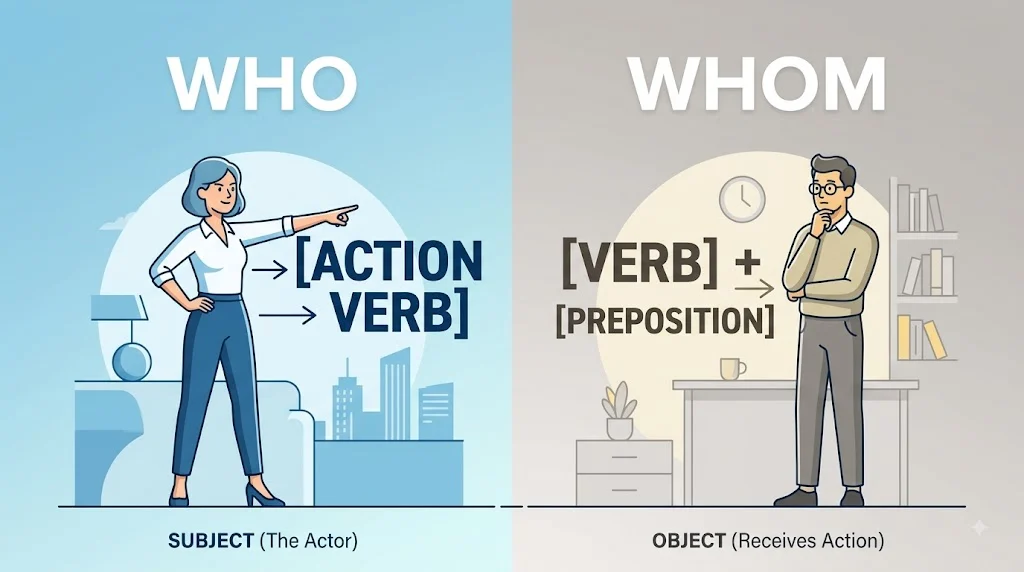
Who is a subject pronoun that performs the action in a sentence, while whom is an object pronoun that receives the action.
Who and whom are both used to talk about people, but they have different roles in a sentence. Who is used as the subject the person doing the action. For example, “Who called you?” Here, “who” is the person performing the action of calling.
Whom is used as the object the person receiving or affected by the action. For example, “Whom did you call?” Here, “whom” receives the action. A simple trick is: Who = he/she, Whom = him/her.
Who vs Whom: What’s the Difference?
Who is a subjective case pronoun, which means it functions as the subject of a verb. Think of who as the doer, the actor, the one performing the action. When you say “Who called you?” the word who refers to the person doing the calling. It occupies the same grammatical position as “I,” “he,” “she,” “we,” or “they.”
Whom is an objective case pronoun, which means it functions as the object of a verb or preposition. Whom is the receiver, the one being acted upon. In “Whom did you see?” the word whom refers to the person being seen, not the person doing the seeing.
| Feature | Who | Whom |
| Part of Speech | Subjective pronoun (subject) | Objective pronoun (object) |
| Role in Sentence | Performs the action | Receives the action |
| Substitution Test | Replace with “he,” “she,” or “they” | Replace with “him,” “her,” or “them” |
| Example | Who wrote this letter? (He wrote it.) | Whom should I call? (Call him.) |
| Common Use | Everyday speech and writing | Formal writing, after prepositions |
Is Who vs Whom a Grammar, Vocabulary, or Usage Issue?
This is primarily a grammar issue, specifically a matter of pronoun case and sentence structure. However, it also has strong usage dimensions that complicate the picture.
These two words are not interchangeable. They serve distinct grammatical functions, and using one in place of the other changes the grammatical logic of your sentence. That said, the rules around who and whom are evolving, and actual usage often diverges from strict grammatical prescription.
Most native English speakers use who in both subject and object positions during everyday conversation. Using whom in casual settings can actually sound overly formal, fussy, or even pretentious.
Academic vs casual usage follows a similar pattern. In academic writing, professors and reviewers expect correct usage, and using who where whom is required can be marked as an error. In casual contexts like text messages, social media, or friendly emails, who is perfectly acceptable in nearly every situation.
The bottom line is this: knowing the difference between who and whom is essential for formal writing, but in everyday speech, you can comfortably use who without raising any eyebrows.
When to Use Who
Who is your go to choice whenever the pronoun is the subject of a verb. A subject performs the action or is the focus of the sentence. If you can answer the question with “he,” “she,” or “they,” then who is correct.
Workplace Example
“The manager who approved the budget will present the quarterly report.”
Here, who refers to the manager and is the subject of the verb “approved.” The manager performed the action of approving.
“Employees who complete the training program receive a certification.”
Who is the subject of “complete,” referring to the employees doing the completing.
Academic Example
“The researcher who conducted the study published her findings in a peer reviewed journal.”
Who is the subject of “conducted.” The researcher performed the action.
“Students who submit their essays on time will receive feedback within two weeks.”
Who is the subject of “submit.”
Technology Example
“Developers who write clean, documented code are invaluable to any engineering team.”
Who refers to the developers and is the subject of “write.”
“The engineer who designed this algorithm solved a problem that had puzzled the industry for years.”
Who is the subject of “designed.”
Usage Recap for Who
Use who when the pronoun is doing something. It is the subject, the actor, the one performing the verb. If you can naturally replace the word with “he” or “she,” you need who. Who is appropriate in virtually all contexts, from casual conversation to formal writing, and it is never grammatically incorrect to use who as a subject.
When to Use Whom
Whom is used when the pronoun is the object of a verb or a preposition. An object receives the action or follows a preposition. If you can answer with “him,” “her,” or “them,” then whom is the correct choice.
Workplace Example
“The new CEO, whom the board selected unanimously, starts on Monday.”
Whom is the object of the verb “selected.” The board selected her (or him).
“To whom should I address this memo?”
Whom is the object of the preposition “to.” You would address it to him or her.
Academic Example
“The professor whom the students admired most received the teaching excellence award.”
Whom is the object of the verb “admired.” The students admired her.
“The candidates whom the committee interviewed were all highly qualified.”
Whom is the object of “interviewed.” The committee interviewed them.
Technology Example
“The data scientist whom we hired last quarter has already delivered three major insights.”
Whom is the object of “hired.” We hired him or her.
“For whom is this software tool primarily designed?”
Whom is the object of the preposition “for.” It is designed for them.
Usage Recap for Whom
Use whom when the pronoun is receiving the action or following a preposition. It is the object, the receiver, the one being acted upon. If you can replace the word with “him” or “her,” whom is correct. Whom is most appropriate in formal writing, academic papers, professional correspondence, and any context where grammatical precision matters. In casual speech, you can often substitute who without issue.
When You Should NOT Use Who or Whom
Even experienced writers make mistakes with these pronouns. Here are common scenarios where choosing the wrong one can undermine your credibility.
Do not use whom as a subject
This is perhaps the most common error. “Whom is coming to dinner?” is incorrect because whom cannot be the subject of a verb. The correct form is “Who is coming to dinner?”
Do not use who directly after a preposition at the start of a clause
When a preposition begins a sentence or clause and is immediately followed by the pronoun, whom is required. “To who should I send this?” is incorrect; it should be “To whom should I send this?”
Avoid whom in casual conversation
unless you want to sound overly formal. Using whom in everyday speech can come across as stilted or pretentious. “Whom did you talk to?” sounds fussy to most native speakers; “Who did you talk to?” is perfectly natural.
Avoid whom when it creates awkward or convoluted phrasing
If using whom makes your sentence sound unnatural, rephrase or use who instead. Clarity should always take precedence over strict grammatical adherence.
Common Mistakes and Decision Rules
| Correct Sentence | Incorrect Sentence | Explanation |
| Who wrote the report? | Whom wrote the report? | Who is the subject of “wrote.” Use who. |
| Whom did you invite? | Who did you invite? (informal) | Whom is the object of “invite.” Use whom in formal writing. |
| To whom should I speak? | To who should I speak? | Whom follows the preposition “to.” |
| The artist who painted this is famous. | The artist whom painted this is famous. | Who is the subject of “painted.” |
| The candidate whom we hired is excellent. | The candidate who we hired is excellent. (informal) | Whom is the object of “hired.” |
| I don’t know who called. | I don’t know whom called. | Who is the subject of “called.” |
| For whom is this gift? | For who is this gift? | Whom follows the preposition “for.” |
| She is the one who I trust. (informal) | She is the one whom I trust. (formal) | Whom is the object of “trust,” but who is widely accepted. |
Decision Rule Box
The pronoun performs the action, use WHO.
If the pronoun receives the action, use WHOM.
Who and Whom in Modern Technology and AI Tools
The who versus whom distinction has found new relevance in the age of artificial intelligence and automated writing tools. Grammar checkers like Grammarly, ProWritingAid, and Microsoft Editor all flag incorrect usage and suggest corrections based on formal grammatical rules.
Interestingly, many AI language models, including the ones powering these tools, have been trained on vast corpora of formal written English. As a result, they tend to favor whom in object positions, even in contexts where human writers might naturally choose who. This can create a slight disconnect between what AI suggests and what sounds natural to human ears.
For professionals who use AI writing assistants, understanding the who versus whom rule is valuable. When your grammar checker suggests whom, you can make an informed decision about whether to accept the suggestion based on your audience and the formality of your context. In formal business documents, academic papers, or legal writing, accepting the whom suggestion is usually the right call. In blog posts, emails, or social media content, you might reasonably override it.
The rise of AI has also made grammatical precision more accessible. Tools can now catch errors instantly and explain the reasoning behind corrections. This means that even writers who struggle with who and whom can produce error free formal writing with the help of technology, as long as they understand when to trust the tool and when to trust their ear.
A Brief History of Who and Whom
The distinction between who and whom is a remnant of the case system that was once much more prominent in English. In Old English, nouns and pronouns had distinct forms depending on their grammatical function, much like modern German or Latin.
The word who comes from the Old English hwā, and whom from hwǣm (or hwām in Middle English), which functioned as the dative (indirect object) case. Over centuries, English gradually lost most of its case endings, but the who/whom distinction persisted because it was reinforced by grammarians and educators.
Despite this preservation, whom has been in steady decline for over two hundred years. In contemporary English, it is largely restricted to formal registers and is almost never heard in casual speech. Some linguists predict that whom may eventually disappear from the language altogether, much like the distinction between “thou” and “you” did centuries ago.
For now, though, whom remains a marker of formal, educated writing. Knowing when and how to use it correctly signals linguistic sophistication and attention to detail.
Expert Insight
“In grammar terms, that makes who a subject, and whom an object. When following a preposition, whom is the preferred choice. Whom often sounds fussy and unnatural in regular speech and writing, even when it is technically correct. In these cases, it’s perfectly standard to use who instead.”
— Merriam Webster Dictionary
Case Studies
Case Study 1: The Job Application That Stood Out
A hiring manager at a Fortune 500 company reviewed over two hundred cover letters for a single position. Only three candidates used whom correctly in phrases like “To whom it may concern” and “the manager whom I would report to.” The hiring manager later noted that these candidates stood out as more polished and detail oriented. While this alone didn’t secure the job, it contributed to a positive first impression that helped those candidates advance to the interview stage.
Case Study 2: The Academic Paper That Received Higher Scores
A graduate student submitted two versions of a research paper to her advisor. The first version used who in every instance, including object positions. The second version corrected each instance to whom where appropriate. The advisor praised the revised version for its “polished, professional tone” and noted that the corrections improved the overall readability and credibility of the work. The paper went on to receive a top grade and was later accepted for publication in a peer reviewed journal.
About the Author
This guide was written by a senior content strategist and grammar specialist with over a decade of experience in educational publishing and SEO content development. The author has helped hundreds of writers master complex grammar rules and has been featured in multiple industry publications on writing and language.
Error Prevention Checklist
Always use WHO when:
- The pronoun is the subject of a verb
- The pronoun performs the action
- You can substitute “he,” “she,” “they,” “I,” or “we”
- The pronoun comes before the verb in a question (Who called?)
- The pronoun is the subject of a relative clause (the person who called)
Never use WHOM when:
- The pronoun is the subject of a verb
- The pronoun performs the action
- You are speaking casually or informally
- Using whom would make your sentence sound unnatural or stilted
- The pronoun is part of the subject of a subordinate clause
Related Grammar Confusions You Should Master
- Who vs That – When to use which relative pronoun for people versus objects
- Who vs Which – Choosing between pronouns for people and things
- Whose vs Who’s – Possessive pronoun versus contraction of “who is”
- Whoever vs Whomever – The same subject object distinction applied to compound forms
- I vs Me – Subject versus object pronouns in the first person
- She vs Her – Subject versus object pronouns in the third person
- They vs Them – Subject versus object pronouns in the third person plural
- We vs Us – Subject versus object pronouns in the first person plural
- That vs Which – Restrictive versus non restrictive relative clauses
- Who vs Whom in Questions – Applying the rule to interrogative sentences
FAQs
1. Should I use who or whom in a formal letter?
Use whom when it is the object, such as “To whom it may concern.”
2. Is “who” acceptable instead of “whom” in academic writing?
Yes, in some contexts, but whom is preferred in formal academic writing.
3. How can I tell whether to use who or whom?
Use the he/him test: if “he” fits, use who; if “him” fits, use whom.
4. Do I need to use whom after every preposition?
In formal writing, whom usually follows a preposition, such as “To whom did you speak?”
5. Is whom becoming obsolete in English?
Whom is less common in everyday speech but is still used in formal and professional writing.
6. What is the difference between whoever and whomever?
Whoever is used as a subject, while whomever is used as an object.
Conclusion
In conclusion, who and whom are both used to refer to people, but they have different roles in a sentence. Who is used for the subject, while whom is used for the object. Remembering the simple rule “who = he/she” and “whom = him/her” can make it easier to use them correctly.

Neil Gaiman is an American writer who contributes educational content to LingRoya.com. His work focuses on helping readers improve their English with clear, practical and easy to follow guidance.