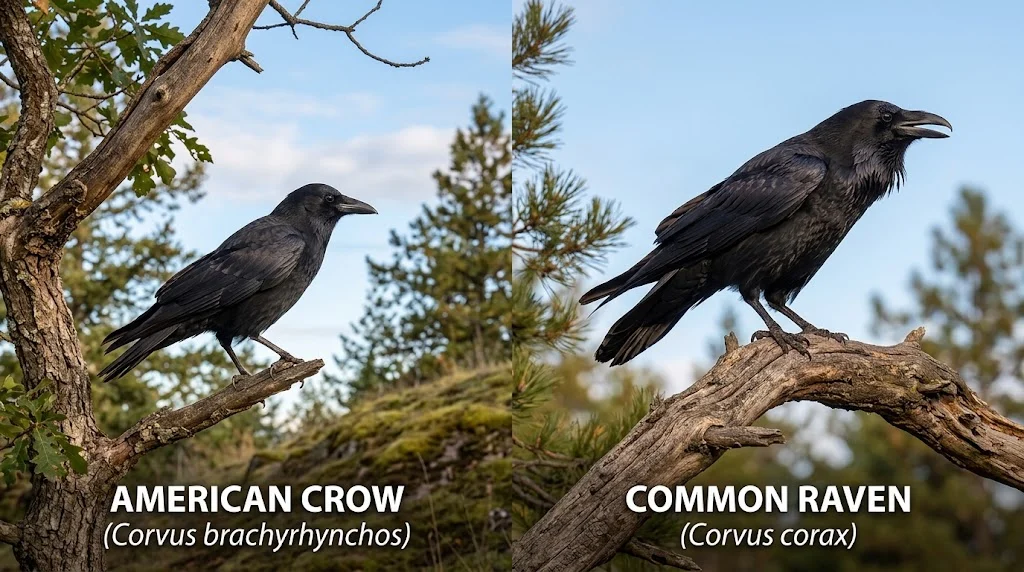
The simplest way to distinguish a crow from a raven is to look at overall size, tail shape, bill shape, and sound. American Crows are smaller with shorter, squarer tails and a familiar caw. Common Ravens are noticeably larger, have heavier bills and wedge shaped tails, and usually produce deeper, more varied croaking sounds.
Have you ever seen a large black bird flying overhead and wondered whether it was a crow or a raven? The confusion is understandable because these birds share the same corvid family, similar black plumage, and impressive intelligence. However, they are not simply two names for the same bird.
Learning how to compare their size, bill, tail, flight pattern, habitat, and calls can make identification much easier. Cornell Lab of Ornithology notes that voice is often one of the strongest clues, while physical features provide several useful backup signals.
Crow or Raven: What’s the Difference?
Both crows and ravens are members of the family Corvidae. They are related birds, but the terms refer to different groups and species rather than interchangeable names.
The American Crow is a large black songbird found across much of North America. It has a relatively smaller bill, broad wings, and a short rounded or squared tail. American Crows commonly forage on the ground and can be found in forests, fields, beaches, roadsides, towns, and cities.
The Common Raven is considerably larger. It has a heavy bill, a thick neck, shaggy throat feathers, longer wings, and a distinctive wedge shaped tail. It occurs across much of western and northern North America and occupies habitats ranging from forests and deserts to coastlines and high elevation environments.
The quickest visual clue is usually size.
The quickest shape clue is often the tail.
The quickest sound clue is the voice.
When several clues agree, identification becomes much more reliable.
Is Crow or Raven a Grammar, Vocabulary, or Usage Issue?
This is primarily a vocabulary and identification issue rather than a grammar problem.
The words crow and raven are both nouns when they refer to birds. They are not interchangeable in precise writing because they identify different birds.
In casual conversation, people sometimes use crow as a general term for a black bird. That can be understandable in everyday speech, especially when the observer is far away from the bird. In birdwatching, educational writing, scientific discussion, and academic work, however, accurate identification matters.
For example, saying that you saw a raven when you actually saw an American Crow changes the species being described. The mistake may not matter in casual conversation, but it matters when documenting wildlife observations.
The same principle applies to photographs, field guides, research notes, nature reports, and educational material.
How to Identify a Crow
An American Crow is generally smaller than a Common Raven. Cornell Lab measurements place the American Crow at roughly 15.8 to 20.9 inches in length, with a wingspan of about 33.5 to 39.4 inches. Its tail is relatively short and rounded or squared at the end.
Workplace Example
Imagine an environmental consultant preparing a report about birds observed around a construction site. Writing that several American Crows were feeding near the site is more precise than simply describing them as black birds.
Academic Example
A student writing a biology assignment might explain that American Crows are omnivorous and can feed on insects, seeds, fruit, carrion, and human food waste. Cornell Lab describes them as adaptable ground foragers with a broad diet.
Technology Example
Bird identification applications may use visual characteristics such as body proportions, tail shape, bill structure, and location to distinguish an American Crow from a Common Raven. A photograph showing a short squared tail and relatively small bill provides useful evidence for crow identification.
Usage Recap
Use crow when you are referring specifically to a crow species. When the bird is clearly smaller and has a shorter, squarer tail, crow is often the more appropriate identification.
How to Identify a Raven
The Common Raven is noticeably larger and more substantial than an American Crow. It has a heavy bill, shaggy throat feathers, long wings, and a wedge shaped tail that becomes especially obvious during flight.
Its voice is another valuable clue. Ravens commonly produce deep, gurgling croaks and have a much broader vocal repertoire than the familiar caw associated with American Crows. Cornell Lab notes that Common Ravens have numerous vocal categories and can produce calls that are considerably deeper than a crow’s typical call.
Workplace Example
A wildlife researcher working in a mountainous region may record Common Ravens near cliffs, forests, or open high elevation areas. Describing the species accurately makes the observation more useful for later ecological analysis.
Academic Example
In a report about animal communication, a student could discuss the different vocal characteristics of crows and ravens. This is more precise than saying that both birds simply make a caw.
Technology Example
Wildlife recognition software can combine multiple signals to identify a raven. A large body, long narrow wings, heavy bill, and wedge shaped tail can collectively provide strong visual evidence.
Usage Recap
Use raven when the bird is substantially larger, has a heavy bill, shaggy throat feathers, and a wedge shaped tail. Its deeper vocalizations can provide another strong clue.
When You Should NOT Use Crow or Raven
- Do not call every black bird a crow.
- Do not identify a distant bird from color alone.
- Do not use raven simply because the bird looks large in a photograph without checking other features.
- Do not assume every bird making a caw is an American Crow.
- Do not identify a species from one unclear visual characteristic.
- Do not treat crow and raven as exact synonyms in academic writing.
- Do not rely entirely on size when the bird is photographed without scale.
- Do not ignore geographic location because several related corvid species can overlap.
A reliable identification usually comes from combining several characteristics rather than depending on one feature.
Common Mistakes and Decision Rules
Decision Rule: If the bird is smaller with a shorter, rounded or squared tail and familiar cawing calls, consider crow. If it is much larger with a heavy bill, shaggy throat, wedge shaped tail, and deep croaking calls, consider raven.
Crow or Raven in Modern Technology and AI Tools
Modern bird identification technology makes the distinction easier for people who are not experienced birdwatchers. Image recognition systems can examine characteristics such as body shape, bill size, tail structure, wing proportions, and coloration.
However, an AI identification result should be treated as evidence rather than unquestionable proof. A poor photograph, unusual angle, juvenile bird, lighting problem, or overlapping species can make automated identification difficult.
Human observation remains valuable. A clear recording of the bird’s call can sometimes provide information that a photograph cannot. Cornell Lab specifically notes that voice is often the best clue when distinguishing similar crow and raven species.
Crow and Raven Etymology
The word crow comes from Old English forms associated with the bird and its characteristic call. Its history is closely connected with the sound the bird makes.
Raven has an even older Germanic history, with related forms appearing across several Germanic languages. The name has traditionally been associated with the black bird and its distinctive vocalizations.
Both words have therefore remained strongly connected with the physical appearance and sounds of these birds throughout the history of English.
An Expert Style Rule for Identification
“When two black corvids look similar, do not rely on color alone. Compare size, bill, tail, flight, habitat, and especially the voice.”
This practical identification principle reflects the multi feature approach recommended by modern bird identification resources.
Two Scientific Case Studies
Case Study 1: Crow Tool Use
New Caledonian Crows provide an important example of sophisticated animal tool use. A 2018 study published in Nature Ecology and Evolution examined their hooked tools and found that the birds obtained food several times faster when using hooked tools compared with non hooked tools. The finding demonstrated that tool shape can have a measurable effect on foraging efficiency.
This case is useful because it shows why the word crow can represent a scientifically specific group rather than simply serving as a general name for any black bird.
Case Study 2: Raven Cognitive Skills
Research published in Scientific Reports has examined the physical and social cognitive abilities of Common Ravens. The review discusses evidence involving spatial memory, object permanence, inference, caching behavior, and sophisticated social behavior.
The broader lesson is that crows and ravens belong to a highly interesting group of birds, but their names should still be used accurately. Similar intelligence does not make the two terms interchangeable.
Error Prevention Checklist
Always Use Crow When
The bird is clearly a smaller corvid.
The tail looks short and rounded or squared.
The bill appears moderate rather than massive.
The call sounds like a familiar caw.
Several identification features point toward an American Crow.
Never Use Raven When
The bird clearly has a short squared tail.
The body is noticeably smaller than a nearby Common Raven.
The bill is relatively modest.
The bird’s overall shape strongly matches an American Crow.
You are using raven simply as a generic word for any black bird.
Related Grammar Confusions You Should Master
Although crow and raven are primarily vocabulary distinctions, learning related word contrasts can strengthen precise English usage. Useful topics include:
- Eagle and hawk
- Dove and pigeon
- Hare and rabbit
- Turtle and tortoise
- Alligator and crocodile
- Butterfly and moth
- Frog and toad
- Crow and rook
- Raven and rook
- Animal and species
Understanding these distinctions helps writers avoid using familiar everyday labels as though they were exact scientific terms.
Frequently Asked Questions
Is a raven bigger than a crow?
Yes. The Common Raven is generally much larger than the American Crow. Cornell Lab describes the Common Raven as roughly 22.1 to 27.2 inches long, while the American Crow is roughly 15.8 to 20.9 inches long.
Does a raven have a different tail from a crow?
Yes. A Common Raven has a long wedge shaped or diamond shaped tail, especially noticeable in flight. An American Crow has a shorter rounded or squared tail.
Are crows and ravens the same species?
No. Crow and raven refer to different birds within the corvid family. Several species of crows and ravens exist around the world, so the exact species depends on location.
Why do crows and ravens look so similar?
They belong to the same bird family and share characteristics such as black plumage, strong bills, and similar body structures. Their relatedness explains much of the visual similarity.
Which has the wedge shaped tail, a crow or a raven?
The Common Raven has the characteristic wedge shaped tail. The American Crow generally has a shorter rounded or squared tail.
Conclusion
Knowing the difference between a crow or raven becomes much easier once you stop relying on black plumage alone. Look at the bird’s overall size, bill, tail, wings, flight pattern, habitat, and voice. A smaller bird with a short squared tail and familiar caw is more consistent with an American Crow. A much larger bird with a heavy bill, shaggy throat, wedge shaped tail, and deep croak is more consistent with a Common Raven. Using several clues together gives you a much more reliable identification.

Margaret Atwood is an American writer who contributes to LingRoya.com creating clear and engaging content about the English language and everyday communication. She enjoys helping readers build confidence in their writing through simple, practical guidance.