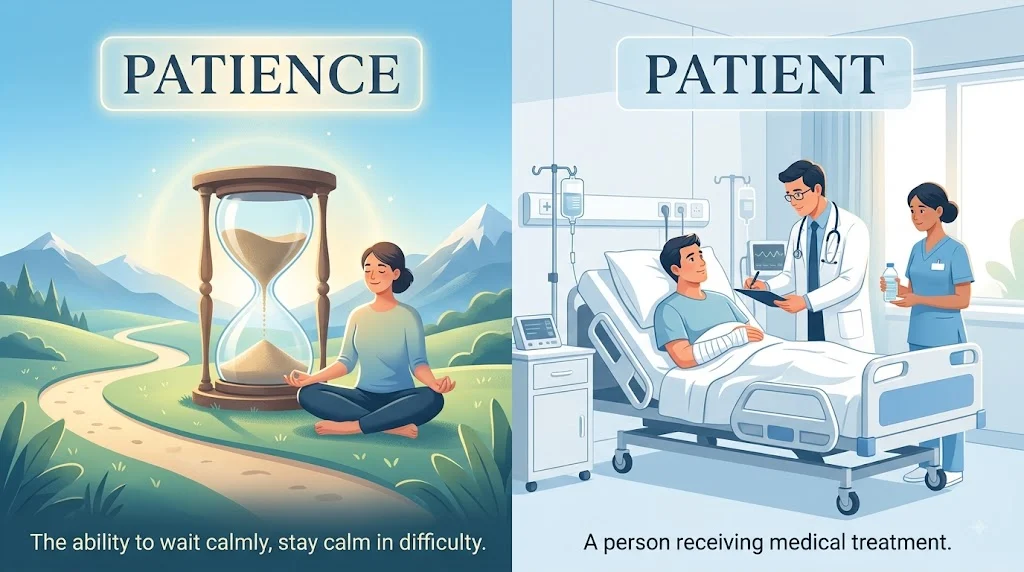
Patient means being able to wait calmly.
Patience is the quality of waiting calmly without getting annoyed.
Patient and patience are two commonly confused words with different meanings. Patient can describe someone who stays calm while waiting, while patience refers to the ability or quality of remaining calm and tolerant.
Understanding the difference between patient and patience can help you use these words correctly in everyday English. Although they are closely related, they have different grammatical roles and meanings.
Patient vs Patience: What’s the Difference?
The core difference between patient and patience comes down to parts of speech and meaning. Patience is an abstract noun. It refers to a quality or a state of being. It is the capacity to accept or tolerate delay, problems, or suffering without becoming annoyed or anxious. You cannot touch patience, but you can possess it, lose it, or run out of it.
Patient, on the other hand, is more versatile. As an adjective, it describes a person who has the quality of patience. A patient person is calm, tolerant, and able to wait. As a noun, patient refers to a person who is receiving medical care or treatment. The plural form of this noun is patients.
| Word | Part of Speech | Meaning | Example |
| Patience | Noun (abstract) | The ability to remain calm and wait without complaining | “Teaching requires a great deal of patience.” |
| Patient | Adjective | Describes a person who can wait calmly and without complaint | “Please be patient; the doctor will see you soon.” |
| Patient | Noun | A person receiving medical treatment | “The patient is resting comfortably in room 302.” |
| Patients | Noun (plural) | More than one person receiving medical care | “The clinic has over fifty patients scheduled today.” |
Mini Recap
If you are talking about the quality of waiting calmly, use patience. If you are describing someone who has that quality, use the adjective patient. If you are talking about someone seeing a doctor, use the noun patient. And if there is more than one, use patients.
Is Patient vs Patience a Grammar, Vocabulary, or Usage Issue?
This confusion is primarily a usage and vocabulary issue with strong grammatical roots. While these words are not interchangeable, the error usually stems from not knowing which part of speech fits the sentence structure.
From a grammar perspective, the mistake happens when you use a noun where an adjective is required, or vice versa. For example, saying “Be patience” is grammatically incorrect because be requires an adjective (patient) to follow it.
In terms of vocabulary, these are distinct words with different meanings. Patience is an abstract concept, while patient can be a trait or a person. The usage rules are clear cut. You cannot use them interchangeably in any context.
Formal vs Informal Usage
The distinction between patient and patience is maintained across all levels of formality. In formal writing (academic papers, business reports, official correspondence), using the correct word is non negotiable. Errors here can make you appear unprofessional or careless. In casual usage (texts, social media), the error is more common but still noticeable and often corrected by observant readers. The phrase “have patience” is slightly more formal than “be patient,” though both are widely used.
Academic vs Casual Usage
In academic settings, precision is paramount. A psychology paper might discuss the “trait of patience” as a measurable variable. A medical student would always refer to the people they treat as “patients.” In casual conversation, the distinction is just as important. You might tell a friend to “be patient” while waiting for a bus, but you would never say they are “a patience.”
Practical Usage: When to Use “Patience”
Patience is a noun, and you use it when you are talking about the quality, state, or virtue of being able to wait calmly. It is something you can have, show, demonstrate, or lose.
Workplace Example
In a professional environment, patience is a highly valued soft skill. It is the quality that allows a manager to repeatedly explain a complex process to a new employee without getting frustrated. It is what enables a customer service representative to listen to a complaint calmly and work towards a solution. A project manager might say, “This project will require a lot of patience from the entire team as we navigate these unexpected delays.” The focus is on the quality needed to endure the situation.
Academic Example
In research, patience is often the subject of study or a prerequisite for success. A student writing a dissertation might acknowledge that the work “required immense patience and perseverance.” A researcher might study the “psychology of patience,” examining how people make decisions about waiting for rewards. It is the noun form that represents the concept being analyzed.
Technology Example
In the tech world, patience is essential for debugging code, waiting for large files to upload, or learning a new software system. A developer might say, “You need a lot of patience to work with this legacy code.” An IT support person might ask a user for “your patience while we resolve this server issue.” The focus is on the user’s capacity to endure the delay without becoming agitated.
Usage Recap for Patience
Use patience when you are referring to the quality or ability itself. It is a thing, an abstract noun. You can possess it (“I have patience”), demonstrate it (“She showed patience”), or ask for it (“I need your patience”).
Practical Usage: When to Use “Patient” (Adjective and Noun)
The word patient operates in two distinct ways, and it is crucial to understand the difference. If an adjective, it describes a person’s character. As a noun, it identifies a person in a medical context.
As an Adjective (Describing a Trait)
When you use patient as an adjective, you are describing someone who possesses the quality of patience.
- Workplace Example: A good leader is often described as being patient with their team, taking the time to mentor and guide them without losing their temper. “My manager is always patient when I ask questions, no matter how busy she is.”
- Academic Example: A teacher must be patient with students who are struggling to grasp a difficult concept. “The professor was remarkably patient, explaining the theory in several different ways until everyone understood.”
- Technology Example: A software trainer needs to be patient when helping non technical users learn a new platform. “The IT specialist was very patient as she walked me through the password reset process.”
As a Noun (Referring to a Person in Care)
When you use patient as a noun, you are referring to someone who is under medical care or treatment.
- Workplace Example: In a hospital, the primary focus is the well being of each patient. “The nurse checked on her patient every hour to monitor his vitals.” The plural form, patients, is used when referring to more than one person. “The emergency room was full of patients waiting to be seen”.
- Academic Example: Medical students learn about doctor patient relationships and communication. A case study might follow a specific patient through their treatment journey.
- Technology Example: Healthcare technology, like electronic health records, is designed to manage data for patients. “The new app allows patients to schedule appointments and view their test results online”.
Usage Recap for Patient
Use patient as an adjective to describe a calm, tolerant person. Use it as a noun to refer to someone receiving medical care. Remember that the plural noun form is patients, which sounds just like patience but has a completely different meaning.
When You Should NOT Use Patient or Patience
Avoiding missteps is just as important as using the right word. Here are common scenarios where using the wrong term can cause confusion or embarrassment.
- Do not use “patience” to describe a person. You cannot say “She is a very patience person” or “The patience in room 5 is ready.” The correct forms are “She is a very patient person” and “The patient in room 5 is ready.
- Do not use “patient” to refer to the quality itself. You should not say “It takes a lot of patient to do this job.” The correct form is “It takes a lot of patience.”
- Do not use “patients” when you mean the virtue. Writing “Thank you for your patients” in a thank you note is a classic and embarrassing error. You mean “Thank you for your patience”.
- Do not use “patience” as a plural noun. Patience is an uncountable noun; it has no plural form. Avoid “patiences.” You can have “a lot of patience” but not “many patiences.”
- Do not use “patient” when you mean “calm” in a general sense. If you are describing a situation, not a person, “patient” might not fit. For example, you wouldn’t say “The sea was patient.” You would say “The sea was calm.”
Common Mistakes and Decision Rules
The best way to master these words is to see common errors and their corrections. The table below illustrates frequent mistakes and explains why they are wrong.
| Correct Sentence | Incorrect Sentence | Explanation |
| “The doctor was very patient with me.” | “The doctor was very patience with me.” | After “was” (a linking verb), you need an adjective to describe the doctor. Patient is the adjective. |
| “You need a lot of patience for this.” | “You need a lot of patient for this.” | You need a noun to be the object of the verb “need.” Patience is the noun. |
| “The clinic has many new patients.” | “The clinic has many new patience.” | You are referring to people, so you need the plural noun patients. Patience is an uncountable noun. |
| “She showed great patience.” | “She showed great patients.” | You are referring to the quality, not people. Patience is the correct abstract noun. |
| “Please be patient with me.” | “Please be patience with me.” | After “be,” you need an adjective. Patient describes the person being addressed. |
Decision Rule Box
If you mean the action, state, or quality of waiting calmly, use patience.
If you mean the person receiving medical care or the quality of being calm and tolerant, use patient.
If you mean more than one person receiving medical care, use patients.
Patient and Patience in Modern Technology and AI Tools
The distinction between patient and patience has even found its way into the world of modern technology and artificial intelligence. Developers are increasingly creating tools that require both concepts to function effectively.
For instance, an AI model named “Ask Patients with Patience (APP)” has been proposed as a multi turn medical assistant. This name cleverly plays on both words, highlighting the AI’s role in interacting with patients (people) and the need for the AI to have patience (or at least simulate it) during long, empathetic dialogues. This shows how the linguistic distinction remains relevant even in cutting edge fields. AI tools are also being used to enhance the patient experience, reducing wait times and improving access to care. While these tools don’t possess patience in the human sense, they are designed to mimic that quality to provide better service. The evolution of AI is bringing these two words together in new and interesting ways, proving that understanding their difference is more important than ever.
Authority and Trust: The Shared Roots of Patient and Patience
The connection between patient and patience is not just grammatical; it is historical. Both words share the same Latin root, which explains why they are so closely linked.
Etymology
The story begins with the Latin word pati, which means “to endure” or “to suffer.” From this verb came the Latin adjective patientem, meaning “bearing, supporting, suffering.” Patience arrived in English first, around the beginning of the 1200s, from the Old French pacience. It meant “the willingness to calmly endure adversity and suffering.” The adjective patient followed in the mid 1300s. By the end of that century, the word had also come to mean a person who suffers, particularly one receiving medical care. So, a patient is literally “one who suffers,” and patience is the quality of enduring that suffering.
Expert Quote
“The word patient originally meant ‘one who suffers.’ This English noun comes from the Latin word patiens, the present participle of the deponent verb patior, meaning ‘I am suffering.'”
Case Studies
- The Patient Teacher: A high school teacher in a challenging urban school was known for her extraordinary patience. Instead of reacting to disruptive behavior with anger, she remained patient, using calm de escalation techniques. Over the course of a semester, her class’s test scores improved by 15%, and disciplinary referrals dropped by 40%. Her consistent patience created a safe learning environment where students felt respected and were more willing to engage. This case demonstrates that patience is not passive; it is an active strategy that yields measurable results.
- The Doctor’s Dilemma: A physician at a busy clinic was struggling with burnout. He found himself becoming short tempered with his patients, which was affecting their satisfaction scores. He decided to consciously practice patience. He started taking three deep breaths before entering each exam room and made a point to listen without interrupting. Within three months, his patient satisfaction scores rose from the 40th percentile to the 85th percentile. His patients reported feeling more heard and cared for. This case shows that even in high stress medical environments, cultivating patience directly improves the experience for patients.
Error Prevention Checklist
Use this quick checklist to ensure you are using the correct word every time.
- Always use “patience” when:
- You are referring to the quality or ability to wait calmly.
- The word is the subject or object of a sentence (“Patience is a virtue,” “I need patience”).
- You are asking for understanding (“Thank you for your patience”).
- Never use “patience” when:
- You are describing a person (“She is patient”).
- You are referring to someone receiving medical care (“The patient is here”).
- You are referring to more than one person in care (“The patients are waiting”).
- Always use “patient” when:
- You are using an adjective to describe someone’s character (“Be patient”).
- You are using a noun to refer to a person under medical care (“The patient”).
- Never use “patient” when:
- You are referring to the abstract quality itself (“It takes patience”).
- You are using the word as a noun in a non medical context (unless you are being metaphorical).
Related Grammar Confusions You Should Master
If you found the patient vs patience distinction helpful, you might also benefit from mastering these other commonly confused word pairs.
- Affect vs Effect: Understanding the difference between a verb (affect) and a noun (effect).
- Your vs You’re: Distinguishing between a possessive pronoun and a contraction.
- Its vs It’s: Knowing when to use the possessive form and when to use the contraction for “it is.”
- There, Their, and They’re: Mastering these three common homophones.
- To vs Too vs Two: Using the preposition, the adverb meaning “also,” and the number correctly.
- Lose vs Loose: Avoiding the common mistake of confusing a verb with an adjective.
- Then vs Than: Using “then” for time and “than” for comparisons.
- Who vs Whom: Understanding the difference between a subject and an object pronoun.
- Accept vs Except: Knowing the difference between receiving something and excluding something.
- Complement vs Compliment: Distinguishing between something that completes and a flattering remark.
Advanced FAQs
1. Is it “be patient” or “have patience”?
Both are correct, but they are used in slightly different contexts. “Be patient” is an adjective phrase used to tell someone to act calmly. “Have patience” is a noun phrase meaning to possess the quality of calmness.
2. Which is correct: “patients” or “patience”?
It depends entirely on the context. “Patients” is the plural form of the noun meaning people receiving medical care. “Patience” is an uncountable noun meaning the ability to wait calmly.
3. Is “patience” a noun or a verb?
Patience is a noun. It is an abstract noun that names a quality or state of being.
4. Is “patient” an adjective or a noun?
Patient can be both. It is an adjective when it describes someone’s character (e.g., “a patient teacher”) and a noun when it refers to a person receiving medical care (e.g., “the patient in bed 4”).
5. What is the difference between “patient” and “patience” in a medical context?
In a medical context, a patient is the person receiving care. Patience is the quality a healthcare provider needs to have when dealing with that person. A doctor has patients and must show patience.
6. How do you remember the difference between “patients” and “patience”?
A helpful trick is that patience has a “c” like “calm,” and patients has an “s” to indicate it’s plural for people. You can also remember that patience is the virtue (a thing), and patients are people.
7. Can “patience” be used as a verb?
No, patience cannot be used as a verb. The verb form would be “to be patient” or “to have patience.”
Conclusion
In conclusion, patient and patience are closely related but have different meanings and uses. Patient describes a person who can wait calmly, while patience is the ability to remain calm and tolerant.
Knowing this simple difference can help you avoid common English mistakes. Remember: patient describes a person, while patience refers to the quality of staying calm and waiting.

Philip Pullman is an American writer dedicated to creating clear and easy to follow English content. Through his work at LingRoya.com, he helps readers strengthen their language skills with practical and reliable guidance so that they can easily understand.