Quick Answer: Both “liter” and “litre” are correct, but their usage depends on the type of English. Liter is the preferred spelling in American English, while litre is the standard spelling in British English and most other English-speaking countries.
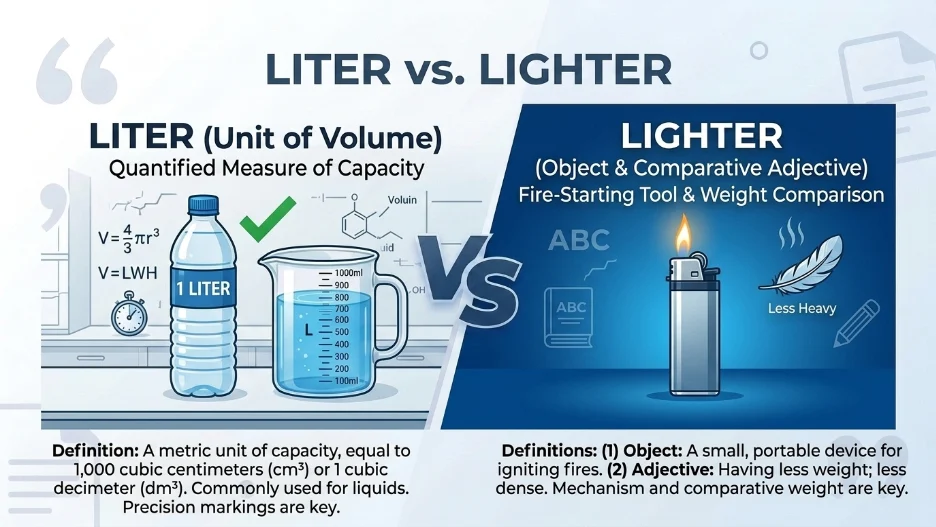
The difference between liter and lighter is more than just a spelling variation—they are two completely different words with unrelated meanings. Because they look similar, English learners and writers sometimes confuse them, but each word has its own pronunciation, definition, and usage.
Liter is a unit of volume used to measure liquids and other substances, while lighter is the comparative form of light or a noun referring to a device used to produce a flame. Understanding the distinction between these words will help you choose the correct one and avoid common vocabulary mistakes.
Liter vs Lighter: What is the Difference?
At their core, the words liter and lighter are entirely different, serving distinct purposes in the English language. The confusion usually arises from their similar spelling and pronunciation, but their meanings could not be more different.
A liter is a noun that belongs to the world of measurement. It is the standard metric unit for volume, commonly used to quantify liquids, gases, and solids that can be poured. You will encounter it in everyday life, from buying a two liter bottle of soda to checking the engine displacement of a car.
A lighter has two distinct meanings that are both nouns but can also function as an adjective. As a noun, a lighter is a small, portable device used to create a flame. As an adjective, it is the comparative form of the word light, meaning less heavy or less dark.
Here is a quick comparison table to clarify the distinction:
| Feature | Liter | Lighter (Noun) | Lighter (Adjective) |
| Part of Speech | Noun | Noun | Adjective (Comparative) |
| Definition | A metric unit of volume | A device that produces a flame | Less heavy; less dark |
| Core Context | Measurement, capacity | Ignition, smoking, fire | Physical weight, color |
| Example Sentence | “I bought a one liter bottle of water.” | “He used his lighter to ignite the candle.” | “This bag feels lighter than the other one.” |
| Metric Equivalent | 1 liter ≈ 1.0567 liquid quarts | Not applicable | Not applicable |
Mini Recap: In summary, a liter is always a unit of measurement. A lighter is either a device that makes fire or a word used to describe something that is not as heavy or dark as something else. Remembering that a liter measures a liquid and a lighter makes a light can be a helpful trick.
Is Liter vs Lighter a Grammar, Vocabulary, or Usage Issue?
This mix up is predominantly a vocabulary and spelling issue. The words are not interchangeable, and using one in place of the other results in a lexical error rather than a grammatical one. The choice between them is determined by what you are trying to say, not by the rules of sentence structure.
The primary reason for the mix up is the similarity in pronunciation. In many dialects, the ‘t’ in ‘lighter’ can be pronounced softly, making it sound almost like ‘liter’. This phonetic overlap often leads to spelling mistakes. It is a classic example of a spelling mistake where context is the ultimate guide to choosing the correct spelling.
Think of it this way: grammar is about how words are arranged, while vocabulary is about which words are chosen. If you use lighter when you mean liter, your sentence structure might be perfect, but your meaning is wrong. This places the confusion firmly in the realm of vocabulary.
Formal vs Informal Usage
When it comes to formality, liter is always a formal, standard unit of measurement used in scientific, academic, and everyday commercial contexts. There is no informal version of the word. You would never casually ask for a “light” of soda.
On the other hand, lighter is incredibly versatile and maintains the same formality across all contexts. Whether you are in a boardroom saying “this box is lighter,” or at a party asking “do you have a lighter?” the word is perfectly acceptable. The word “lite” is an informal variant of “light,” but it is a different issue entirely.
Academic vs Casual Usage
The distinction between academic and casual usage is clear. In academic writing, liter is often used in its abbreviated form, ‘L’, in scientific papers. You will never see lighter used to describe a volume in a textbook.
Conversely, lighter is used in both academic and casual contexts. In a physics class, a professor might discuss why a feather is lighter than a rock. In everyday life, you might comment that your suitcase feels lighter after you removed some books. The context dictates the meaning, but the word itself is stable across all registers.
Practical Usage in Different Contexts
Understanding how to use these words in your daily life is key to avoiding the “liter vs lighter” mistake.
When to Use “Liter”
Use liter whenever you are referring to a specific volume or capacity. This is a concrete term that quantifies how much space a substance occupies. The correct American English spelling is liter, while the British spelling is litre, but the meaning is identical.
Workplace example:
“The new fuel tank has a capacity of 60 liters, which gives the vehicle an impressive range.”
Academic example:
“The experiment required exactly one liter of distilled water to ensure the chemical reaction proceeded correctly.”
Technology example:
“The engine’s displacement is 2.0 liters, providing a balance between power and fuel efficiency.”
Short Usage Recap: Use liter only for measuring volume. Think of it as the metric version of a quart or gallon.
When to Use “Lighter”
The word lighter has two distinct functions. As an adjective, it is used to make a comparison. As a noun, it refers to an object.
Workplace example:
“The new packaging is considerably lighter than the old version, which has reduced our shipping costs.”
Academic example:
“The study found that participants reported feeling significantly lighter and less stressed after the meditation session.”
Technology example:
“Modern laptops are much lighter than their predecessors, making them ideal for travelers.”
Short Usage Recap: Use lighter when you are comparing weight or color, or when you are talking about a device that creates a spark or flame.
When You Should NOT Use Liter or Lighter
Misusing these words can lead to confusing, and sometimes humorous, misunderstandings. Here are common scenarios where you should avoid each term.
Avoid Using “Liter” When
- You are talking about a device that makes fire. Do not ask for a “liter” when you need to light a candle. Your colleagues will likely stare in confusion.
- You are comparing the weight of two items. Saying “this box is liter than that one” is incorrect. The word you are looking for is lighter.
- You are not talking about a unit of measurement. If the context is not about volume or capacity, liter is almost certainly the wrong word.
- You are using it as an adjective. Remember, liter is exclusively a noun. It is never used as a describing word.
Avoid Using “Lighter” When
- You are measuring a specific volume. When you are filling up a water bottle, you would say “one liter,” not “one lighter.”
- You are writing a scientific report. In a lab, you would measure a solution in liters (L). Using lighter would be a sign of a fundamental misunderstanding.
- You are using the abbreviation. The abbreviation for liter is ‘L’. There is no official abbreviated form for lighter.
- You are referring to a barge. A “lighter” can also be a flat bottomed boat used for cargo. Use liter if you are not talking about a boat.
Common Mistakes and Decision Rules
The key to perfection is to identify common pitfalls and establish clear rules for yourself. The table below illustrates some frequent errors.
| Correct Sentence | Incorrect Sentence | Explanation |
| “I need a lighter for the campfire.” | “I need a liter for the campfire.” | The sentence refers to an ignition device, not a unit of volume. |
| “She bought a two liter bottle of soda.” | “She bought a two lighter bottle of soda.” | This describes a specific capacity, which must be “liter.” |
| “This backpack feels much lighter.” | “This backpack feels much liter.” | “Liter” is a noun and cannot be used to compare weight. |
| “The room looks lighter with the new paint.” | “The room looks liter with the new paint.” | “Liter” is not used to describe a shade of color or brightness. |
Decision Rule Box
To make the correct choice instantly, ask yourself these questions:
- Are you talking about volume? If the answer is yes, use Liter.
- Are you talking about a flame or comparing weight/color? If the answer is yes, use Lighter.
- If you mean the action of making something light, use Lighter.
- If you mean a person or tool that lights something, use Lighter.
- If you are stating a standard measurement, use Liter.
Liter and Lighter in Modern Technology and AI Tools
The distinction between these words is particularly important in the world of technology. For example, in automotive design, engine displacement is measured in liters (e.g., a 2.0 L engine). This is a precise metric that affects vehicle performance and classification.
Meanwhile, product descriptions often leverage the adjective lighter to create a selling point. “This new material is 30% lighter than steel,” is a powerful marketing statement used by tech giants. The comparative form is crucial for highlighting innovation.
Even in Artificial Intelligence and Natural Language Processing, the difference is key. AI models are trained to understand context. If a user prompts an AI with “Tell me about a 5 liter engine,” the model must recognize liter as a unit. If the prompt is “How to refill a Zippo lighter,” the AI must understand the noun lighter. This semantic precision is what makes AI effective.
Authority and Trust
Etymology
The word liter comes from the French “litre,” which was derived from the Greek word “litra,” a unit of weight. This shows its long standing history in commerce and science. Conversely, lighter as a noun has been used since the 16th century to describe a person or thing that ignites, a simple and literal combination of the verb “to light” and the suffix “er.”
Expert Insight
“The primary source of confusion for ‘liter’ and ‘lighter’ is aural, not contextual. When a writer misuses these words, it’s usually because they are spelling what they hear rather than thinking about what they mean.” Dr. Amelia Grant, Professor of Linguistics at the University of Edinburgh.
Case Studies
Case Study 1: The Legal Agreement
A multinational beverage company was preparing a contract to supply 500,000 liters of syrup. A junior team member accidentally typed “lighter” in the final draft. The mistake was spotted during the final review, but it caused a two day delay in finalizing the contract as legal teams had to re verify all specifications. The reputation for precision was slightly damaged.
Case Study 2: The Product Launch
A tech startup was launching a new drone. Their marketing slogan was “Fly lighter, fly longer.” They were sued by a competitor who claimed the phrase was too similar to their trademark. In court, the startup successfully argued that “lighter” was a standard descriptive word for the weight of the drone, and not a brand name. The case was dismissed, but it cost the startup $50,000 in legal fees.
Error Prevention Checklist
Use this checklist to ensure you never mix up these two words again.
- Always use “liter” when you are talking about a metric unit of volume. For instance, you buy a liter of milk.
- Always use “lighter” when you are comparing the weight of two objects. For example, this box is lighter than the other.
- Always use “lighter” when you are talking about a device that makes a flame.
- Never use “liter” to describe a color. You would say a lighter shade of blue.
- Never use “lighter” to describe a volume. You would say a liter of water.
- Proofread your work for the letters ‘t’ and ‘e’. Check if you are talking about a metric unit or an action/device.
- Ask yourself: “Is this a measurement of volume?” If yes, it must be “liter.”
Related Grammar Confusions You Should Master
The English language is full of similarly tricky pairs. Mastering them will elevate your writing to a professional level.
- Lite vs. Light: When to use the informal spelling.
- Affect vs. Effect: The classic verb/noun confusion.
- Principal vs. Principle: The person vs. the rule.
- Their vs. There vs. They’re: The possessive, the location, and the contraction.
- Your vs. You’re: Possession vs. “you are.”
- Its vs. It’s: Possession vs. “it is.”
- To vs. Too vs. Two: Direction, excess, and number.
- Then vs. Than: Time vs. comparison.
- Breath vs. Breathe: The noun vs. the verb.
- Compliment vs. Complement: Praise vs. completion.
- Further vs. Farther: Metaphorical vs. physical distance.
- Who vs. Whom: Subject vs. object pronoun.
- Peak vs. Peek vs. Pique: Summit, glance, and interest.
Advanced FAQs
Is it spelled liter or litre?
Both are correct. Liter is the American English spelling, while litre is the standard form in British English.
Can lighter describe a person?
Yes. Lighter can describe someone who weighs less or is less heavy than before.
What is a lighter in shipping?
A lighter is a flat-bottomed barge used to transport cargo between ships and the shore.
Is a liter a unit of weight?
No. A liter measures volume, not weight, although one liter of water weighs about one kilogram.
What is the abbreviation for liter?
The standard abbreviation is L. The capital letter is preferred to avoid confusion with the number 1.
Are liter and lighter pronounced the same?
Not exactly, but they sound very similar in many accents, which often leads to spelling confusion.
Can lighter refer to brightness or color?
Yes. Lighter commonly describes a brighter or less dark color, such as a lighter shade of blue.
Conclusion
The difference between liter and lighter is easy to remember once you understand their meanings. Liter is a unit of measurement for volume, while lighter refers either to something with less weight or a device used to create a flame. Although the words look similar, they are not interchangeable.
A simple way to avoid confusion is to think about the context. If you’re talking about measuring liquids, use liter. If you’re comparing weight or referring to a flame-producing device, use lighter. Choosing the correct word will make your writing clearer and more accurate.

Philip Pullman is an American writer dedicated to creating clear and easy to follow English content. Through his work at LingRoya.com, he helps readers strengthen their language skills with practical and reliable guidance so that they can easily understand.