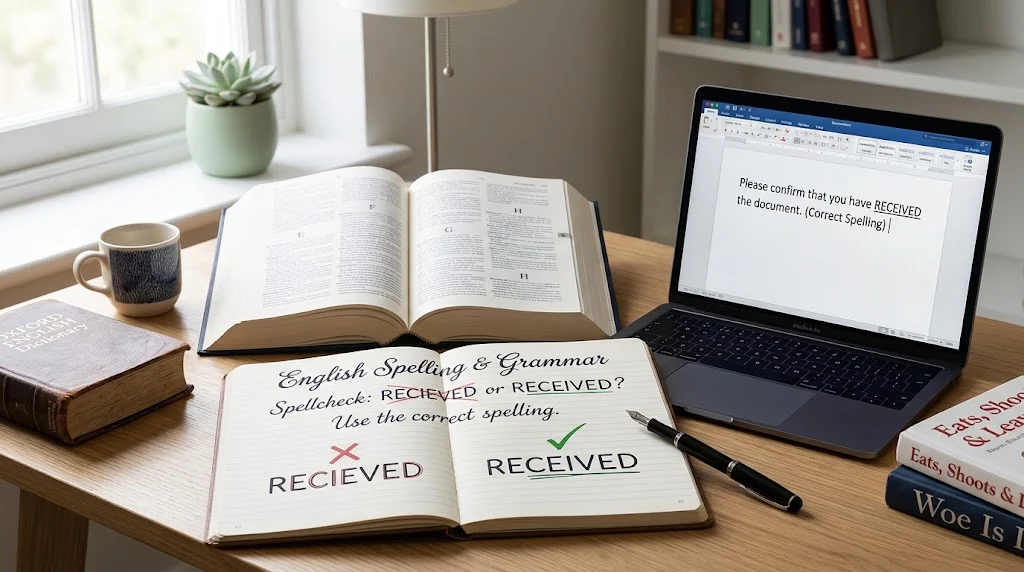
Received is the correct spelling in standard English, while recieved is a common spelling mistake. The word received is the past tense and past participle of receive, meaning to get, accept, or be given something. Remember the spelling rule “i before e, except after c” to help avoid this error in emails, academic assignments, professional documents, and everyday writing.
Have you ever written an important email and wondered whether to use recieved or received? This small spelling mistake can make professional messages and academic work look less polished.
Whether you’re writing a business email, submitting an assignment, or updating a website, learning this spelling pattern will help you avoid a frequent error and use the word confidently.
Recieved vs Received: What’s the Difference?
The difference between recieved and received is straightforward: received is the correct English spelling, whereas recieved is a misspelling. Both forms may appear in online searches or informal messages, but only received is accepted in standard written English.
| Feature | Received | Recieved |
| Spelling status | Correct | Incorrect |
| Part of speech | Verb, past tense and past participle | Intended as a verb form but misspelled |
| Base word | Receive | Receive |
| Meaning | Got, accepted, or was given something | Intended to express the same meaning |
| Formal writing | Appropriate | Avoid |
| Academic writing | Correct | Spelling error |
| Professional emails | Recommended | Incorrect |
| Example | I received your email. | I recieved your email. |
Quick Recap
Received is the correct spelling in standard English.
Recieved is a spelling mistake, not an alternative form.
Use received when describing something you got or accepted in the past.
The same spelling applies whether you’re writing a casual message, an academic paper, or a business report.
What Does Received Mean?
Received is the past tense and past participle of the verb receive. It means to get something, accept something offered, or have something delivered to you.
The word appears in many everyday situations, including receiving a message, receiving payment, receiving an award, or receiving information.
Examples:
- I received your invitation yesterday.
- The student received an award for excellent performance.
- We have received your application and will review it soon.
In the first example, received describes an action completed in the past. In the third example, it forms part of the present perfect tense, following the auxiliary verb have.
The spelling remains received in both cases.
What Does Recieved Mean?
Recieved is not a standard English word. It is a common misspelling of received, often caused by confusion about the order of the letters “i” and “e.”
For example:
Incorrect: I recieved the package this morning.
Correct: I received the package this morning.
The intended meaning is usually clear, but the incorrect spelling may be flagged by a spellchecker or noticed by a reader. It is best to correct it before publishing or sending your writing.
Is Recieved vs Received a Grammar, Vocabulary, or Usage Issue?
The difference between recieved and received is primarily a spelling issue, rather than a grammatical or vocabulary distinction.
Are Recieved and Received Interchangeable?
No. Although readers can often understand recieved, it isn’t an accepted alternative spelling of received. Use received whenever you intend to express the idea of getting, accepting, or being given something.
Formal vs Informal Usage
Received is correct in both formal and informal writing. You should use it in professional correspondence, social media posts, text messages, reports, and everyday communication.
Even in casual writing, there is no need to use recieved intentionally. Informal language may include slang or shortened expressions, but this misspelling doesn’t serve a standard linguistic purpose.
Academic vs Casual Usage
In academic writing, spelling accuracy matters because errors can distract readers and reduce the overall polish of an assignment. Received is the appropriate spelling in essays, research papers, examinations, and reports.
In casual communication, a reader might overlook the error, but received remains the correct form.
When to Use Received
Use received whenever you want to describe getting something, accepting something, or having something delivered. The word works in a wide range of grammatical structures.
Workplace Example
A manager might write:
“I received the updated report from the finance team this morning.”
Here, received describes the completed action of getting a report.
Academic Example
A student could write:
“The participants received detailed instructions before the experiment began.”
The word describes what the participants were given before the research activity.
Technology Example
An application might display the message:
“Your verification code has been received.”
In this example, received is the past participle used in a passive construction. It indicates that the system has obtained the code.
Usage recap: Use received in every context where you mean got, accepted, or was given. The spelling does not change between formal and informal writing.
When to Avoid Recieved
Since recieved is a misspelling, you should avoid using it in standard English writing. Here are common situations where the error can cause problems.
1. Professional emails: Write “I received your message,” not “I recieved your message.”
2. Academic assignments: Use received in essays, examinations, and research papers.
3. Business reports: Write “The company received the payment,” with the correct letter order.
4. Online applications: Use received when confirming that a document or submission has arrived.
5. Website content: Correct the spelling before publishing articles, landing pages, or educational resources.
6. Formal letters: Write “We have received your request” rather than using the misspelled form.
7. Customer service messages: Use received when confirming an order, complaint, or support ticket.
8. Resumes and cover letters: If describing an award or qualification, write “received an award” rather than “recieved an award.”
Common Spelling Mistakes and Decision Rules
Understanding the correct spelling is easier when you compare typical errors with their corrected versions.
| Correct sentence | Incorrect sentence | Explanation |
| I received your email yesterday. | I recieved your email yesterday. | Received is the correct spelling. |
| She received a scholarship. | She recieved a scholarship. | The letters “ei” follow the letter “c.” |
| We have received your application. | We have recieved your application. | The past participle is received. |
| He received the package this morning. | He recieve the package this morning. | Received is the appropriate past tense. |
| The office received several complaints. | The office recieved several complaints. | The incorrect form reverses the letter order. |
| Your payment has been received. | Your payment has been recieved. | Received is correct in the passive construction. |
The Decision Rule
If you mean that someone got, accepted, or was given something, use received.
Never use recieved as the standard spelling of this verb.
Remember the spelling sequence: recei ved. The letter “c” is followed by “ei,” giving you received.
Received in Modern Technology and AI Tools
Digital communication makes the word received especially common. Email platforms, banking applications, online forms, messaging services, and automated customer support systems frequently use it to confirm that information has arrived.
For example, an online application might display “Application received,” while a payment platform may state “Payment received successfully.”
AI writing assistants and spelling checkers can usually identify recieved as a misspelling and recommend received. However, automatic tools shouldn’t replace proofreading entirely. A spellchecker may catch the letter order but won’t always identify every contextual or grammatical issue in a sentence.
For the best results, enable English spellchecking in your preferred writing tool and review important messages before sending them.
Etymology: Why Is Received Spelled This Way?
The verb receive entered English through Anglo French and Old French forms associated with the Latin verb recipere, meaning to take back, accept, or receive.
Its spelling follows a familiar English pattern: the letter “i” comes before “e” in receive and received, but the sequence follows the letter “c.” This is one reason the common mnemonic “i before e, except after c” can help learners remember the word.
However, the mnemonic is not a universal rule for every English word. The most reliable way to spell received is to remember its base form, receive, and add the appropriate verb ending.
The spelling does not change when receive becomes received.
Expert Insight: A Simple Way to Remember Received
A useful spelling principle is to learn related word forms together rather than memorizing each one separately.
For example:
- Receive
- Receives
- Received
- Receiving
- Receiver
Notice that received retains the letter sequence found in receive. Remembering this word family makes it easier to recognize the correct spelling when writing quickly.
As a practical editorial rule, always check the base word before adding a suffix. This approach helps prevent similar errors in everyday English.
Two Practical Case Studies
Case Study 1: A Professional Email
Imagine an employee replying to a client who has sent a contract for approval. The employee drafts the sentence, “I have recieved the contract and will review it today.”
The message is understandable, but the spelling error may make the communication appear less carefully edited. After proofreading, the employee changes the sentence to “I have received the contract and will review it today.”
Result: The revised message uses standard spelling and presents a more polished professional impression. This is an illustrative example, not a measured workplace study.
Case Study 2: An Educational Website
Consider an English learning website publishing an article about common spelling mistakes. During editing, the writer discovers that recieved appears several times in example sentences and headings.
The editor replaces each incorrect instance with received where appropriate, then checks the page using an English spellchecker.
Result: The article provides correct spelling guidance and avoids teaching readers an error. The improvement is based on editorial accuracy, not a claimed increase in search rankings.
Error Prevention Checklist
Use the following checklist when proofreading your writing.
Always Use Received When
- Describing something you got in the past.
- Writing about an award, message, payment, or delivery.
- Using the present perfect tense, as in “have received.”
- Writing professional emails, essays, reports, or website content.
- Describing something delivered or accepted by a person or organization.
Never Use Recieved When
- Writing standard English.
- Preparing academic or professional documents.
- Confirming the delivery of a message or payment.
- Publishing educational content about spelling.
- Proofreading a document where the correct form is required.
One useful final check is to search your document for the exact string “recieved.” If it appears where you intended the verb receive, correct it to received.
Related Grammar Confusions You Should Master
Learning received alongside other commonly confused English words can strengthen your spelling skills.
- Believe vs Beleive: Correct letter order in a common verb.
- Receive vs Recieve: The base word and its frequent misspelling.
- Achieve vs Acheive: Correct spelling of a verb meaning to accomplish.
- Perceive vs Percieve: The correct sequence of vowels after “c.”
- Deceive vs Decieve: Spelling a verb that means to mislead.
- Separate vs Seperate: A common vowel substitution error.
- Definitely vs Definately: Correct spelling of a frequently misspelled adverb.
- Occasion vs Ocassion: Correct placement and number of consonants.
- Necessary vs Neccessary: Correct spelling and consonant order.
- Beginning vs Begining: Correct consonant doubling when adding an ending.
These comparisons show why it helps to learn a word’s standard spelling rather than rely entirely on how it sounds.
Frequently Asked Questions
1. Is it recieved or received?
Received is correct. Recieved is a common misspelling and should not be used in standard English writing.
2. Why is received spelled with ei instead of ie?
The spelling follows the established form of the verb receive. The sequence “ei” comes after the letter “c,” which is also reflected in the related word deceive.
3. How do you spell received correctly?
Spell it R E C E I V E D. Remember that the letter “i” comes after “e” in the sequence following “c.”
4. Is recieved ever correct in English?
Recieved is not a standard spelling of the verb. It may appear in informal messages or online content, but it should be corrected to received.
5. What is the past tense of receive?
The past tense of receive is received. For example, “I received the letter yesterday.”
6. Is received the past participle of receive?
Yes. Received is both the simple past tense and the past participle. For example, “She received the package” and “She has received the package.”
7. How can I remember the spelling of received?
Remember the base word receive and keep its spelling when adding “d” to form received. You can also practice the sequence “c, e, i” in the middle of the word.
8. Is received correct in formal and informal writing?
Yes. Received is the standard spelling in formal and informal English, including academic papers, business emails, text messages, and online articles.
9. How do you use received in a sentence?
You can write, “I received your invitation yesterday.” Here, received means that the invitation arrived or was given to you.
Conclusion
When choosing between recieved or received, remember that received is the only correct spelling in standard English. It is the past tense and past participle of receive and describes getting, accepting, or being given something.
Although recieved is a frequent typing mistake, it isn’t an accepted alternative. Use received in emails, academic assignments, professional reports, and everyday messages. Remembering the base word receive is a simple way to avoid the error, and a quick spelling check can help catch it before publication.
Accurate spelling makes your writing easier to read and helps you communicate with confidence. Once you remember the correct letter order, you’ll be much less likely to repeat this common mistake.

Margaret Atwood is an American writer who contributes to LingRoya.com creating clear and engaging content about the English language and everyday communication. She enjoys helping readers build confidence in their writing through simple, practical guidance.