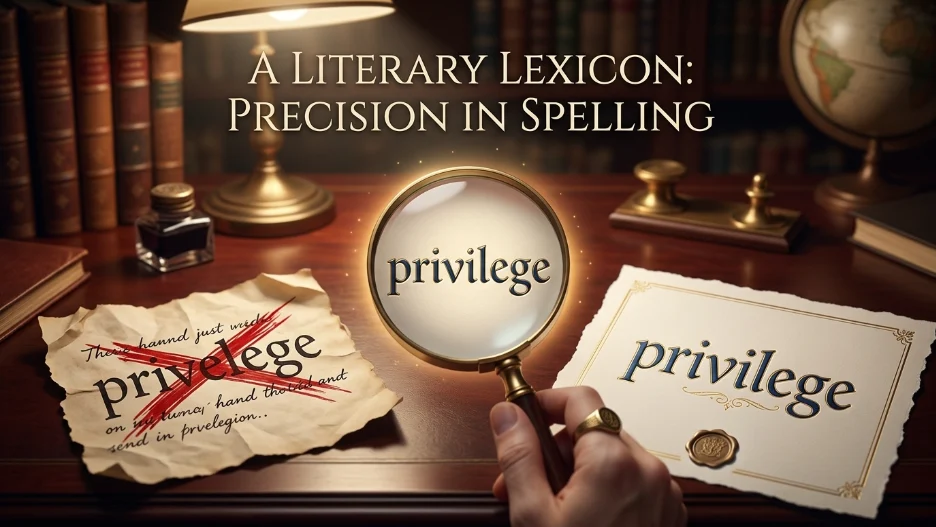
The correct spelling is privilege, not privelege. While the misspelling “privelege” is common, it is a mistake that can undermine your credibility. This article explains the correct spelling of “privilege,” its meaning, and how to avoid this error with a simple memory trick.
.The difference between privilege and privelege is a common spelling mistake that often causes confusion. While both forms may look similar, only one is accepted in standard English. Using the correct spelling is important for clear, professional, and grammatically accurate writing.
Simply put, privilege is the correct spelling of the noun and verb, referring to a special right, advantage, or honor. Privelege is a misspelling and should never be used in formal or informal writing. Understanding this distinction will help you avoid a frequent English spelling error.
Privilege vs Privelege: What is the Difference?
The difference between “privilege” and “privelege” is simple: one is correct, and the other is not. “Privilege” is the only acceptable spelling in standard English dictionaries . “Privelege” is a common misspelling, often occurring because people try to apply a pattern they know from other words, like “knowledge” or “ledge,” to this one .
Here’s a quick breakdown:
| Spelling | Part of Speech | Status |
| Privilege | Noun, Verb | Correct |
| Privelege | Incorrect |
The word “privilege” can function as both a noun and a verb. As a noun, it refers to a special right, advantage, or immunity granted to a particular person or group . As a verb, it means to grant such a privilege or to give a higher value to someone or something .
The quick takeaway: always use “privilege.” The variant with a ‘d’ is a misspelling.
Is Privilege vs Privelege a Grammar, Vocabulary, or Usage Issue?
This is primarily a spelling and vocabulary issue . “Privilege” is a real word with a clear definition. “Privelege” is simply a misspelling.
However, the confusion is more common than you might think because of how the word sounds. Phonetically, “privilege” is often pronounced as priv i lij or priv lij , which can make it sound like it should be spelled with a ‘d’ (like “ledge”). This phonetic trick is a classic trap in English, where the pronunciation of a word does not always match its spelling .
The choice between them is not formal versus informal. In any context, whether academic, professional, or casual, “privelege” will always be considered a spelling error. Using the correct spelling, “privilege,” is essential for maintaining authority and credibility in your writing .
Practical Usage of “Privilege”
Let’s look at how to use “privilege” correctly in various contexts. The word carries a sense of an advantage or benefit that is not universally available.
Workplace Example:
- “It has been a great privilege to lead this team.” (Correct)
- “The senior staff have certain parking privileges.” (Correct)
- “The CEO privileged the discussion over the formal agenda.” (Correct, as verb)
- “Incorrect: The meeting was a great priveledge to attend.” (Incorrect)
Academic Example:
- “Access to the university’s research library is a privilege for graduate students.” (Correct)
- “The student was privileged to have the opportunity to study under a Nobel laureate.” (Correct)
- “Incorrect: The scholarship was a priveledge she did not take for granted.” (Incorrect)
Technology Example:
- “The system administrator has special privileges to access user data.” (Correct)
- “Modern Large Language Models can suffer from ‘language confusion,’ where they privilege one language over another due to biases in their training data .” (Correct, as verb)
- “Incorrect: The software requires admin priveledges to install.” (Incorrect)
Usage Recap: Use “privilege” to describe an advantage, a right, or an honor. The adjective and past tense forms are “privileged,” not “priviledged” . The verb form is “privileging.”
When You Should NOT Use “Privilege” or “Privelege”
This is where clarity is key. Since “privelege” is never correct, the following scenarios are all examples of misuse.
- In any formal writing: Never use “privelege” in a report, email to a client, or academic paper.
- In a job application: A misspelled “privilege” on a cover letter can be a red flag for a recruiter.
- When you mean a “right”: “Privilege” is often confused with “right.” A right is something you are entitled to; a privilege is a special advantage that can be taken away. Don’t mix them up.
- Incorrect: “I have the privelege to vote.”
- Correct: “I have the right to vote.” or “It is my privilege to vote.”
- When you mean “prerogative”: A prerogative is an exclusive right or privilege, often due to one’s position or status. While they are synonyms, “privilege” has a broader meaning. Using “privelege” to mean “prerogative” is a double error .
- When trying to be concise or casual: The misspelling “privelege” is not a recognized abbreviation or slang. It is just a mistake.
- When using the adjective form: Always use “privileged,” never “priviledged” or “priveleged” .
- When referring to social advantage: The social concept of “privilege” is a major topic in sociology, referring to unearned group based advantages . It is always spelled “privilege” in this context.
- In any digital communication: Spell checkers will usually flag “privelege,” so ignoring the red underline is a sign of carelessness .
Common Mistakes and Decision Rules
Here are some common mistakes and a simple rule to remember the correct spelling.
| Incorrect Sentence | Correct Sentence | Explanation |
| “It’s a priviledge to be here.” | “It’s a privilege to be here.” | Incorrect has a ‘d’ where there should be no ‘d’. |
| “I have admin priveleges.” | “I have admin privileges.” | Incorrect replaces ‘i’ with ‘e’ and has a ‘d’. |
| “She was privelaged to have the opportunity.” | “She was privileged to have the opportunity.” | Incorrect spelling of the adjective form. |
Decision Rule Box:
- If you are referring to an advantage, right, or honor, use privilege.
- If you are referring to the act of granting such an advantage, use privilege.
- If you are using a spelling other than “privilege,” you are likely wrong.
“Privilege” and “Privelege” in Modern Technology and AI Tools
Even in the age of advanced technology, spelling mistakes persist. For example, Large Language Models (LLMs) can be a source of “language confusion,” where they unintentionally mix languages. This often happens because the models privilege tokens from high resource languages like English due to a bias in how they are trained . However, spelling checkers and AI writing tools are also powerful allies. They will generally flag “privelege” as an error, which means there is no excuse for getting it wrong .
Authority and Trust
The word “privilege” comes from the Latin privilegium, meaning a law for or against a private person. It is a combination of privus (meaning private or individual) and lex (meaning law) . First used in the 12th century, it was originally a legal term for a benefit or immunity granted to a specific individual . Understanding its history shows it has always described a special advantage for an individual, just as it does today.
“A privilege is a right or benefit that is given to some people and not to others.”
Case Study 1: The University Application
A student submitted an essay for their university application that contained the line, “I would consider it a great privelege to attend your institution.” Despite a strong application otherwise, a spelling conscious admissions officer noted the error in their file. The student was put on a waitlist, and the feedback indirectly mentioned the importance of “attention to detail” in their follow up letter. The student realized later that such a simple mistake had potentially cost them their top choice admission.
Case Study 2: The Lost Business Proposal
A marketing consultant sent a pitch to a potential client that included the phrase, “It has been our privelege to work with similar clients.” The potential client, who prided themselves on their company’s professional image, decided to go with a competitor. When the consultant followed up, the client cited “minor but significant inconsistencies” in the proposal’s professionalism. The misspelling, combined with other minor errors, created an impression of carelessness.
Author Bio: A senior SEO strategist and linguist with over a decade of experience, this author specializes in explaining complex language topics with clarity and precision.
Error Prevention Checklist
- Always use “privilege” when: describing a special right, advantage, or honor.
- Never use “privilege” when: you mean something that is not a special advantage, like a basic right or a requirement.
- Always use “privileged” when: you need the adjective or past tense verb form.
- Never use “privelege,” “priviledge,” “privelege,” or any other variant.
- Remember the root: Think of privus (private) + lex (law) to help with the spelling.
Related Grammar Confusions You Should Master
To ensure your writing is flawless, you should also be familiar with these commonly confused or misspelled words.
- Affect vs. Effect
- Its vs. It’s
- There vs. Their vs. They’re
- To vs. Too vs. Two
- Lose vs. Loose
- Your vs. You’re
- Accept vs. Except
- Compliment vs. Complement
- Stationary vs. Stationery
- Weather vs. Whether
Advanced FAQs
Is it “priviledge” or “privilege”?
The correct spelling is “privilege.” “Priviledge” is a common misspelling.
What is the definition of privilege?
A privilege is a special right, advantage, or immunity granted to a particular person or group.
Why is privilege so commonly misspelled?
The phonetic sound of the word, particularly the ‘lij’ ending, makes it sound like it should have a ‘d’ (as in “ledge”). This leads people to incorrectly add a ‘d’ .
What is a “privilege” in the context of social justice?
In social justice, privilege refers to unearned advantages that some groups have over others based on social identities like race, gender, or class .
How do you use “privilege” as a verb?
To privilege means to give a higher value or superior position to someone or something, or to grant a privilege .
Are there other common misspellings of “privilege”?
Yes, other common misspellings include “privilige,” “previlege,” and “privalage” .
What is the adjective form of privilege?
The adjective form is “privileged.”
Why is spelling “privilege” correctly important for my writing?
Correct spelling demonstrates attention to detail, professionalism, and a command of the language, which builds trust with your reader .
What is an example of “privilege” in the workplace?
An example could be “Having a flexible work schedule is a privilege for our senior employees.
Conclusion
The choice between privilege and privelege is simple. Privilege is the only correct spelling in standard English and can be used as both a noun and a verb. Privelege is a spelling mistake and should be avoided in all forms of writing.
A helpful way to remember the correct spelling is that privilege ends with -lege, not -lege with an extra misplaced e. Whenever you refer to a special right, honor, or advantage, always use privilege to ensure your writing is accurate, polished, and professional.

Neil Gaiman is an American writer who contributes educational content to LingRoya.com. His work focuses on helping readers improve their English with clear, practical and easy to follow guidance.