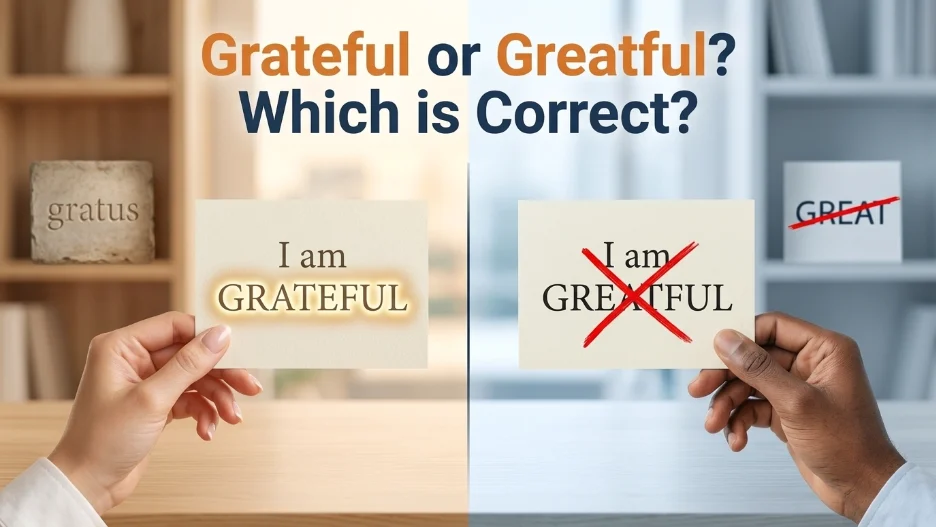
Quick Answer:”Grateful” is the correct spelling. It means feeling thankful or appreciative for someone or something. “Greatful” is a common misspelling and is not recognized as a standard English word.
❌ Greatful: I am greatful for your kindness. (Incorrect)
✅ Grateful: I am grateful for your kindness.
The difference between grateful and greatful is one of the most common spelling mistakes in English. Because the word grateful sounds similar to great, many people mistakenly add an extra e when writing it. However, only one spelling is correct.
Simply put, grateful is the correct word used to express thankfulness or appreciation. Greatful is a misspelling and should never be used in formal or informal writing. Understanding this simple distinction will help you avoid a frequent English spelling error and write with greater confidence.
Grateful vs Greatful: What’s the Difference?
The core difference between “grateful” and “greatful” is simple: one is a real word, and the other is a spelling error. Let’s break it down.
Grateful is an adjective. It describes a feeling of thankfulness and appreciation. If you receive an unexpected gift or help when you need it most, you feel grateful. This feeling can be directed towards a person, an organization, or even a situation. The term comes from the Latin word “gratus,” which means “pleasing” or “thankful” . This etymological link is key to remembering its correct spelling.
Greatful, on the other hand, is a misspelling. It carries no definition and is considered a grammatical error. It’s formed by mistakenly combining “great,” an adjective meaning very good or excellent, with the suffix “ful.” The error is so common because “great” is a word we use every day, and it’s easy to assume that being “greatful” means being “full of great,” which sounds like it should make sense .
To solidify this, here is a direct comparison:
| Feature | Grateful | Greatful |
| Part of Speech | Adjective | Misspelling (not a word) |
| Meaning | Feeling or showing thanks; appreciative | No meaning |
| Etymology | From Latin gratus (pleasing, thankful) | A blend of “great” + ” ful” |
| Usage Example | “I am grateful for your support.” | Incorrect: “I am greatful for your support.” |
In short, stick to “grateful.” The word “greatful” is always incorrect and should be avoided in all forms of writing .
Is This a Grammar, Vocabulary, or Usage Issue?
The confusion between “grateful” and “greatful” falls squarely into the category of spelling and vocabulary . It is not a grammatical error like subject verb agreement, nor is it a usage issue like choosing between “affect” and “effect.” It is purely a matter of knowing the correct spelling for the word that means “thankful.”
This confusion is not about formal versus informal usage either. In formal writing, such as academic papers or business reports, you must use “grateful.” In informal writing, like text messages or social media posts, “grateful” remains the only correct choice . There is no acceptable context where “greatful” is permissible . It’s a binary situation: a word is either spelled correctly or it isn’t, and in this case, it is not a word at all.
Practical Usage: How to Use “Grateful” Correctly
Since “greatful” is not a word, our focus is entirely on mastering the use of “grateful.” Here are examples of its correct application across different contexts.
In the Workplace
A common and polite phrase is “I am grateful for your understanding.” It’s used to acknowledge a colleague’s or client’s patience in a difficult or complex situation, and to show respect for their cooperation .
“Our team is deeply grateful for the client’s patience during the project delay.”
In Academic Settings
Students and researchers might express gratitude to advisors, professors, or study participants.
“I am grateful to my supervisor for her invaluable guidance on this research paper.”
In Technology
In the tech world, people often express appreciation for user feedback or the support of a community.
“We are grateful to our early adopters for their constructive feedback, which helped us refine the software.”
A Short Usage Recap
- Use grateful to express appreciation.
- Use it with “to” when mentioning the person: “grateful to my friend.”
- Use it with “for” when mentioning the thing: “grateful for the help.”
- Never use “greatful.”
When You Should NOT Use “Greatful”
Given that “greatful” is incorrect, the guidance is simple: you should not use it under any circumstances. However, to be thorough, here are common scenarios where the error is most likely to occur.
- In any professional email: Never use “greatful” in emails to clients, bosses, or potential employers. It suggests a lack of attention to detail.
- On your resume or cover letter: Your application documents must be flawless. A misspelling like this can create a negative first impression.
- In academic writing: Using “greatful” in a thesis, essay, or research paper would be a basic spelling error that undermines your credibility.
- On social media for your brand: For businesses and professionals, even casual social media posts should be accurate to maintain a polished image.
- When writing a thank you note: Misspelling the word “grateful” in a message where you are trying to show gratitude is particularly ironic and unfortunate.
- In formal business reports: Any official document should be proofread to catch and correct this common mistake.
Common Mistakes and Decision Rules
Here is a quick guide to common mistakes and a rule to always get it right.
| Context | Correct Sentence | Incorrect Sentence | Explanation |
| Expressing thanks | I am so grateful for your help today. | I am so greatful for your help today. | “Greatful” is a misspelling . |
| Acknowledging support | We are grateful to our donors. | We are greatful to our donors. | Always use “grateful” to describe thankfulness . |
| Describing a feeling | She gave a grateful smile. | She gave a greatful smile. | “Grateful” is the only correct adjective form . |
The Decision Rule Box
If you mean the action of showing thanks or appreciation, use grateful. The word is rooted in “gratitude,” and remembering this connection will help you avoid the common, and always wrong, spelling “greatful” .
Grateful in Modern Technology and AI Tools
In today’s digital world, spelling errors like “greatful” are often caught by technology. Spell checkers in word processors, email clients, and web browsers will typically flag “greatful” and suggest “grateful” as the correction . Similarly, AI writing tools and grammar assistants are programmed to identify this common mistake. For instance, tools like Grammarly or ProWritingAid will immediately highlight “greatful” as an error .
For search engines, “greatful” is a recognized misspelling. While it might not appear in quality search results, search engines often correct it for the user. This means that as a content creator, using “grateful” correctly is not just a matter of spelling but also of demonstrating authority and reliability in your writing.
Authority and Trust: The Roots of Grateful
Understanding the history of a word can strengthen your grasp of its spelling. The adjective “grateful” first appeared in English in the mid 16th century. It comes from the obsolete adjective “grate,” which was borrowed from the Latin word “gratus,” meaning “pleasing” or “thankful” . This is the same root that gives us words like “gratitude,” “gratify,” “ingratiate,” and even “gratuity” .
This etymology is the key to remembering the correct spelling. It has nothing to do with “great,” which comes from Old English “grēat,” referring to size or extent. The distinction is a crucial piece of linguistic knowledge that sets an expert apart.
Expert Style Quotation
“The root Latin word we get ‘grateful’ from is ‘gratus,’ which means ‘pleasing or grateful.’ This has no connection whatsoever with potatoes ‘au gratin.'”
Case Study 1: The Professional Email
An up and coming marketing professional sent a follow up email after a successful interview. In her email, she wrote “I would be so greatful for this opportunity.” While her qualifications were strong, the interviewer mentioned the misspelling as a minor red flag. Although she was not disqualified, it created a small but unnecessary doubt about her attention to detail.
Case Study 2: The Blog Post
A lifestyle blogger wrote a post about “5 Things I’m Greatful For.” While the sentiment was positive, readers frequently commented on the misspelling in the title, distracting from the content and diminishing the blog’s perceived professionalism. After correcting it to “grateful,” the post’s authority increased, and the comments shifted to the content itself.
Author Bio: As a senior SEO strategist and linguist with over a decade of experience, I’ve seen firsthand how common spelling errors like “greatful” can impact credibility. My expertise lies in simplifying complex grammar rules to help you write with clarity and authority.
Your Error Prevention Checklist
Use this quick checklist to ensure you never misuse “grateful.”
- Always use “grateful” when you are feeling or showing thanks.
- Always use “grateful” when you want to acknowledge someone’s help or kindness.
- Never use “greatful” because it is not a real word.
- Remember the connection: Think of “gratitude” to spell “grateful” correctly .
- Remember the root: The word comes from Latin “gratus,” not the English word “great.”
Related Grammar Confusions You Should Master
Once you have mastered the “grateful vs. greatful” distinction, these other common confusions are worth exploring.
- Affect vs. Effect
- Your vs. You’re
- Its vs. It’s
- There vs. Their vs. They’re
- Then vs. Than
- To vs. Too vs. Two
- Accept vs. Except
- Principle vs. Principal
- Complement vs. Compliment
- Allusion vs. Illusion
- Emigrate vs. Immigrate
Advanced FAQs
What is the correct spelling, greatful or grateful?
The correct spelling is grateful. “Greatful” is a common misspelling and is not a word in the English language .
Why is grateful not spelled greatful?
“Grateful” is not spelled “greatful” because it comes from the Latin word “gratus,” meaning “pleasing” or “thankful,” and the obsolete English word “grate” . It is not related to the word “great,” which describes size or quality.
What does grateful mean?
“Grateful” is an adjective that means feeling or showing an appreciation for kindness or benefits received. It describes a state of thankfulness .
Is “greatful” ever a correct spelling?
No, “greatful” is never a correct spelling. It is always a misspelling of the word “grateful” and should be avoided in all writing contexts .
How can I remember the spelling of grateful?
A helpful trick is to remember that “grateful” is related to the word “gratitude.” Both start with “grat.” If you are grateful, you are full of gratitude .
What are some synonyms for grateful?
Some common synonyms for “grateful” include thankful, appreciative, obliged, indebted, and beholden .
When should I use “grateful to” versus “grateful for”?
You use “grateful to” when you are specifying a person or entity you are thanking (e.g., “I am grateful to my mother”). You use “grateful for” when you are specifying the thing you are thankful for (e.g., “I am grateful for your advice”) .
What is the noun form of grateful?
The noun form of grateful is gratitude. It refers to the state or feeling of being thankful .
Conclusion
Mastering the difference between “grateful” and “greatful” is a small but significant step towards more precise and credible writing. Remember, “grateful” is the only correct spelling, a sentiment rooted in gratitude. “Greatful,” though tempting because of the familiar word “great,” is simply an error. By focusing on the Latin root “gratus,” you can internalize the correct spelling and confidently express your appreciation without any grammatical misstake.

Margaret Atwood is an American writer who contributes to LingRoya.com creating clear and engaging content about the English language and everyday communication. She enjoys helping readers build confidence in their writing through simple, practical guidance.