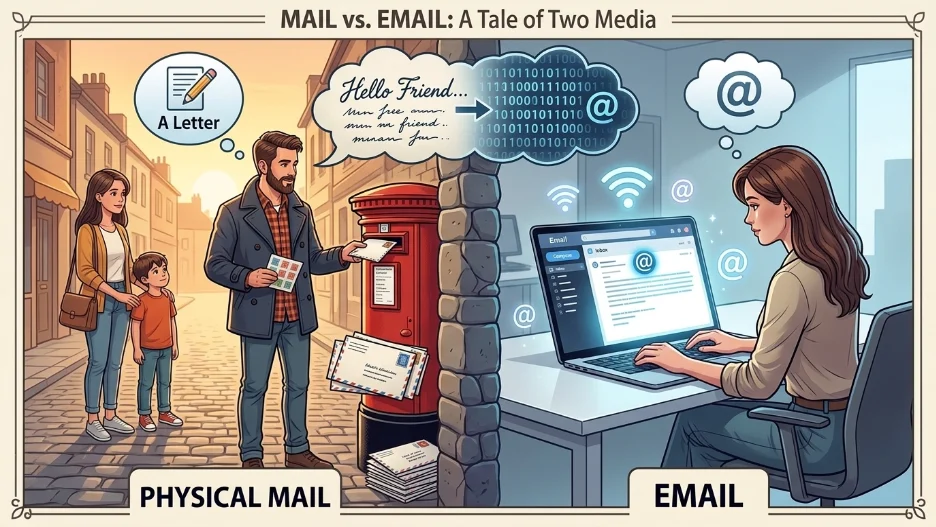
Quick Answer:Mail is a general term for messages or packages sent through a postal service and, in some contexts, electronic messages. Email specifically refers to electronic messages sent over the internet. If you’re talking about digital communication, email is the more accurate and widely used term.
Although mail and email are closely related, they are not always interchangeable. Mail traditionally refers to letters, documents, and packages delivered through a postal service, while email refers to electronic messages sent over the internet. Because digital communication is now part of everyday life, many people use mail informally to mean email, which can sometimes cause confusion.
Understanding the difference between mail and email helps you choose the right term for the situation. Whether you’re writing a business message, filling out a form, or talking about postal deliveries, using the correct word makes your communication clearer and more professional. This guide explains their meanings, key differences, and proper usage with practical examples.
Mail vs Email: What’s the Difference?
At their core, both mail and email serve the same basic function: they deliver messages from one person to another. But the similarities largely end there.
Defining Mail
Mail is a physical communication method that involves tangible items such as letters, postcards, packages, and parcels. When you send mail, you’re engaging with a postal system that collects, transports, and delivers these physical objects to a recipient’s address. Mail has existed in various forms for thousands of years, evolving from messenger systems to the sophisticated postal networks we use today.
Key characteristics of mail include:
- Physical, tangible format
- Requires postage payment
- Delivered through postal or courier services
- Delivery time ranges from days to weeks
- Can include handwritten or printed content on paper
Defining Email
Email is a digital communication method that transmits messages over the internet. Short for “electronic mail,” email allows users to send text, images, documents, and other files instantly to recipients anywhere in the world. The message travels from your device to an email server, then to the recipient’s inbox, often arriving within seconds.
Key characteristics of email include:
- Electronic, intangible format
- Usually free to send (beyond internet access costs)
- Delivered through internet networks
- Nearly instantaneous delivery
- Can include multimedia attachments, links, and formatting
Comparison Table
| Feature | ||
| Format | Physical, tangible | Digital, electronic |
| Delivery Method | Postal or courier services | Internet networks |
| Speed | Days to weeks | Seconds to minutes |
| Cost | Postage fees required | Generally free |
| Content Type | Paper letters, packages | Text, images, attachments |
| Environmental Impact | Uses paper and fuel | Uses digital infrastructure energy |
| Tracking | Limited, often extra cost | Usually built in delivery confirmation |
| Formality | Generally more formal | Ranges from casual to formal |
Mini Recap: Mail is physical and slow but tangible and formal. Email is digital and fast but intangible and versatile. Both serve communication needs, just in different ways.
Is Mail vs Email a Grammar, Vocabulary, or Usage Issue?
The confusion between mail and email isn’t strictly a grammar problem. It’s primarily a usage and vocabulary issue.
Interchangeable or Not?
In most contexts, mail and email are not interchangeable. Using “mail” when you mean “email” can cause confusion, especially in professional settings. However, in casual conversation, people sometimes use “mail” as a shorthand for email, saying things like “I’ll check my mail” to mean checking their email inbox.
Formal vs Informal Usage
Formal contexts: In professional, academic, or official writing, the distinction matters significantly. Business documents, academic papers, and legal communications typically distinguish between “mail” (physical) and “email” (electronic) to avoid ambiguity .
Informal contexts: Among friends or in casual conversation, the terms often blend. Saying “I got your mail” might refer to either a physical letter or an email, depending on context .
Academic vs Casual Usage
Academic writing: Scholars and researchers almost always distinguish between mail and email. Academic style guides typically prefer “email” for electronic messages and “mail” for physical correspondence .
Casual usage: In everyday conversation, “mail” often serves as a catch all term. People frequently say “checking my mail” even when they mean checking their email inbox .
When in doubt: If you’re writing for a professional audience, always make the distinction. For casual communication, context will usually clarify your meaning.
When to Use Mail
Mail is your choice when you need to send physical items or when formality and tangibility matter.
Workplace Example
Imagine you work in human resources at a large company. You need to send an official job offer letter that requires a physical signature. The contract must be signed and returned before the candidate can start. In this situation, mail is the appropriate choice because the document needs to be physically handled and signed. You would print the letter, place it in an envelope, and send it through the postal service or a courier .
Key workplace use cases for mail:
- Legal documents requiring original signatures
- Physical product samples or materials
- Items that cannot be transmitted electronically
- Formal correspondence requiring a physical paper trail
Academic Example
A university professor is submitting a research grant proposal that requires original signatures and hard copies of supporting documents. The funding agency explicitly states that they will not accept electronic submissions. The professor must compile all materials, print multiple copies, and send them via tracked postal mail to ensure receipt .
Academic contexts where mail is preferred:
- Official transcripts and diplomas
- Signed consent forms or agreements
- Physical portfolios or presentation materials
- Grant applications with specific submission requirements
Technology Example
You run a small e commerce business selling handmade jewelry. Customers order items online, but you need to ship the physical products to their addresses. Your shipping process relies entirely on the postal system. Every order you receive requires you to package the jewelry, print shipping labels, and send the package through the mail .
Technology and business contexts for mail:
- Shipping physical products to customers
- Sending hardware or equipment
- Distributing promotional materials like catalogs
- Mailing invoices and receipts
Usage Recap: Use mail when you’re dealing with physical items, official documents that require signatures, or any situation where a tangible record is necessary.
When to Use Email
Email is your go to choice for nearly all modern business and personal communication that doesn’t require physical delivery.
Workplace Example
Sarah is a marketing manager coordinating a campaign with a graphic design team across three time zones. She needs to share campaign briefs, creative assets, and feedback quickly and efficiently. She uses email to send the brief with attached design files, request revisions, and share final approved designs. The entire process, from initial brief to final delivery, happens within hours through email .
Common workplace email uses:
- Internal team communication
- Client correspondence and updates
- Sharing documents and files
- Scheduling meetings and appointments
Academic Example
A university student needs to submit a research paper to their professor. The professor has specified that all assignments must be submitted electronically through email. The student attaches the file, includes a brief message explaining the submission, and sends it before the deadline. The professor receives the assignment instantly and can provide feedback or acknowledgment within the same day .
Academic email use cases:
- Submitting assignments and projects
- Communicating with professors and advisors
- Sharing research materials and resources
- Participating in academic discussions and collaborations
Technology Example
A tech startup founder needs to pitch their product to potential investors. They create a compelling email with a video demo, pitch deck, and product links. The email allows them to reach dozens of investors globally within minutes. Each recipient can review the materials at their convenience and respond when ready .
Technology and business email uses:
- Pitching products and services
- Sending digital marketing materials
- Sharing software updates and information
- Managing customer support queries
Usage Recap: Use email for speed, convenience, and when sharing digital content. It’s the default choice for most modern communication.
When You Should NOT Use Mail or Email
When NOT to Use Mail
- When you need immediate delivery Mail takes days or weeks; it’s not suitable for urgent communications .
- When sending information that can be shared digitally Don’t waste paper and postage on files that could be emailed.
- When cost is a concern Mail requires postage; email is generally free.
- When you need to reach an international audience quickly International mail can take weeks; email arrives almost instantly.
- When tracking proves essential While tracking is available, it often costs extra and provides limited visibility compared to email delivery receipts.
- When the content is primarily digital Sending a USB drive or CD through the mail for digital content is inefficient when email can send the same files instantly.
When NOT to Use Email
- When legal documents require original signatures Many contracts and legal forms require physical signatures and must be mailed .
- When sending physical items You cannot email a package or product.
- When the recipient lacks internet access Not everyone has reliable internet or an email address.
- When extreme formality is required Some formal correspondence, like official government notices or high level invitations, is still better suited to traditional mail .
- When creating a lasting physical record Physical letters have more permanence than digital files that could be deleted or lost.
- When the message is meant to be tangible Handwritten cards, physical photos, or printed certificates convey a personal touch that email lacks.
- When you suspect spam filters might block your message Important communications can be lost in spam folders.
- When you need to prove delivery date Registered mail provides a definitive delivery record; email timestamps can be challenged.
Common Mistakes and Decision Rules
Correct vs Incorrect Usage
| Correct Sentence | Incorrect Sentence | Explanation |
| “I sent the contract by mail because it requires an original signature.” | “I sent the contract by mail because it requires an original signature.” (When actually sent by email) | Don’t call it mail if you used email. |
| “Please email me the report by 5 PM today.” | “Please mail me the report by 5 PM today.” | Mail cannot deliver a digital report within hours. |
| “The package will arrive by mail in three business days.” | “The package will arrive by email in three business days.” | Email doesn’t deliver physical packages. |
| “I check my email every morning.” | “I check my mail every morning.” (When referring to email) | In formal writing, distinguish the two. |
| “The letter arrived in yesterday’s mail.” | “The email arrived in yesterday’s mail.” | Mail is physical; email is electronic. |
| “You can email your application and follow up by mail with supporting documents.” | “You can mail your application and follow up by mail with supporting documents.” | Using the same term for two different actions creates confusion. |
Decision Rule Box
If you mean the action of sending a message, use the specific term.
- Use “email” when you’re referring to electronic messages sent over the internet. If you’re typing, clicking send, and expecting the recipient to receive it on their device, you’re using email.
- Use “mail” when you’re referring to physical letters, packages, or items sent through a postal service. If you’re addressing an envelope, adding postage, and dropping it in a mailbox, you’re using mail .
Quick test: Can you hold it in your hand? If yes, it’s mail. If no, it’s email.
Mail and Email in Modern Technology and AI Tools
The distinction between mail and email matters more than ever in our technology driven world. Email remains the backbone of professional and business communication, with over 4.48 billion users worldwide and projections reaching nearly 5 billion by 2028 . An incredible 93% of people use email daily, and 86% maintain at least three separate email addresses for different purposes .
AI tools are transforming how we use email. Modern email platforms integrate artificial intelligence for everything from smart filtering and spam detection to automated responses and personalized content recommendations. Many email services now use AI to predict which messages matter most, helping users manage the average employee’s 120 daily emails more effectively .
Meanwhile, traditional mail has adapted through technology too. Postal services now offer digital tracking, delivery notifications, and hybrid services that allow digital document creation with physical delivery. In some cases, the lines blur even further, with services that print and mail physical documents from digital files.
Despite the rise of other communication platforms, email remains central to digital life. Email users actually outnumber social media users across all age groups, and contrary to popular belief, younger demographics (16 24) are actually the most likely to use email among working age adults . This demonstrates that email, in its digital form, continues to be an essential tool across generations.
The Etymology of Mail and Email
The word “mail” has a fascinating history. It entered English in the 13th century from Old French “male,” meaning a traveling bag or pack. Initially, it referred to the bags that carried letters and parcels. Over time, it came to mean both the system of communication and the items delivered through that system.
“Email” as a term emerged much later, first appearing in the 1970s. The original form was “e mail,” with the “e ” prefix standing for “electronic” . When Ray Tomlinson sent the first network email in 1971, using the @ symbol to designate addresses, he sparked a communication revolution. By 1975, “electronic mail” had entered common usage, and in 1981, CompuServe popularized the shortened “EMAIL” .
The hyphenated “e mail” dominated for years, but modern style guides increasingly favor “email” without the hyphen. Both forms remain accepted, though “email” has become the standard for most publications and organizations . For the record, you should always use “an” before email (an email) because it begins with a vowel sound, and you generally don’t capitalize email unless it starts a sentence .
“Electronic mail is a method of transmitting and receiving messages using electronic devices. It was conceived as the digital version of, or counterpart to, mail.”
Case Studies: When Choosing Matters
Case Study 1: The Contract That Almost Wasn’t
A small business owner sent a signed contract to a client via email as a scanned PDF. The client had agreed verbally, and everything seemed on track. However, the client’s email provider had a strict spam filter, and the contract ended up in the spam folder, where it remained unread for two weeks. When the deadline passed, the business owner had to scramble to resend the contract through registered mail to ensure delivery and get a signature. The delay nearly cost them the deal. Lesson: For legally binding documents, traditional mail with tracking provides more certainty than email .
Case Study 2: The Global Campaign That Succeeded
A marketing agency needed to coordinate a global campaign launch across 15 countries. They used email to share creative assets, collect feedback, and approve final designs. Team members in different time zones could respond when convenient, and the entire project moved forward without a single physical meeting or piece of mail. The campaign launched on schedule, with all materials reviewed and approved within days. Lesson: For digital collaboration, email is unparalleled in speed and convenience .
About the Author: With over a decade of experience in professional writing and SEO strategy, I’ve helped countless organizations communicate more effectively through precise language and strategic content. My expertise lies in making complex language concepts accessible and actionable.
Error Prevention Checklist
Always use email when:
- Sending digital files, documents, or images
- Communicating with colleagues or clients about routine matters
- You need a fast response
- The recipient has internet access
- You want to save paper and postage costs
- Sending international communications
- You need a written record that’s easy to archive and search
- Sharing information that needs to be forwarded easily
- Responding to queries in a timely manner
- Communicating with large groups simultaneously
Never use email when:
- You need an original physical signature
- Sending tangible items like packages or products
- The recipient specifically requests mail
- Legal requirements mandate physical delivery
- The message is extremely sensitive and email security is a concern
- You’re sending something that needs to be physically preserved
- Formality requirements are extremely high
- You suspect your email might be lost in spam or ignored
Related Grammar Confusions You Should Master
- Compliment vs Complement Praising vs completing
- Affect vs Effect Verb vs noun usage
- Their vs There vs They’re Possession, location, and contraction
- Your vs You’re Possession vs contraction of “you are”
- Its vs It’s Possession vs contraction of “it is”
- To vs Too vs Two Preposition, adverb, and number
- Then vs Than Time vs comparison
- Whose vs Who’s Possession vs contraction of “who is”
- Accept vs Except Receive vs exclude
- Principal vs Principle Head or money vs rule or belief
- Stationary vs Stationery Not moving vs writing materials
- Altogether vs All Together Completely vs collectively
FAQs
1. Is “email” or “e-mail” the correct spelling?
Email is the modern and most widely accepted spelling. E-mail is still correct but is less common today.
2. Can “mail” be used as a verb for sending an email?
Yes, informally it can, but email is the clearer and preferred verb when referring to electronic messages.
3. What is the difference between “post” and “mail”?
Post is more common in British English, while mail is preferred in American English for physical deliveries.
4. Should I say “a email” or “an email”?
Always use an email because email begins with a vowel sound.
5. Is email the same as Gmail?
No. Email is the communication method, while Gmail is one of many email service providers.
6. How do I format an email address correctly?
A valid email address includes a username, the @ symbol, and a domain name, such as name@example.com.
7. Is email formal or informal?
Email can be either formal or informal, depending on the purpose, audience, and writing style.
8. What does “spam” mean in email?
Spam is unwanted or unsolicited email, usually sent in bulk for advertising or fraudulent purposes.
9. When should I use mail instead of email?
Use mail for physical documents and packages, and email for fast electronic communication.
10. Why is email still so popular?
Email remains popular because it’s fast, professional, widely accepted, and provides a permanent record of communication
Conclusion
The difference between mail and email comes down to the method of delivery. Mail usually refers to physical letters and packages sent through a postal service, while email refers to electronic messages sent over the internet. Choosing the correct term helps avoid confusion, especially in professional and formal communication.
As digital communication continues to grow, email has become the standard word for online messages, while mail is still widely used for traditional postal services. By understanding the distinction and considering the context, you can use both terms confidently and accurately in everyday writing.

Margaret Atwood is an American writer who contributes to LingRoya.com creating clear and engaging content about the English language and everyday communication. She enjoys helping readers build confidence in their writing through simple, practical guidance.